priest of Rakahanga
pp. 63-64 · Read in the full issue
Yesterday
Vale Father Placido, the placid priest of Rakahanga
R. DAWSON MURRAY pays a deeply felt tribute to a man whom he met only briefly, but who made a lasting impression on him; FATHER PLACIDO, a Dutch-born Roman Catholic priest who for many years single-handedly ministered to the needs of three small congregations scattered through the northern Cook Islands. Father Placido died in 1980.
He has been dead for more than two years now, Father Placido. I was greatly saddened by the news. I met him first on Penrhyn Island, the northernmost of the Cook Islands, more than 1100 kilometres from Rarotonga. He had been for many years the sole Roman Catholic priest for Pen rhyn, Rakahanga, and Manihiki a vast area filled with a few faithful: three small congrega tions separated by sea, time and language, united only by Father Placido who travelled from one island to another to another, and then round again as the rare ships offered passage.
I’d travelled north to Penrhyn and the northern Cook Islands to fulfil a long-nurtured desire. I boarded the dirty trading vessel in Rarotonga for a hot and hide ous trip north four days sail ing with no sight of land. Four days only made bearable by such moments as I spent with Father Philip, a New Zealand priest on his way to take some of the travel burden from Father Placido. In deed, it was from Philip that I first learned of Placido.
“Old Placido!” mused Father Philip as we sipped a drink in a sticky, airless cabin one evening, squatting on sagging suitcases.
“Old Placido: he’s been years in the Northern Cook Islands: he’s just returned from a long over-due furlough in his home land Holland: There, he got some bad news about his health. He wasn’t supposed to come back . . . but he insisted. . .”
And so, I was learning a little about Placido.
Then, 9 o’clock one February morning, we were off Taruia Passage into Penrhyn’s mighty lagoon. The tide was rolling against us through the passage.
The bow swung close to the unyielding coral. Delicate
manoeuvring swung the slow bow into the channel, and we were into the lagoon, edging towards the wharf, skirting huge hard heads of coral.
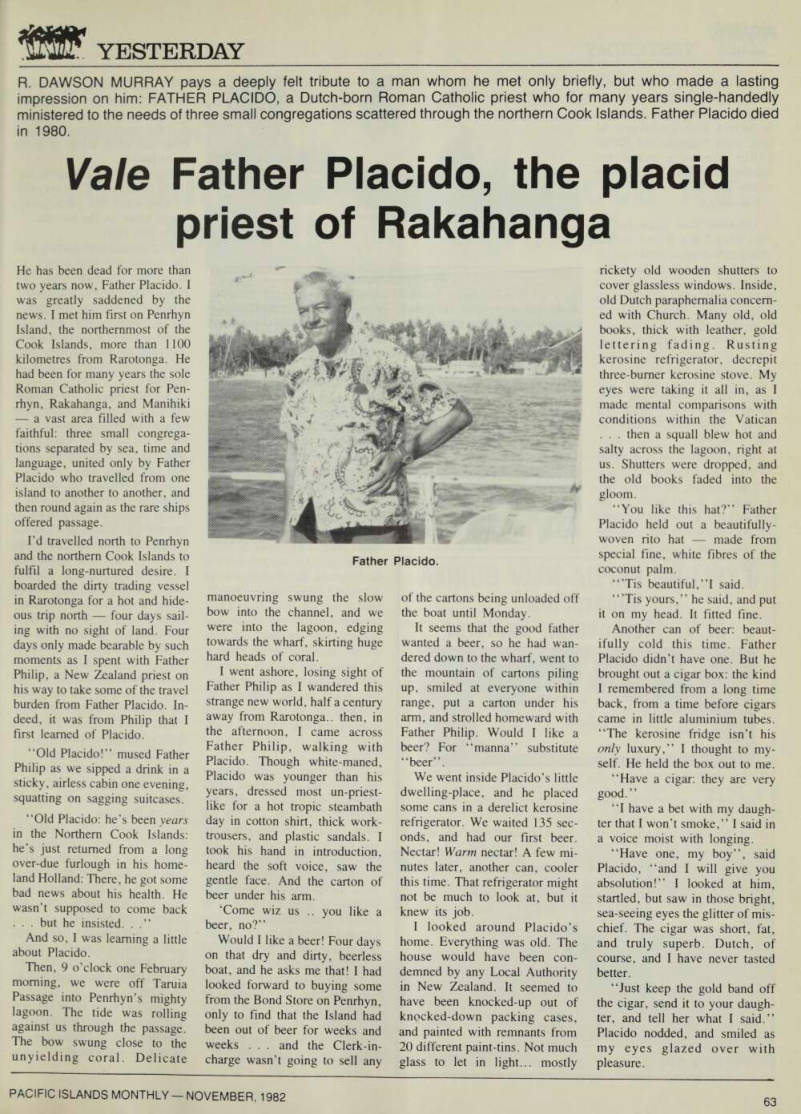
I went ashore, losing sight of Father Philip as I wandered this strange new world, half a century away from Rarotonga., then, in the afternoon, I came across Father Philip, walking with Placido. Though white-maned, Placido was younger than his years, dressed most un-priest like for a hot tropic steambath day in cotton shirt, thick work trousers, and plastic sandals. I took his hand in introduction, heard the soft voice, saw the gentle face. And the carton of beer under his arm. ‘Come wiz us .. you like a beer, no?”
Would I like a beer! Four days on that dry and dirty, beerless boat, and he asks me that! I had looked forward to buying some from the Bond Store on Penrhyn, only to find that the Island had been out of beer for weeks and weeks . . . and the Clerk-in charge wasn’t going to sell any
of the cartons being unloaded off the boat until Monday.
It seems that the good father wanted a beer, so he had wan dered down to the wharf, went to the mountain of cartons piling up, smiled at everyone within range, put a carton under his arm, and strolled homeward with Father Philip. Would I like a beer? For “manna” substitute “beer”.
We went inside Placido’s little
dwelling-place, and he placed
some cans in a derelict kerosine refrigerator. We waited 135 sec onds, and had our first beer.
Nectar! Warm nectar! A few mi nutes later, another can, cooler this time. That refrigerator might not be much to look at, but it knew its job.
I looked around Placido’s home. Everything was old. The house would have been con demned by any Local Authority in New Zealand. It seemed to have been knocked-up out of knocked-down packing cases, and painted with remnants from 20 different paint-tins. Not much
glass to let in light... mostly
rickety old wooden shutters to cover glassless windows. Inside, old Dutch paraphernalia concern ed with Church. Many old, old books, thick with leather, gold lettering fading. Rusting kerosine refrigerator, decrepit three-burner kerosine stove. My eyes were taking it all in, as I made mental comparisons with conditions within the Vatican . . . then a squall blew hot and salty across the lagoon, right at us. Shutters were dropped, and the old books faded into the gloom.
“You like this hat?” Father Placido held out a beautifully woven rito hat made from special fine, white fibres of the coconut palm.
“Tis beautiful,”! said.
“Tis yours,” he said, and put it on my head. It fitted fine.
Another can of beer: beaut ifully cold this time. Father Placido didn’t have one. But he brought out a cigar box: the kind I remembered from a long time back, from a time before cigars came in little aluminium tubes.
“The kerosine fridge isn’t his only luxury,” I thought to my self. He held the box out to me.
“Have a cigar: they are very good.”
“I have a bet with my daugh ter that I won’t smoke,” I said in a voice moist with longing.
“Have one, my boy”, said Placido, “and I will give you absolution!” I looked at him, startled, but saw in those bright, sea-seeing eyes the glitter of mis chief. The cigar was short, fat, and truly superb. Dutch, of course, and I have never tasted better.
“Just keep the gold band off the cigar, send it to your daugh ter, and tell her what I said.”
Placido nodded, and smiled as my eyes glazed over with pleasure.
Father Placido.
Two days later, the hot greasy little ship was ready to sail.
Father Placido was on board he arrived with a minimum of fuss, little luggage, and Father Philip. We were bound for Rakahanga, where Placido was to live awhile.
Rakahanga.
The name held magic for me even since I saw three beautiful young girls dancing their love for their island at a culture festival in Rarotonga many years before. It had held magic for me ever since I read Julian Dashwood’s de
lightful book, ‘South Seas
Paradise’ (I am always glad the silly title didn’t stop me reading that book!) We arrived offshore the fol lowing day, after chasing the setting sun across the blue-ink sea.
Getting ashore was exciting
and fun and effective.
There was ugliness on
Rakahanga ugliness in the
tidy heaps of rusting iron, stored for possible future use; ugliness
in the hideous rusting corrugated
copra-driers along the lagoon
edge. Ugliness in some of the shanties built from old packing cases and tin. But there is also so
much beauty.
There is a tidy beauty in the
coral-stone-groomed crunchy
roads winding between houses and around trees. There is beauty in the hearts of the friendly peo ple, and in the traditional pan danus-thatched huts. And there is infinite beauty in the lagoon. It looks to be small and land locked. It is neither. The water
was clear deep ming-blue. On the edge of the main channel was the Roman Catholic Church, with the Father’s accommodation attached.
Placido had come to live here: here, where many years before, as a younger man, he had built this church. It is a big church for Rakahanga, and in its Island fashion, quite beautiful. It has only a concrete floor, but em bedded in it are intricate patterns of cowrie shells. Other shells decorate the pulpit, altar and walls. Vases are made from shells, and so are candle-holders.
Typically, the accommodation he had built for himself was of
secondary importance to Placido.
And it was obvious. Heavy rain the night before our arrival had flooded his “kitchen”: it was awash. His “bathroom” was at the bottom of a set of concrete steps let into the floor; to bathe, you stood on the bottom step, reached up to a tap, which drained rainwater from a floor level tank in his primitive “kitchen”.
There was no refrigerator here. His bedroom was a space behind a rough packing-case par tition. He slept on a rough cot made of scrap timber. But there was a porch ... a cool porch, and it was here that Placido sat and looked down and across to the most beautiful sight a mortal could ever wish for. I sat with him for many hours. There was no need to talk; just a need to be, and to see.lo see the beauty of the little motu, Te Kainga, across the channel, the bursting white of the waves on the far reef. Te Kainga: uninhabited now, green with palms, stirring up a little breeze with gently-waving fronds.
We saw the clear and lovely water in the channel: ice-smooth, glass-clear, limpid soul of water.
A little breeze from Te Kainga came and wrote things on it for us to read.
Placido broke a silence to say; “You could see a five-cent piece in that water 40 yards away, under water on the far side.”
He was right.
Tiny breezes kept playing with the water, and tiny waves, no more than an inch high, lap licked softly to the white sand.
“Wind is a slippery thing, yes?”
asked Placido, and went on; “And water is a slippery thing.
Yet wind can pick up water, no?
One slippery thing can pick up anodder!”
Not for Placido the massive miracle of space travel and
speed-of-light communication
across the earth. He was content with the tiny miracles of every
soft and gentle day.
Next afternoon, we sailed for Manihiki, Father Philip and I.
Father Philip was going to stay in Manihiki to look after Placido’s people there. Placido came to see us go. We walked along the edge of that crystal water to The Ce ment. The Cement is the local name for the concrete causeway built across to the reef-edge: Rakahanga’s umbilicus to the world. We hoped that Placido would enjoy his time on Rakahanga, and said so. “It will be good for me” he said, with the mischief-glitter in his eyes.
“Last time I was here, I lost two inches off my surroundings.” He patted his tummy.
We sailed, and could see, for a time, Placido standing there waving, a solitary papa a in his chosen Paradise.
A Paradise where shortly he was to die. To die, thousands of miles from his kinsfolk in Hol land. To die where he chose to die, on a tiny atoll, which gave him solace for his soul, and meaning for his life.
Life is a slippery thing, yes?
And death is a slippery thing.
Yet Death can pick up Life.
“One slippery thing can pick up anodder?”
You’ll perhaps know the ans wers to your small miracles now, Placido. Rest in Peace: you still have your Rakahanga.
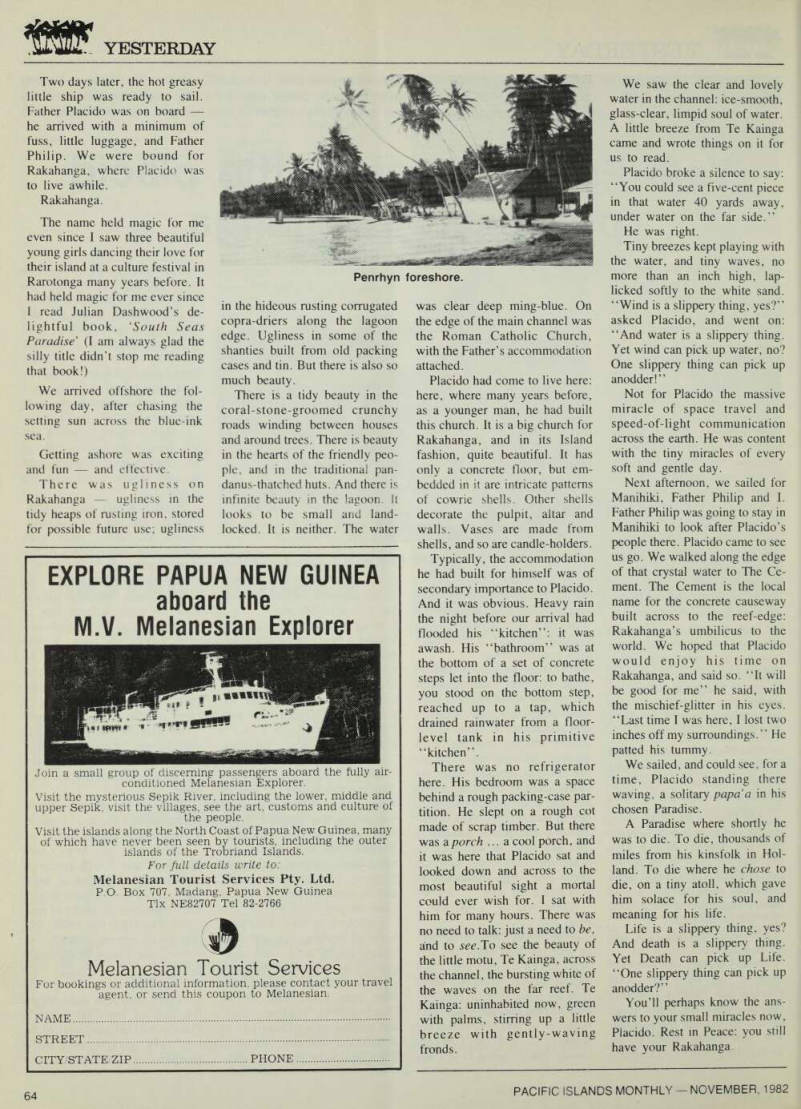
Penrhyn foreshore.