tourists, or pilgrims?
pp. 65-66 · Read in the full issue

The future of Guam: Mecca for tourists, or pilgrims?
Turnon Bay is Guam’s most visited recreation area and big gest tourist attraction. It has sev eral of Guam’s best beaches, including the most popular one, Ypao Beach. Because Guam is a volcanic island, it offers little of that beauty found in greater abundance on other Micronesian islands. Nevertheless Turnon Bay does offer some of “the grace of trees overleaning the water, the rare sensitiveness of pencilled line and shadow, the matchless transparencies of at mosphere’’ that Grimble found on the islands of the eastern extremity of Micronesia, in Kiribati.
These qualities are exploited
by the nine hotels that have gone up on Turnon Bay’s wide curving arc: from the Okura in the north, to the Hilton in the south. The Okura almost exclu sively caters to Japanese tourists and is, along with seven others,
owned by Japanese companies.
Only the Hilton is American owned.
Apart from its beauty. Turnon Bay highlights the changes that have taken place on Guam over the last decade; it also foreshadows the changes that might alter the character of theis land in the years to come. Before the early 19705. the era of hotel building in Guam, mostly along Turnon Bay, the area was largely a recreation centre for island resi dents. Early photographs show it as a beach lapped by calm lagoon waters and roofed by ocean leaning coconut palms. It was sparsely populated and did not attract busloads of tourists.
Today, the character of the bay has changed from that of a recreation centre to Guam’s foremost tourist attraction Be sides the nine hotels, there is
popular Ypao Beach, located between the Hilton hotel and the two-year-old Pacific Islands Club. The beach has been used for international beauty contests,
as a large playground for visiting
Japanese schoolchildren, and the site for international body building contests, which are held in the Ypao Beach amphitheatre.
The only reminder of an Island lifestyle here are the poles set in the coral heads to mark safe passage out of the reef in the same manner poles are used else where in Micronesia to safely guide fishermen on their way to shore after a long fishing trip as the tide begins to fall. (I saw my first ones in Belau during Peace Corps service there.) The boom in tourism the numbers of Japanese tourists visiting annually has increased steadily for the last few years has prompted noticeable de
velopment along the bay. The
Hilton has committed itself to building a 100-room addition to their present accommodation.
Moped rental services have re cently increased from one opera tion to four. A police sub-station was established in one half of a wooden modular home, the other half of which serves as a tourist information centre for Japanese tourists. Seven new Japanese
businesses have recently opened
between the Okura and Fujita hotels; these would advertise ex clusively in Japanese were it not for a recently enacted law requir ing businesses to advertise in English or Chamorro, as well as their usual business language.
The oddest addition is a Kentuc ky Fried Chicken restaurant with a life-sized plastic model of Col onel Sanders, founder (now de ceased) of this franchise, which is moved in and out with the weather a sort of five-foot white barometer.
Landscaping, bulldozing and construction continue apace. The northern edge of the drive down to the bay is up for lease and newly bulldozed; the same is true for the road up the hill east of and just across from the police sub station. A new condiminium.
Bayshore Condominium, is be ing built on the beach near the Fujita hotel. Another is being planned on land in front of the Hilton. But people living in Tu
mon Heights immediately above the Hilton have already voiced complaints about the prospect of a tall building obstructing their view of the bay.
But high-rise buildings are just
one of the problems connected with development. New build ings require increased demand on the fresh water stored in the underground lens. Such a de mand might interfere with water supplies for island residents.
Pornography has also become more readily available as more tourists arrive. It was recently reported in the Pacific Daily News that, since Japanese tour ists cannot view X-rated movies (showing explicit sex) in Japan, the possibility of viewing such on Guam serves as one of Guam's strongest drawing cards; the same is probably true of
sexually explicit printed mate
rials Although the Guam legisla ture has just enacted an anti pornography law (after much publicity on the bill aroused by the activities of Citizens for a Decent Community), this has not resulted in the removal of sexual ly explicit materials, or the clos ing of theatres showing such movies.
Finally, to match an island wide trend, crimes against tour-
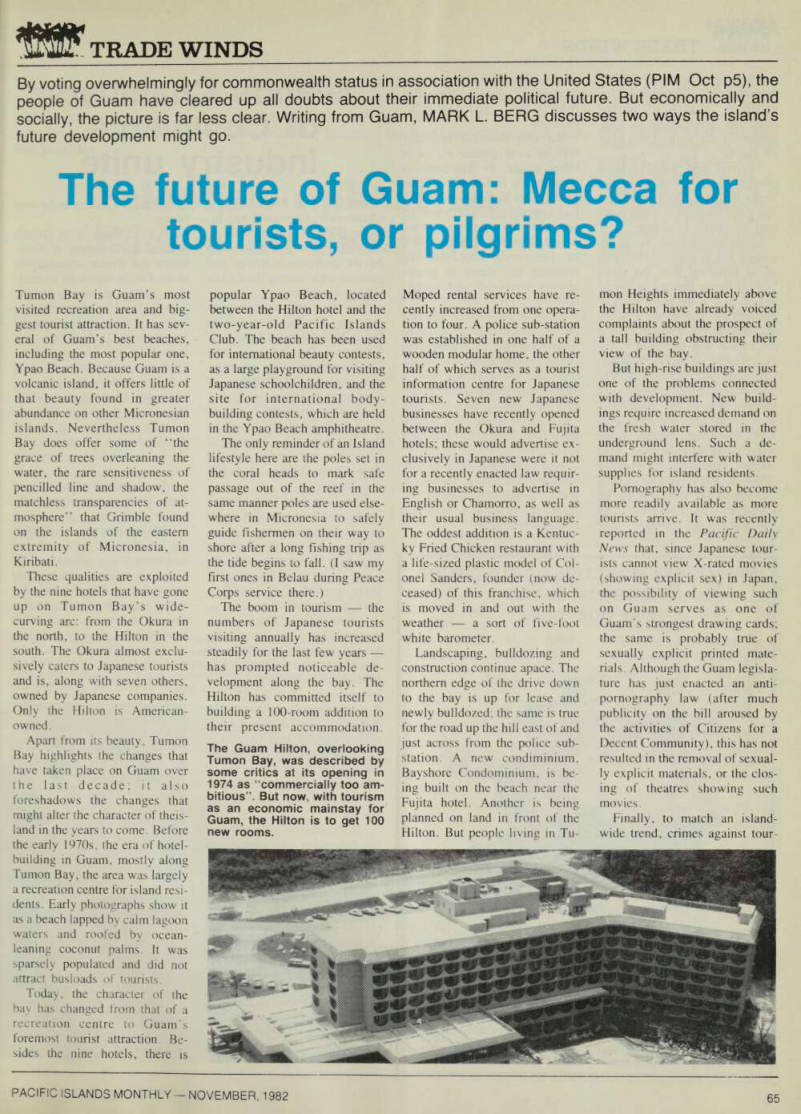
The Guam Hilton, overlooking Turnon Bay, was described by some critics at its opening in 1974 as “commercially too am bitious". But now, with tourism as an economic mainstay for Guam, the Hilton is to get 100 new rooms.
ists have increased over the last several years. There was, for example, a rash of purse snatching in the month of July, apparently the work of one gang of youths.
Tourism and tourist-related
develpment and problems cur
rently define Guam’s character.
But there are signs that this is, or may be, about to change.
Guam might come to be re garded less as a tourist stop than as an historical site: the scene both of heavy fighting in World War II and of the martyrdom of Father Luis Sanvitores, a Span ish Jesuit priest, who lost his life on Turnon Bay just prior to the period of the so-called “Spanish- Chamorro wars” of the 1680 s.
The National Park Service, under the direction of Mr Stell New man, is gathering war relics at its Asan beach-front facilities, and is preparing various former bat tlefield properties to resemble World War II conditions there at the time of the U.S. invasion of Guam in July 1944. As these
preparations go forward, they
promise to attract increasing numbers of people, especially from Hawaii and the U.S. mainland.
But this historical emphasis will be even greater if, as is being sought, Fr Sanvitores is canonised as St Sanvitores. This would make his shrine on Turnon Bay (erected on a site where he was slain by two Chamorros, near the Reef Hotel) a busy Mec ca. The circular iron fence sur rounding the shrine is almost always unvisited and locked now.
It is a moot question whether or not Guam will come to be regarded as first and foremost the island where Santivores died.
The road along Turnon Bay is already called Sanvitores Road.
It is only natural, therefore, that canonisation would have a com parable effect on Guam’s character.
And Turnon Bay, with its San vitores shrine, and its Sanvitores Road, would have foretold this happening in its own silent but unmistakable way.