persuasively
pp. 61-62 · Read in the full issue
Kanak identity persuasively affirmed
Kanake The Melanesian Way. By Jean-Marie Tjibaou and Philippe Missotte. Photo graphs M. Folco and C. Rives.
Original French text translated by Christopher Plant, with the collaboration of the University of the South Pacific, Suva. Publish ed by Les Editions du Pacifique, 10 avenue Bruat, Papeete, Tahiti. Available from Hachette Caledonie, BP E 2, Noumea, New Caledonia. ISBN 2 85700 111 8.
It often happens that a book assumes greater topicality for an international audience several years after the date of its publica tion than it had at publication time itself.
Kanake The Melanesian Way is certainly such a book. In
the wake of the recent highly effective affirmations of Melane sian cultural identity that have been made in Noumea and else where in New Caledonia, and in general the recent political de velopments there, the book has an interest for readers outside the territory far greater than at the time of its publication in 1979. (Although published in that year, Kanake was actually inspired by a still earlier event, the cultural festival known as Festival Melanesia 2000, held in 1975.) Jean-Marie Tjibaou (now Vice-President of New Caledonia’s Government Coun cil) sets the tone for the work in a short preface, writing: “The oc casion for producing this book was Melanesia 2000, the first Festival of Melanesian Arts.
“Melanesia 2000 was 2000
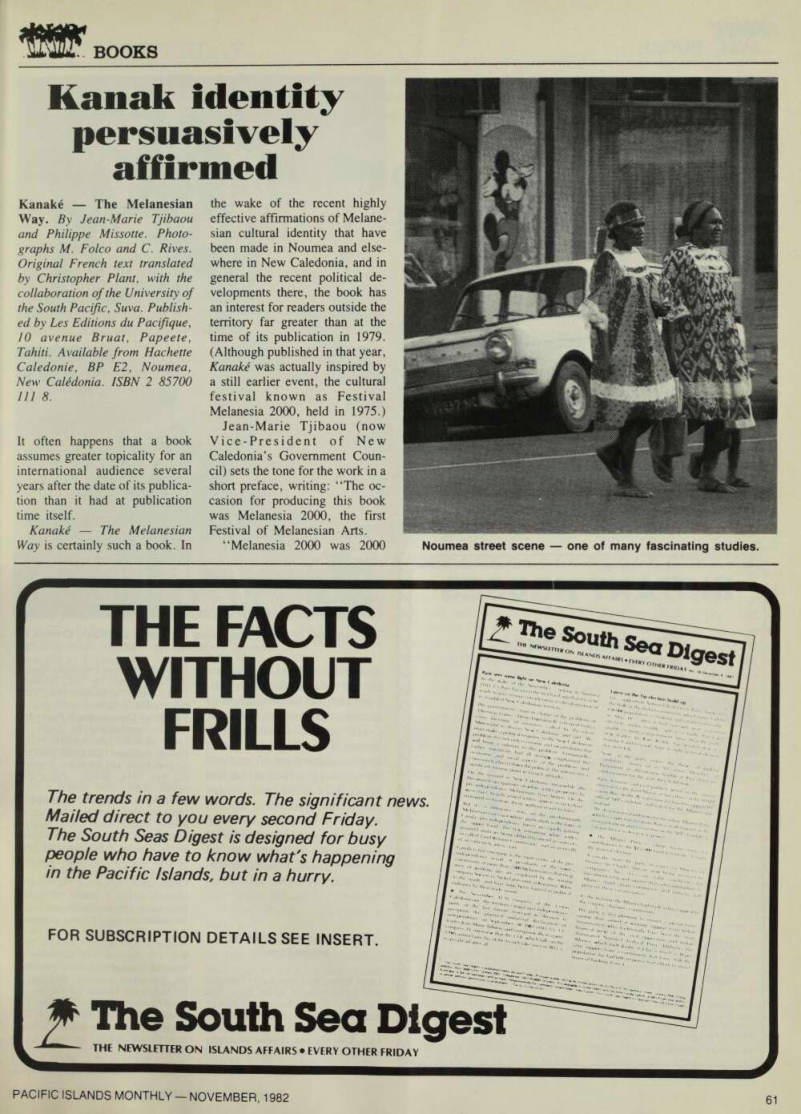
Noumea street scene - one of many fascinating studies.
Melanesians gathered for an im posing celebration, and the 50,000 spectators who attended.
“Melanesia 2000 was a brief moment in the Kanaka quest for an identity, and for many Euro peans the event which made them aware of the existence of an
aboriginal culture.
“Through this book, we want to resume the dialogue, to re build, to tell the world that we are not survivors of prehistory, still less archaeological fossils, but men of flesh and blood.
“Today, Kanake comes to you, charged with time and his tory, rich in his unique cultural experience. He claims his place in the sun.’’
This affirmative theme, the theme of survival, permeates the text, as in this passage from the first chapter: “. . . after so many years of denial and scepticism about the existence of a real culture in the Melanesian world, it is astonishing to see emerge from obscurity . . . rituals which are still practised but which had remained hidden both from the
Europeans, who considered them only as savage customs, and from the missionaries, who pro hibited such customs as being idolatrous and whom they (the Melanesians) could not con tradict for fear of losing their protection against the petty an noyances of colonial administration.
“The Kanakas are there, 74 years after a European dignitary welcomed Pastor Maurice Leenhardt, who had come to New Caledonia at the request of Protestant converts, with these words; ‘What are you going to do here? You’ve come for the Kanakas, but in 10 years’ time there won’t be a single Kanaka left.’ ’’
The book explores thoroughly
the role of myth, space and time in the traditional Melanesian un iverse, “because the experience of these three dimensions is what makes Kanake’s originality.’’
Its discussion of the colonial experience is objective and level in tone, devoid of any hint of chauvinism. But the assertion of
Melanesian values is no less firm for that. Indeed these two attri butes give to Kanake much of its
special and persuasive character.
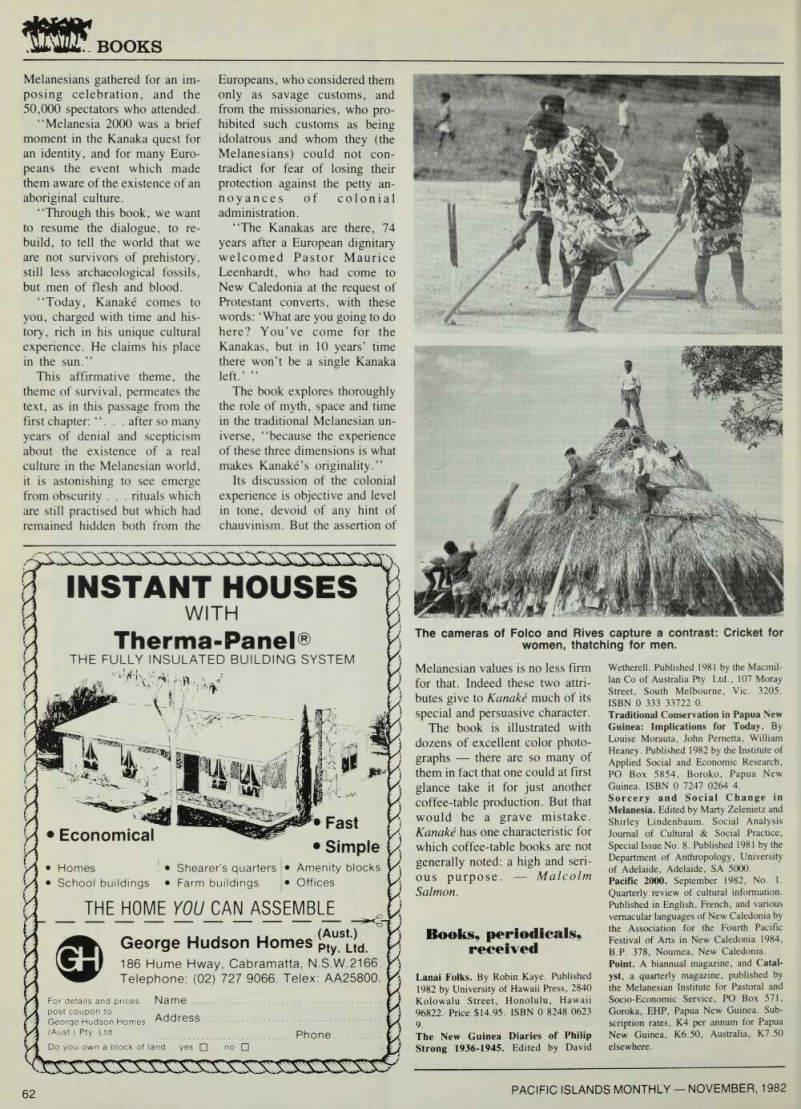
The book is illustrated with dozens of excellent color photo graphs there are so many of them in fact that one could at first glance take it for just another coffee-table production. But that would be a grave mistake.
Kanake has one characteristic for which coffee-table books are not generally noted: a high and seri
ous purpose.
Malcolm
Salmon.
Books, periodicals,
received
Lanai Folks. By Robin Kaye. Published 1982 by University of Hawaii Press, 2840 Kolowalu Street, Honolulu, Hawaii 96822. Price $14.95. ISBN 0 8248 0623 9.
The New Guinea Diaries of Philip Strong 1936-1945. Edited by David
Wetherell. Published 1981 by the Macmil lan Co of Australia Pty. Ltd., 107 Moray Street, South Melbourne, Vic. 3205.
Isbn 0 333 33722 0.
Traditional Conservation in Papua New Guinea: Implications for Today. By Louise Morauta, John Pemetta, William Heaney. Published 1982 by the Institute of Applied Social and Economic Research, PO Box 5854, Boroko, Papua New Guinea. ISBN 0 7247 0264 4.
Sorcery and Social Change in Melanesia. Edited by Marty Zelenietz and Shirley Lindenbaum. Social Analysis Journal of Cultural & Social Practice, Special Issue No. 8. Published 1981 by the Department of Anthropology, University of Adelaide, Adelaide, SA 5000.
Pacific 2000. September 1982, No. 1.
Quarterly review of cultural information.
Published in English, French, and various vernacular languages of New Caledonia by the Association for the Fourth Pacific Festival of Arts in New Caledonia 1984, B.P. 378, Noumea, New Caledonia.
Point. A biannual magazine, and Catal yst, a quarterly magazine, published by the Melanesian Institute for Pastoral and Socio-Economic Service, PO Box 571, Goroka, EHP, Papua New Guinea. Sub scription rates, K 4 per annum for Papua New Guinea, K 6.50, Australia, K 7.50 elsewhere.
The cameras of Folco and Rives capture a contrast: Cricket for women, thatching for men.