Continuity, change in U.S.
pp. 49-51 · Read in the full issue
From Jimmy to Ronald: Continuity, change in U.S.
Pacific Islands policy
“. . . American officials quickly discovered that the lilliputian world of Pacific microstates re quired the special attribute of being able to ‘think small’.
“This meant, in part, adjust ing to the fact that any American initiative would elicit responses from more than 20 different political entities enjoying vary ing degrees of sovereignty, and
most smaller than a modest size prairie city such as Omaha.
“It has not been an easy lesson for a global superpower to learn.”
Dr Richard A. Herr, a U.S. bom academic now working at the University of Tasmania, made this point in a paper pre sented in September at the Aust ralian National University, Canberra.
Taking as his theme “Ameri can Policy in the South Pacific: The Transition from Carter to Reagan”, Dr Herr concluded that there has been more con tinuity than change in the South Pacific policies of the two administrations.
He said; “One of the more significant indicators of the con tinuity of the Carter policies ap pears in the decision of the Reagan administration, contrary to expectations, not to cut the foreign assistance budget for the South Pacific. Indeed, the Carter administration aimed to lift American aid to the region to
roughly SU.S. 5 million by the early 1980 s. The two Reagan budgets have produced the fi gures of $5 million in 1981 and $5.1 million in 1982. Thus in quantitive terms at least the U.S. continues to maintain the basic levels of assistance created under the expanded Carter policy.
“There can be little doubt that in general terms the U.S. sub stantially upgraded its relations with the South Pacific under Car ter (largely at the urging of its ANZUS allies, Australia and New Zealand, following the “Tonga Scare” of 1976, when the establishment of diplomatic ties between the Soviet Union and Tonga was mooted), and that this policy of closer ties has been continued by the Reagan administration.
“Security provided the prim ary focus of the new policy and this remains the first objective in American relations. The Soviet threat to the Islands is perceived to be remote but sufficiently tangible as to require the direct
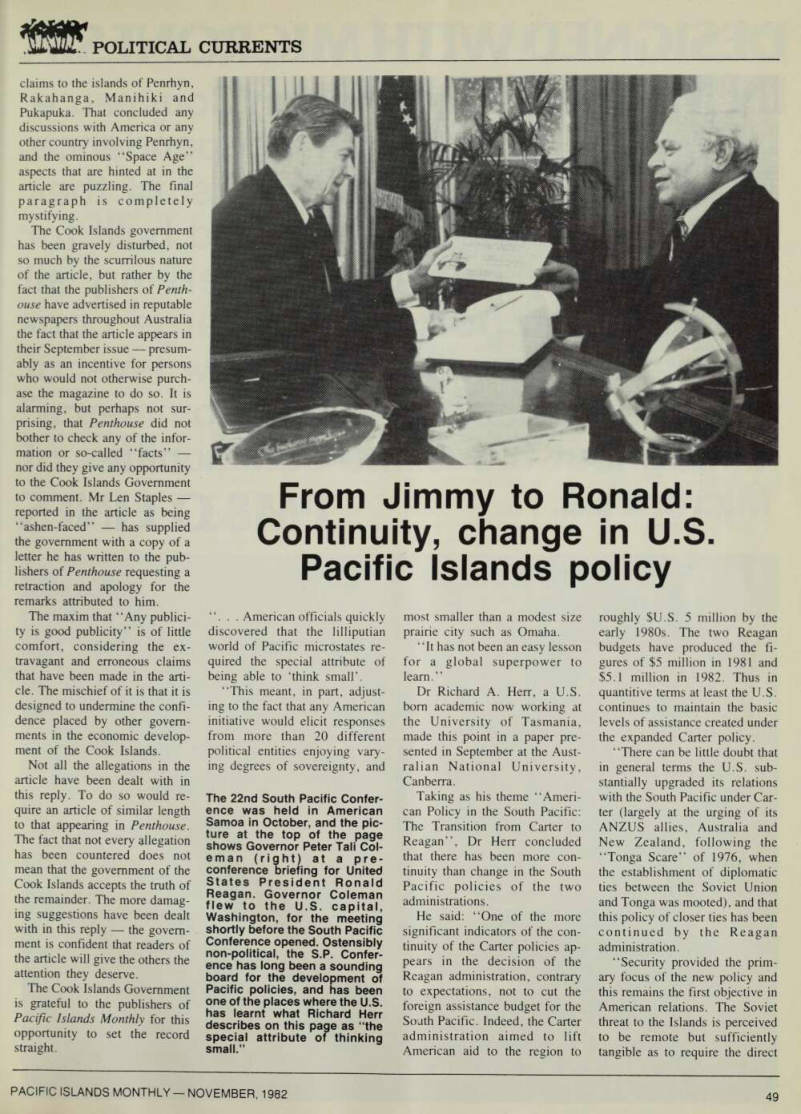
The 22nd South Pacific Confer ence was held in American Samoa in October, and the pic ture at the top of the page shows Governor Peter Tali Col eman (right) at a pre conference briefing for United States President Ronald Reagan. Governor Coleman flew to the U.S. capital,
Washington, for the meeting
shortly before the South Pacific Conference opened. Ostensibly non-political, the S.P. Confer ence has long been a sounding board for the development of Pacific policies, and has been one of the places where the U.S. has learnt what Richard Herr describes on this page as “the special attribute of thinking small.”
and continuing attention of the U.S.
“In addition, the changing
maritime regime has encouraged
the two administrations to keep a watching brief, at the minimum, on the region. Both the Carter and Reagan administrations have indicated they would wish to be included in the fisheries policy making process for the region if at all possible, although neither was prepared to risk the wrath of the tuna lobby to achieve this
goal.
“While the Reagan administ ration has been prepared to main tain most of the reforms of American policy in the South Pacific, there were some signif icant departures.
“By seeking to reconsider any concession to the region which might have been made during the Carter years, the Reagan govern ment gives an impression of real politik at odds with the more relaxed style of relations as sociated with the ‘Pacific Way’.
“The consequences of this ap parant selfishness are likely to be serious in the case of Micronesia, and certainly unhelpful in the cases of the United Nations Con vention on the Law of the Sea (UNCLOS), and Washington’s slowness in ratifying the treaties of friendship with Kiribati and Tuvalu.
“Whether or not the appoint ment of a non-career diplomat to the sensitive post in Fiji (ex public relations man and Reagan friend Fred Eckert has replaced experienced career diplomat Bill Bodde) was intended to suggest a downgrading of relations, the ac tion could be interpreted in this vein. Certainly one of the values to the South Pacific of having resident missions derives from the access this normally provides to trained foreign affairs officers.
Thus, a gesture which would go unnoticed in a larger community, may take on disproportionate sig nificance in a small community.
“The Reagan administration appears somewhat less willing than the Carter administration to leam to ‘think small’.”