NZ security overkill
pp. 51-52 · Read in the full issue
hobbled media at 13th Forum
The experience of 13 meetings of the South Pacific Forum since the first one in August, 1971, underlines the truth that every one of them is different. The difference comes mainly in the atmosphere dictated by the locale.
The locale dictates the chair man, who is appointed from the host country, and the difference between this year’s chairman, New Zealand Prime Minister Robert Muldoon, and last year’s, Vanuatu Prime Minister Father Walter Lini, was striking.
In Port-Vila last year Father Lini ran a Forum in true consen sus style “not tough, because he’s a Christian who believes in dialogue,” as one participant de scribed it at the time. That Forum was slow, and also had a “big conference” atmosphere which irked Mr Muldoon, who de scribed it as largely a waste of time, lacking the spirit of the
early days.
He was especially critical of the time taken up in Port-Vila on the question of independence for New Caledonia, and in Rotorua the day before the 13th confer
ence began he told a news con ference that “there were more important topics to discuss” at Rotorua, and that, anyway, the Islands leaders had already reached agreement on the main issues.
At Rotorua, Chairman Mul doon certainly wasted no time, but he was wrong in his evalua tion of the time and importance of the New Caledonia question, and not all the “more important” topics got an airing because of his tight control of the agenda.
If Chairman Lini had erred by giving too much latitude to de bate, Chairman Muldoon erred by sometimes giving too little.
Several questions the Pacific peace-keeping force proposal was one, and Russian penetration of the Pacific was another never got mentioned because of Mr Muldoon’s sometimes relen
tless steam-rollering.
This style irritated some and caused resentment among others Father Lini, not unexpected ly, was one who resented it. Yet
many, perhaps the majority,
were not critical of it. The chair man was regarded as fair and
businesslike, with those who wanted to enter into debate, in cluding Father Lini, given the opportunity. But they had to be quick!
Some heavy publicity was gi ven to a statement outside the conference by Mr Muldoon that the Forum “sat around and talk ed, had a nice lunch, and sat around and talked some more.”
But he was referring then to the traditional “retreat” held on the Sunday before the serious business starts, when the leaders
get together informally without
their ministers and advisers.
The atmosphere during the formal meetings with all advisers present was a different matter.
Mr Muldoon’s chairmanship was made easier by a rearrange ment of the agenda procedure, done as result of experience at Port-Vila, when it was found that the agenda had been loaded with matters that should have been handled at ministerial level at the meeting of the South Pacific Bureau for Economic Co operation (SPEC) preceding the Forum.
Father Lini had been saddled with this inflated agenda last year; this year Mr Muldoon wasn’t. The SPEC meeting, chaired by the efficient, highly experienced Taniela Tufui, Ton
ga’s long-time Secretary to Gov
ernment, resolved all but matters of top policy, and divided the final, heavily pruned agenda into
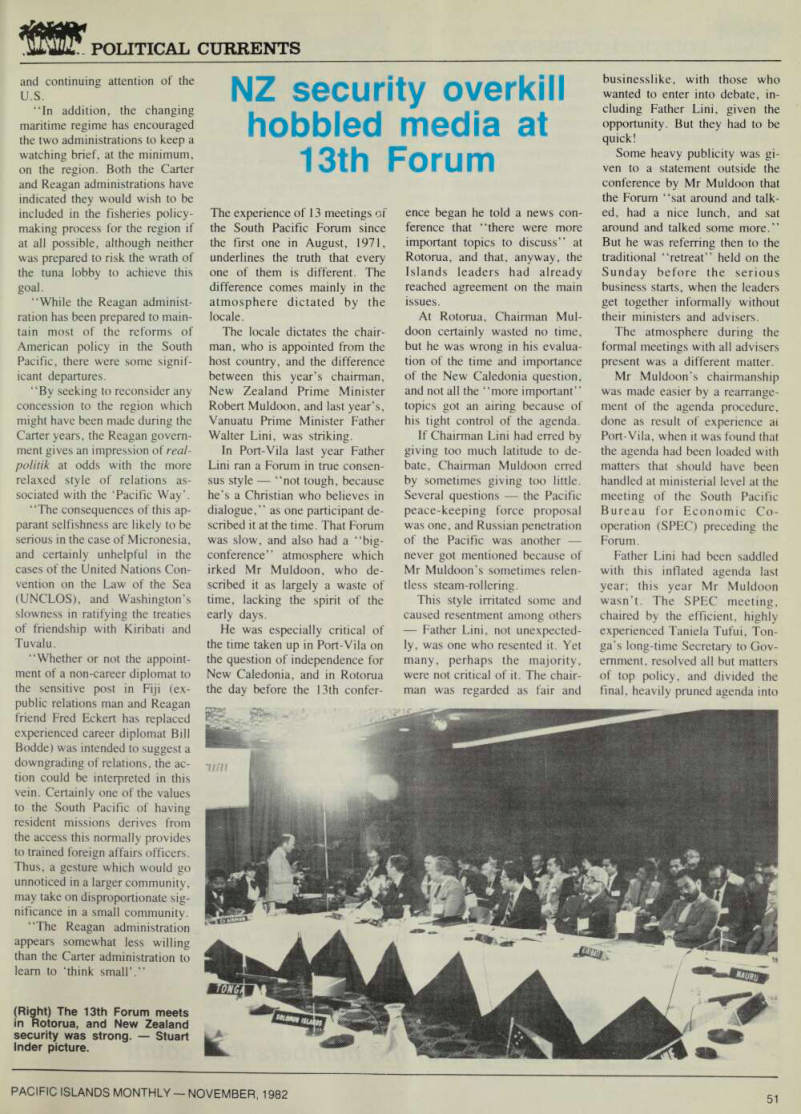
(Right) The 13th Forum meets in Rotorua, and New Zealand security was strong. - Stuart Inder picture.
two categories: items likely to attract detailed discussion and debate, and those that could be expected to go through swiftly.
The SPEC predictions turned out to be about right, including the listing of new Caledonia in the “debate” category, and the whole exercise was a success that no doubt will ensure that it is enshrined as a tenet of future procedure. It certainly removed one of Mr Muldoon’s main reasons for complaint last year.
Forum meetings are always held in camera, and there has always been security for the heads of government. But the Rotorua Forum was the tightest ever. The heads of government lived, moved and had their being in the tower block of the Rotorua Sheraton.
The meeting rooms and their quarters were sealed off 24 hours a day, and visitors could make contact only by phone in the first instance, after which they had to be personally escorted through security in and out.
Most HOGs (as the Heads of Government were rather unflat teringly referred to by officials, who also noted that Chief HOG was “Piggy” Muldoon) found these arrangements fairly com fortable. They provided privacy as well as security, and Western Samoa’s Prime Minister Va’ai Kolone was one who wanted to avoid the press so that he would not be drawn on the Samoan citizenship problem before he could discuss its implications with Mr Muldoon.
Tonga’s Prime Minister Prince Tu’ipelehake was another who didn’t want press interviews, but these two were probably the ex
ceptions, and with the security restrictions also applying to the social functions (to which the press were pointedly not in vited), a unique public relations opportunity was lost.
There was a very big press corps at Rotorua, which incestu ously interviewed and enter tained itself when it would have
been more productively engaged
in talking with Pacific Islands leaders about their problems, hopes and fears.
The Island leaders are neither backward nor shy, and would have been happy with oppor tunities to do this, especially at the social functions when every body is relaxed. Ratu Sir Kamis ese Mara recognised this need and gave the small Fiji media contingent personal news
briefings twice a day.
Mr Muldoon, Australian Prime Minister Fraser and Father Lini all gave press conferences that were “media events”, but what was missing was the oppor tunity for short, off-the-cuff per
sonal exchanges.
Especially unfortunate was the fact that the tight security was
apparently applied because of
New Zealand’s concern over a group of leather-lunged Maori activists in Rotorua, and not be cause of any fears about the behaviour of properly accredited media people, all of whom were
identifiable through lapel
badges. But it’s the media who suffered, and, in the end, so did the atmosphere of the South Pacific Forum.
There has to be a lesson there for the organisers of next year’s Forum meeting, to be held in Australia. Stuart Inder.