A broadside from Penthouse - and
pp. 45-49 · Read in the full issue

Political Currents
a Cooks minister replies
The September issue of the Australian edition of Penthouse magazine contained in addition to its usual quota of titillating photographic studies of female anatomy, a lurid attack on the Cook Islands Government.
Entitled “Plundering Paradise” and written by a person signing himself William Royal, the article was so wild in its claims that PIM decided to draw it to the attention of the Cook Islands Government and to offer it the right of reply in our columns. This reply, prepared by the Cooks Minister for Economic Development VINCENT INGRAM, appears below.
The vitriolic attack on the Cook Islands Government contained in the September issue of the Aust ralian edition of Penthouse is, at best, biased, and, at worst, cri minally libellous. The allega tions are plainly malicious, and the ‘‘facts” distorted.
To deal with all the misstate ments of fact and libellous state ments would require a line-by line analysis of the article which space does not permit.
The following points however should be made particularly as, through Sir Gaven Donne, there has been a very serious attack on the system of justice in this country. In referring to the 1978 election petition, the writer aserts ‘‘if the court had rejected only those votes from the Cook Islands Party (CIP) charters (all votes were numbered and thus the identity of the voters known) then Henry’s men would have held a slender majority.”
Read on its own, this passage is meaningless because that is precisely what the judge did.
However, the article goes on ‘‘as it turned out, Justice Donne re versed the result in so many electorates that the Democrats took 16 of the assembly’s 22 seats, resulting in a handy two thirds parliamentary majority . . .” This of course is a very serious attack on the chief justice as it suggests that, presumably acting on some whim of his own, he discounted even further votes than those properly disqualified by virtue of the charter flights.
This is quite untrue.
The article states that Sir Ga ven Donne was a “retired Rotorua magistrate,’’ ‘‘nominated by New Zealand as
Queen’s Representative to the Cook Islands and . . . Chief Justice.”
At the time of Sir Gaven’s appointment as chief justice of the Cook Islands he was chief justice of Western Samoa. He was appointed by the Cook Is lands cabinet, presided over by Sir Albert Henry (as he then was). The New Zealand Govern ment was not involved in his appointment.
It is equally incorrect to sug gest that Albert Henry had been ‘‘stripped of his knighthood . . . on a recommendation from the Cook Islands executive coun cil.” The records show (see New Zealand Gazette No. 38, April 11, 1980) that the Queen was acting on the advice of the gover nor-general of New Zealand who has no function in the Cook Islands. No such advice was ten dered or considered by either the Cook Islands executive council or cabinet. The nomination of Sir Albert for his knighthood was made by the New Zealand execu tive council which recommended his removal. Until August 1982 the Cook Islands had no say in the conferment of honors.
The writer’s apparent obses sion with honors is continued in a suggestion that the present gov ernor-general of New Zealand, Sir David Beattie, the then chief justice of the Cook Islands, Sir Gaven Donne, and the prime minister of the Cook Islands, Sir Thomas Davis, all received knighthoods as some kind of reward for what had passed be fore. Sir David Beattie was, of course, knighted on his appoint ment as governor-general of New Zealand. No doubt he, and the
government and people of New Zealand, would be dismayed at the strange suggestion that he was honored because he presided at the trials of Albert Henry and the other conspirators (all except two of whom, it should be noted, pleaded guilty). Sir Gaven Don ne’s knighthood was bestowed upon him as a result of submis sions from the governments of Western Samoa and Niue where he had been chief justice for many years. Sir Thomas received his knighthood on the recom mendations of the New Zealand executive council for his services to space medicine, his medical services in the Pacific and public life.
The article also contains a number of suggestions of finan cial mismanagement at one ex treme, and financial dishonesty at the other, on the part of Cook Islands officials.
It is said at one point that $1.5 million was advanced to the housing authority account. That is not so. The housing authority has been abolished and its func tions taken over by the Cook Islands Development Bank.
So far as the Cook Islands Development Bank is concerned, it is quite true that Mr J. Ingram was chairman of the board of that bank from January 25, 1979 to April 22, 1981. At that time he resigned to devote his attention to his substantial business inter ests in Auckland and Rarotonga.
Mr Ingram senior is a qualified accountant and was the only per son so qualified in Rarotonga at the time who was not either a politician or a member of the only accounting firm on the is land that firm being the major
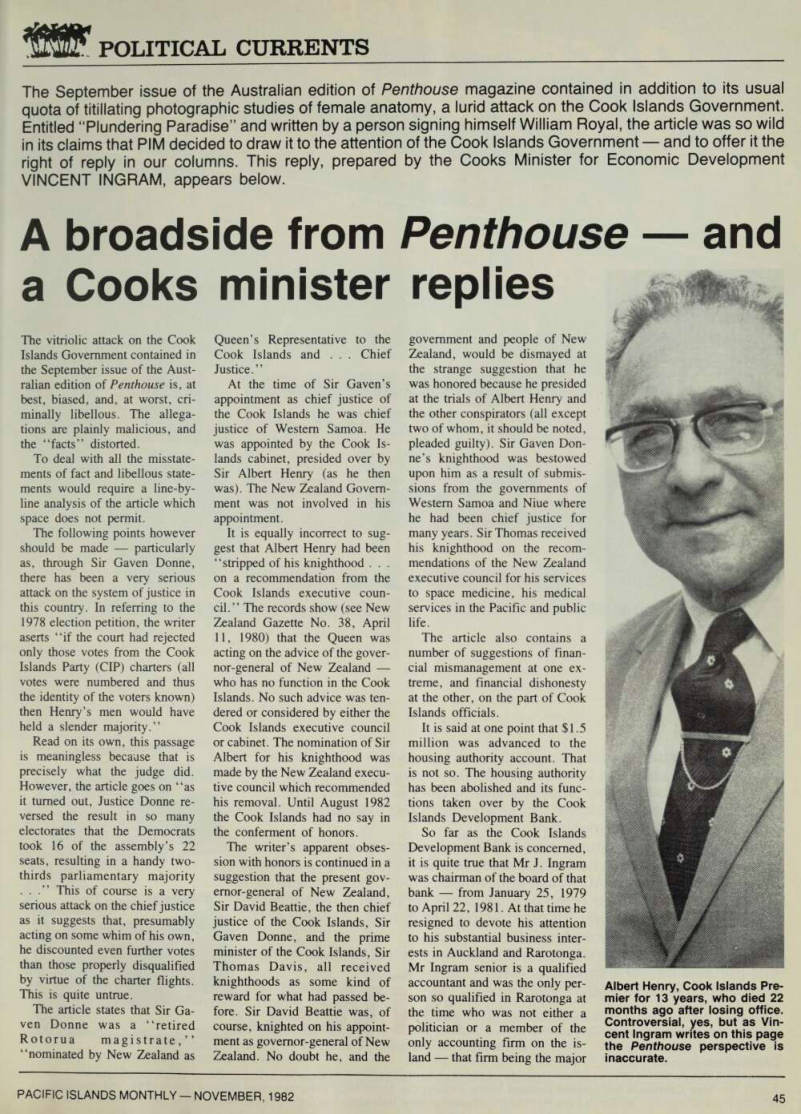
Albert Henry, Cook Islands Pre mier for 13 years, who died 22 months ago after losing office.
Controversial, yes, but as Vin cent Ingram writes on this page the Penthouse perspective is inaccurate.
source of the very applications that the board would have to consider.
Mr Ingram received a fee of $25 for every meeting of the board which he attended. The record shows that he attended 25 of the 35 meetings held during the time he was chairman. He received no other remuneration.
It is equally true that the Cook Islands Government has arranged a “credit-line” of $1.5 million from the Asian Development Bank to be disbursed for ap
proved enterprises through the
Cook Islands Development Bank. In order for the govern ment to on-lend the funds to the Cook Islands Development Bank, an act was required to be passed in parliament. That act was duly assented to and became law on September 7, 1982 some weeks following the publi cation of the article. None of those funds have yet been drawn upon and any project must be approved by the board of the Cook Islands Development Bank, and by the Asian Develop ment Bank.
The description of the events surrounding Mr Richard McDonald’s prosecution for
drunken driving causing injury
suggests that there was political interference in the police depart ment, or that the police them selves “framed” Mr McDonald.
The description of the events is quite at odds with the police evidence. It is noteworthy that
McDonald pleaded guilty. He
was represented by a solicitor.
The fact that such a lengthy explanation is made in the Penth ouse article relating to Mr
McDonald’s accident confirms suspicions in the Cook Islands that he was very likely respons ible for the article.
It is worth noting that he was not “tossed out of the Cooks” as the article claims. He had a resi dence permit which had expired and was not renewed. Upon the expiry of his residence permit he became an illegal resident and as such was served with a “removal order.” He complied with the order and left the country of his own accord.
The same Mr Richard McDonald in 1981 wrote to the United Nations secretary-general alleging misuse of United Na tions funds in the Cook Islands.
This received considerable publ icity, and as a result the Cook Islands requested that the United Nations despatch a suitable per son to investigate this outrageous claim. Mr Dennis Halliday of the United Nations office in Apia duly arrived in the Cook Islands and investigated the matter, in the course of which he inter viewed Mr McDonald. He found the allegations to be utterly groundless and reported to the Cook Islands Government that Mr McDonald had, following the conversation, withdrawn his alle gation. The attendant publicity however could not have been to the Cook Islands’ advantage.
Much is made in the article of two insignificant events firstly a quip in parliament by one of the Mangaia members regarding the cultivation of cannabis a re mark that was greeted with laughter from both sides of the house and occupied no more than half a minute of the house’s time.
One of the government’s biggest prob lems has been in spending the vast travelling allowance they have granted themselves. This has become such an onerous task that, as discovered by Op position Leader Geoffrey Henry, official Treasury cheques have begun popping up in ministers’ private accounts. When the unsporting Mr Henry saw fit to raise the matter in parliament, laveta Short was reported to have turned to him, eyes ablaze, and responded: “You’re just jealous.”
Penthouse on travelling allowances
Having gained office in mid-1978, after a sequence of politically expedient manoeuvres which would have made Machiavelli shudder in disgust, Prime Minister Davis’ first statement was the electorally pleasing announcement that parliamentary salaries would be cut by $lOOO a year. What Davis overlooked in the announcement was the simultaneous counter-move to increase ministers’ tax free allowances by $2OOO a year. There was a subtlety here although it would seldom later be evident in the Democrat ic powerhouse because after his years in the wilderness, Davis had learnt to reward his friends. He set about creating ministers and associate ministers, like Father Christmas at a children’s party.
Penthouse on Prime Minister Tom Davis
Then there is the matter of the use of a grader on the island of Manuae.
The facts of that matter are that the grader was sent to Manu ae for the purpose of assisting in the construction of an airstrip.
There is no permanent popula tion on the island. The lease is held by the Manuae Holding Company which comprises the landowners of the island, who in turn comprise a large number of people from Aitutaki an island that is a stronghold of supporters of the present opposition.
Although it is true to say that the grader was originally sup plied for the construction of air strips in the northern group, de lays in launching the airstrip program in the northern group islands meant that the grader was available for the construction of a strip on Manuae.
The grader was lost overboard in rough seas while being return ed to Rarotonga. It has since been recovered and is now back at Rarotonga. The Australian Government were advised of the mishap and the Australian high commissioner in New Zealand, who was in Rarotonga recently, has inspected it. It will be re paired and put back into use. It is not “now lying in 10 fathoms of water,” as the article claims.
The notion of a “Seychelles style mercenary raid”, master minded by the Democratic Party, is so incredible as to defy any sensible rejoinder. Cook Islan ders are a peace-loving people.
The Islands are devoid of serious crime. It is inconceivable that such a scheme could be hatched by any of the political factions contesting the election concerned.
Travelling and accommoda tion allowances for ministers and public servants in the Cook Is lands are calculated in accord ance with a schedule prepared by the treasury based on hotel tariffs from time to time prevailing in the appropriate destination. Such allowances are paid by govern ment cheque to the minister or public servant concerned. The recipient must make his own arrangements concerning the purchase of travellers cheques or overseas currency with the only bank in Rarotonga the Nation al Bank of New Zealand. It is a necessary routine for such a che que to be paid into the recipient’s private account if the person travelling is visiting New Zea land (NZ currency being the leg al tender in the Cook Islands), or for the purpose of arranging pay ment from his account for the purchase of the required overseas funds.
It is difficult to follow the drift of the allegations contained in the final few paragraphs of the article. A treaty was concluded with the United States in 1980 by which the limits of the exclusive economic zone as between the Cook Islands and American Samoa were fixed and by which America abandoned its previous ly held, although not pursued,
claims to the islands of Penrhyn, Rakahanga, Manihiki and Pukapuka. That concluded any discussions with America or any other country involving Penrhyn, and the ominous “Space Age” aspects that are hinted at in the article are puzzling. The final paragraph is completely mystifying.
The Cook Islands government has been gravely disturbed, not so much by the scurrilous nature of the article, but rather by the fact that the publishers of Penth ouse have advertised in reputable newspapers throughout Australia the fact that the article appears in their September issue presum ably as an incentive for persons who would not otherwise purch ase the magazine to do so. It is alarming, but perhaps not sur prising, that Penthouse did not bother to check any of the infor mation or so-called “facts” nor did they give any opportunity to the Cook Islands Government to comment. Mr Len Staples reported in the article as being “ashen-faced” has supplied the government with a copy of a letter he has written to the pub lishers of Penthouse requesting a retraction and apology for the remarks attributed to him.
The maxim that “Any publici ty is good publicity” is of little comfort, considering the ex travagant and erroneous claims that have been made in the arti cle. The mischief of it is that it is designed to undermine the confi dence placed by other govern ments in the economic develop ment of the Cook Islands.
Not all the allegations in the article have been dealt with in this reply. To do so would re quire an article of similar length to that appearing in Penthouse.
The fact that not every allegation has been countered does not mean that the government of the Cook Islands accepts the truth of the remainder. The more damag ing suggestions have been dealt with in this reply the govern ment is confident that readers of the article will give the others the attention they deserve.
The Cook Islands Government is grateful to the publishers of Pacific Islands Monthly for this opportunity to set the record straight.