People
pp. 39-44 · Read in the full issue

Nelson, New Zealand, yachtsman Peter Fagan took on a delivery job of a “thank you” catamaran to the Kiribati island of Abaiang in October hoping he’d miss the hurricane season.
The SNZ4O,OOO catamaran was launched and underwent its first sea trials in Wellington Har bour in September before being loaded aboard a freighter for the journey to Auckland.
From there the boat sailed aboard another freighter to Fiji.
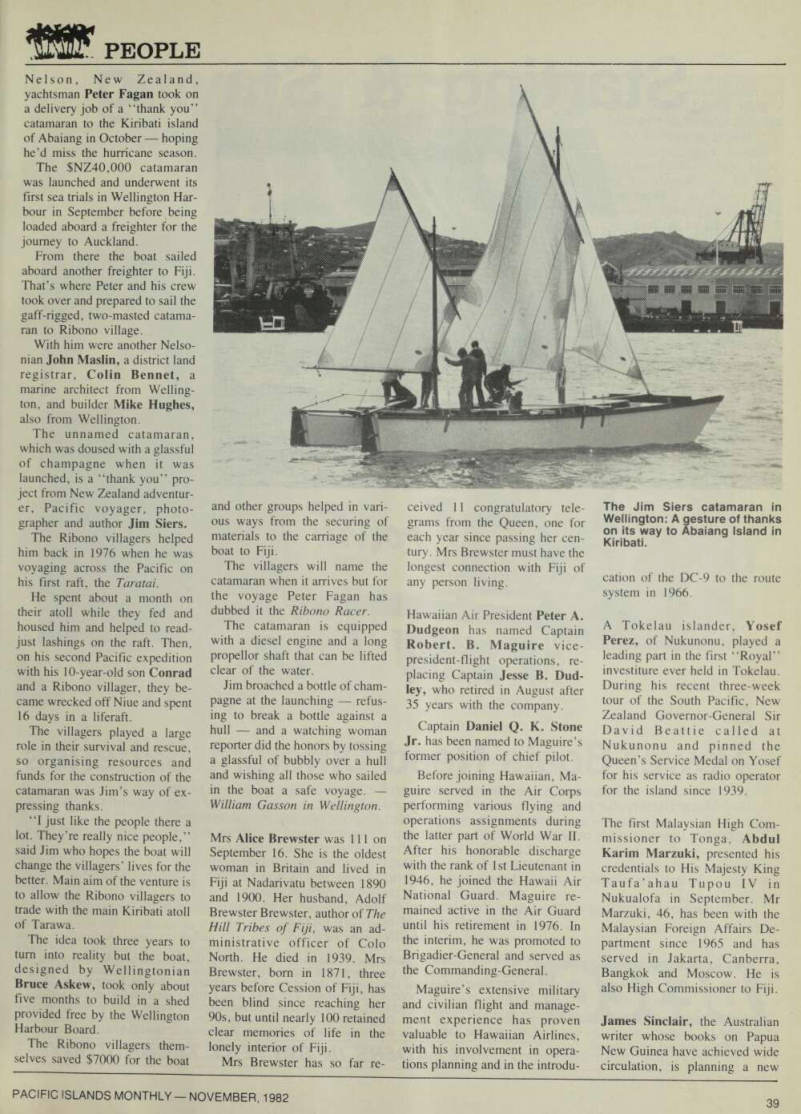
That’s where Peter and his crew took over and prepared to sail the gaff-rigged, two-masted catama ran to Ribono village.
With him were another Nelso nian John Maslin, a district land registrar, Colin Bennet, a marine architect from Welling ton, and builder Mike Hughes, also from Wellington.
The unnamed catamaran, which was doused with a glassful of champagne when it was launched, is a “thank you” pro ject from New Zealand adventur er, Pacific voyager, photo grapher and author Jim Siers.
The Ribono villagers helped him back in 1976 when he was voyaging across the Pacific on his first raft, the Taratai.
He spent about a month on their atoll while they fed and housed him and helped to read just lashings on the raft. Then, on his second Pacific expedition with his 10-year-old son Conrad and a Ribono villager, they be came wrecked off Niue and spent 16 days in a liferaft.
The villagers played a large role in their survival and rescue, so organising resources and funds for the construction of the catamaran was Jim’s way of ex pressing thanks.
“I just like the people there a lot. They’re really nice people,” said Jim who hopes the boat will change the villagers’ lives for the better. Main aim of the venture is to allow the Ribono villagers to trade with the main Kiribati atoll of Tarawa.
The idea took three years to turn into reality but the boat, designed by Wellingtonian Bruce Askew, took only about five months to build in a shed provided free by the Wellington Harbour Board.
The Ribono villagers them selves saved $7OOO for the boat
and other groups helped in vari ous ways from the securing of materials to the carriage of the boat to Fiji.
The villagers will name the catamaran when it arrives but for the voyage Peter Fagan has dubbed it the Ribono Racer.
The catamaran is equipped with a diesel engine and a long propeller shaft that can be lifted clear of the water.
Jim broached a bottle of cham pagne at the launching refus ing to break a bottle against a hull and a watching woman reporter did the honors by tossing a glassful of bubbly over a hull and wishing all those who sailed in the boat a safe voyage.
William Gasson in Wellington.
Mrs Alice Brewster was 111 on September 16. She is the oldest woman in Britain and lived in Fiji at Nadarivatu between 1890 and 1900. Her husband, Adolf Brewster Brewster, author of The Hill Tribes of Fiji, was an ad ministrative officer of Colo North. He died in 1939. Mrs Brewster, bom in 1871, three years before Cession of Fiji, has been blind since reaching her 90s, but until nearly 100 retained clear memories of life in the lonely interior of Fiji.
Mrs Brewster has so far re
ceived 11 congratulatory tele grams from the Queen, one for each year since passing her cen tury. Mrs Brewster must have the longest connection with Fiji of any person living.
Hawaiian Air President Peter A.
Dudgeon has named Captain Robert. B. Maguire vice president-flight operations, re placing Captain Jesse B. Dud ley, who retired in August after 35 years with the company.
Captain Daniel Q. K. Stone Jr. has been named to Maguire’s former position of chief pilot.
Before joining Hawaiian, Ma guire served in the Air Corps performing various flying and operations assignments during the latter part of World War 11.
After his honorable discharge with the rank of Ist Lieutenant in 1946, he joined the Hawaii Air National Guard. Maguire re mained active in the Air Guard until his retirement in 1976. In the interim, he was promoted to Brigadier-General and served as the Commanding-General.
Maguire’s extensive military and civilian flight and manage ment experience has proven valuable to Hawaiian Airlines, with his involvement in opera tions planning and in the introdu
cation of the DC-9 to the route system in 1966.
A Tokelau islander, Yosef Perez, of Nukunonu, played a leading part in the first “Royal” investiture ever held in Tokelau.
During his recent three-week tour of the South Pacific, New Zealand Governor-General Sir David Beattie called at Nukunonu and pinned the Queen’s Service Medal on Yosef for his service as radio operator for the island since 1939.
The first Malaysian High Com missioner to Tonga, Abdul Karim Marzuki, presented his credentials to His Majesty King Taufa’ahau Tupou IV in Nukualofa in September. Mr Marzuki, 46, has been with the Malaysian Foreign Affairs De partment since 1965 and has served in Jakarta, Canberra, Bangkok and Moscow. He is also High Commissioner to Fiji.
James Sinclair, the Australian writer whose books on Papua New Guinea have achieved wide circulation, is planning a new
The Jim Siers catamaran in Wellington: A gesture of thanks on its way to Abaiang Island in Kiribati.
book which will tell the story of how today’s civil aviation struc ture developed in PNG. It will deal with the airlines and air services of the period between World War II and today. Histor ically the book will be a sequel to Sinclair’s Wings Of Gold which told of the early years of PNG aviation. Because of the wide research involved Sinclair esti mates the book is still another two or three years away, and he would appreciate hearing from people who could provide infor mation, photographs or other re cords which would help to in crease the scope of the work.
James Sinclair lives in Queens land, at 25 Adaluma Avenue, Buddina Beach, 4575.
Philip Snow, founder of the Fiji Cricket Association in 1946 and vice-patron, has been elected chairman of the Associate Mem ber Countries on the Internation al Cricket Conference. They number 18, ranging from Canada to Zimbabwe and including Papua New Guinea all the cricket nations in the world ex cept the seven playing Test matches. He found all the spon sorship for the 1979 visit of the Fiji team to England for the World Cup and most of the spon sorship for the 1982 Fiji team in their recent successful tour when they were placed above East Af rica, West Africa and Malaysia in their group in final position.
Mr Snow, administrative of
ficer in Fiji for 15 years, cap tained Fiji’s very successful first cricket tour of New Zealand in 1948 and was awarded the MBE in the Fiji List in 1979.
He is the author of a number of works on Pacific history, includ ing The People from the Hori zon: An illustrated history of the Europeans among the South Sea Islanders, (reviewed in the 50th anniversary issue of PIM in 1980). His latest book is a biog raphy of his brother, Lord Snow.
Entitled Stranger and Brother: A Portrait of C. P. Snow, it has just been published by Macmillan in the UK and by Scribner in the USA and has been serialised in British newspapers.
Chief Superintendent of Prisons in Tonga, Sosaia Masima Fifi ta, retired on September 17 after over 40 years service, beginning his career as a police constable.
He took over the job of chief superintendent of prisons in 1972. Recalling his career, Mr Fifita said that one of the most significant roles of a warder was to do everything possible to en sure that the prisoner utilised his term in prison to become a better person when he returned to free society. Technical, fisheries, and religious programs had been in itiated. They have been so suc cessful that escape attempts had become rare, and relationships between inmates and warders had much improved.
Twenty-five-year-old Maureen Kiala has her head in the clouds.
Maureen is the first woman in Papua-New Guinea to take up flying, and now she’s going solo.
She completed her first half hour solo flight in August.
According to her instructor, Mike Carney, the flight was safe and well controlled.
Maureen, from Hanahan vil lage on Bougainville, has a stu dent pilot’s licence and is aiming for restricted private licence.
She has flown for 25 hours with her instructor seven hours more than the statutory minimum for a private licence holder.
She took a basic aero knowledge examination in Sep tember and must fly alone for a further 14 hours and 30 minutes before qualifying.
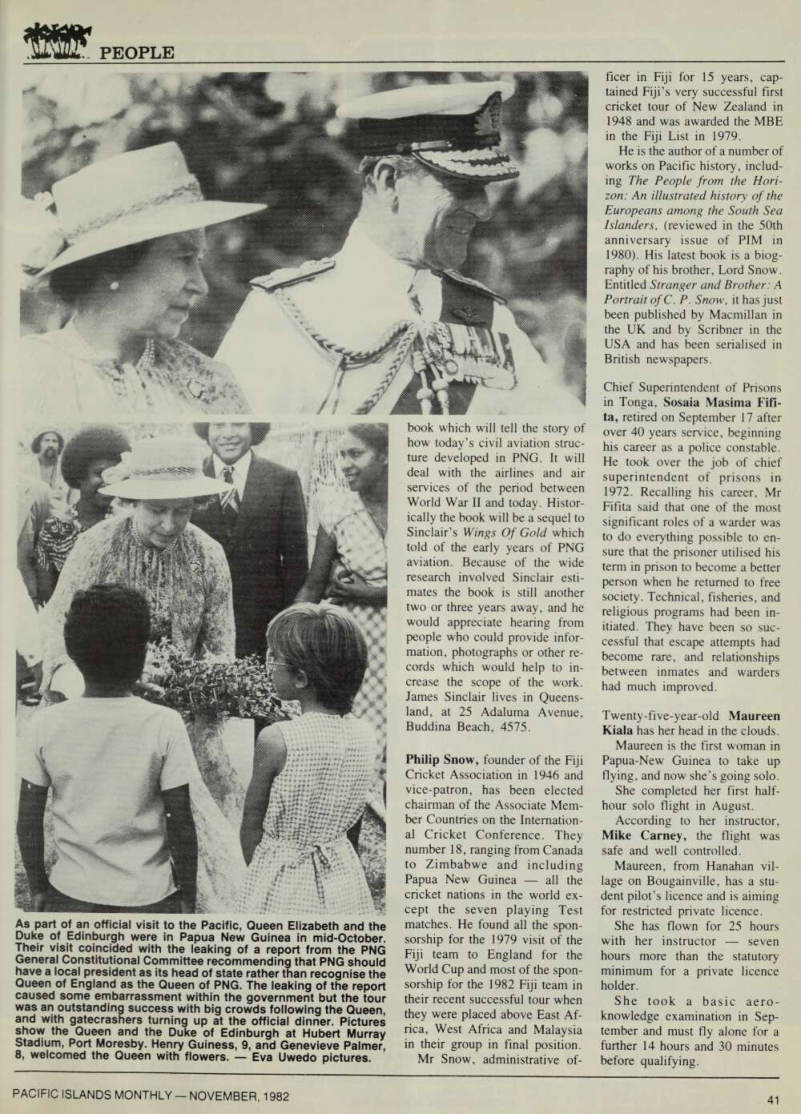
As part of an official visit to the Pacific, Queen Elizabeth and the Duke of Edinburgh were in Papua New Guinea in mid-October.
Their visit coincided with the leaking of a report from the PNG General Constitutional Committee recommending that PNG should have a local president as its head of state rather than recognise the Queen of England as the Queen of PNG. The leaking of the report caused some embarrassment within the government but the tour was an outstanding success with big crowds following the Queen, and with gatecrashers turning up at the official dinner. Pictures show the Queen and the Duke of Edinburgh at Hubert Murray Stadium, Port Moresby. Henry Guiness, 9, and Genevieve Palmer, 8, welcomed the Queen with flowers. - Eva Uwedo pictures.
And then the sky’s the limit, and what now is a pastime, says Maureen, may well become a career.
Maureen has worked as a Civil Airline Agency clerk for three years.
A recent project of the South Pacific Peoples Foundation of Canada was the bringing to Brit ish Columbia and Alberta of a painter and weaver from Tonga.
Sinisia Taumoepeau, who paints on tapa cloth and weaves with pandanus leaves, was to be exhibiting her work, giving de monstrations, and holding work shops in which Canadians could participate. Sinisia was to start the tour in B. C. on September 16, and visit Victoria, Duncan, Nanaimo, Courtenay, Port Alb nemi, Ahouset, and Vancouver.
She was due to start her tour of Alberta on October 4, visiting Edmonton, Calgary, and Banff, finishing on October 15.
The Pitcairn Miscellany in June reported what was almost a royal visit. Well, the visitor represents the Queen anyway.
It was a week-long call by the French yacht Kebir of the gover nor of Pitcairn, Sir Richard Stratton, only he didn’t know he was Sir Richard until after he had landed on Pitcairn. He was Mr Stratton when he left New Zea land, where he’s also British
high commissioner. After going
ashore, he was handed a tele gram, which told him the Queen had given him a KCMG in the Birthday Honours List.
Said Miscellany: “Sir Richard must be the first person to re ceive news of a knighthood whilst on Pitcairn.”
Well, they dined him and gave him a carved vase, and he gave them a large replica of the Royal Coat of Arms to be hung above the magistrate’s bench in the Court House. (A few of them have been distributed around the Commonwealth countries, in
cluding Fiji, only recently.)
Another gift from Sir Richard was a pair of 10-power binocu lars, extremely useful on Pitcairn for spotting ships and, when luck holds, getting the ships to pay a call.
The Pitcairners had several public discussions with their governor, and made several re quests. They were concerned with declining numbers on the island and asked if more regular shipping contacts could be made.
They felt that might persuade more people to live there.
They also asked if payment could be made to those building a new longboat, and approved plans for a new aluminium boat to be made in New Zealand.
If anyone employed by a building society is reading this, the islanders’ next request might produce a reaction. As they have no avenues for borrowing funds for housing finance, the Pitcair ners suggested to Sir Richard that their housing could be dramatic ally improved if the government provided low-cost finance for house-building and improve ments. They also asked for the services of a registered surveyor to re-establish official boun daries, and a replacement for their D 4 bulldozer, which is rapidly losing its dozing powers.
A new one would cost about SNZB6,OOO, they thought, an amount which could, perhaps, come from the British Government.
And, believe it or not, infla tion has hit Pitcairn. They told Sir Richard they thought that, because of inflation, the
minimum wage rate for public work should be a dollar an hour.
On the question of imports, some of the islanders asked that dogs should be imported as there’s only one such animal on the island. The governor thought this was up to the individual as
the machinery for importing dogs
already existed.
Some councillors felt that one dog on the island was one dog too many! Before leaving, the governor gave the Pitcairners this formal message: “I have spent a very happy week amongst you on Pitcairn. I have enjoyed meeting you all and being able to put faces at last to names I had read of in Miscel lany for nearly two years. I had the added bonus of seeing a supply ship come in. I now understand very well why you are keen to maintain your com munity on this beautiful island.
During the remainder of my tour as governor I shall do my best to ensure that together we achieve this aim. I am sure we shall. I shall hope to come back to see you again before I leave the Pacific in about two years’ time.”
Miscellany also reported that they had been reading about the
presentation by Professor Harry
Maude and wife Honor of the Pitcairn Ring to Norfolk Island, reported in the August PIM (p.
55). The Maudes were on Pit cairn in 1940-41 and the ring, used for marriages of early set tlers on Pitcairn, which had been lost for about 100 years, was found by Honor Maude on the site of John Adams’ house.
The Miscellany’s last words on the subject were: “Local peo ple on Pitcairn agree that it is pleasing that the ring has found a final resting place in an island which has links with Pitcairn.
However, they think there is one even better place for the ring and that’s back here on Pitcairn, with the Bounty Bible.”
When Kirk and Leone Dillon recently called on John Milne at the Australian Embassy in Taiwan, Bangkok, the occasion became an unexpected reunion of seven people with Pacific Island backgrounds. The seven, left to right, are John Milne (for merly of Apia Observatory), Leone Dillon (daughter of Bob and Sophia Rankin of Apia), Kirk Dillon (a former U.S. Peace Corps worker in Apia), Rina Crainean (formerly Rina Wong of Suva), Joe Crainean (a for mer PNG teacher), Bruce Lock ie (a former Australian High Commission officer in Solomon Islands), and Paul Smith (a for mer PNG teacher). Leone Dillon trained as a doctor in New Zea land under an award granted by the World Health Organisation.
She and her husband, who has worked as a teacher and as a fisheries research officer in Apia, are now in USA.