Eat Japan-style
pp. 33-37 · Read in the full issue
Tropicalities
Eat Japan-style in Honiara
Expatriates and seasoned travel lers alike no matter how ad venturous eventually suffer nostalgia for the cuisine of their home country. There are now few countries in the Pacific where it is not possible to eat a variety of Chinese meals, a limited range of French dishes, standard American hamburgers and hot dogs and, failing all else, the redoubtable Brown Windsor Soup, Meat Pie and Steamed Pudding on which the British Empire is said to have been founded.
Some of the islands have addi tional specialities: in Fiji, for
example, magnificent curries are
served in the most unpretentious of surroundings; in New Caledonia, as well as the best and worst of French provincial cooking, there are some excel lent Italian Trattoria; and in most countries there are unique offer ings of fish which owe nothing to
imported recipes or tastes.
Conspicuous by its absence
from the international food fare of the Pacific has been a Japan ese flavor despite the flood of Japanese travellers through the region and the burgeoning num ber of temporary and long term Japanese residents.
There are Japanese restaurants in Australia, Fiji (at Pacific Har-
Dennis Richardson looks at two aspects of food in the Islands: Japanese cooking in Solomon Islands and the curry culture in Fiji.
hour), New Zealand, (one only) and, of course, in Hawaii. There is none in Papua New Guinea the biggest of the islands nor, as far as is known to this travel ler, in any of the 2000-odd smal ler inhabited islands of the South Pacific, except Nauru. Some Japanese would explain this lack by claiming that their cuisine has no appeal to non-Japanese and that, in any case, it is impossible to obtain the right ingredients to do it justice in other countries.
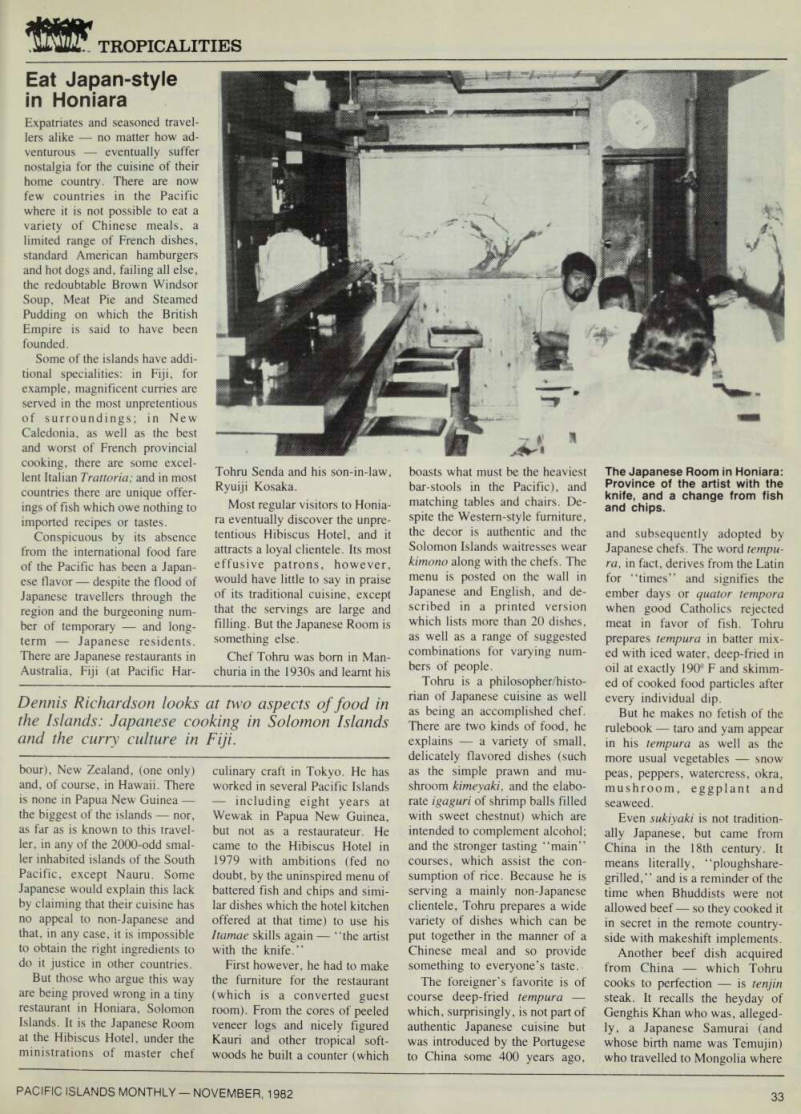
But those who argue this way are being proved wrong in a tiny restaurant in Honiara, Solomon Islands. It is the Japanese Room at the Hibiscus Hotel, under the ministrations of master chef
Tohru Senda and his son-in-law, Ryuiji Kosaka.
Most regular visitors to Honia ra eventually discover the unpre tentious Hibiscus Hotel, and it attracts a loyal clientele. Its most effusive patrons, however, would have little to say in praise of its traditional cuisine, except that the servings are large and filling. But the Japanese Room is something else.
Chef Tohru was bom in Man churia in the 1930 s and learnt his
culinary craft in Tokyo. He has worked in several Pacific Islands including eight years at Wewak in Papua New Guinea, but not as a restaurateur. He came to the Hibiscus Hotel in 1979 with ambitions (fed no doubt, by the uninspired menu of battered fish and chips and simi lar dishes which the hotel kitchen offered at that time) to use his Itamae skills again “the artist with the knife.”
First however, he had to make the furniture for the restaurant (which is a converted guest room). From the cores of peeled veneer logs and nicely figured Kauri and other tropical soft woods he built a counter (which
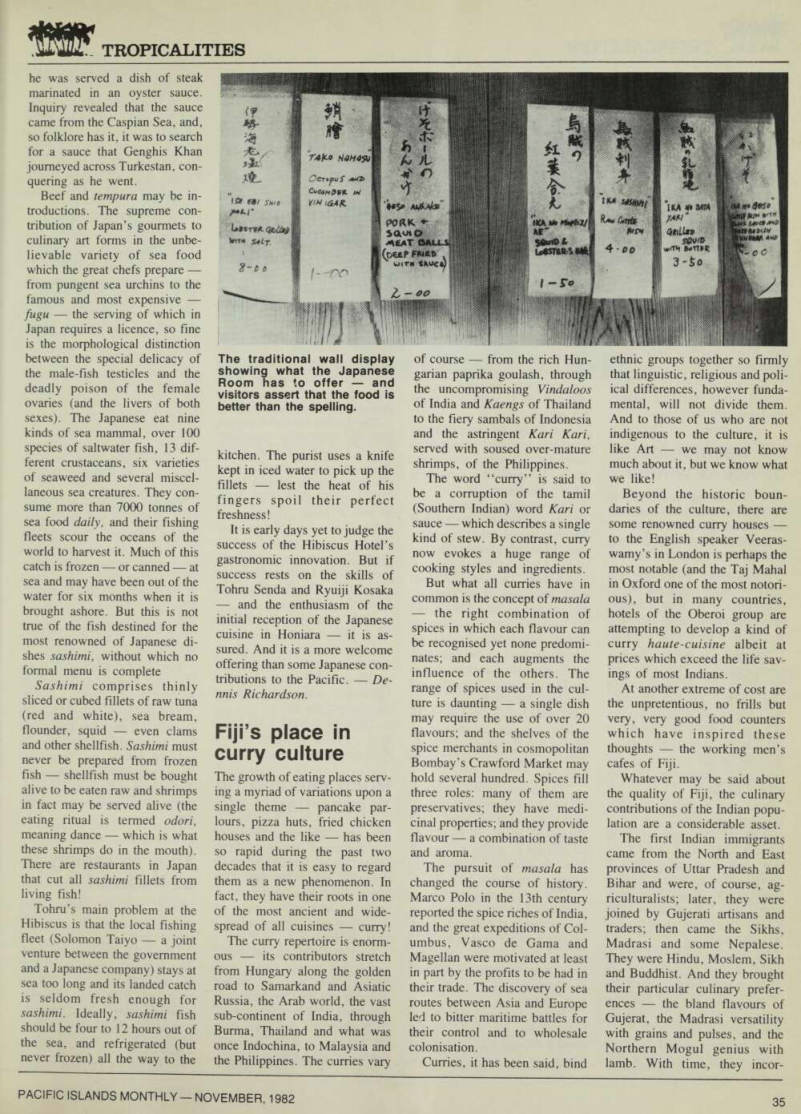
boasts what must be the heaviest bar-stools in the Pacific), and matching tables and chairs. De spite the Western-style furniture, the decor is authentic and the Solomon Islands waitresses wear kimono along with the chefs. The menu is posted on the wall in Japanese and English, and de scribed in a printed version which lists more than 20 dishes, as well as a range of suggested combinations for varying num bers of people.
Tohru is a philosopher/histo rian of Japanese cuisine as well as being an accomplished chef.
There are two kinds of food, he explains a variety of small, delicately flavored dishes (such as the simple prawn and mu shroom kimeyaki, and the elabo rate igaguri of shrimp balls filled with sweet chestnut) which are intended to complement alcohol; and the stronger tasting “main” courses, which assist the con sumption of rice. Because he is serving a mainly non-Japanese clientele, Tohru prepares a wide variety of dishes which can be put together in the manner of a Chinese meal and so provide something to everyone’s taste.
The foreigner’s favorite is of course deep-fried tempura which, surprisingly, is not part of authentic Japanese cuisine but was introduced by the Portugese to China some 400 years ago,
and subsequently adopted by Japanese chefs. The word tempu ra, in fact, derives from the Latin for “times” and signifies the ember days or quator tempora when good Catholics rejected meat in favor of fish. Tohru prepares tempura in batter mix ed with iced water, deep-fried in oil at exactly 190° F and skimm ed of cooked food particles after every individual dip.
But he makes no fetish of the rulebook taro and yam appear in his tempura as well as the more usual vegetables snow peas, peppers, watercress, okra, mushroom, eggplant and seaweed.
Even sukiyaki is not tradition ally Japanese, but came from China in the 18th century. It means literally, “ploughshare grilled,” and is a reminder of the time when Bhuddists were not allowed beef so they cooked it in secret in the remote country side with makeshift implements.
Another beef dish acquired from China which Tohru cooks to perfection is tenjin steak. It recalls the heyday of Genghis Khan who was, alleged ly, a Japanese Samurai (and whose birth name was Temujin) who travelled to Mongolia where
The Japanese Room in Honiara: Province of the artist with the knife, and a change from fish
and chips.
he was served a dish of steak marinated in an oyster sauce.
Inquiry revealed that the sauce came from the Caspian Sea, and, so folklore has it, it was to search for a sauce that Genghis Khan journeyed across Turkestan, con quering as he went.
Beef and tempura may be in troductions. The supreme con tribution of Japan’s gourmets to culinary art forms in the unbe lievable variety of sea food which the great chefs prepare from pungent sea urchins to the famous and most expensive fugu the serving of which in Japan requires a licence, so fine is the morphological distinction between the special delicacy of the male-fish testicles and the deadly poison of the female ovaries (and the livers of both sexes). The Japanese eat nine kinds of sea mammal, over 100 species of saltwater fish, 13 dif ferent crustaceans, six varieties of seaweed and several miscel laneous sea creatures. They con sume more than 7000 tonnes of sea food daily, and their fishing fleets scour the oceans of the world to harvest it. Much of this catch is frozen or canned at sea and may have been out of the water for six months when it is brought ashore. But this is not true of the fish destined for the most renowned of Japanese di shes sashimi, without which no formal menu is complete Sashimi comprises thinly sliced or cubed fillets of raw tuna (red and white), sea bream, flounder, squid even clams and other shellfish. Sashimi must never be prepared from frozen fish shellfish must be bought alive to be eaten raw and shrimps in fact may be served alive (the eating ritual is termed odori, meaning dance which is what these shrimps do in the mouth).
There are restaurants in Japan that cut all sashimi fillets from living fish!
Tohru’s main problem at the Hibiscus is that the local fishing fleet (Solomon Taiyo a joint venture between the government and a Japanese company) stays at sea too long and its landed catch is seldom fresh enough for sashimi. Ideally, sashimi fish should be four to 12 hours out of the sea, and refrigerated (but never frozen) all the way to the
kitchen. The purist uses a knife kept in iced water to pick up the fillets lest the heat of his fingers spoil their perfect freshness!
It is early days yet to judge the success of the Hibiscus Hotel’s gastronomic innovation. But if success rests on the skills of Tohru Senda and Ryuiji Kosaka and the enthusiasm of the initial reception of the Japanese cuisine in Honiara it is as sured. And it is a more welcome offering than some Japanese con tributions to the Pacific. De nnis Richardson.
Fiji’s place in
curry culture
The growth of eating places serv ing a myriad of variations upon a single theme pancake par lours, pizza huts, fried chicken houses and the like has been so rapid during the past two decades that it is easy to regard them as a new phenomenon. In fact, they have their roots in one of the most ancient and wide spread of all cuisines curry!
The curry repertoire is enorm ous its contributors stretch from Hungary along the golden road to Samarkand and Asiatic Russia, the Arab world, the vast sub-continent of India, through Burma, Thailand and what was once Indochina, to Malaysia and the Philippines. The curries vary
of course from the rich Hun garian paprika goulash, through the uncompromising Vindaloos of India and Kaengs of Thailand to the fiery sambals of Indonesia and the astringent Kari Kari, served with soused over-mature shrimps, of the Philippines.
The word “curry” is said to be a corruption of the tamil (Southern Indian) word Kari or sauce which describes a single kind of stew. By contrast, curry now evokes a huge range of cooking styles and ingredients.
But what all curries have in common is the concept of masala the right combination of spices in which each flavour can be recognised yet none predomi nates; and each augments the influence of the others. The range of spices used in the cul ture is daunting a single dish may require the use of over 20 flavours; and the shelves of the spice merchants in cosmopolitan Bombay’s Crawford Market may hold several hundred. Spices fill three roles; many of them are preservatives; they have medi cinal properties; and they provide flavour a combination of taste and aroma.
The pursuit of masala has changed the course of history.
Marco Polo in the 13th century reported the spice riches of India, and the great expeditions of Col umbus, Vasco de Gama and Magellan were motivated at least in part by the profits to be had in their trade. The discovery of sea routes between Asia and Europe led to bitter maritime battles for their control and to wholesale colonisation.
Curries, it has been said, bind
ethnic groups together so firmly that linguistic, religious and poli ical differences, however funda mental, will not divide them.
And to those of us who are not indigenous to the culture, it is like Art we may not know much about it, but we know what we like!
Beyond the historic boun daries of the culture, there are some renowned curry houses to the English speaker Veeras wamy’s in London is perhaps the most notable (and the Taj Mahal in Oxford one of the most notori ous), but in many countries, hotels of the Oberoi group are attempting to develop a kind of curry haute-cuisine albeit at prices which exceed the life sav ings of most Indians.
At another extreme of cost are the unpretentious, no frills but very, very good food counters which have inspired these thoughts the working men’s cafes of Fiji.
Whatever may be said about the quality of Fiji, the culinary contributions of the Indian popu lation are a considerable asset.
The first Indian immigrants came from the North and East provinces of Uttar Pradesh and Bihar and were, of course, ag riculturalists; later, they were joined by Gujerati artisans and traders; then came the Sikhs, Madrasi and some Nepalese.
They were Hindu, Moslem, Sikh and Buddhist. And they brought their particular culinary prefer ences the bland flavours of Gujerat, the Madrasi versatility with grains and pulses, and the Northern Mogul genius with lamb. With time, they incor-
The traditional wall display showing what the Japanese Room has to offer - and visitors assert that the food is better than the spelling.
porated local ingredients, includ ing taro and breadfruit, while the chutneys and salads have a uni quely Pacific character.
Fiji’s curry culture is not among the most sophisticated in the world; there is no restaurant equivalent to that of Bombay’s Centaur or Singapore’s Omar Khayyam or even Moti Mahal.
But in terms of variety and value for money the curry houses are second to none. They are not fancy; they do not advertise; of ten there is not even a sign
indicating an eating place.
But the devotee of the garam masala only has to ask an Indian taxi-driver and for little more than a dollar can experience the variety and delights of a cuisine which spans half the world.
Dennis Richardson.
NZ haemoglobin
device a winner
New Zealand ingenuity has pro duced a portable meter that mea sures haemoglobin in the blood.
It should save lives in developing countries all round the world.
Haemoglobin is the oxygen carrying molecule in the blood.
Measurement of it is a funda mental requirement in the basic diagnosis of the person’s health.
Measuring is usually done in urban centres in a laboratory us ing a piece of equipment costing between $20,000 and $40,000.
But what do you do in the jungles of Latin America and Southeast Asia, in the snow-tipped moun tains of Nepal or among the isolated communities in the Pacific Islands?
You use a Delphi portable haemoglobin meter.
It weighs 650 grams, is 12 cm long, 9.5 cm wide, and 9.5 cm high, and costs under SSOO. It operates in temperatures ranging from 0 to 50 degrees centigrade with a nine volt transistor radio battery that can give up to 100,000 readings.
Its running costs are 21c a measurement compared with $1.70 or more from similar types of equipment, and you can drop it, kick it, or throw it across the room and not harm it.
Its accuracy, based on three years of field trials using a con
trolled group of 500 patients, produced a variance of 0.025 per cent when compared with expen sive laboratory instruments.
All that adds up to a highly reliable, accurate, robust piece of New Zealand technology that is quick and easy to operate and
cheap enough for developing
countries to buy.
There are more than 100 units operating in New Zealand and Australia already which, indi vidually, do up to 600 to 1000
readings a day.
Their use has now spread to Nepal, Papua New Guinea, In donesia, Tanzania and Tuvalu.
You can find them in blood transfusion centres, pre-natal and post-natal clinics, radiation clin
ics, hospital casualty depart
ments, and military field
hospitals.
Now Delphi Industries Ltd. of Auckland is poised to launch an international marketing cam paign to publicise this little known instrument.
The company’s general mana
ger, Ray Crutcher, is the catalyst for this project which includes people like the Medical Director of the Auckland Blood Transfu sion Centre, Dr Graeme Wood field, who sparked off develop ment of the meter while operat ing in Southeast Asian jungles; Walter Wilson who carried out laboratory work at the Auckland centre plus initial work by staff at the Department of Scientific and Industrial Research.
“I’m taking the front end tech nology resource and then trans ferring that information to com mercial application,” said Crutcher.
“The beauty of the device is the way it was developed initially so that we could use it for blood transfusion centres. It takes only 60 seconds to screen a potential donor so you know immediately whether you should take blood.
“The cost savings are dramat ic and the fact that you can have an accurate, stable and quick reliable measurement in the field and that you can adjust the meter to an international standard in 10 seconds or so is very,
very important.
“People knowledgeable about
haemoglobin get pretty excited about it because it doesn’t matter where you are, your standardisa
tion technique can be carried out on the spot.
“That means you are not wor ried about temperature perform ance or all the other problems you face in the field,” he said.
William Gas son in Wellington.
Penpal gamble
comes off
It’s a long way from Puerto Rico, in the Caribbean, to Papua New Guinea especially if you are trying to contact someone you know only by face.
But that didn’t stop a letter from a school-girl in San Juan finding its way half-way round the world to the chairman of the Public Services Commission, Mr Renagi Lohia, in September.
The picture is cut from the National Geographic magazine, and the letter is addressed simply Port Moresby, Papua New Guinea, with the request: “Post Office, please deliver this letter to man in photo. Thanks.”
The Posts and Telecommuni cations Corporation took it from there. The letter was hand de livered to Mr Lohia yesterday by PTC public relations officer Mrs Carlene Lohberger.
Mr Lohia said he was delight ed to have a penpal.
The schoolgirl, whom he de clined to name, had read an article about PNG in the National Geographic and wanted to know more about the place.
“Request granted,” Mr Lohia
said.
Papua New Guinea
Post-Courier.
Much yapping on
Yapese flag
Yap, one of the member states of the Federated States of Mic ronesia, is having second thoughts about its new flag which bears the design of a canoe, a star and a piece of traditional stone money, all on a field of blue.
Well, that’s what it’s supposed to be, but people aren’t sure, which is why there are second thoughts and why the Yap Con stitutional Convention unanim ously adopted a resolution from the Mayor of Rull, Fernando Falewaath, asking the state legis
lature to call for a contest for a
new design.
“The state should have a flag that the public would recognise what it represents,’’ said the
Mayor of Rull, Yap’s biggest
municipality. State Information Officer Willy Gorongfel told it this way to the FSM Information Service: There are certain different in dividual opinions and impres sions on the design and represen tation of the present flag of the state, with those who think of it as the best thing after betel nuts, and those who choose to retain the opinion of abstract expre ssionism . . .
Those who had seen the Yap
state flag waving and chopping
the thin air so proudly only walk ed away with nothing but a bit of mixed feeling as to why Yap, among all Pacific neighbors, and also known for its cultural herit age and conservatism, chose a flag which represents a chicken leg in a frying pan.
Others have interpreted the de sign as that of a broken, two bladed propeller. Then there is the bizarre, mental imagination of those gorgeous provocative cheer leaders of the Super Bowl Dallas Cowboys and how far sky
high they may leap in cheers
since they may think that the flag of this state is also representing the helmet of their football team.
But, most difficult of all is the idea to determine which side of the flag is to be flying upward.
Perhaps these could be the reasons that the state flag never has been allowed to take its position beside the Stars and Stripes, the FSM flag and the UN flag in front of the state administ ration office and elsewhere in the state.
They’re racing
at Nadzab!
“Bang! went the starter’s gun and Bang! went the starter’s
motor cycle.”
Under this headline the Syd ney Sunday newspaper Sun- Herald of October 10, carried a report of a September horse racing meeting held at Nadzab, near Lae in Papua New Guinea, by the New Guinea Amateur Turf Club.
Describing an event known as the Stockmen’s Race, the news paper’s racing reporter Bert Lil lye wrote: “There was high dra ma even before the race began.
The starter, who went to the barrier on a motor bike, sent the runners away by firing a gun.
“Unfortunately he put the gun behind his back before he pulled the trigger. The bullet blew a hole in the motor bike behind him and the petrol tank exploded Praising the initiative of the Nadzab racing enthusiasts, Lillye writes: “For instance, when it was discovered that someone had forgotten to provide saddlecloth numbers . . . This problem was solved when Mrs Clift, the club president’s wife, hurried home and brought back eight pillow slips from her linen supply.
“These were split down the centre and the numbers put on with special crayons.’’
Two Australian racing experts were impressed by the excellence of Nadzab’s 1600-metre grass track, and with its heavy duty barrier stalls, built by local volunteers.
Another Australian visitor who broadcast the races was non plussed when a helicopter landed on the racecourse and he found himself shouldered aside from the microphone by one of the volunteer local committeemen, who grabbed the mike and yelled into it: “You fellows at the gate, get over to that helicopter and get their money. Those blokes never pay their fare in.’’
Hawksbill turtle
on S.l. stamp
To follow Sanford’s Eagle and cater for a new heavy weight air parcel post service the Solomon Islands have hatched a high value Hawksbill Turtle ($10) stamp for the current definitive series.
Ousting the Estuarine Crocodile from its place as the previous top value ($5), the Hawksbill has been portrayed by the same artist, Leslie Curtis, and is printed by Enschede en Zonen of Holland.
The Hawksbill is related to the Green Turtle and the Common Loggerhead, averaging about 33
brewery is running short of bot tles and no wonder: the beer is becoming one of Western Samoa’s most liquid overseas as sets. It’s selling and being drunk all over the South Pacific.
Vailima’s resident agent, Gary Cooper (see picture this page) wants all his bottles back so he’s been running a two-week Find the Vailima Bottle contest, with four main prizes of $lO each, to the top boy and girl collectors on the north side of the island and the top boy and girl on the south side, plus five cents for each bottle collected by all competitors.
Canoe plan holed
by lack of funds
A canoe voyage to retrace the migration route of the Maori peo ple to New Zealand may now never take place.
The epic voyage, hailed last year as perhaps the last great voyage of the 20th century, has gone aground in Tahiti because there is not enough money for the return trip.
Early last year, Matahi Whakataka Brightwell, a Master ton-bom carver, had the twin canoe hulls - which were carv ed out of totara logs shipped to Tahiti.
In Tahiti the hulls were to be linked and sails woven for the voyage to New Zealand, using the ancient sea route from Raiatea, in the Society Islands, to the Cook Islands.
The voyagers intended to use
inches in length. It is positively minute compared with an At lantic Leatherback, which would weigh in at about a ton, and in turn completely outstrips the very smallest members of the family which are less than six inches long!
The Hawksbill must be one of the few creatures to really ap preciate the invention of plastic, now that it has largely replaced the use of the Hawksbill’s shell in the tortoise-shell industry.
Turtle shells are incrdibly strong.
If nature had thought fit to pro vide a man with one, in propor tion to his size, he would be able to suport the weight of two elephants at least... at a pinch!
The release date for the stamp was September 20, 1982.
From Stangib, New York.
Niue’s Vailima
bottle hunt
Youngsters on Niue spent much of their September school holi days combing the island for bot tles not just any sort of bottle but those that had contained Western Samoa’s pride and joy, Vailima beer. Apparently, the
the Polynesian art of navigation.
The voyage should have been completed last February.
But Mr Brightwell and his canoe are still in Tahiti. And prospects do not look good.
Mr Brightwell said in Tahiti that he could not make the voy age to New Zealand because he could not get financial help from either his own country or Tahiti.
“The Maori Affairs Depart ment did not want to finance our project,” he said. “They even said that they would seize the canoe in New Zealand.”
A spokesman for the Depart ment of Maori Affairs, Neville Baker, said his department had been asked for about $lOO,OOO and the department did not have “that sort of money”.
As to the suggestion of seizing the canoe, Mr Baker said: “lam not sure what the department would do with the canoe if it did seize it.”
But a Wellington group hopes to raise $50,000 in donations to finance continuation of the voyage.
A spokesman for the Friends of the Hawaiki Nui group, David Paterson, said that the voyage had been “financially disastr ous” from the start.
But the group of about 15 Wellington people believed it could still be revived.
He believed the necessary fi nance could be found because the group had had some success with a similar appeal last year, boost ing a $30,000 government contribution.
Gary Cooper (right), managing
director of Niue Products, who organised the bottle drive re ported on this page. He was recently in Sydney selling Niue
produce - including coconut
cream and honey in the comb - to Australian importers. He talks here with Geoff Upton, one of the importers who showed interest.