Has Smiley
p. 31 · Read in the full issue
Tropicalities
Has Smiley the answer for Pitcairn?
They’ve been having some stir ring times on Pitcairn, according to the Pitcairners’ own newspap er, the Pitcairn Miscellany, which, humble production as it is, has a much wider circulation than many metropolitan newspapers.
Of course, it’s not on door steps abroad the morning after publication as Pitcairn has to rely on the odd ship sailing by to get its Miscellany to its overseas readers throughout the world which is why the “stirring events”, which occurred in May and June, are only now being reported in PIM.
The first, reported in the May Miscellany, was an approach by American multi-millionaire Smiley Ratliff. Mr Ratliff called at Pitcairn during April last year, in a yacht he had especially chartered to have a look at Hen derson Island. He must have liked what he saw, for he is at present conducting negotiations with the Pitcairn Island Ad ministration and the Island Coun cil, which will enable him to live on Henderson. Why he should choose such an inhospitable, re mote spot, we don’t know.”
Miscellany describes the hazards associated with landing and walking on the island, which is uninhabited and serves the Pitcairners as a spot for week long picnics (it’s 168 km ENE of Pitcairn), and as a supplier of wood the islanders use for mak ing sourvenirs bought by passers by. One group of five men (a lighthouse party, says Miscel lany) attempted in 1948 to reach the northeast point from the northern landing place. They were forced to give up after making only half a mile in five hours during which they suffered cuts and bruises from falls on the sharp coral hidden in the dense undergrowth.
Miscellany continues: “There is also very little fresh water on Henderson. In fact, the human remains which still exist in caves on Henderson today, are thought to be those of survivors of a
shipwreck; and that the primary cause of death was lack of water.
“On the surface, these obsta cles appear to be insuperable, but we hear that the greater the chal lenge, the more determined Mr Ratliff is to overcome it. The last attempt at inhabitation occurred in 1957, when an American named Robert Tomarchin, and his chimpanzee Moko, were landed there from a passing yacht. They lasted only three weeks before being dramatically rescued by a passing ship, and taken to Pitcairn.
“Henderson is also a natural bird sanctuary, and 13 species of birds have been observed there including four species of land birds, of which two are believed to be unique to the island. These are the flightless rail (Henderson Chicken) and a green fruit pi geon. Conservation groups are already seeking assurances that
these birds and their habitat will be protected, should the island become inhabited.
“If the scheme goes ahead, the people of Pitcairn stand to gain a great deal. Mr Ratliff is willing to pay one million dollars to be spent to aid the lot of the islanders, although it is not clear if the money is to go to the Pitcairn Island Administration in Auckland, or to the Glynn Chris tian fund. A large airstrip will be built on Henderson with links with Tahiti, and a smaller airstrip would be built on Pitcairn. This
would mean more regular mail services, it would provide an outlet for emergency medical evacuation, and perhaps a small tourist industry could be estab lished. Who would pay the costs for such a service is not yet clear.
“Mr Ratliff also has his eye on a small ship, which he plans to
purchase to bring heavy supplies
to Henderson and Pitcairn. This ship would work from the ports of San Diego, Papeete and Auck land. Pitcairn housing could also be helped, for Mr Ratliff pro poses to bring a team with
machinery, capable of building
sound, block, houses.
“We on Pitcairn are cautious ly optimistic that this scheme can be carried out, and the tremend ous problems such as landing
heavy machinery on Henderson,
can be overcome. But as always on Pitcairn, we will only really believe it’s happening, when we see the ‘whites of the eyes’ of Mr Ratliff and his party on Henderson.”
Then follows a graphic ac count of a brave rescue from a rough sea. As surnames are sel dom used on Pitcairn, the name of the woman who fell from a rock while fishing, conveys to us outsiders, no information on her identity, other than that she is called Vula. Incidentally, the name doesn’t occur in the census list PIM printed in the June issue (p 25).
But we do know the brave rescuer, whose name did appear in the list. She is Dobrie Chris tian, who raised the alarm and then dived into the water. Dobrie had to support the injured Vula, who had a broken wrist, for 30 minutes about 40 metres from shore until the boat arrived.
(British Royal Lifesaving Socie
ty please note!) There’s also the fishing report for the month. The Pitcairners mention it in passing, but it would cause consternation any where else that’s if they really
mean what they printed.
“This month has been a good one,” reports Miscellany.
“Rock fishing brought in seven crabs, while boat fishing brought in 3467 fish, including three whales and a sea serpent. Those
fishing off the icebergs bagged
three seals and a walrus.”
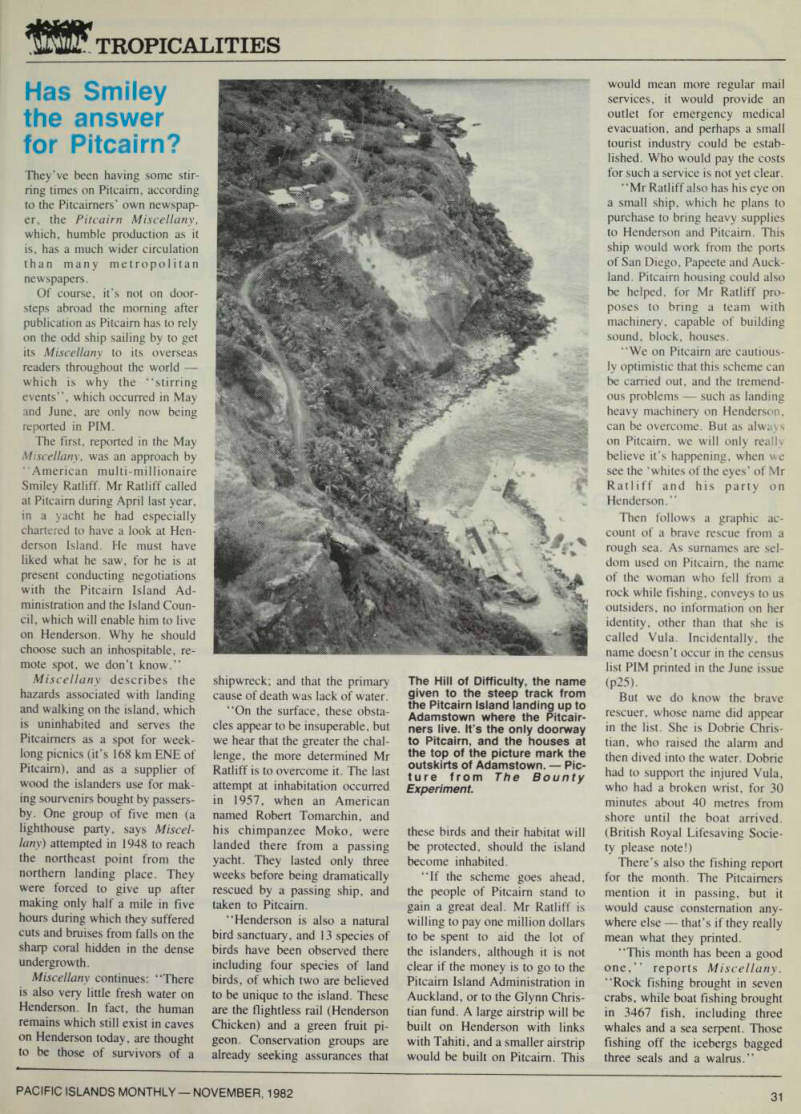
The Hill of Difficulty, the name given to the steep track from the Pitcairn Island landing up to Adamstown where the Pitcair ners live. It’s the only doorway to Pitcairn, and the houses at the top of the picture mark the outskirts of Adamstown. - Pic ture from The Bounty Experiment.