The Kon-Tiki
pp. 28-29 · Read in the full issue
raft sails on, and on and on ...
Until a couple of generations back, Australians and New Zealan ders of British descent used to call England “home”, even if they had never been there. Naturally, in the circumstances, they felt a strong urge to make a pilgrimage there.
I am just back in Tahiti myself after such a sentimental journey.
But in my case it was to Scandinavia, where I spent my whole childhood and youth.
Over the years, I have made quite a few similar trips “home”, but I must confess that the emotional impact on me is hardly noticeable except when I am once again able to see the tiny hut in which, as a young man of 26,1 spent the three happiest months of my life.
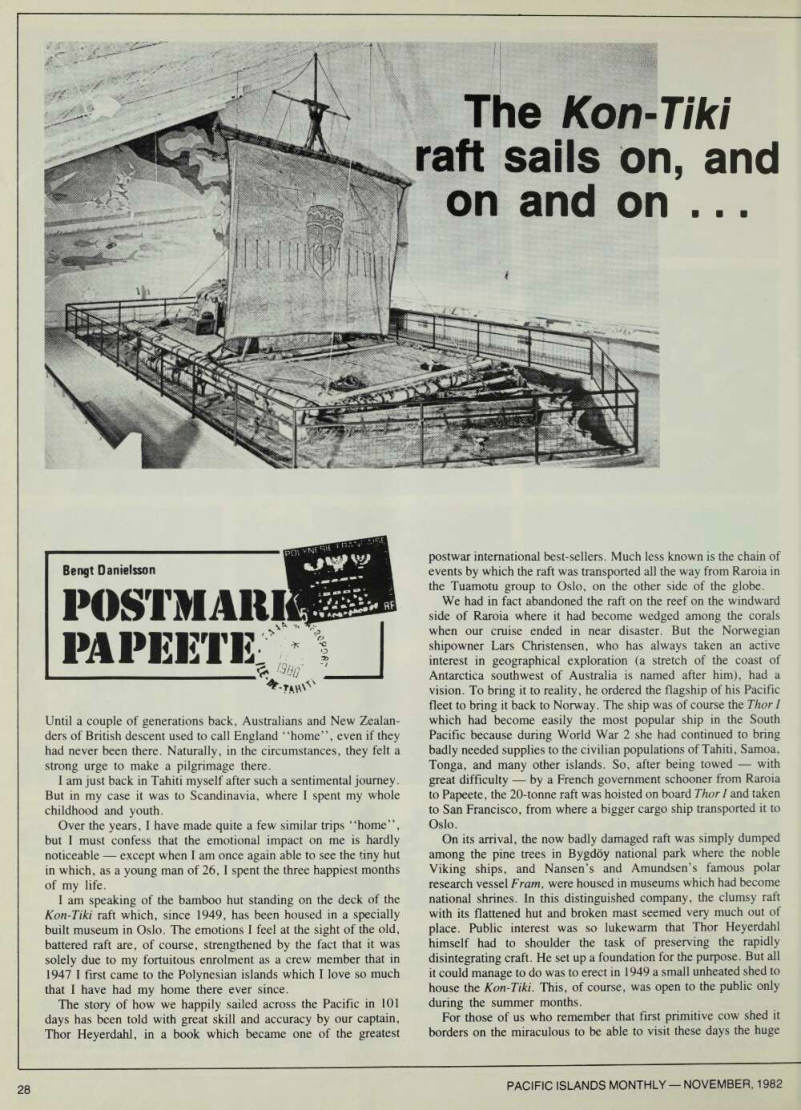
I am speaking of the bamboo hut standing on the deck of the Kon-Tiki raft which, since 1949, has been housed in a specially built museum in Oslo. The emotions I feel at the sight of the old, battered raft are, of course, strengthened by the fact that it was solely due to my fortuitous enrolment as a crew member that in 1947 I first came to the Polynesian islands which I love so much that I have had my home there ever since.
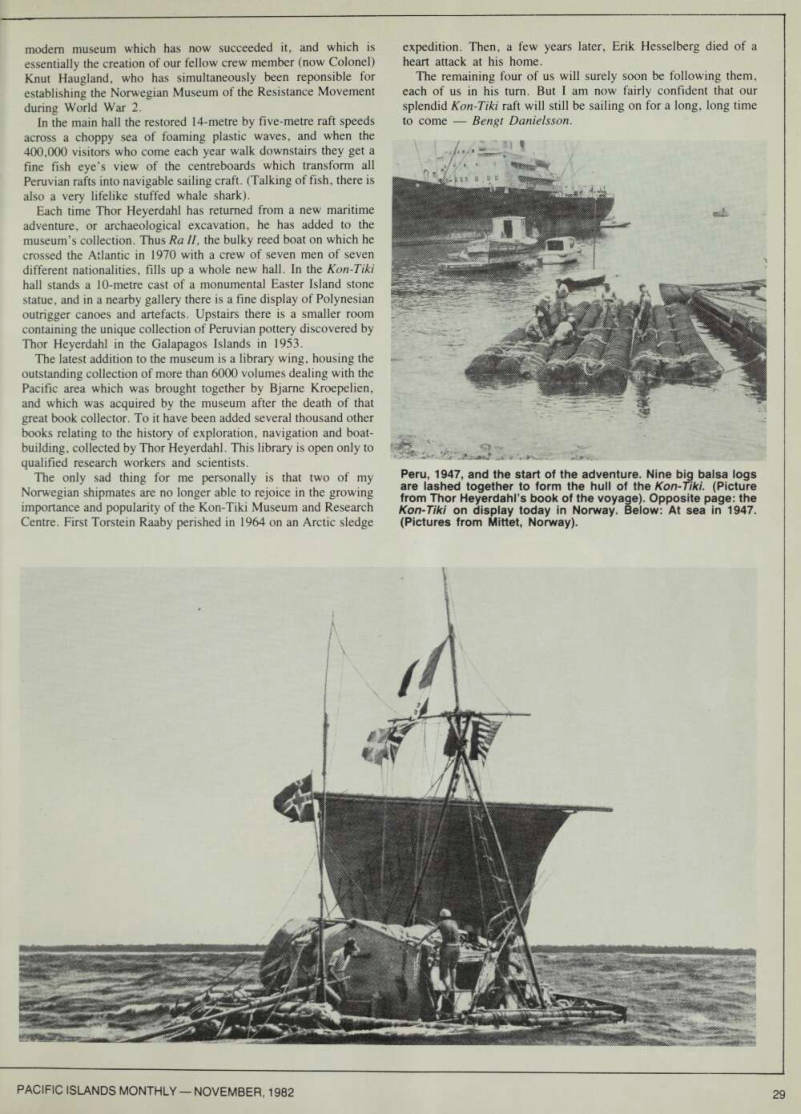
The story of how we happily sailed across the Pacific in 101 days has been told with great skill and accuracy by our captain, Thor Heyerdahl, in a book which became one of the greatest
postwar international best-sellers. Much less known is the chain of events by which the raft was transported all the way from Raroia in the Tuamotu group to Oslo, on the other side of the globe.
We had in fact abandoned the raft on the reef on the windward side of Raroia where it had become wedged among the corals when our cruise ended in near disaster. But the Norwegian shipowner Lars Christensen, who has always taken an active interest in geographical exploration (a stretch of the coast of Antarctica southwest of Australia is named after him), had a vision. To bring it to reality, he ordered the flagship of his Pacific fleet to bring it back to Norway. The ship was of course the Thor I which had become easily the most popular ship in the South Pacific because during World War 2 she had continued to bring badly needed supplies to the civilian populations of Tahiti, Samoa, Tonga, and many other islands. So, after being towed with great difficulty by a French government schooner from Raroia to Papeete, the 20-tonne raft was hoisted on board Thor I and taken to San Francisco, from where a bigger cargo ship transported it to Oslo.
On its arrival, the now badly damaged raft was simply dumped among the pine trees in Bygdoy national park where the noble Viking ships, and Nansen’s and Amundsen’s famous polar research vessel From, were housed in museums which had become national shrines. In this distinguished company, the clumsy raft with its flattened hut and broken mast seemed very much out of place. Public interest was so lukewarm that Thor Heyerdahl himself had to shoulder the task of preserving the rapidly disintegrating craft. He set up a foundation for the purpose. But all it could manage to do was to erect in 1949 a small unheated shed to house the Kon-Tiki. This, of course, was open to the public only during the summer months.
For those of us who remember that first primitive cow shed it borders on the miraculous to be able to visit these days the huge
modem museum which has now succeeded it, and which is essentially the creation of our fellow crew member (now Colonel) Knut Haugland, who has simultaneously been reponsible for establishing the Norwegian Museum of the Resistance Movement during World War 2.
In the main hall the restored 14-metre by five-metre raft speeds across a choppy sea of foaming plastic waves, and when the 400,000 visitors who come each year walk downstairs they get a fine fish eye’s view of the centreboards which transform all Peruvian rafts into navigable sailing craft. (Talking of fish, there is also a very lifelike stuffed whale shark).
Each time Thor Heyerdahl has returned from a new maritime adventure, or archaeological excavation, he has added to the museum’s collection. Thus Ra 11, the bulky reed boat on which he crossed the Atlantic in 1970 with a crew of seven men of seven different nationalities, fills up a whole new hall. In the Kon-Tiki hall stands a 10-metre cast of a monumental Easter Island stone statue, and in a nearby gallery there is a fine display of Polynesian outrigger canoes and artefacts. Upstairs there is a smaller room containing the unique collection of Peruvian pottery discovered by Thor Heyerdahl in the Galapagos Islands in 1953.
The latest addition to the museum is a library wing, housing the outstanding collection of more than 6000 volumes dealing with the Pacific area which was brought together by Bjame Kroepelien, and which was acquired by the museum after the death of that great book collector. To it have been added several thousand other books relating to the history of exploration, navigation and boat building, collected by Thor Heyerdahl. This library is open only to qualified research workers and scientists.
The only sad thing for me personally is that two of my Norwegian shipmates are no longer able to rejoice in the growing importance and popularity of the Kon-Tiki Museum and Research Centre. First Torstein Raaby perished in 1964 on an Arctic sledge
expedition. Then, a few years later, Erik Hesselberg died of a heart attack at his home.
The remaining four of us will surely soon be following them, each of us in his turn. But I am now fairly confident that our splendid Kon-Tiki raft will still be sailing on for a long, long time to come Bengt Daniels son.
Peru, 1947, and the start of the adventure. Nine big balsa logs are lashed together to form the hull of the Kon-Tiki. (Picture from Thor Heyerdahl’s book of the voyage). Opposite page: the Kon-Tiki on display today in Norway. Below: At sea in 1947. (Pictures from Mittet, Norway).