face challenge of ecumenism
pp. 23-26 · Read in the full issue

“Folk churches” of the Pacific face challenge of ecumenism
“Suva may well be the multi-faith capital of the world ..."
Canon REX DAVIS, Sub-Dean of Lincoln Cathedral, England, writes below on the specific problems facing Pacific churches in relation to the modern ecumenical movement. Australian-born Canon Davis has a long history of involvement in Pacific church affairs, and is a leading figure in the Foundation for the Peoples of the South Pacific. His article was written for translation and publication in a German lexicon on mission and ecumenism.
Religion, since the depths of time, has been and remains a profoundly significant element in the Pacific way of life. Partly because of this deep-seated sense of the transcendent, the Christian missionary enterprise of the 19th century, whether Roman Cathol ic, Congregational, Methodist, Anglican, Presbyterian or Luthe ran, met such astonishing suc cess that today it can be said that Pacific culture has captured Christianity, or, more evidently, Christianity has become the culture.
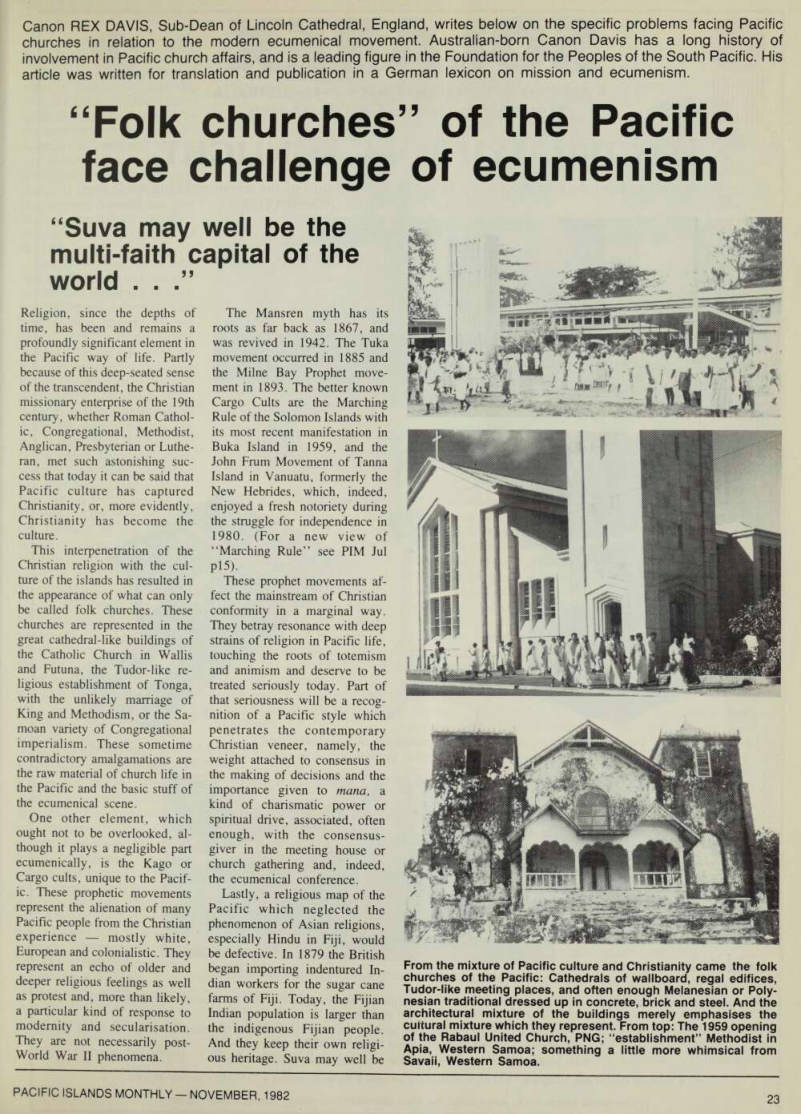
This interpenetration of the Christian religion with the cul ture of the islands has resulted in the appearance of what can only be called folk churches. These churches are represented in the great cathedral-like buildings of the Catholic Church in Wallis and Futuna, the Tudor-like re ligious establishment of Tonga, with the unlikely marriage of King and Methodism, or the Sa moan variety of Congregational imperialism. These sometime contradictory amalgamations are the raw material of church life in the Pacific and the basic stuff of the ecumenical scene.
One other element, which ought not to be overlooked, al though it plays a negligible part ecumenically, is the Kago or Cargo cults, unique to the Pacif ic. These prophetic movements represent the alienation of many Pacific people from the Christian experience mostly white, European and colonialistic. They represent an echo of older and deeper religious feelings as well as protest and, more than likely, a particular kind of response to modernity and secularisation.
They are not necessarily post- World War II phenomena.
The Mansren myth has its roots as far back as 1867, and was revived in 1942. The Tuka movement occurred in 1885 and the Milne Bay Prophet move ment in 1893. The better known Cargo Cults are the Marching Rule of the Solomon Islands with its most recent manifestation in Buka Island in 1959, and the John Frum Movement of Tanna Island in Vanuatu, formerly the New Hebrides, which, indeed, enjoyed a fresh notoriety during the struggle for independence in 1980. (For a new view of “Marching Rule” see PIM Jul Pl 5).
These prophet movements af fect the mainstream of Christian conformity in a marginal way.
They betray resonance with deep strains of religion in Pacific life, touching the roots of totemism and animism and deserve to be treated seriously today. Part of that seriousness will be a recog nition of a Pacific style which penetrates the contemporary Christian veneer, namely, the weight attached to consensus in the making of decisions and the importance given to mana, a kind of charismatic power or spiritual drive, associated, often enough, with the consensus giver in the meeting house or church gathering and, indeed, the ecumenical conference.
Lastly, a religious map of the Pacific which neglected the phenomenon of Asian religions, especially Hindu in Fiji, would be defective. In 1879 the British began importing indentured In dian workers for the sugar cane farms of Fiji. Today, the Fijian Indian population is larger than the indigenous Fijian people.
And they keep their own religi ous heritage. Suva may well be
From the mixture of Pacific culture and Christianity came the folk churches of the Pacific: Cathedrals of wallboard, regal edifices, Tudor-like meeting places, and often enough Melanesian or Poly nesian traditional dressed up in concrete, brick and steel. And the architectural mixture of the buildings merely emphasises the cultural mixture which they represent. From top: The 1959 opening of the Rabaul United Church, PNG; “establishment” Methodist in Apia, Western Samoa; something a little more whimsical from Savaii, Western Samoa.
the multi-faith capital of the world.
The Pacific is a vast span of water, a great ocean stretching from the Arctic to the cliffs of southern icebergs, bordered by the continents of Asia and the Americas and peppered with its tiny islands and magnificent ar chipelagos. The greatest of these islands is Papua New Guinea if one discounts Australia and New Zealand expropriated by white settlement and immigration in the 19th century.
Since 1960 these island com munities have bounced one after another into the comity of mod em nationhood following their brief colonial history. Western Samoa (1962), Nauru (1968) Tonga (1970) and Fiji (1970) are the elder brothers in the South Pacific Forum set up in 1971 (the South Pacific Commission estab lished in 1947 is an institution of the bigger, former colonial, sis ters as well). Niue (1974) is one of the tiniest states and, along with the Cook Islands, keeps its ties with New Zealand. Papua New Guinea (1975) marked the beginning of the Melanesian en try, followed by the Solomon Islands (1978) and quite recently Vanuatu (1980). The Polynesian world is represented now by Tuvalu (1978) and Kiribati (1979), while there remains the anomaly of French Overseas Ter ritories like New Caledonia and French Polynesia. Finally, the tiny islands of Micronesia, still under the Trusteeship of the Un ited States of America, present an as yet unsettled problem.
This race into nationhood has uniquely marked the last two decades. The churches of the Pacific have played a significant part in the process. The folk church has not necessarily been an instrument of conformity and conservatism. In Papua New Guinea, Vanuatu and Fiji church people have played significant roles in the emergence of politic al consciousness and leadership.
At times this style, reminiscent of Europe in the 17th ventury, has confused and discomfited European administrators of the late 20th century. This leadership is perhaps now facing a new crisis as newly emerging nations face the bewildering complexity of contemporary secularisation.
The Pacific Way may have something to say in this context.
What it says may depend on how younger Pacific leaders, such as Anglican priest Walter Lini, Prime Minister of Vanuatu or Roman Catholic priest John Momis, now Deputy Opposition Leader in the Papua New Guinea Parliament interpret their respon sibilities and opportunities.
Christian lay and ordained in volvement in many levels of gov ernment and civic life remains consciously committed. The in terpenetration of church and state, religion and life, is a seri ous matter.
The Pacific Conference of Churches was set up in the late 1960 s and held its first assembly in 1969. It represented that period in ecumenical prosperity when regional conferences were encouraged and subsidised by the World Council of Churches and its richer member churches. To a large extent the P.C.C. remains dependent on that circle of sup port. The Melanesian Council of Churches (in Papua New Guinea) and the Solomon Islands Chris tian Association represent more indigenous ecumenical com munities. The national councils of churches have been weaker cousins; in the ’7os they were better developed in Tonga, Fiji and the then New Hebrides.
These ecumenical institutions
disguised to some extent the gre ater passion for discovering a common Christian basis which was felt in parts of the Pacific.
Desires for a new, national church, in Papua New Guinea, were expressed in the heady at mosphere of independence. The United Church of Papua New Guinea and the Solomon Islands represented one of the earlier unions. But old ties to founding churches and the complex finan cial strings to missions and “mother” churches frustrated any naive desire to make radical changes. These classic problems were perhaps most acute in Papua New Guinea. As well the older lines of comity arrange ments tended to leave churches with well defined areas of con trol: the folk church in Popondet ta might be Anglican, in Milne Bay Roman Catholic, and in Lae Lutheran. So it was in other Pacific nations. Presbyterian, Methodist, Anglican, Roman Catholic, Lutheran and Congre gational strongholds remain to confuse any bolder attempt at church unity.
Nevertheless, the Pacific Con ference of Churches took a lead in electing the Roman Catholic Bishops’ Conference in the Pacific (CEPAC) to membership at its third Assembly in 1976.
There were moments when ecu menical progress seemed more likely in the Pacific than else where, but it seems now that regional consciousness, which the P.C.C. encouraged and which naturally demanded ecu menical awareness, is being out weighed by the pressing need in so many small new nation states for the discovery of national identity, and alongside that, sometimes a stronger local church commitment.
The P.C.C. announced in Sep tember 1982 that it was reor ganising its ecumenical work to give more authority to individual national churches.
The ecumenical commitment has manifested itself in several ways. Earlier, there was a strong emphasis on issues of human development which had land marks in the Melanesian Council of Churches consultations of
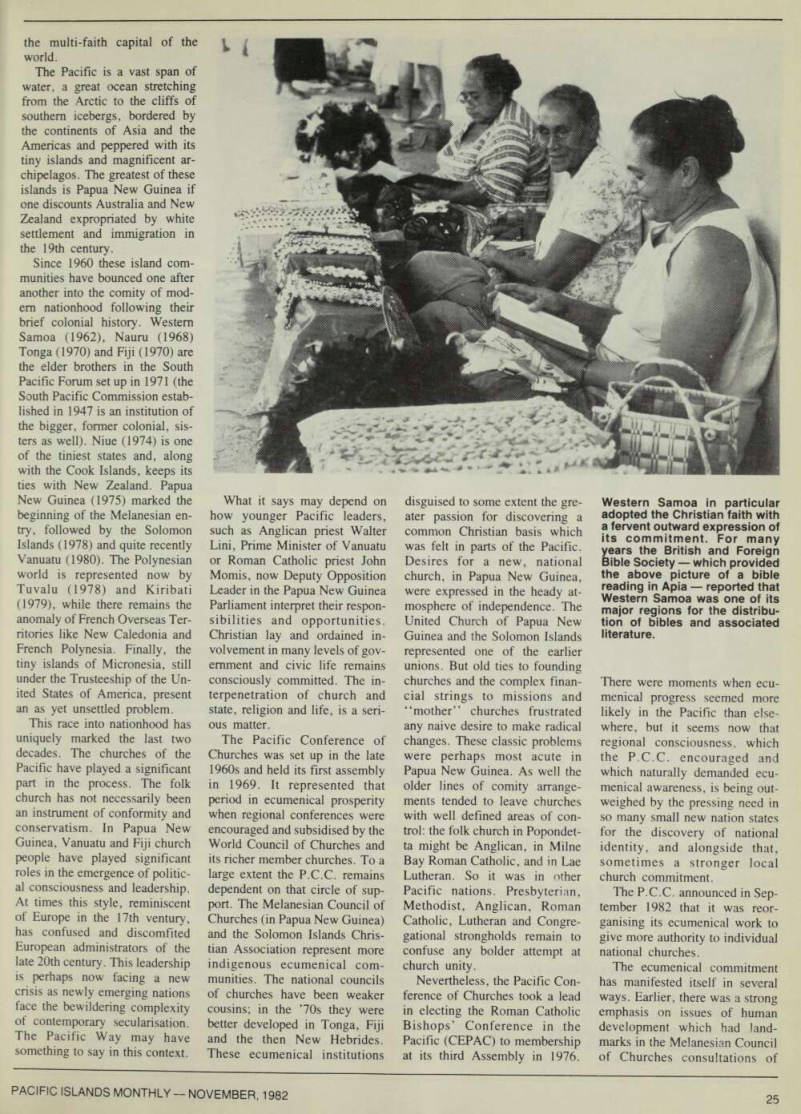
Western Samoa in particular adopted the Christian faith with a fervent outward expression of its commitment. For many years the British and Foreign
Bible Society - which provided
the above picture of a bible
reading in Apia - reported that
Western Samoa was one of its major regions for the distribu tion of bibles and associated literature.
1970 on Society, Development and Peace in Papua New Guinea (SODEPANG), the South Pacific Development Strategy (SPADES) consultation of 1973 in New Hebrides (now Vanuatu), with the program of the same name in the P.C.C., under the leadership of Sitiveni Ratuvili, and the Solomon Islands’ Con ference in 1977 (Pacifique ’77) which possibly marked the apogee of this line of work. A recent smaller conference in Fiji (1981) looked back at these meetings and forward at develop ment, aid and mission for this decade.
Another strong emphasis in the P.C.C. has been on education and family life, which it has supported both institutionally and through consultations. The issue of a nuclear-free Pacific has come into heightened regard since 1976 and the P.C.C. has led in raising critical questions about the role of the U.S.A. in Micronesia. In publishing and printing the P.C.C. through Lotu Pasifika has developed an educa tional program which has consid erable significance. Other prog ram commitments relate to the impact of tourism in Pacific countries and the significance of trans-national corporations.
The P.C.C. has emerged in the short span of 20 years as a major ecumenical force. In that de velopment some personalities have made a particular contribu tion. The first general secretary of the P.C.C., Vavai Toma and his successor Setareki Tuilivoni supported a time of cautious but careful establishment, especially winning the support of member churches themselves beginning
to claim autonomy. The thrust of the P.C.C. into wider social and political issues came under the leadership of the fourth general secretary, Lorini Tevi. Her suc cessor Baiteke Nabetari, took of fice in 1982. The reliable con sensus-giver at many confer ences and meetings has been Dr Sione Amanaki Havea, until re cently Principal of the Pacific Theological College.
In the realm of theological education the ecumenical move ment has again made an impor tant impact in the Pacific. The setting up of the Pacific Theolog ical College in Suva, Fiji, in 1966 meant that a regional col lege, aiming at a higher standard of theological education than had until then been found in smaller, isolated and denominational col leges, provided a new meeting ground for the future pastors of several Pacific churches. Later the Roman Catholic Church’s re gional seminary was established near P.T.C. and there are oppor tunities for collaboration.
Evangelism has been the focus for many fresh movements in the Pacific, often within an ecumen ical context quite apart from the W.C.C. and P.C.C., the ecumenism of evangelical mis sions and fundamentalist teach ings. A number of these move ments have an American origin and there are many quite consid erable establishments, especially in Papua New Guinea. The Mor mons, too, have a big investment in Tonga, the Cook Islands and the Solomon Islands. As well the Charismatic Renewal has ap peared in diverse ways, some times divisive, and is another element in the religious scene.
One cannot avoid making a com parison with that tendency to wards prophetic movements noted earlier. Can the Charismat ic Renewal be the latest Cargo Cult?
Despite the degree of success of the P.C.C. the traditional churches still dominate the Pacif ic scene. Partly because of the historical accident of mission work, partly because of geog raphical isolation and partly be cause of language differences, especially in colonial times, churches seem now to have do minant areas in which they exer cise the function of a folk church.
Congregationalism, from the London Missionary Society, is the hallmark of Samoan and Cook Island Christianity; Methodism sets its mark chiefly in Tonga and Fiji; Roman Catholicism tends to follow the French influence, in Tahiti, New Caledonia, and Vanuatu, as well as the German and Australian presence in Papua New Guinea.
Dutch and American SVD and Marist missionaries have been an additional factor in the growth of Catholicism. The Anglican influ ence is chiefly to be found in Papua New Guinea and the Sol omon Islands as well as in Vanuatu. The Lutheran vein is
strong and localised in Papua New Guinea with its brief experi ence of German colonisation at the end of the 19th century and in the early part of the 20th century.
Church leaders who have in fluenced the events of these last decades include Leslie Boseto, the former Moderator of the Un ited Church of Papua New Guinea and the Solomon Islands.
Boseto has played a role in ecu menical affairs at the internation al level as well.
Bishop Patelisio Finau SM of Tonga has given considerable commitment to ecumenical af fairs on behalf of the Roman Catholic Church.
One of the most ardent spokes men for ecumenism and a pas sionate advocate for develop ment at a human level was Father Patrick Murphy SVD, who was a staff member of P.C.C. when he was tragically killed in a motor accident at the end of 1978.
These, and many others, are contributors to the life and vitali ty of the Pacific churches. These are churches which face many problems common to churches in the wider oecumene, but, at the same time, they are churches facing some very specific problems.
Not the least of these is the future of the Pacific as it be comes a focus for world attention in mineral sea-bed mining, or with a protein crisis provoking an increased demand for fish.
But there is a deep human problem. Still seeking to be rid of the last remnants of colonial ism the peoples of the Pacific also face the eroding threat of neo-colonialism politically and economically. As Francis Bugotu wrote in 1976: “The psychology of neo-colonialism is disguised and often silent. Its strength lies behind clever and effective manipulation and planned role-playing on the part of the colonialist, causing con fused passivity in the minds of the colonised. The ‘light’ of the civilised world preached to the man who lives ‘in darkness’ has become a newly imposed darkness . . .’’
The problem the churches face is whether they collude in this new colonialism which threatens the Third World, or whether, as Pacific churches, they will be partners in liberation and mes sengers of hope.
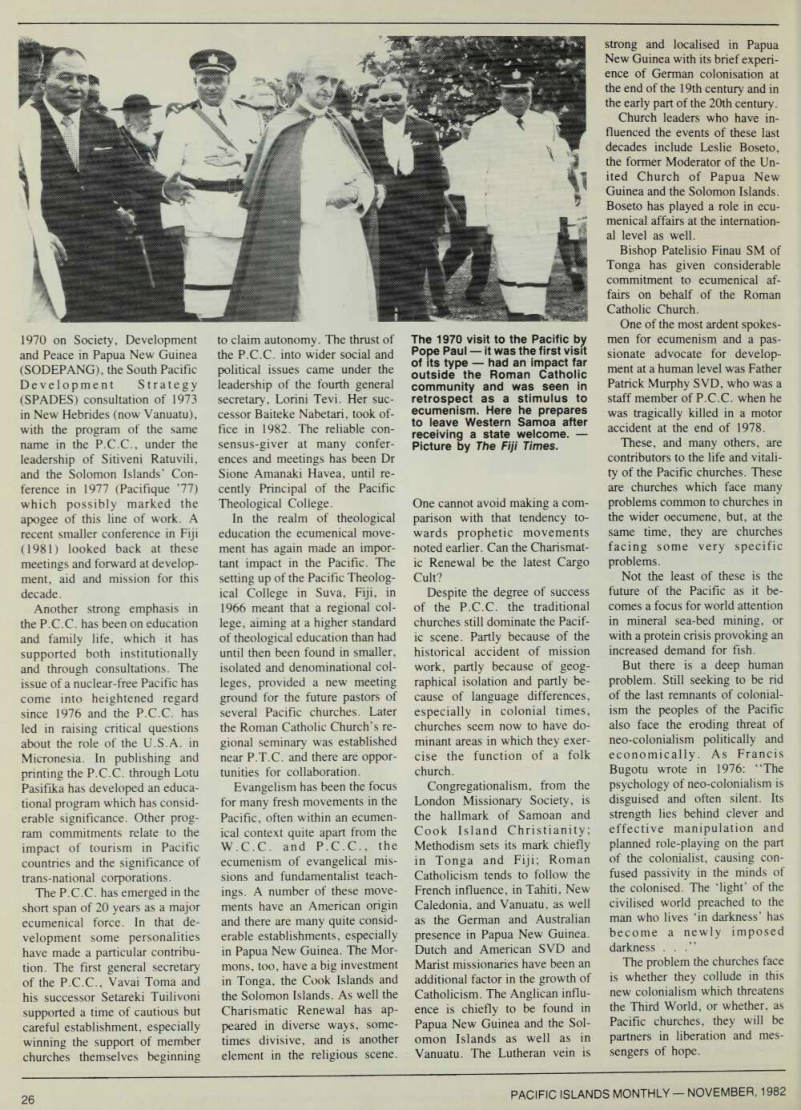
The 1970 visit to the Pacific by Pope Paul - it was the first visit of its type - had an impact far outside the Roman Catholic community and was seen in retrospect as a stimulus to ecumenism. Here he prepares to leave Western Samoa after receiving a state welcome. - Picture by The Fiji Times.