the great oyster breakthrough?
pp. 69-71 · Read in the full issue

Are NZ scientists on brink of the great oyster breakthrough?
Oyster connoisseurs may be in for a great treat in a few years time a new breed of oyster that combines the unique flavor of New Zealand’s rock oyster with the size of the international ly known Pacific oyster.
The genius who has brought about this mouth-watering possi bility is fisheries scientist Dr P. (Mani) Dinamani. He heads the aquaculture group of the Fisheries Research Division of the Ministry of Agriculture and Fisheries at Mahanga Bay hatch ery in Wellington.
Dr Dinamani and his Auck land technician Rob Swind lehurst have succeeded where scientists around the world have failed in crossing mature rock and Pacific oysters.
The result produced larvae which settled down happily as baby oysters, called spat, on empty scallop shells in sea water filled tanks at the hatchery.
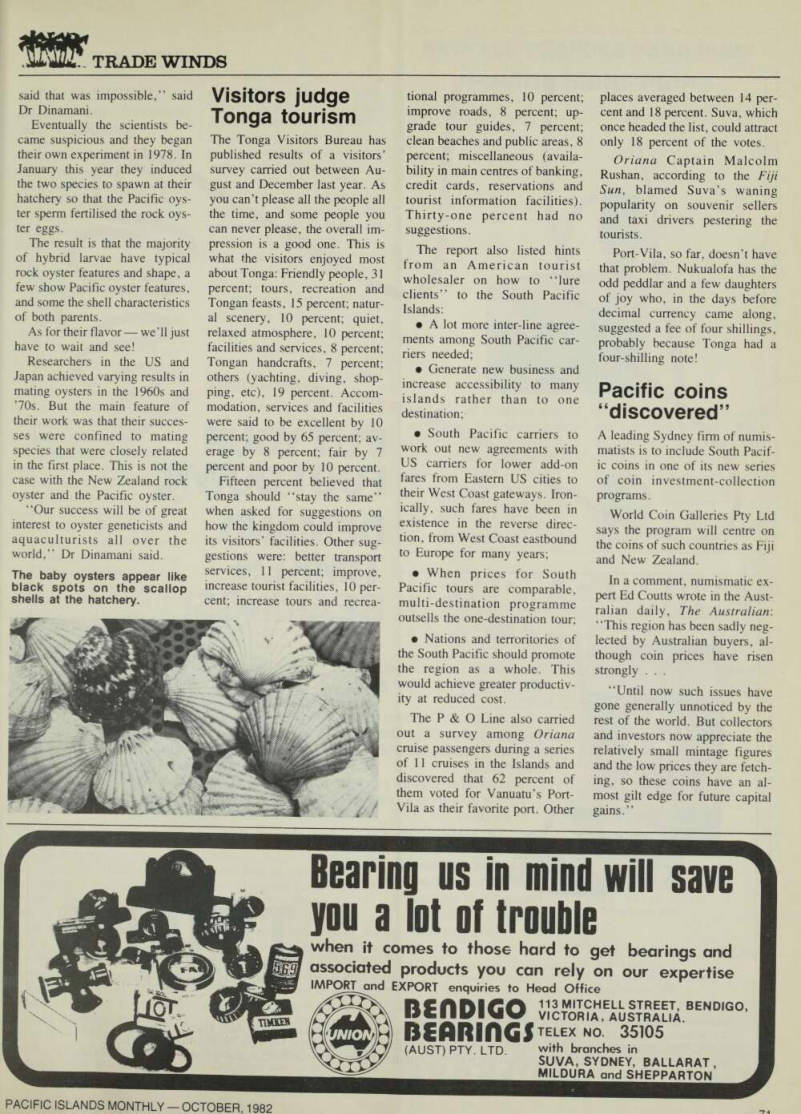
In the early stages of the breeding experiment the spat looked like black specks of mould on the scallop shells.
They gave absolutely no hint of their gastronomic potential as they developed into an as yet unnamed species of oyster.
We suggest they be called the “Mani oyster” in recognition of their foster father Dr Dinamani Mani to all his colleagues who helped to bring them into the world.
This world “first” for the Mahanga Bay hatchery staff in mating the two species success fully reflects the highly technical skills they have developed in recent years. This fortunately coincides with the growing economic importance of New Zealand’s fisheries resources.
The hatchery plans similar lar vae rearing and breeding experi ments with paua (abalone) to help develop that industry.
Meanwhile Dr Dinamani points out that the oyster experi ments are only the first step in a long journey. The next step will be to rear these spat to full size and to determine whether they have become what he calls sexu ally ripe.
If they do, they can then be used as stock for a series of breeding experiments to bring out the best characteristics of both species.
He hopes to establish some pure lines which can be interbred to develop hybrids exhibiting hybrid vigor.
The whole process is much the same as a horticulturalist de veloping a hybrid plant that con tains the best qualities of its parents. But, like all breeding experiments, it takes time.
“It may be a few years from now before the results can be properly assessed,” said Dr Di namani, who is not as impatient as an oyster gourmet to taste the new breed because he never eats oysters.
He is of course a specialist in oysters and he came to New Zealand some 14 years ago from India when the government call ed for scientists to work on oys ter-breeding oysters. The com mercial implications are consid erable for New Zealand if the scientists can develop a breed that will: 1. Combine the unique flavor and keeping qualities of the small rock oysters that take three years to reach market size, with 2. The large, high meat yield of the quick-growing Pacific oys ter which takes only 15 to 18 months to reach market size.
Although the Pacific oyster is grown worldwide, to New Zealanders and Australians who value their identical Sydney rock oyster the taste is bland
and the keeping qualities of the shellfish limited.
The rock oyster needs no pro cessing whatsoever and can be marketed fresh to any part of the world. It can stay fresh in its shell for two to three weeks. The Pacific oyster lasts only two to three days.
The Pacific oyster is an illegal immigrant. It is thought to have arrived on the hulls of ships some 10 years ago and has since spread like wildfire throughout harbors in the North Island of New Zealand.
Now it has spread to the Tas man and Golden Bay areas at the top of the South Island, where
some fishermen worry that it might affect the large local scal lop beds. Its spread has been so phenomenal that it is now endan gering the rock oyster, says Dr Dinamani, who added “so we must tame it”.
He said the reason why New Zealand succeeded in crossing the two oysters when other coun tries like Japan and the United States had failed was because the Pacific oyster had arrived here naturally, it had grown alongside the rock oyster for the past 10 years, and their breeding periods overlapped.
“Farmers suspected for years that the two were crossing but we
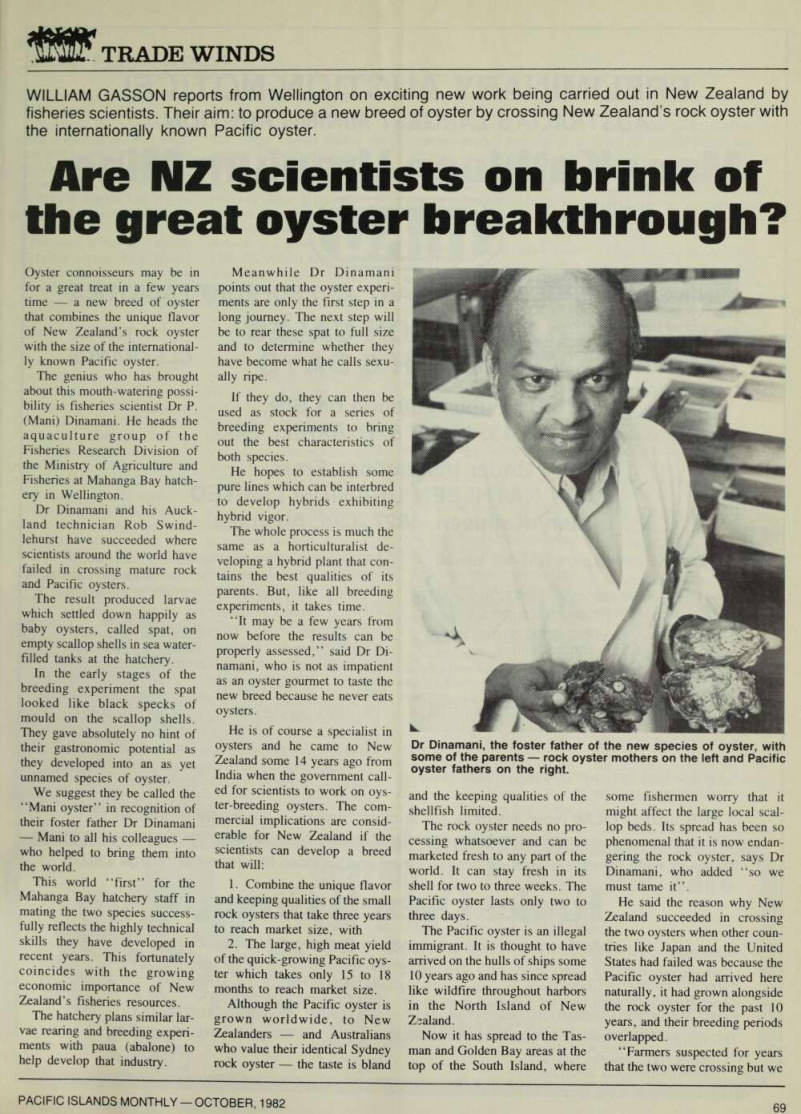
Dr Dinamani, the foster father of the new species of oyster, with some of the parents - rock oyster mothers on the left and Pacific oyster fathers on the right.
said that was impossible,” said Dr Dinamani.
Eventually the scientists be came suspicious and they began their own experiment in 1978. In January this year they induced the two species to spawn at their hatchery so that the Pacific oys ter sperm fertilised the rock oys ter eggs.
The result is that the majority of hybrid larvae have typical rock oyster features and shape, a few show Pacific oyster features, and some the shell characteristics of both parents.
As for their flavor we’ll just have to wait and see!
Researchers in the US and Japan achieved varying results in mating oysters in the 1960 s and ’7os. But the main feature of their work was that their succes ses were confined to mating species that were closely related in the first place. This is not the case with the New Zealand rock oyster and the Pacific oyster.
“Our success will be of great interest to oyster geneticists and aquaculturists all over the world,” Dr Dinamani said.
Visitors judge
Tonga tourism
The Tonga Visitors Bureau has published results of a visitors’ survey carried out between Au gust and December last year. As you can’t please all the people all the time, and some people you can never please, the overall im pression is a good one. This is what the visitors enjoyed most about Tonga: Friendly people, 31 percent; tours, recreation and Tongan feasts, 15 percent; natur al scenery, 10 percent; quiet, relaxed atmosphere, 10 percent; facilities and services, 8 percent; Tongan handcrafts, 7 percent; others (yachting, diving, shop ping, etc), 19 percent. Accom modation, services and facilities were said to be excellent by 10 percent; good by 65 percent; av erage by 8 percent; fair by 7 percent and poor by 10 percent.
Fifteen percent believed that Tonga should “stay the same” when asked for suggestions on how the kingdom could improve its visitors’ facilities. Other sug gestions were; better transport services, 11 percent; improve, increase tourist facilities, 10 per cent; increase tours and recrea-
tional programmes, 10 percent; improve roads, 8 percent; up grade tour guides, 7 percent; clean beaches and public areas, 8 percent; miscellaneous (availa bility in main centres of banking, credit cards, reservations and tourist information facilities).
Thirty-one percent had no suggestions.
The report also listed hints from an American tourist wholesaler on how to “lure clients” to the South Pacific Islands: • A lot more inter-line agree ments among South Pacific car riers needed; • Generate new business and increase accessibility to many islands rather than to one destination; • South Pacific carriers to work out new agreements with US carriers for lower add-on fares from Eastern US cities to their West Coast gateways. Iron ically, such fares have been in existence in the reverse direc tion, from West Coast eastbound to Europe for many years; • When prices for South Pacific tours are comparable, multi-destination programme outsells the one-destination tour; • Nations and terroritories of the South Pacific should promote the region as a whole. This would achieve greater productiv ity at reduced cost.
The P & O Line also carried out a survey among Oriana cruise passengers during a series of 11 cruises in the Islands and discovered that 62 percent of them voted for Vanuatu’s Port- Vila as their favorite port. Other
places averaged between 14 per cent and 18 percent. Suva, which once headed the list, could attract only 18 percent of the votes.
Oriana Captain Malcolm Rushan, according to the Fiji Sun, blamed Suva’s waning popularity on souvenir sellers and taxi drivers pestering the tourists.
Port-Vila, so far, doesn’t have that problem. Nukualofa has the odd peddlar and a few daughters of joy who, in the days before decimal currency came along, suggested a fee of four shillings, probably because Tonga had a
four-shilling note!
Pacific coins
“discovered”
A leading Sydney firm of numis matists is to include South Pacif ic coins in one of its new series of coin investment-collection programs.
World Coin Galleries Pty Ltd says the program will centre on the coins of such countries as Fiji and New Zealand.
In a comment, numismatic ex pert Ed Coutts wrote in the Aust ralian daily. The Australian : “This region has been sadly neg lected by Australian buyers, al though coin prices have risen strongly . . .
“Until now such issues have gone generally unnoticed by the rest of the world. But collectors and investors now appreciate the relatively small mintage figures and the low prices they are fetch ing, so these coins have an al most gilt edge for future capital gains.’’
The baby oysters appear like black spots on the scallop shells at the hatchery.