New Caledonia: Nucci promises
pp. 15-17 · Read in the full issue

new, freer regime by June ’83
HELEN FRASER reports from Noumea on the French Government’s latest plans for the future development of New Caledonia, and on the September 5 by-election made necessary by the resignation and immediate re-nomination for election of Right-wing Deputy to the National Assembly in Paris, Jacques Lafleur.
The French Government has pro mised that there will be a new statute constitution for New Caledonia, probably by June, 1983, and that it will give in creased internal autonomy (self government) to the Territory.
The undertakings were given at a September 9 press confer ence in Noumea, by French High Commissioner Christian Nucci, who had just returned from Paris and talks with President Mitterrand.
Outlining the government’s formula for advance in New Caledonia, Mr Nucci said that the first step had been to estab lish economic, social and judicial reforms designed to “remove in equalities and injustices”. The
first four concerning land, Melanesian culture, economic development and the judicial sys tem will shortly become realities in New Caledonia, fol lowing their approval by the French Cabinet.
A further two reforms con cerning mining and energy would be presented to New Caledonia’s Territorial Assembly before the end of September for advice, Mr Nucci said.
With these reforms in place, the Mitterrand government plans to change the statute for the Territory.
Mr Nucci told the press con ference that President Mitterrand had confirmed during their talks in August “that there would be no solution imposed by France, and that the solution would be the result of a democratic debate and a vote”.
“It will be up to the people of
New Caledonia to say what they want,” Mr Nucci said. He would not enlarge on whether the “de mocratic process” would mean a referendum on independence.
But, with Melanesians forming a minority (43 per cent) in their own land, the question of elec toral reform becomes important.
Mr Roch Pidjot of Union Caledonienne, the largest party in the Independence Front, who is a Deputy to the National As sembly in Paris, has put forward a private member’s bill in the assembly which would limit vot ing rights in New Caledonia to those with 20 or more years residence.
For Jean-Marie Tjibaou, Vice- President of the Government Council, the results of his August talks with President Mitterrand in Paris were unsatisfactory.
He said: “It would be in the interests of all if the government
would say clearly what its calen dar is. Whether their objective is autonomy or independence, it must be in the framework of the economic development of the country.”
When the leader of the anti independence RCPR party, Jac ques Lafleur, resigned his seat as Deputy in June, he said his mo tive was “to let Caledonians have a say about the future”.
The result of the September 5 by-election made necessary by Mr Lafleur’s resignation was 91 per cent of all votes cast for Lafleur, and eight per cent for Noumea lawyer, Michel Jaquet, who is also opposed to independence.
Mr Lafleur, who was assisted in his campaign by Gaullist lead er Jacques Chirac, who came especially from France for the occasion, campaigned strongly against the Mitterrand govern ment’s reforms, and against the rise to power of the Independ ence Front in the Government Council. Mr Lafleur claimed that the coalition between the Front and the FNSC party does not represent the will of the people.
The Independence Front cam
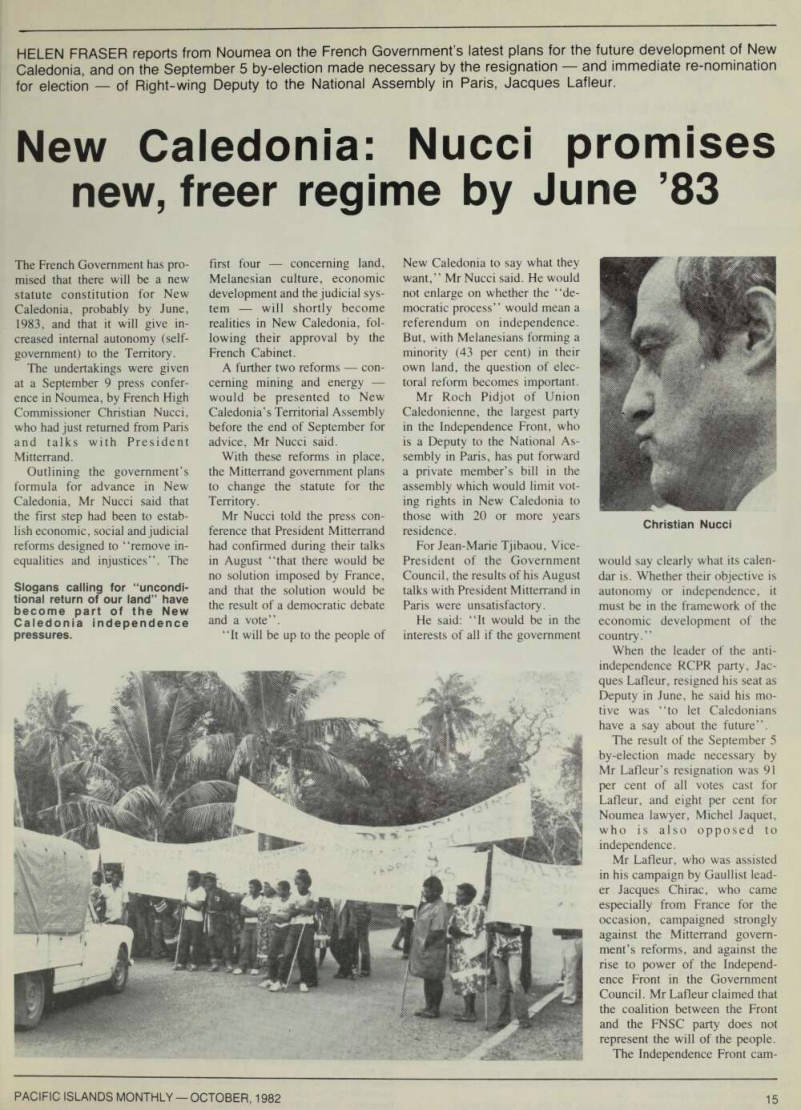
Slogans calling for “uncondi
tional return of our land” have become part of the New
Caledonia independence
pressures.
Christian Nucci
paigned strongly for abstention during the election, saying the only matter on which they would vote was a date for independ ence. As it turned out, the ab stention rate was 46 per cent, with voter tum-out in some all- Melanesian areas being zero. In dependence Front leaders calcu late that only two per cent of Melanesians in Lafleur’s “Noumea and the West’’ consti tuency took part in the vote.
Seventy-five per cent of the population in the electorate is non-Melanesian.
Independentist leader Yeiwene Yeiwene described the election as “a racist vote, a vote against the Kanaks”. He added that he was “more than happy’’ with the level of abstention from the vote.
Jean-Marie Tjibaou said the vote demonstrated the refusal of Europeans to open dialogue with Melanesians.
Speaking in a television debate after the election, Mr Lafleur said that for him the “results were clearly an acknowledgment of the political manipulation be ing practised by the French Gov ernment’’. “It’s now confirm ed,” he said, “that the existing legal majority Independence Front plus FNSC does not represent the realities in the Territory.”
In a satellite interview, a leading spokesman for the French Social ist Party said in Paris that the election result would “accen tuate the cleavages between races, between Kanaks and non- Kanaks”.
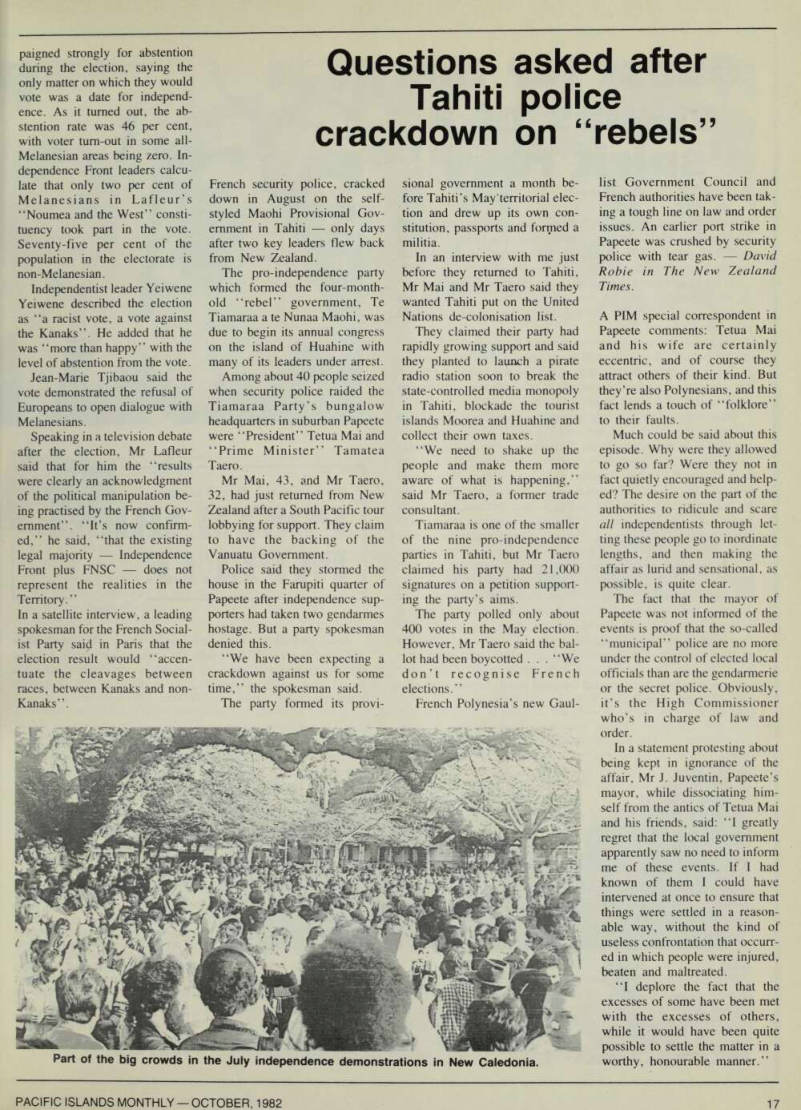
Part of the big crowds in the July independence demonstrations in New Caledonia.