A response
pp. 9-13 · Read in the full issue


Letters
A response to FAF from Niue
I was very interested in the arti cle in which Daniel Tardieu has written of the French-made vehi cle, the Citroen FAF (PIM Jun. p. 49). It relates very closely to what is happening in all the Islands.
It is no different on Niue, one of the smallest island nations in the world. Our island is sur rounded by Tonga, Fiji, Samoa, Tahiti, the Cook Islands, New Zealand and Australia.
From Niue Island (population 3300), people have been drifting to New Zealand and Australia.
There are 12,000 of our people in those countries in 1982.
Our national budget for 1982- 83 is more than SNZ6 million from New Zealand and Aust ralian aid, etc. We are develop ing slowly, but we are developing.
The vehicles we are buying here are Japanese, Suzuki pick ups mainly, and the sale price for such a vehicle new here is $7500. We often buy old pickups from New Zealand that may last three or four years if you’re lucky. Australia’s Holdens eat petrol, which is more than $3 a gallon now.
Our island is supposed to be the biggest uplifted coral island in the world, roughly 29,000 hectares, and about 80 metres above sea level.
Our wharf is now to be de veloped by Australian aid.
Ships call from New Zealand and other islands.
There’s lots of room for de velopment in Niue. Land is cheap. There are good schools and a good hospital, good access roads, and good rainfall.
I would like to discuss this further with Mr Tardieu because I think Niue could be an ideal place for the development of a FAF assembly industry such as he talks of. I was employed by Ford Motors in Auckland for two years working on ignition and chassis parts for Australia.
Much of our recent develop ment, especially in agriculture, has been helped by French aid,
with French experts coming here every now and then.
So if someone could approach our government, or a private company, on the question of starting up this kind of FAF assembly operation in Niue I’d be the first one to make land for
the plant.
I certainly am serious in want ing to know more about this, and look forward to hearing from Mr Tardieu about ways to get it moving.
L. K. Tuhega
P.O. Box 132 Alofi Niue Island
Defending Hilda
Lini (1)
I am surprised that PIM (July p. 10) is stooping to be the vehi cle for character assassination.
the character of the Republic of Vanuatu, and the character of Miss H. Lini, a Vanuatu citizen.
It would be helpful to address an identity in replying to Hilda Lini’s anonymous detractor, but in Vanuatu’s experience such people are often nameless, faceless, gutless little wonders that only come out in the open in mobs.
Hilda has not spoken to the press since joining the South Pacific Commission, most defi nitely not to the New Caledonian press. The truth of the matter is that the New Caledonian press (the Rightwing elements that fanned the Vanuatu rebellion) are going out of their way to make
Hilda’s stay in New Caledonia
unpleasant.
The people who fled Vanuatu in the wake of the Vanuatu re bellion did so on their own voli tion to save their own skins and salve their guilty consciences.
It is sad to note that these people haven’t learnt from that experience. If they want a place to settle at, unjustified attacks on the Republic of Vanuatu are not going to endear them to Vanuatu and printing lies about Hilda in New Caledonia and PIM is the best way to attract Kanaks to her, serving to strengthen the bond between New Caledonian Kanaks and Ni-Vanuatu. In which case if our nameless writer doesn’t hurry up and wake up to the realities of Melanesian polit ics (particularly in New Caledonia) he or she may be hurriedly packing bags and scur rying after a one-way-ticket one more time!
Unfortunately some people just never learn.
Hilda was with the Vanuaaku Pati long enough for Vanuatu to
gain independence, something
her present detractors never dreamed would ever be possible!
Hilda has developed as a per son and progressed in her life.
What has our nameless letter writer done?
I offer Miss Lini my heartiest
congratulations for stumbling on
to the perfect place to work.
Where else would she get instant
recognition and free publicity
promotions while the New Caledonian political climate
heats up?
Mata Moligogona
Luganville Santo Vanuatu
Defending Hilda
Lini (2)
Women have always played an unrecognised role in the develop ment of their countries, so it is not surprising to hear abusive and anonymous comments from Noumea about Miss Hilda Lini.
As an organisation which en couraged and endorsed her appli cation to the South Pacific Com mission, it seems unfortunate to us that persons in Noumea are unable to recognise the important
job Miss Lini has pursued for years in her own country and in the Pacific . . . that of the de velopment of justice and peace for people of the Pacific. She is amply suited for the SPC job with well-proven talents in com munication, a wide knowledge of the Pacific, and great respect from Pacific Island women and women from around the world.
The position of Anglophone
Co-ordinator of the Pacific Wo men’s Resource Bureau moves her round the Pacific where she shares her organisational abilities and gives focus and support to the often forgotten 50 per cent of the population. Clearly, this more important work leaves Miss Lini with little time to campaign against insecure French whose colonial policies have left prob lems which her own country is struggling still to untangle.
Diane Goodwillie
Ofis Blong Ol Meri World YWCA South Pacific Office Nadi Fiji
Pita Fanene knew
James Bond
The death of Pita Fanene Maivia (PIM Aug. p. 73) reminds me that this well-known Samoan sportsman was also in a film that was immensely popular in his own country.
You Only Live Twice, based on lan Fleming’s thriller, featured not only 007, but also Pita Fanene. He played the part of the chauffeur who turned attacker.
Incidentally, this film was on TV in Sydney on the night that the Samoan papers brought news of his death to us here.
Bill Sharpe-Dunn
Westgate NSW Australia
Forum rapped on
New Caledonia
I wish to express my deep con cern over the South Pacific Forum’s stand, resolution and attitude towards the New Caledo nian issue during their last meet ing in Rotorua, New Zealand.
It was both an unbelievable and incomprehensible attitude which showed a total lack of
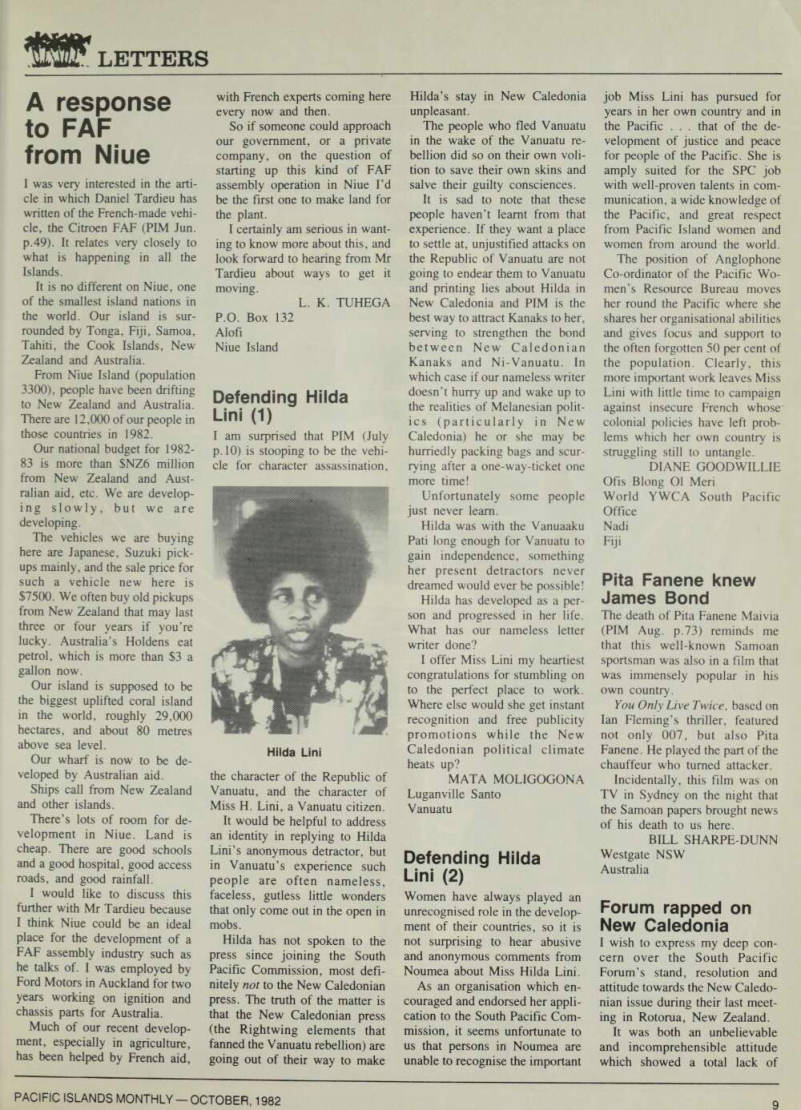
Hilda Lini
understanding of the general
policies of French colonialism, and of the New Caledonian situation.
The attitude taken by the Prime Minister of New Zealand only substantiated his govern ment’s record of a lack of ap preciation of human rights. It was only a year ago that his government approved of a racist South African Rugby team’s visit to New Zealand, which almost caused chaos throughout the country. At the Forum he brand ed New Caledonia’s Kanak Lib eration Front as in the same category as the Palestine Libera tion Organisation (PLO). The Kanak people were never terror ists, and it is attitudes like that of Mr Muldoon that could one day turn them to terrorism if human rights are not respected.
The Forum’s resolution ack nowledging the French Govern ment’s so-called “reforms” is totally contrary to the wishes of the Kanak people. If anyone cares to study the recent history of the Republic of Vanuatu they will find facts and figures reflect ing a policy on the same lines implemented in the former New Hebrides by the French Govern ment. This is particularly so with regard to land. In the late 1960 s and early 1970 s the French ad ministration in the then New Hebrides bought back a lot of land from its nationals to return it to the New Hebrideans (Ni- Vanuatu). The whole policy of land reform as it was then in the New Hebrides, and will be this year in New Caledonia, is de signed to defuse the call for independence. In actual fact the reforms aim to enable the French to strengthen their grip on New Caledonia.
It is a pity that Forum leaders are more than willing to accom modate the French Government’s point of view, but are less willing to listen to the small voice of the Kanak people, the true owners of New Caledonia. The Kanaks are
the only people who can speak
truthfully about the injustices of the French Government committ ed on their lands and their country.
The Forum leaders should have followed the line advocated by Vanuatu Prime Minister
Father Walter Lini and agreed to take the issue before the United Nations Special Committee of 24 on decolonisation, and should also have proposed that France set a deadline for New Caledonia’s independence to be declared no later than December, 1984.
Some of our leaders in the Pacific appear more concerned about sending their soldiers to
the Middle East to take part in so-called peace-keeping forces, which are in actual fact suppres sing the rights of the Palesti nians, than assisting their sup pressed brothers in nearby Pacif ic countries who may one day be of more use to them than all the Arabs and Israelis.
Let’s hope that next time we deal with the French more cauti ously. Vanuatu should be a les son to learn from. French are French and the fact that the pre sent government is Socialist doesn’t make the slightest differ ence. The French colonial policy is always the same, and will remain so in the future.
Clarence Marae
University of Papua New Guinea Port Moresby
Png
The underside of
yachting
Congratulations to Jane deßidder for her succinct story on the “keel” side of yachting (PIM May p 59).
Does PIM have any stories it might print about on-board con ditions of earlier sailing in the Pacific?
Bruce S. Hopping
Laguna Beach, California,
Usa
We’re fossicking. Editor.
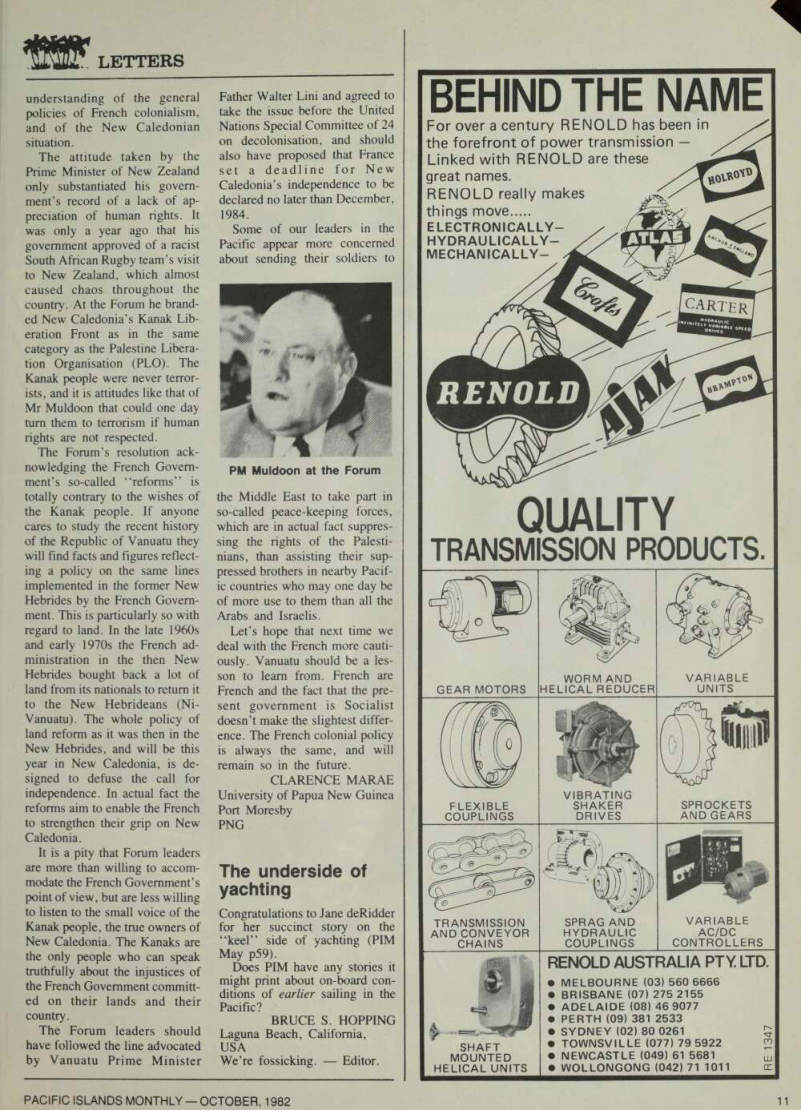
PM Muldoon at the Forum
Tourism and
Gizo
Permit me some comments on your welcome article about Gizo and the Panakera couple (PIM, June, p. 37). My stay in Gizo last year on an academic sabbatical in Oceania was unexpectedly pro longed, and I lived for over a month there with two Peace Corps volunteers. I saw what the private initiative of a dynamic and charming couple, the Panakeras, can accomplish for a sleepy community like Gizo. In deed they are a credit to Solomon Islands.
A matter of some interest to me during the Oceania trip was the issue of open, vs. controlled, vs. closely restricted, tourism.
We are aware, due to our worldwide travels and residences and a permanent home in Flori da, of the positive and negative results of tourism. I think Sol omon Islands, and Gizo Island is a good example, should not be targeted for accelerated tourism.
There are better possibilities for economic stability and progress.
Take the case of the fine beach, mentioned in the PIM article as a tourist attraction
planned by the enterprising cou
ple. It is a beautiful spot, over 16 kilometres from Gizo town. It is next to a local village which has a small primary school on the beach a short walk from the structure earmarked for tourist beach visitors. It is a traditional village. The school which we visited, conversing with teachers and pupils, appeared to us primi tive but with dedicated teachers and students producing admir able results. The impact of an everyday presence of tourists on the village and school cannot be advantageous. Local casual visitors to the islands and resi dents of Gizo town will always, as in the past, visit the beach.
But this will be mainly on weekends or holidays, taking ad vantage of the occasional local transport.
Finally, I somewhat disagree
with your reporter characterizing Gizo town as “not very attrac tive”. We have seen many unat tractive towns all over the world, but Gizo is not one of them. I find Gizo’s waterfront and main
street somewhat untidy, but with a certain charm and a welcome change from the plasticity and
unimaginative global conformity
of most of today’s urban loca tions. Gizo’s modest residential section on the ridge above the centre is most pleasant and has splendid views over the ocean and adjacent islands, including
impressive Kolombangara (and
not forgetting the small atoll where President Kennedy was shipwrecked with his PT boat during World War II).
Charles W. Arnade
Professor of International Studies, University of South Florida, Tampa,
Usa.
“Imperialist”
Usa?
The review by one Dan Boylan of the book Empire Can Wait, the story of the annexation of Hawaii (PIM, June, p. 40) is, indeed, an interesting exercise in wishful thinking, to say the least.
Admittedly, the take-over of Hawaii by our Government had some ethically questionable as pects. However, when Mr Boy lan gets into the general aspect of ‘lmperialism’ his nose appears to be out of joint. Particularly is this true when he discusses Vietnam.
Our government’s intervention in South Vietnam was at the request of that nation’s function ing government, following the invasion by the forces of North Vietnam. This was an action which, incidentally, should have been undertaken by the United Nations, if that pseudo organisation had acted in accord with its own charter.
Had our government intended to take over South Vietnam (and, presumably, the North as well) the war would certainly have been waged in accord with such intentions. Instead, our forces were handicapped by continuous intervention on the part of our political leaders, which resulted in the troops becoming bogged down in half-measures, and frus trating make-believe war actions, which not only doomed their efforts to win victory, but result ed in betraying a friendly people who had trusted our promises.
The thousands of boat-people
who are still fruitlessly looking for a secure sanctuary from the aggression of the “victorious” forces from the North present ample evidence that our initial aims had humanist merit, had they been permitted to succeed.
The 5,000,000 people of South east Asia murdered since the “liberation” of South Vietnam would doubtless wish, if they had the opportunity, that the Un ited States had been a bit more
imperialistic.
I have no idea of the who, what, or where of Dan Boylan, but his general tone of criticism evidences a woeful lack of know ledge of history over the past 40 years. If we (the United States) had had imperialist designs most of the South Pacific might well be living under our government’s
supervision today. During the
early ’4os we had troops in (to name a few of the more promi nent areas) Fiji, Guadalcanal (I was among them), New Georgia (I was among them), New Caledonia (I was among them).
New Guinea, Manus (I was among them), Luzon (I was among them) and others too numerous to detail. Following hostilities we not only left the islands, but left behind enough material and supplies to enable many a local entrepreneur to light out on his own, as a small businessman. I had the opportun ity, during the ’6os, to re-visit many of these localities, and saw this for myself.
Had we harbored ulterior de signs at the time, who would have said us nay? There were no opposing forces to argue with us.
This may be imperialist in Mr Boylan’s vision, but I doubt that he would be able to recruit many followers. As to the Philippines,
your reviewer apparently forgot
(or never learned) that they were given their independence back in 1946. Since that time they have been regulating (for better or worse) their own affairs.
Urban D. Kapler
Phoenix Arizona