A new look, and on the
pp. 59-61 · Read in the full issue
Burns Philp (Png) Ltd
A new look, and on the go for profitable ’Bos
STUART INDER talks to KENNETH HEDDLE, managing director of Burns Philp (PNG) Ltd, about the company’s active planning for diversification and expansion, which, according to Mr Heddle, will ensure the company’s profit growth in 12 to 18 months.
Although overall Pacific Islands trade is in severe recession, and Papua New Guinea is having its toughest year in a decade, Kenneth Heddle is confident, even optimistic, about the fu ture profit growth of the Burns Philp Group. ‘Look at it this way,’ he says from behind his Port Moresby desk. ‘ln almost 100 years of history, the Islands have made a significant contribution to Burns Philp’s success. ‘Now the Islands are in serious recession here in PNG we’ve only just reached the bottom of it, and I think we are going to bump along the bottom for the next 12 to 18 months. ‘But in the meantime, as a result of a very sensible diversification policy, the group has strongly developed its Aus tralian operations and is not so dependent on the Islands. ‘Now, when we in the Islands come out of this recession and start adding to the impact of that steady Australian growth, well, I think you could visualise some most exciting results!’
Kenneth Heddle is 50 and a Scot, originally from Glasgow like the original Philp. He was appointed managing director of Burns Philp (PNG) Ltd 18 months ago after spending the major part of his business ca reer in senior management pos itions in the developing world Latin America, Africa, Middle East, Southeast Asia.
Burns Philp got him from Wilkinson Sword, where for four years he had been regional director Middle East and Africa.
The recession in PNG had only just begun when he arrived he says it really bit savagely from July last year but after
90 years in PNG, Burns Philp’s image and direction were in need of rethinking, and Heddle was invited to do it with full support from the parent com pany in Sydney.
The plantation division, which now reports to Sydney, is to come under his direction too on July 1.
Burns Philp (PNG) has, as Heddle says, made a significant contribution to the group which will celebrate its centenary in 1983. James Burns chose Port Moresby in 1891 for his first branch in the South Pacific by buying, for shares, the pioneer ing Andrew Goldie’s trade store and 50 acres of land.
Burns Philp (PNG) is con siderably bigger than Burns Philp (South Sea), which runs the Fiji, Tonga and Samoa operations. For most of its life it has been the largest company in PNG, and is only surpassed now by Bougainville Copper Ltd.
It employs 5000 people, is 32 percent locally owned (26 per cent held for the PNG Govern ment by the PNG Investment Corporation), with local owner ship projected to rise to 40 percent over the next 18 to 24
months, depending on the state of the market.
Total assets are about KB5 million (about $ All 3 million).
But this figure is expected to drop by about KlO million next year which is a clue to Burns Philp’s new strategy in PNG. ‘We’ve taken stock of what we own and what we want to do, and we have too much of what we don’t need,’ says Mr Heddle. ‘We’re disposing sensibly of the excess so we can concentrate on what we do best automotive, shipping and transport, a grow ing industrial division, and of course our very large merchan dising business, particularly the wholesale.’
Burns Philp is hiving off the small businesses which once earned it the reputation of being a corporate octopus (although Mr Heddle feels that the public has never appreciated just how much BPs has ploughed back into the country in that time).
Picture theatres, liquor tav erns, small retail stores in Bulolo, Wau, Dam, Kokopo and Samarai have been sold or are for sale. The taverns should all have gone by the end of the year. Port Moresby’s old Papuan Theatre has been bought for redevelopment by businessman Hugo Berghuser.
It’s not true any more, if it ever was, that every second commercial site in Port Moresby’s town area is owned by Burns Philp and the others by Steamships Trading Co.
Burns Philp has sold off more than K 2 million’s worth of town property in the last 12 months, and the only significant superfluous block still to be sold is the Port Moresby Hotel the Bottom Pub (to distinguish it from the Papua Hotel, or Top
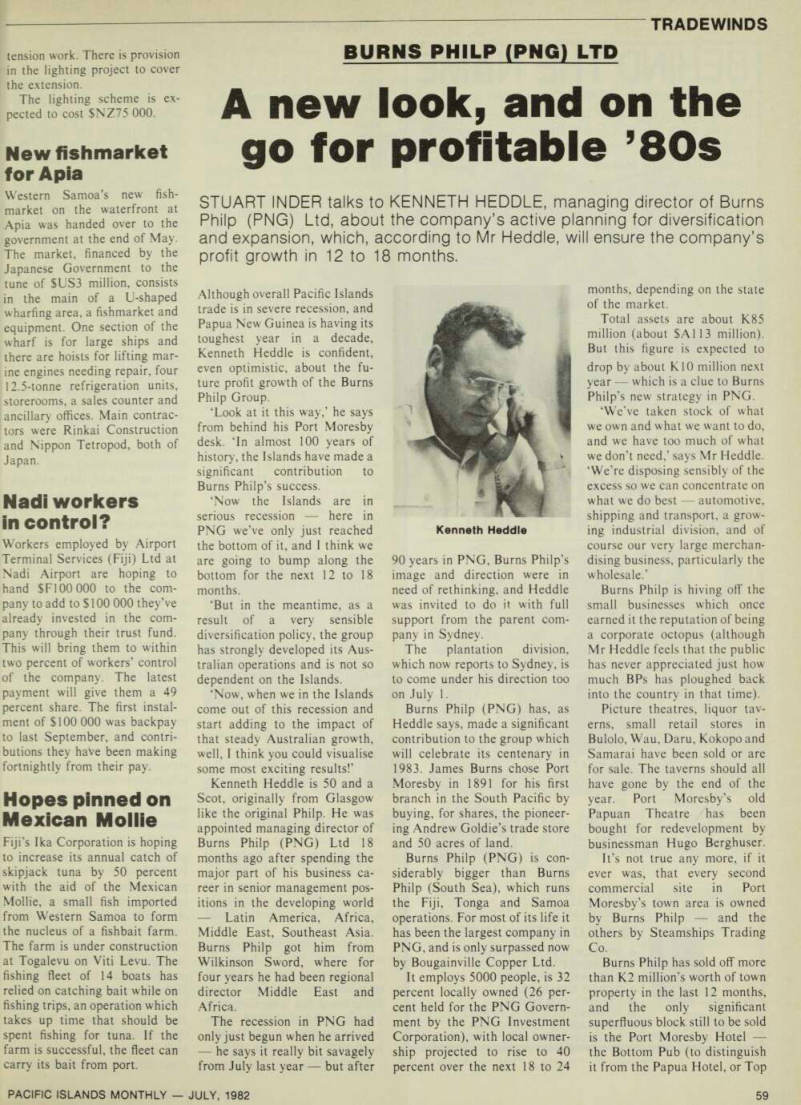
Kenneth Heddle
Pub, also owned by BP). The notorious Snake Pit bar has gone and the pub itself is closed, awaiting redevelopment. It’s a prime site, ideal for an office block. ‘We’re not property devel opers,’ says Mr Heddle.
He’s hopeful that the surplus property can be got into local hands, and is prepared to look at joint ventures. Residential prop erty is not for sale the company can use all it has as part of its policy of upgrading staff quarters.
BP will sell all its small retail outlets. Under recent new laws many types of small businesses will have to be 50 percent locally owned anyway, but Burns Philp sees sense in selling the stores to local businessmen who want to grow bigger. BP’s wholesale division can service a growing chain of retail outlets no matter who owns them its Port Moresby wholesale store, worth more than K 1 million, contains K 5 to K 6 million worth of goods at any one time.
In Australia in the early days Burns Philp based its expansion on wholesale operations, selling many of the goldfields trade stores it acquired to its man agers on condition they con tinued to buy wholesale from the firm.
Burns Philp’s bigger retail stores, which it is retaining, are changing their image too. In the main Port Moresby store, buyers won’t find large stocks of Stuart crystal and Wedgwood pottery as in the old days.
Papua New Guineans now comprise 75 percent of the buying power, says Mr Heddle, and although a growing middle class urban population has the money to buy Wedgwood, and is buying Wedgwood, there is not the need for the same range of stocks now that the expatri ate population is dwindling. ‘We must look to serve our main market, and expatriate ranks will continue to thin,’ said Mr Heddle.
He’s changing the image in other ways. BP buildings are being smartened up and painted in standard colours. The Burns Philp house flag is appearing on vehicles and buildings through out the country, for Mr Heddle looks on it as an image-builder. ‘When I travel I find people
recognise it now, and sometimes even wave,’ he says.
He’s considerably expanded staff training. A fully qualified accountant is looking after com mercial training and eight girls are always in training in the company’s secretarial school. ‘We’ve the best training and development department in the country,’ he says. ‘We’ve taken positive measures to beef it up so we can train citizen staff to be future managers. ‘And we are actively looking for two prominent Papua New Guineans for our board and I don’t mean window-dressing.’
The training of nationals doesn’t mean there are not good opportunities for Australians in the meantime.
Mr Heddle says: ‘We are very keen to attract bright young Australians prepared to adjust to this society for a period of three to four years. They will be given responsibility and auth ority early, and they will get tremendous experience from it, which will stand them in very good stead in their future career development. But they must be young managers interested in helping to develop this country.’
All these changes are aimed at making the company more efficient. For expansion he is looking at the company’s manu facturing base, which is cur rently seven to eight percent of its business. His target is 25 pfercent.
Because of PNG’s unique problems of terrain with a high central mountain barrier on the main island so there is no trans-island road, or any possi bility of one being economically viable for many years Mr Heddle sees great opportunities for small factories. ‘lf there is not the volume of goods from a factory in, say, Port Moresby to support ship ping costs to the other side, then you build another factory on the other side,’ he says. ‘You can establish similar plants in sev eral locations, and instead of having a KlO million turnover in one spot, you have five factories each with a turnover of K 2 million at strategic spots around the country. This devel opment is already happening and, frankly, it’s going to con tinue because of the difficulties
and costs of road building.’
Factories can concentrate usefully on import substitution, such as in the manufacture of bleach, detergent and soap pow der, which he says can be brought into the country in bulk or concentrate, processed, packed in conjunction with the company’s interests in packag ing operations, and distributed through the company’s own distribution network, which is the largest in the country.
Mr Meddle is optimistic in the long term about Burns Philp’s plantation operations, despite substantial losses last year and more losses this year.
The uneconomic units among the company’s 21 PNG plan tations have had to be closed or put on a care and maintenance basis, and hundreds of workers have been laid off. Copra and coffee prices have fallen by half since 1980, cocoa and oil palm by more than 30 percent. ‘We are talking continuously to see what we can do,’ he says. ‘The plantation industry is not dead but it’s flat on its back and the referee has got to a count of eight. We need significant in crease in coconut and cocoa yields plus an increase in area in the main plantations.’
He sees the yield problem being resolved in time with the development of higher yielding hybrids. It can’t be done over night, but he says that Burns Philp will continue to be in volved with primary industry.
Meanwhile he is not despon dent at the effects of the general recession, although it has knocked more than 30 percent off the important automotive industry in the last 12 months, and hit general sales. The re cession is hurting disposable income which, he feels, is strug gling to keep up with inflation. ‘We are having our toughest year, I should think, in the last decade,’ he says. ‘But we are busy streamlining the organis ation, getting it leaner and fitter. ‘Being broadly based we have the organisational and financial strength to weather the storm, and we are preparing now for the emergence from recession in 12 to 18 months. ‘When that happens, we shall be a damn sight better at our job.’