in Tongatapu, Vavau, 8 in Haapai?
pp. 57-59 · Read in the full issue

Trade
Winds
Getting up after Isaac: 2 years in Tongatapu, Vavau, 8 in Haapai?
PENNY HODGKINSON reports from Nukualofa on Tonga’s economic outlook following Cyclone Isaac on March 3 and a second, more localised, cyclone which hit Tongatapu on May 30.
Tonga’s predominantly agricul tural economy could take two full years to recover from the March 3 cyclone disaster. But limited exports of vanilla and sweet potatoes are expected before the end of this year, and it is hoped that manioc and taro will be added to next year’s list.
However, yam and copra ex ports are unlikely to resume before 1984.
This was the forecast made by Director of Agriculture T.
Simiki on May 28 just two days before another severe though more localised cyclone hit the main island, Tongatapu, extensively damaging crops and buildings in the Eastern District which had escaped compara tively unscathed from Cyclone Isaac.
The second blow in both senses of the word will inevitably distort the recovery picture and further delay the agricultural recovery on which Tonga’s economic future de pends so heavily.
Even if Tongatapu and Vavau still manage to swing back to normal within the predicted two-year period, re covery in the central island group of Haapai will be a much longer and more difficult pro cess.
The population there relies almost entirely on subsistence crops, fishing, and copra as a cash-earner. With 50 percent of coconut palms, and most fishing boats and plantation areas de stroyed by Isaac, it could be as much as eight years before the Haapai people struggle back to their pre-cyclone living stan dard.
To speed up the process, the Agriculture Department is already experimenting with the development of alternative cash crops in this area (such as vanilla and black pepper), and seeking the rapid replacement of small boats, fishing gear and cold storage facilities.
Mr Simiki sees copra as the
key income-earner for the fore seeable future, both as an ex port and as the basis for local production of coconut oil, desic cated coconut, and soap, de spite the worrying drop in world prices caused by increased oil palm production in Asia and Papua New Guinea. ‘We haven’t the climate or the area for oil palms,’ he says, ‘so we’ll have to stick with copra and concentrate on increasing nut output per palm.’
Asked about rumours that the new desiccated coconut factory an ultra-modern Australian aid design-and-build project is encountering major problems, Mr Simiki admitted that ‘bugs in the technology’ were causing head aches concerning both quality and quantity of production.
Also, heating by electricity was proving an extremely expensive alternative to the simple, low cost system of burning coconut
husks as used in the old factory.
On the subject of commercial fishing, long a problem in Tonga, the director said the picture was looking consider ably brighter.
The new Japanese-aid tuna vessel Lofa had caught and sold more fish in its first three months of operation than the combined output of previous Fisheries vessels over a full year. This he attributed partly to the excellent equipment and conditions aboard the vessel, and partly to a new system under which captain and crew plan their own operations on a bonus scheme basis that motiv ates them to put in as much time at sea as possible.
On the broad economic front, economists at the Central Plan ning Department say that the 1980-85 Development Plan IV will continue to be im plemented, but will need to be
modified to incorporate re habilitation projects ahead of some planned development pro jects.
The rehabilitation pro gramme will come under the direction of the Disaster Relief Control Office, which is to remain in existence for two years. Most of the programme will be funded from overseas aid money. But it is not yet clear to what extent this will be finance diverted from develop ment projects, as distinct from new supplementary assistance.
The drop in exports and rise
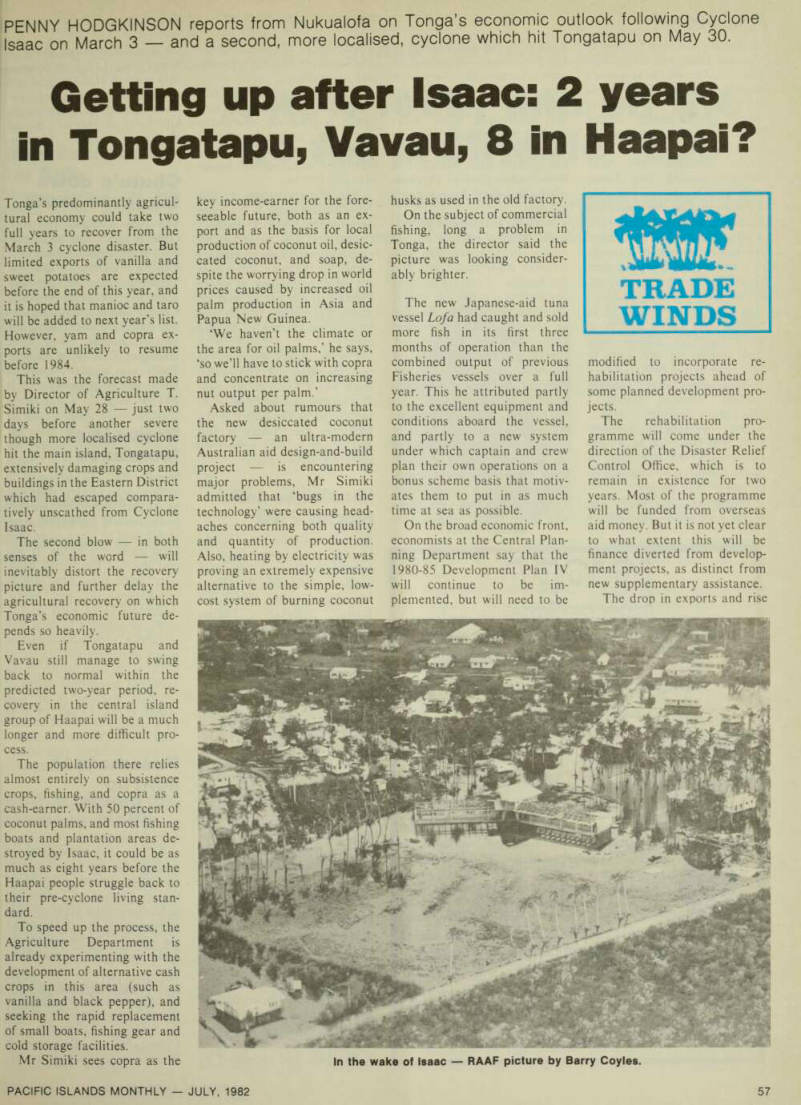
In the wake of Isaac - RAAF picture by Barry Coyles.
in imports as a direct result of Cyclone Isaac will almost certainly exacerbate the kingdom’s already massive visible trade deficit problem, and there are other cyclone-linked factors which are bound to depress the 1982 revenue flow.
For example, all relief supplies coming into Tonga (and to some degree replacing normal imports) are free of the usual port and customs charges.
Again, agricultural extension services to farmers, the supply of tractors and other equipment from the Government machinery pool, etc, are being provided free or at cost, instead of at normal rates. Likewise, fees, at all government schools have been waived for two terms to assist family rehabilitation.
Remittances from Tongans working overseas, always a significant economic factor, swelled dramatically immediately after Isaac, but have since fallen back. At this stage it looks as if the 1982 total will be no higher than average.
Broadly speaking, the private sector does not appear to have
been badly affected. Numerous small Tongan corner-stores were demolished. Very few were insured. However, the larger retail outlets have prob ably received a boost. What damage they suffered was fully insured against, and business has boomed since March 3 as householders flock to purchase what they need to get going again.
Both the private and govern ment building sectors are, of course, hyper-active. The gov ernment construction firm and the handful of private building contractors are flat out coping with the post-cyclone demand for repair and replacement work, and the Ministry of Works’ prefabrication line for manufacturing 2000 cyclone resistant‘core houses’is already in full production, The sharp increase in build ing and agricultural activity in cyclone-ravaged areas has had the incidental benefit of gener ating more jobs, but full em ployment is still a pipe dream in Tonga, particularly for those who leave school with School
Certificate or UE qualifications and search in vain for appropri ate job openings.
The number of families still living in the post-Isaac tent towns is gradually decreasing but a large question mark still hangs over the heads of the hard-core remainder of home less and helpless.
The official attitude, in this Non-Welfare State, is ‘No more help for those who do not help themselves’. This rugged insist ence on the self-help principle is admirable in theory. But it does not solve the problem of where to begin, if one has no land, no home, no money, no job and little or no chance of finding one.
The consensus seems to be that the March 3 kick-in-the teeth was a ST2S million one.
The second cyclone on May 30 has added to the bill, and the problems. But Tonga is still determined to pick herself up again within two years.
‘Business talk’
risk in PNG
Tourists in Papua New Guinea on a 30-day visa are liable to fines or expulsion if they ‘talk business’ with locals. The threat came from Foreign Affairs and Trade Secretary Paulias Matane, who said foreign busi nessmen were entering the country as tourists and then attempting to do business with PNG firms. The National In vestment and Development Authority, which was the legit imate avenue for business nego tiations, would be given daily lists of new arrivals entering on tourist visas. It is understood that the measures are directed, largely, at some Asian business men, particularly from the Philippines, who have proposed ‘get rich quick’ schemes to some of the provincial governments.
Tourism men
honoured
Bartholomew Buchanan, man ager of the Solomon Islands Tourist Authority, and Marae Irata, an administrative officer in the Kiribati Department of Tourism, have been awarded the 1982 scholarships offered by the Pacific Area Travel Association, and sponsored by
the Avis Corporation and Panell Kerr Forster Ltd. Each scholar ship is worth SUS22SO and will cover the cost of attending a six weeks specialised course at the University of Hawaii’s School of Travel Industry Manage ment.
Chute’s down
takeover chute
The New Zealand company.
General Foods, has taken over Fiji’s biggest poultry meat firm, Chute’s Chicken Ltd of Tamavua, but the purchase price has not been disclosed.
Chute’s Chicken has more than 100 staff including farming and process workers. Bob Fyfe, managing director of General Foods, said he plans to open a fried chicken takeaway shop in Suva in July.
Bonuses at
Monasavu
Nearly 500 Fiji construction workers, who will lose their jobs by August when the Monasavu hydro-electric project is com pleted, will be given more than $BOO each as a bonus. It will cost the Fiji Electricity Auth ority more than $142 000 in redundancy pay and bonus.
According to an FEA spokes man, the payment to each man includes a ‘generous completion bonus’ averaging $292 in recog nition of the high quality of the work and completion ahead of schedule resulting in an esti mated saving to the FEA of $1.2 million.
Fuaamotu to
light up
Runway lighting is to be in stalled at Tonga’s international airport this year.
A New Zealand bilateral aid project, the work will enable Fuaamotu airport, situated on the main island of Tongatapu, to handle regular night services by jet aircraft. It will also make the airport safer for emergency flights during the hours of dark ness.
Although the equipment has all been ordered, installation is affected by a proposal to extend the runway by 120 metres. The United Nations Development Programme is funding the ex
tension work. There is provision in the lighting project to cover the extension.
The lighting scheme is ex pected to cost SNZ7S 000.
New fishmarket
for Apia
Western Samoa’s new fish market on the waterfront at Apia was handed over to the government at the end of May.
The market, financed by the Japanese Government to the tune of SUS 3 million, consists in the main of a U-shaped wharfing area, a fishmarket and equipment. One section of the wharf is for large ships and there are hoists for lifting mar ine engines needing repair, four 12.5-tonne refrigeration units, storerooms, a sales counter and ancillary offices. Main contrac tors were Rinkai Construction and Nippon Tetropod, both of Japan.
Nadi workers
in control?
Workers employed by Airport Terminal Services (Fiji) Ltd at Nadi Airport are hoping to hand SFIOOOOO to the com pany to add to $lOO 000 they’ve already invested in the com pany through their trust fund.
This will bring them to within two percent of workers’ control of the company. The latest payment will give them a 49 percent share. The first instal ment of $lOO 000 was backpay to last September, and contri butions they have been making fortnightly from their pay.
Hopes pinned on
Mexican Mollie
Fiji’s Ika Corporation is hoping to increase its annual catch of skipjack tuna by 50 percent with the aid of the Mexican Mollie, a small fish imported from Western Samoa to form the nucleus of a fishbait farm.
The farm is under construction at Togalevu on Viti Levu. The fishing fleet of 14 boats has relied on catching bait while on fishing trips, an operation which takes up time that should be spent fishing for tuna. If the farm is successful, the fleet can carry its bait from port.