Australia and the Free French:
pp. 51-53 · Read in the full issue
Books
New Caledonia 1940-42
Australia and the Free French: A difficult but fruitful union
The Cross of Lorraine in the South Pacific Australia and the Free French Movement 1940-1942. By John Lawrey.
Published by the Journal of Pacific History, Canberra, 1982. vii 142 pp. 5A8.50. ISBN 0 99595477 1 I.
As a young man in the period 1940-43 John Lawrey spent more than two years in Noumea as assistant to B. C. Ballard, the Australian Government rep resentative there. He therefore witnessed, and sometimes took part in, events described in this book.
But he writes: T have striven... to keep fallible memory in its proper, subordi nate place; the account now given is founded essentially on the extensive documentation now available to researchers in the Australian, British and United States archives, and on such trustworthy French sources as I found accessible despite the 50-year rule still applied to French official re cords.’
He is as good as his word. His text is practically devoid of personal reminiscences, but ref erences to his sources, together with a good index, occupy almost 20 pages at the back of the book.
With a lifetime of writing serious reports on serious mat ters behind him (he has served as Australian ambassador to countries as significant as Spain, Egypt and the USSR), John Lawrey excels at sticking to his theme which, in his own words, is ‘to set the develop ment of the Free French move ment, and Australia’s co operation with it, in the context of the contemporary political and strategic situation’. This he does in a masterly manner, disentangling the thread of his narrative unerringly from the vast mass of material before him.
It must be said, however, that his method has the defects of its
qualities. The nub of his subject is the circumstances in which the Free French movement pre vailed in New Caledonia in September, 1940, the role played by Australia in these events, and their enormously beneficial effects on Allied for tunes in the Pacific War which broke out in December, 1941.
He pursues this theme with such single-mindedness that, for example, Tahiti’s adherence to the Free French cause is re ferred to in a single phrase. A few paragraphs on what hap pened in Tahiti, and why, would surely not have been out of place. Likewise ‘the lamentable battle of Oran’ (which resulted in victory for the Vichy forces who held this Algerian city until it fell to the Allies in November, 1942) is referred to only in the five words quoted above, as if all Mr Lawrey’s readers are as steeped in the history of World War II as he undoubtedly is.
There are other, similar examples.
But these points seem not much more than quibbles when set against the dignity and authority of Lawrey’s text as a whole.
The book opens with a no tably humane and sensitive account of the French conquest of New Caledonia from 1853 onwards, the nature of the society implanted there (with particular reference to the pernicious effects of the penal colony system), and the fate of the indigenous Melanesian population.
He provides a vivid account of the utter confusion reigning in the colony following the fall of France in June 1940, the generally pusillanimous behav iour of local French officialdom, the trifling impact made at first by de Gaulle’s call to resistance from his base in London, and then the gradual emergence, especially in ‘the bush’ outside Noumea, of a popular ground swell of support among French settlers for de Gaulle and the
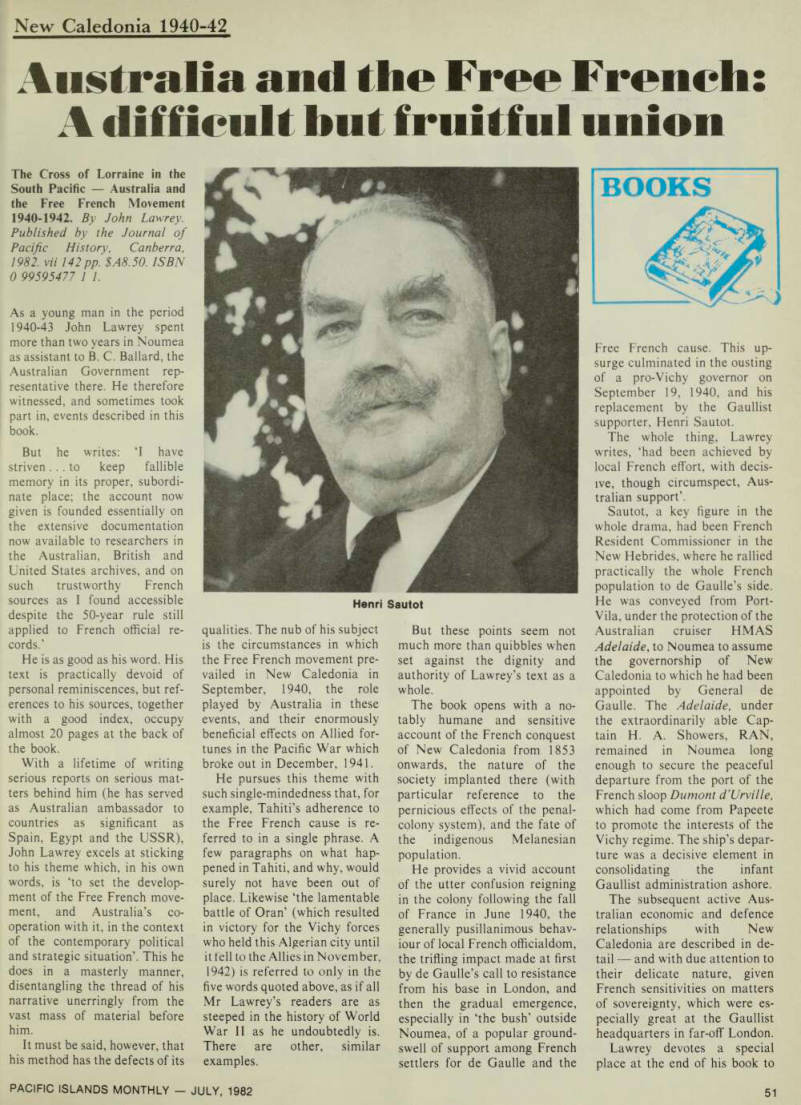
Free French cause. This up surge culminated in the ousting of a pro-Vichy governor on September 19, 1940, and his replacement by the Gaullist supporter, Henri Sautot.
The whole thing, Lawrey writes, ‘had been achieved by local French effort, with decis ive, though circumspect, Aus
tralian support’.
Sautot, a key figure in the whole drama, had been French Resident Commissioner in the New Hebrides, where he rallied practically the whole French population to de Gaulle’s side.
He was conveyed from Port- Vila, under the protection of the Australian cruiser HMAS Adelaide , to Noumea to assume the governorship of New Caledonia to which he had been appointed by General de Gaulle. The Adelaide, under the extraordinarily able Cap tain H. A. Showers, RAN, remained in Noumea long enough to secure the peaceful departure from the port of the French sloop Dumont d’Urville, which had come from Papeete to promote the interests of the Vichy regime. The ship’s depar ture was a decisive element in consolidating the infant Gaullist administration ashore.
The subsequent active Aus tralian economic and defence relationships with New Caledonia are described in de tail and with due attention to their delicate nature, given French sensitivities on matters of sovereignty, which were es pecially great at the Gaullist headquarters in far-off London.
Lawrey devotes a special place at the end of his book to
Henri Sautot
the work in New Caledonia in 1941-42 of the Australian army’s No. 3 Independent Company, a small guerrilla unit of about 300 men. They rep resented the only Australian force available to strengthen New Caledonia’s defence fol lowing the outbreak of the Pacific War, and did remark ably effective work until they were withdrawn after US forces had arrived in strength.
Lawrey’s bias always most discreetly expressed, it must be said is understandably in the direction of a favourable ap praisal of Australian official actions. But he is far from blind to the contemporary realities.
He frankly acknowledges that the involvement of the Adelaide in New Caledonia came about as the result of British urging.
Giving full personal credit to the then Australian Prime Min ister R. G. Menzies for acced ing to British appeals concern ing the Adelaide, and for the general policy of Australian co operation with the Free French movement, he nevertheless writes: Australia at this time was in a quasi colonial situation, locked firmly and voluntarily into the British imperial system. Rather than a foreign policy of its own it had a recognised but sparingly exercised right to comment on the policies developed by the United King dom on behalf of the empire as a whole.
In war even more than in peace Austra lian policies had to be harmonised with those of the United Kingdom.
The events of 1940 paved the way directly for the massive
American military presence in New Caledonia, which was the pre-condition for victory in the decisive battle for Guadalcanal in 1942. Lawrey quotes the American naval historian S. E.
Morison on the Guadalcanal battle; ‘The nerve center of this campaign was not ... at Wash ington or Pearl Harbor, but at Noumea, where Admiral Halsey and his chief of staff. .. with about 15 seasoned staff officers and 50 blue-jackets ran the entire South Pacific Force of Navy, Army, Marine Corps. .
Lawrey’s concluding para graph pulls his whole story together in typically authoritat ive fashion; . . . Without straying unduly into the realm of conjecture it is possible to reflect on the complications that would have arisen if a Vichy regime, destined inevitably to toe the Japanese line, had been allowed to take hold in the South Seas. In 1940 the ralliement of New Caledonia had been a close-run thing, but fortune had favoured the brave and skilful. One of Australia’s first genuine foreign policy decisions had been forced on it, with the happiest results, but the harmonious merging of this modest beginning into the great events of 1942-45 should not obscure the fact that the successful execution of Menzies’ bold decision to co-operate with the Free French was the achievement of a tiny group of men on the ground Australian, British and French. In this corner of the world Allied co-operation was a reality and, whatever may be thought of New Caledonia’s history as a French colony, no man of goodwill can fail to rejoice in that, nor in the way thus prepared for the territory’s reunion with a liberated France.
One startling new fact learned by this reviewer from Lawrey’s book is that the warm and engaging character, Sautot, after having been arrested and
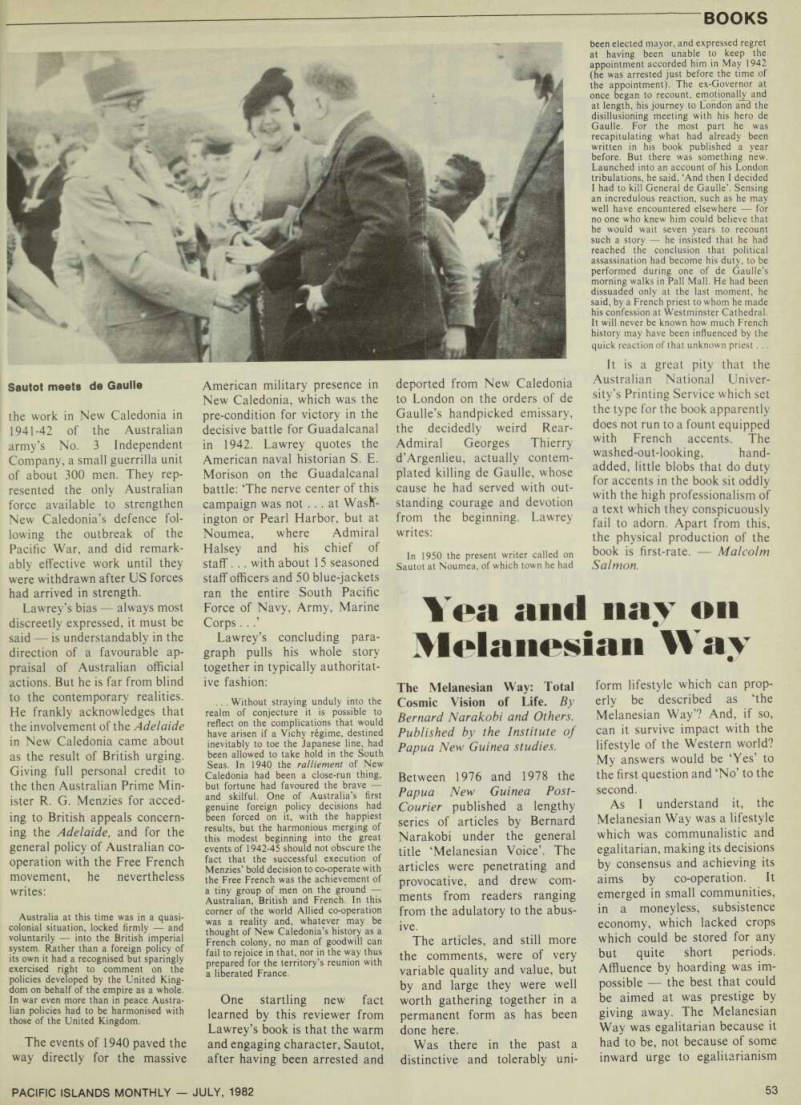
deported from New Caledonia to London on the orders of de Gaulle’s handpicked emissary, the decidedly weird Rear- Admiral Georges Thierry d’Argenlieu, actually contem plated killing de Gaulle, whose cause he had served with out standing courage and devotion from the beginning. Lawrey writes: In 1950 the present writer called on Sautot at Noumea, of which town he had
been elected mayor, and expressed regret at having been unable to keep the appointment accorded him in May 1942 (he was arrested just before the time of the appointment). The ex-Governor at once began to recount, emotionally and at length, his journey to London and the disillusioning meeting with his hero de Gaulle. For the most part he was recapitulating what had already been written in his book published a year before. But there was something new.
Launched into an account of his London tribulations, he said, ‘And then I decided I had to kill General de Gaulle’. Sensing an incredulous reaction, such as he may well have encountered elsewhere for no one who knew him could believe that he would wait seven years to recount such a story he insisted that he had reached the conclusion that political assassination had become his duty, to be performed during one of de Gaulle’s morning walks in Pall Mall. He had been dissuaded only at the last moment, he said, by a French priest to whom he made his confession at Westminster Cathedral.
It will never be known how much French history may have been influenced by the quick reaction of that unknown priest. . .
It is a great pity that the
Australian National Univer
sity’s Printing Service which set
the type for the book apparently
does not run to a fount equipped with French accents. The
washed-out-looking, hand
added, little blobs that do duty for accents in the book sit oddly
with the high professionalism of
a text which they conspicuously
fail to adorn. Apart from this,
the physical production of the
book is first-rate.
Malcolm
Salmon.
Sautot meets de Gaulle