To the far north, for the stories of Corlette
pp. 47-50 · Read in the full issue

Corlette, and of ill-fated Mazoyer
Yesterday
E. A. HARVEY concludes his four-part series on a 1938 journey through the then New Hebrides on the inter-island trading vessel Mirani. This time he continues his exploration of the islands in the north of the Group, meeting as usual some thoroughly memorable characters on the way.
The following day we proceeded on to the small islands of Rano, Ouala and Atchin. We arrived at Atchin at sunset and went ashore, our Boys lustily singing their plaintive songs. The Chief, Willy, and the whole village were drawn up between their beached canoes to welcome us.
The island is free from fever and flourishing. No whites live here. It is hard to realise that Rano, Ouala and Atchin are hard by the northwest coast of Malekula. The atmosphere here is so different.
The Chief trades the copra on behalf of his people. They are a co-op, as it were. There are a few native teachers here, but no white missionaries. The Atchinites seem to be too much for them.
Willy ordered a guide to show us the old dancing grounds. A track led to a broad, winding avenue flanked by low coral walls. Great trees met over head. We went on for about 20 minutes, and found the avenue opened on to an oval. Here were two rounded stones, covered in moss and at least 10 feet high, like the halves of two huge eggs.
Near these were heavy stone slabs. We were told: ‘Some stones belong water, some stones belong salt water.’
This oval gave on to a long elliptical clearing. On one side were thatched and woven huts, smallish and rubbing shoulders with each other. The front of the ridge poles ran off into beautifully carved frigate birds with a wingspread of about eleven feet. Their immense wings gave one the odd feeling that they were about to take off, like moulting and dilapidated fowl. The doorposts were huge upright slabs of stone with grotesque inscribed heads. The strange huts stood close together in a long line, which was broken by a large banyan trunk and some 12-feet high tam-tams. In front of the huts were what appeared to be slab seats. The visual effect in the
torchlight and dappled moon beams was really weird.
On the opposite side of the ellipse were rows of stones innumerable. Each one, the guide said, represented a pig. (I wonder if he meant long pig!) At a point one third down the long axis were two upright stakes, close together and rubbed smooth. Twenty feet high, they were. Two-thirds of the way down the axis was a circle of stakes. The men who constructed this were no mean artists. What wild stamping had gone on there, and by whom?
The guide could only tell us: ‘A long, long, long, long, long, long, time Master, me no savvee.
Father belong me no savvee, long time.’ He drew his ‘longs’ out into a long note and held it.
He ‘no savvee’. We saw a 30-foot canoe with a frigate bird figurehead, and smaller canoes with pigeon heads upon their bows. Here I was able to procure a pig’s skull: ‘One head belong earth’, and a club which had been blooded: ‘Five men, Master, my Word!’ Maurice
informed the stately native that he was ‘a bloody liar’. However, I got a fine old war club for three shillings, thanks to Maurice’s bargaining.
After the Chief had finished weighing the copra, he in formed us that the club really had killed men. We were anxious to know that, blood thirsty blighters that we are.
Unfortunately we leave Atchin at 3am and arrive at Bushman’s Bay again at 6.30 am.
Maurice, Les Love and I got away early. After a really tough bush walk, we were met by Margaret Corlette, our host’s daughter. She is a beautiful and charming girl and speaks English perfectly. Her skin is the colour of honey, and she wore red and white flowers in her dark, warm hair. She listened to our adventures and congratulated us on our bushmanship, exclaiming, ‘By Jove!’, in a low, attractive voice.
Her father is a fascinating and most erudite gentleman. He is a member of a distinguished
family and has lived in the New Hebrides for 35 years. He is a man of humour and great hu manity. After long years of research he has collected a vast amount of data on the New Hebrides Group. The British Museum has consulted him, and other men who have written books on the Group have been greatly aided by his notes.
I listened spellbound as he told us about the New Hebridean people. He ex plained to us the two great cultural divisions, and the pos ition of the geographical line that divided them.
There is the matrilineal north, with their non circumcision and mat skirts, and the patrilineal south, with their circumcision, grass skirts
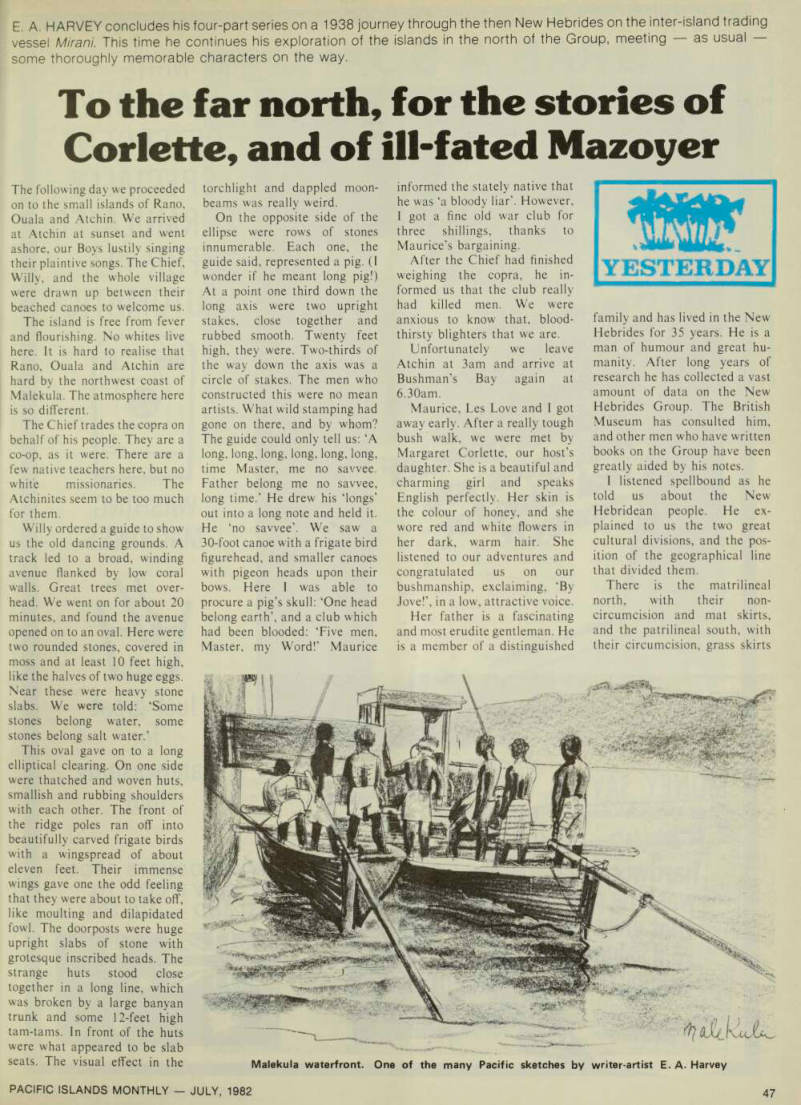
Malekula waterfront. One of the many Pacific sketches by writer-artist E. A. Harvey
and debased women. He spoke of their complex marriage sys tem, and their religion, which seems akin to primitive spiri tualism.
North Malekula is the only place in the Group where canni balism is still practised. Aoba was considered to be the most notorious of the cannibal isles in its heyday. A regular traffic in victims was carried on. This was still within the memory of older men.
I learnt that it would be quite safe to travel alone from coast to coast right across Malekula.
A Namba village would give you food and overnight accom modation and send you on to the next village, which in turn would pass you on until you had reached your destination. If you wanted to stay for a day they would understand, the journey could be tiring or maybe you were sick.
But if you were an anthropol ogist, or just a sticky-beak, and stayed on and on asking all sorts of questions, even about their sex habits, the hosts would become very suspicious. One day you would be hurrying to bring your notes up to date and passing one of the village men.
Death would come upon you unawares and instantly with one blow to the back of your head with a club. The outside world would never know what hap pened,, you had simply disap peared.
The conversation turned to the influence of the Missions. It is said that a story loses nothing in the telling with Corlette. The following one deserves to be repeated ... A churchman of high rank was dismissed from Melanesia for offences against boys. Corlette insisted the cir cumstances were as follows. A certain trader imported can tharides, thinking he would do a good trade because the natives are partial to home-grown aphrodisiacs. The cantharides arrived unground, so the trader, with considerable cheek, bor rowed the churchman’s coffee grinder and returned it un cleaned. The Mission Boy ground the good man’s coffee through it ... The point is taken.
Corlette told a good cannibal story too. It came from native sources originally and is one of
the stock yarns of the Group. A gentleman was gnawing away at a forearm, and catching a sinew from the wrist in his teeth he reefed at it the cooked hand closed quickly and scratched his face.
Sometimes unwanted chil dren on the island are left to starve. Often they are found by Corlette, who brings them up.
He showed us the latest arrival, a baby girl about four months old, and weighing five pounds.
Corlette is feeding her on milk and olive oil. When he first got her six weeks before she was only half the size and covered in sores and flies. Our host is a great favourite with the shy piccaninnies.
Towards sunset Margaret took us for a walk to see her garden of crotons. The walk led us through tomatoes, wild chillies, yams, pineapple, ba nanas and grenadilla vines. Oc casionally we passed coffee trees. Upon returning we were more than ready for high tea.
There was to be a big ‘danis’ that night. In the meantime a girl amused herself and us by making intricate patterns with a circle of string. She twirled it round her fingers with extra ordinary speed and with a marvellous variety of weave.
Our enjoyment of the ‘danis’ was interrupted by the Mate,
who had been sent to round us up. The ship was supposed to sail at 10pm. Not a hope. Back on board we found La Fleur tight, and what a nuisance.
It is very late now, or early if you wish. Mirani has cleared Bushman’s Bay and is on a nor’ by nor’westerly course for the Canale du Segond. Fare thee well, unforgettable Malekula. • • • The Canale du Segond is 20-odd miles of winding chan nel formed by the Island of Acre and a good half of the south coast of neighbouring Santo. Half way along is the Santo town of Luganville. I say ‘town’ because there is a French hospital and residence there.
The whole district is very decid edly French. As usual our Supers knew where to go, a cafe-cum-grog shop, run by a big, good-humoured woman who knew what’s what.
Concluding our business here, the ship moved on to Baldwin Cove on Santo. We anchored in a lagoon with a maze of small islands hard by.
Winding lanes of water me andered between them. The sea was like shimmering satin, and far away a slash of white proclaimed the reef. The British District Agent came aboard to say ‘Hullo’.
Once more winding up our business, we moved down the channel to the wealthy Seventh day Adventist Mission, ‘Fella him eat grass no more’. Then on down the Bruat Strait between Acre and the bigger island of Malo. This waterway is full of reefs and has a seven-knot tide.
The insurance companies will not cover an accident in this channel. We bring up at Bay Benia and it is as hot as hell.
I suppose it would be about 4pm when a launch approached the Mirani. I was being shown how to handle a sextant and was bringing the sun down to the horizon. The planter came aboard and eventually was in troduced to me. He took my hand in an iron grip, and said he noticed me from the launch and thought: ‘Monsieur has never handled a sextant in his life before.’ He was M’sieur Paul Mazoyer, a tall, powerfully built, French colonial, with a slight stumble in his walk.
During the War he had served in France. We hit it off well together and he invited me ashore for dinner. Maurice was to follow later. We went fishing together in the quiet of the afternoon. My friend threw a hand net with great accuracy and silence and caught a huge quantity of sardines.
He showed me a 42-foot
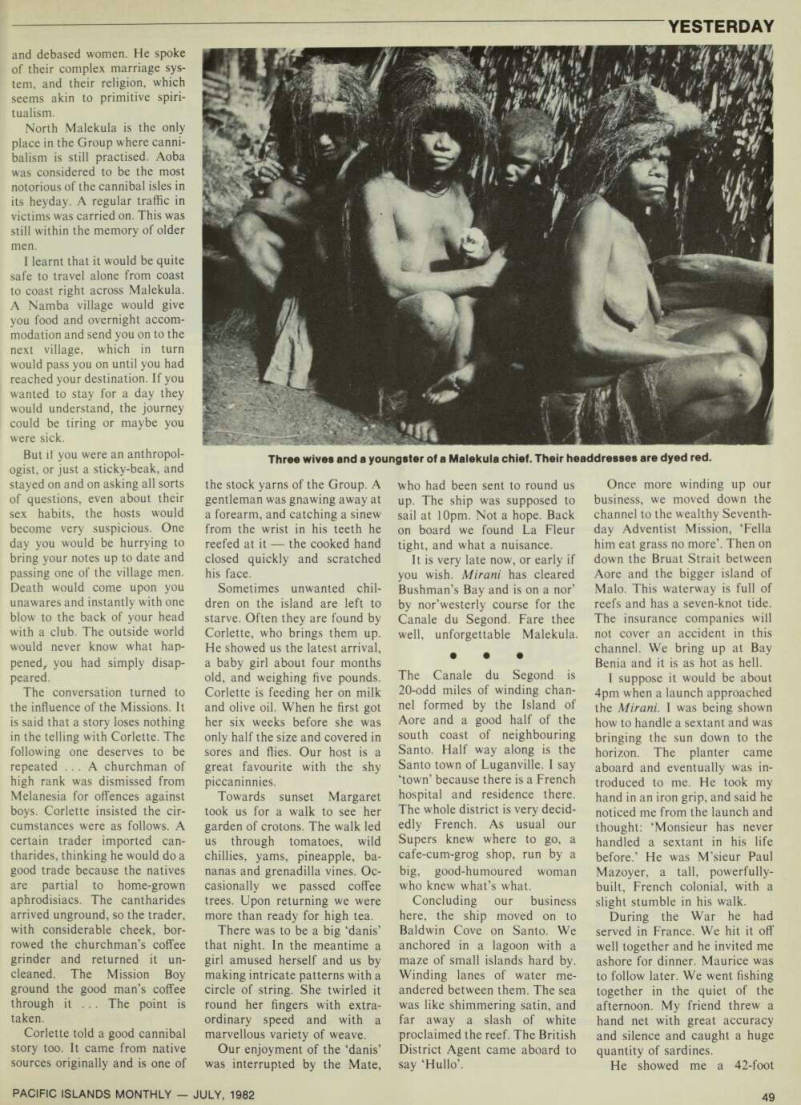
Three wives and a youngster of a Malekula chief. Their headdresses are dyed red.
ketch he was building. It hadn’t the lines of a shipwright’s job he said he was a seaman, not a carpenter. One had to learn to do everything in the islands. He was sure it would be seaworthy.
The wood came from his own teak trees that he had felled.
In his dealings with his workers he claimed to be a hard man but just. Dishonesty from anyone he would not tolerate. A short while before he had trouble with a Tonkinese cook.
Matters came to a head and the cook took off at top speed.
Mazoyer rushed for his gun and fired at the fleeing figure. De pending on the way you look at it, the cook was lucky, or unlucky, to lose only one of his balls. Mazoyer has a thousand acres here and exports the best cocoa to Marseilles.
Once more I enjoyed the fine island hospitality. Mazoyer is a man in his late 40s with a wild history. Now, on his own hearth, nursing his cat, he is a kindly and interesting host.
It was near midnight when the two plantation Boys rowed Maurice and me to the ship.
Across the dark lagoon came the strains of Mazoyer’s bugle farewelling us. The last call at night: ‘Extinguish all lights.’
It was barely 18 months later that I was shocked to get word from friends that Paul Mazoyer, anchored in a remote bay in north-western Malekula, had his fine little ketch sud denly surrounded by hostile war canoes. Mazoyer and his crew died bloodily, exacting a heavy toll from their attackers.
The next weeks were spent
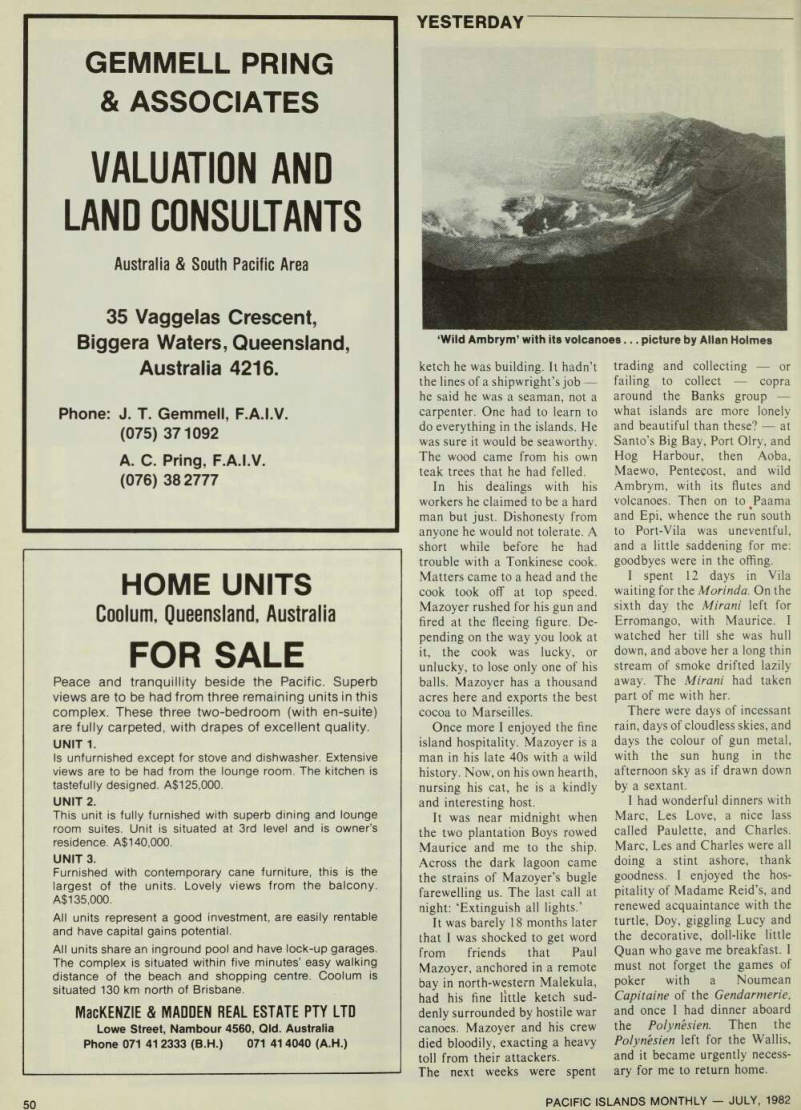
trading and collecting or failing to collect copra around the Banks group what islands are more lonely and beautiful than these? at Santo’s Big Bay, Port Olry, and Hog Harbour, then Aoba, Maewo, Pentecost, and wild Ambrym, with its flutes and volcanoes. Then on to and Epi, whence the run south to Port-Vila was uneventful, and a little saddening for me: goodbyes were in the offing.
I spent 12 days in Vila waiting for the Morinda. On the sixth day the Mirani left for Erromango, with Maurice. I watched her till she was hull down, and above her a long thin stream of smoke drifted lazily away. The Mirani had taken part of me with her.
There were days of incessant rain, days of cloudless skies, and days the colour of gun metal, with the sun hung in the afternoon sky as if drawn down by a sextant.
I had wonderful dinners with Marc, Les Love, a nice lass called Paulette, and Charles.
Marc, Les and Charles were all doing a stint ashore, thank goodness. I enjoyed the hos pitality of Madame Reid’s, and renewed acquaintance with the turtle, Doy, giggling Lucy and the decorative, doll-like little Quan who gave me breakfast. I must not forget the games of poker with a Noumean Capitaine of the Gendarmerie, and once I had dinner aboard the Polyn'esien. Then the Polyn'esien left for the Wallis, and it became urgently necess ary for me to return home.
‘Wild Ambrym' with its volcanoes... picture by Allan Holmes