the ‘Melanesian Renaissance’
pp. 25-28 · Read in the full issue
Political
Currents
Lini pleads for understanding of the ‘Melanesian Renaissance’
Appearing below is the text of the keynote address delivered by Vanuatu Prime Minister Father WALTER LINI at the opening session of the Australian and the South Pacific conference on February 18-19. While frequently praised by later speakers from the platform, informal corridor discussions among participants suggested that there was something less than unanimous approval of the speech, especially as it concerned Fr Lini’s concept of ‘Melanesian socialism’. It is reproduced here as a significant, if rather controversial, document of Pacific Islands politics of the 1980 s.
Your conference takes place at a time of deep and continuing crises in international relations.
The drama currently being played out in Eastern Europe, the persistent tragedy of the affairs of the Middle East, linked to the ever-growing ten sions between industrialised so ciety and the primary producing nations, often re ferred to, somewhat quaintly, as the North-South dialogue, all serve as a depressing backdrop to this conference.
Indeed, in face of the ever present threat to world peace, the affairs of a small island primary-producing stale such as Vanuatu may appear insig nificant, and, to some, even of no consequence. Yet when one considers that it is states such as my own which together consti tute nearly half of the member ship of the Commonwealth, then the matter assumes a different proportion.
As isolated in the geographi cal sense as many of the island stales like my own are, none of us over the years has escaped the acquisitive gaze of Western man, and the historical conse quences of this continue, even though many of us now enjoy varying degrees of political and economic freedom.
The fact that the winds of economic difficulty which now blow so roughly over the land scape of industrial society often attain hurricane force when they reach our shores is yet further proof that, in practical terms, our isolation exists in name only. I could not help thinking on my way here travelling in far, far more comfortable conditions than those of my ancestors who first arrived on the shores of this
country of how very much the world has indeed been reduced in size by the immedi acy of modern communications, and of the consequences of this for small slates such as my own.
What is equally true is the speed with which decisions taken in this capital in which we meet more often than not even when there is no direct intention produce an effect in the capital of my country, Porl-Vila.
Australia and Vanuatu are linked by history. 11 is a con nection containing within it cultural, political and social ingredients which have pro duced a relationship of almost a Siamese-twin nature.
Give the nature of the society my government and people are striving to create, there does exist a very real need for our aspirations and our expec
tations, based very much on our traditional values, to be under stood in Australia, if we are not, over the years, to experience the pain of pulling in separate directions.
Indeed. I shall be so bold as to say the following, and to say it in terms which none can fail to understand, and, in doing so, to reply to the question con tained within the subject you have asked me to address you upon. It is plain and it is simple.
Australia’s relations with the Island States of the Pacific are essentially going to depend, if such a relationship is to avoid confrontation, on a practical acknowledgment of the fact that our new-found freedoms were fought for so that, to a significant degree,'a renaissance of Melanesian values, principles and expectations can take place. I speak only for Vanuatu
when I say that such a renaissance will take place, and that I hope and pray that the journey my government and people embarked upon on July 30 1980 will not be open to misinterpretation.
On that day, addressing those distinguished people who had so kindly travelled to Vanuatu to* witness the birth of our nation, I made the following comments: There arc many visitors here today from countries far and near, and they all can, I am sure, testify to the fact that there is no such thing as an “Independent State”. “Inde pendent” that is, in the sense given by the dictionary. Indeed all the countries of the world are becoming less and less indepen dent. In that sense, both financially and economically, we can expect to be less inde pendent than many States. ‘We shall, for several years to come, depend on external aid, not just for capital or development needs, but also for our ordinary government ser vices such as education, health and public works. In order, however, to be even politically independent, we shall depend on the goodwill and generosity of foreign aid donors. We are entitled to hope that we shall be able to exercise freedom of choice, in other words indepen dence, in the way in which we provide public services, and
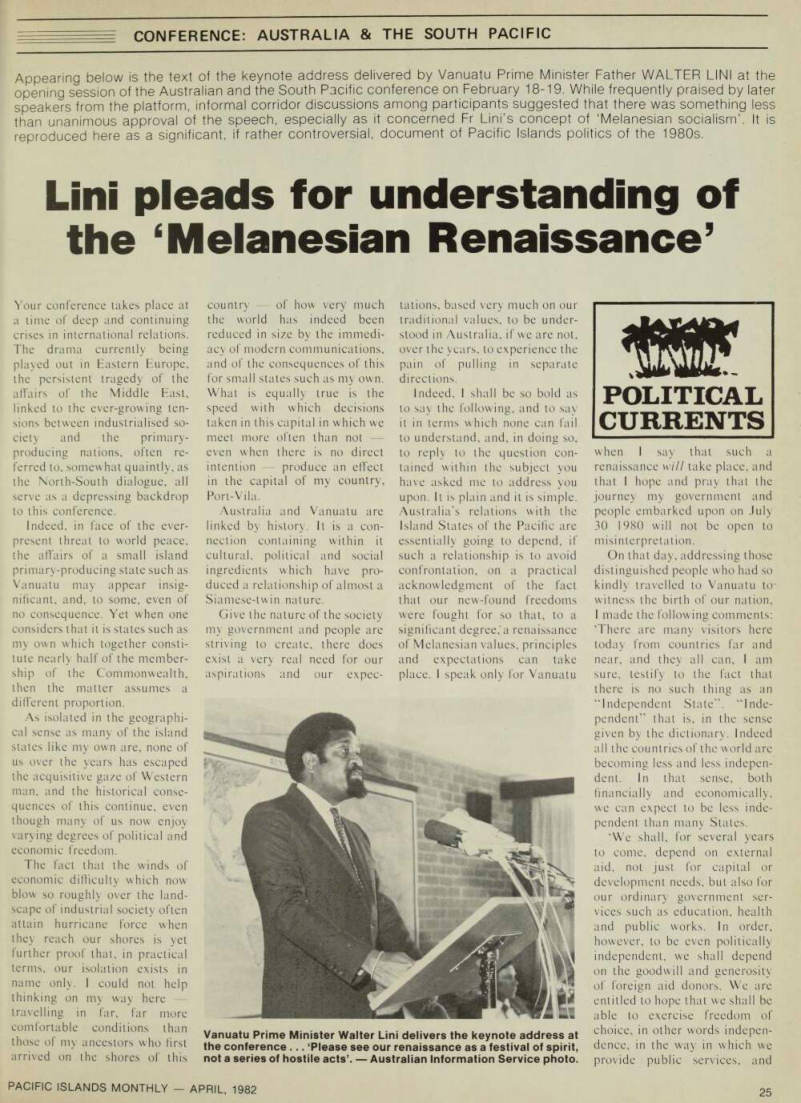
Vanuatu Prime Minister Walter Lini delivers the keynote address at the conference ... ‘Please see our renaissance as a festival of spirit, not a series of hostile acts’. - Australian Information Service photo.
change our society as we de velop. ‘At the same time, we have to face the fact that there may be external pressures on us from large companies and foreign governments, to conform to their ideas rather than our own when the two may differ. This itself will be a test of our determination and ability as well as a test of their generosity and spirit, and the result will, of course, be a greater or a lesser degree of independence for Vanuatu.’
In view of the fact that Vanuatu receives, and is grate ful for, a significant degree of financial and technical assist ance from Australia, I believe that it is appropriate that 1 recall sentiments I expressed on the occasion of our indepen dence. It is essentially an atti tude of mind. I represent, to give one basic example, a ‘land using’ culture. European oriented Australia represents a ‘land owning’ culture. The Western concept of land as a marketable commodity is not just alien to the Melanesian, but is considered impractical and immoral in the very best sense that the terms can be applied.
Land exists to be used by the community for its needs. This is by any definition a socialist principle, but one which we practised hundreds of years before Marx, Engels or indeed Lenin were even born, let alone heard of.
Chapter 12 of our consti tution enshrines this principle; ‘All land in the Republic be
longs to the indigenous custom owners and their descendants.’
This again is a socialist prin ciple. but essentially Melanesian socialism the total rejection of the freehold concept of land does not mean that we arc quite suddenly and quite miraculously in tropical Vanuatu going to have snow on our bools.
That the spirit and intent behind such a renaissance of Melanesian values will be open to misinterpretation and misun derstanding by the West and in Western-orientated societies such as Australia is in no doubt.
The leaders of the newly independent countries who make practical attempts to di lute values and national prac tices which were inherited dur ing the colonial period now accept, as indeed I do, that such criticism is almost an occu pational hazard. Indeed, we only have to give a side glance eastwards and we are immedi ately accused of courting the communist world. 1 have yet to visit a socialist society, or, if you prefer, a stale that professes communism. As 1 have already indicated. 1 have no need to go to understand or indeed accept, the principles of socialism. Even given the fact that my colleagues and 1 in the government of Vanuatu existed for so long in the suffocating embrace of external influence, we remain products of Melanesian socialism. 1 have said that a visit to the communist world would not necessarily make me a commu
nist, but visiting Australia, Britain, France, New Zealand or indeed any country which practises the market economy does not, most certainly, inspire me to become an apostle of the capitalist system.
My concern about the market economy has been expressed in precise terms and with particu lar emphasis in discussing the future relationship between those countries that practise it in undiluted form, and the Third World, or as I prefer to express it, the Primary- Producing nations.
Speaking at the 361 h session of the United Nations General Assembly in September of last year I remarked: ‘Much de pends, both in terms of justice and international welfare, on the future relationship that will exist between the manufactur ing countries, industrialised so ciety, and those who supply the basic raw material upon which industrialised society so vitally depends. ‘The world must turn away from concepts of dominance and dependence to the reality of interdependence, and the im peratives of change which this produces. The improvement in the quality of welfare for so many who desperately need it depends on a practical recog nition by industrialised society that it is no one’s interests for a national profit to be pursued at the expense of international poverty, that the continuance of such a circumstance can only result in the inflammable struc tures of injustice mounting
higher and higher; trade struc tures that do not allow half of the world to earn a decent living, consumption patterns that strain and pollute the world’s resources, and economic systems that benefit the few at the expense of the many.
In expressing such criticism 1 was also registering my concern that those who operate the capitalist system should recog nise that the West and Western orientated societies will sooner rather than later have to ‘come off the drug of ever increasing affluence, and that if their societies are not to experience severe withdrawal symptoms they had better start educating them in the new international reality of interdependence.
For the primary-producing countries will no longer remain passive while the multi-national companies take their natural resources on their own terms, like marauding cavemen of old.
And when the primary producing states take measures to protect themselves that, too must not be a matter for misunderstanding, even give the enormous capacity for mis understandings to take place in such matters.
Julids Nyerere commented some years ago, following a visit he had just undertaken to China: ‘I wish we could just speak of simple facts. If you take me to see General Motors in America, I will marvel. If you will take me to London I will say “How wonderful”. Last year I visited Holland, a small country but a very advanced one, and they are spending vast sums of money to push back the sea. Well, all I can say is “Wonderful”. But it is irrel evant to I can do in my country. The assembly plants in North America and Europe are irrelevant. ‘China is different, China is a backward country, but it has pulled itself up through its own efforts. You could see the steps and you say, “Boy, why didn’t we think of that? We should do that.” It is a question of what we are capable of. We are using hoes. If two million farmers in this country could jump from the hoe to the plough, it would be a revolution. It would double our living standard, triple our product. With the kind of thing
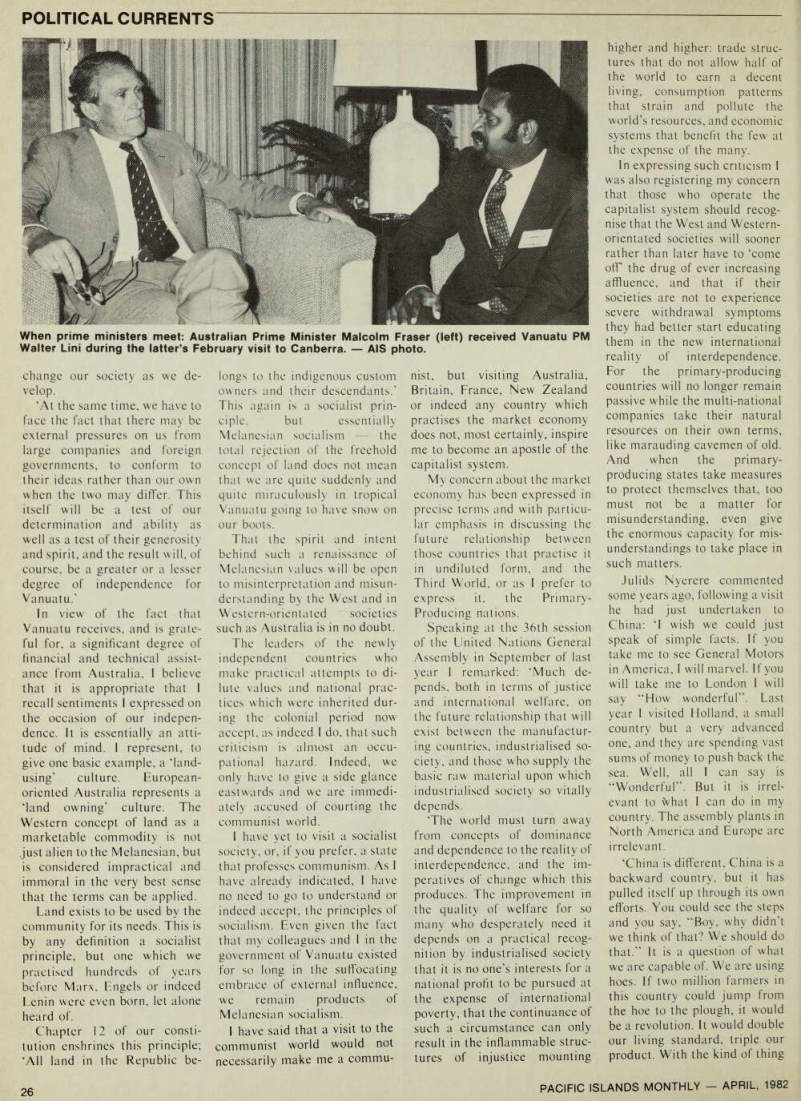
When prime ministers meet: Australian Prime Minister Malcolm Fraser (left) received Vanuatu PM Walter Lini during the latter’s February visit to Canberra. - AIS photo.
China is doing, the stage of such development is relevant to us. I wish I could state this as an observed fact and nothing more.
But when you say “From China you can learn” they say you are going Red.’ 1 have used this example given by Julius Nyerere, be cause, quite frankly, it cannot be bettered to illustrate the point.
The great adventure of inde pendence and the duty of pre siding over the rebirth of our identity and purpose, and of preserving without inhibition our God-given right to develop in our own way, and in accord ance with our own values and expectations, essentially means casting aside many of the in herited attitudes that at present bolster practices alien to the Melanesian mind.
Independence has given us the right and the duly to formulate a nature of adminis tration and the establishment of a society that is in concert with the needs and ideals of the people of Vanuatu. Again it is a question of an altitude of mind.
Our institutions must be geared and tuned to servicing and nurturing the creation of a social, political and economic order born of the environment of Vanuatu, an order in keeping with the desires and needs of the great majority, and not one coloured by notions of a society that basically has little in com mon with the indigenous society of Melanesia.
For Australia, and particu larly Australia, this is going to be the test. Is the Melanesian renaissance going to be viewed as a festival of spirit, or a collection of hostile acts? I have here before me a story from The London Telegraph of March 2, 1978, tiled from this capital, which quotes officials here talk ing seriously of the danger of Russian and Cuban interests, and ladies and gentlemen, would you believe it, even of ‘Tanzanian influence’ on my governing Vanuaaku Party.
Perhaps Mr Denis Warner who wrote the article will feel vindicated by my having quoted today, with all sincerity, the good thoughts of my Comrade Julius Nyerere However, lime has passed and I hope and have confidence
that the government and people of Australia will not misinter pret or misunderstand the re cmergcncc of Melanesian values which is taking place and which will continue to lake place in Vanuatu.
If I may sketch briefly for you the basic ingredients of our colonial experience, and the fabric of our indigenous society which was lorn asunder by that experience, it will, I am sure, be that much clearer to you why we in Vanuatu arc inspired to revive those of our traditional values which can, as 1 have remarked, serve our people as well as they did in the past. 1 well understand that many of you may be in possession of such facts indeed some of you may even have written about the matter based on your own research. But hear it from a Melanesian.
It has been written that the arrival of the European in the Pacific was, for the indigenous people a ‘fatal impact.’ But Melanesians demonstrated a marked resilience in the matter of survival, doing so in the face of alien diseases to which no immunity existed, and, in the case of Vanuatu, forced trans portation of labour. However, the indigenous culture and the priorities of values which were an important and essential as pect were drastically influenced by European practices, and, indeed, undermined by them.
Pre-European Melanesia was strongly characterised by a sus tained awareness of the need for communal discipline. It was a disciplined society in the very best sense that the term can be used, for it was a discipline based on an awareness of the community, where the individ ual was not to consider himself or his private interests taking precedence over the general interests of the community. ‘Giving’ was based on one’s ability to do so. ‘Receiving’ was based on one’s need. The fabric of this society, with its inherent communal discipline was, as I remarked, torn by the arrival of European commercial practices which carried with them the message of materialism, together with the creed of enlightened self-interest. Both aspects were a direct contradic
tion of Melanesian values and priorities.
The introduction into Melanesia of Christianity added a further element of division and confusion in the minds of the people. While the Christian religion was broadly compatible with the ethic and principles of Melanesian communalism, with its empha sis on mutuality, compassion, and caring for one another, it was a practice that very few of the Europeans appeared to fol low.
It also ran contrary to the religion of individualism and self-interest, which had not only more important exponents, but was followed by the majority of Europeans. Added to this was the resentment caused by the insensitive way all things ‘native’ in the form of spiritual and cultural activities were deemed to be evil.
There were honourable and notable exceptions, but gener ally there was not due regard for the opinions, feelings, cus toms and values born of the Melanesian experience and en vironment.
Practices which had very real social and spiritual value were outlawed by many of the early exponents of the Christian re ligion.
A widespread and damaging attitude of cultural arrogance existed. In short, there were imposed upon the subject people of Melanesia alien con cepts of materialism, individu alism, and a narrow, insensitive brand of organised religion, all of which ran contrary to and therefore ruptured the indigen ous concept of communalism, or, as I prefer to describe it, Melanesian socialism.
But we in Vanuatu have defied the usual consequences of an alien and aggressive manner of living, and while we will take with us into the future those aspects of European prac tice which undoubtedly are of benefit, we will also take with us into the often turbulent seas of nationhood those aspects of our traditional manner of living without which social cohesion will not be ours. It is this that must be understood and re spected by Australia, and, in deed, other states which would almost certainly view the resur rection of Melanesian socialism
as acts contrary to their inter ests.
The capacity for misunder standing is enormous, but there need be no conflict of interests.
Perhaps it is not possible to have totally shared expec tations, totally shared assump tions, but at least let us strive to understand them, and, what is more, acknowledge that within them, lie self-evident truths. 1 said earlier that I essentially speak on this occasion only for Vanuatu. What I can do how ever is to welcome the news of only last week that the States of Papua New Guinea, the Marshall Islands, Kiribati, the Solomons, Nauru and Palau, together with the Federated States of Micronesia, are to sign a fisheries co-operation agree ment.
The agreement is designed to co-ordinate exploitation of com mon fisheries resources, strengthen the bargaining pos ition of Island countries in their dealings with Japanese, Taiwanese and other foreign fishing nations, and regulate the issue of licences to foreign fishing companies.
I speak personally when I say that it is my hope that in the years ahead we will see the birth, whether or not within a federal structure I know not at this lime, of a common trade policy, a pooling of common
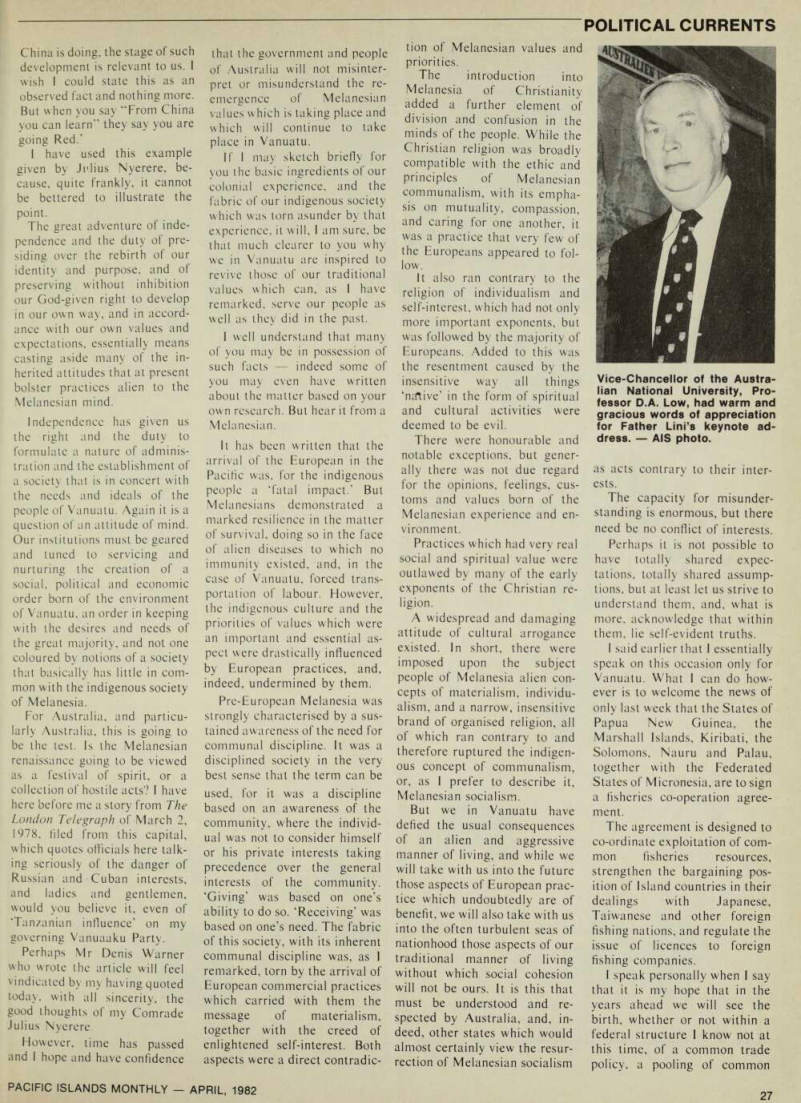
Vice-Chancellor of the Austra lian National University, Pro fessor D.A. Low, had warm and gracious words of appreciation for Father Lini’s keynote ad dress. - AIS photo.
services, and perhaps a common foreign policy, among the slates of Melanesia.
It is my considered opinion that much will depend on such a vision of the future being fulfilled. Certainly such an as sociation of Melanesian states would hasten the day when we could finally rid ourselves of the inhibition of requiring foreign aid.
For while I have been talking about domestic strategy, the awakening and gaining of strength in the Islands of the Pacific will undoubtedly and quite rightly influence us to draw' more closely together, in order to generate yet further strength. This in turn will assist us towards developing a re gional strategy, which I hope will include a common policy on foreign relations.
Vanuatu’s marine economic zone is a potential source of great economic strength, and we intend to safeguard it and to see that it is utilised for the good of the majority of our people.
It will only be by a coming together of the Island states that we will maintain our hard won independence in a danger ous and precarious world. The Pacific is one of the last regions of the world where the heavy hand of colonialism continues to be played.
These remnants of the past must be lifted from our ocean, for, in all truth, and as I have remarked before, until all of us are free, none of us are. We will be watching Australia with the greatest of interest in this re gard, and if at limes we become bolder in international matters, then our reasons for so doing, will. I hope, be understood in
this and other capitals.
My government’s decision of two weeks ago to prohibit two American warships from visit ing Port-Vila, because no assur ance could be given by the government of the United States that nuclear devices were not being carried on board was, 1 hope, understood and appreci ated. That, ladies and gentlemen, is just one small piece of evidence as to how bold we hope to be in the future.
There was a book written some years ago called The Ugly American which spoke of an aggressive American influence in Southeast Asia. 1 hope that there will never be a cause for a work to be written called The Ugly Australian. I hope and believe not. It has been said by another, and at a different time, that Australia is a ‘white island in a brown sea’.
There are good and encourag ing signs, particularly among the young in Australia, that the natural commitment their country has to the Pacific has to be practically acknowledged.
There are good and positive signs that this is so in the government of Australia, and 1 applaud it.
The success of Australia’s relations with the Pacific Islands states will be based upon the practical and sus tained recognition that no one culture is basically superior to another, that each and every culture, together with its social, political and economic ingredi ents, has a meaning and value to the people who gave birth to it.
It remains the hope of the government I lead that such a principle will colour Australian Pacific policies in the years that lie ahead.