warm new web of
pp. 19-23 · Read in the full issue

Epeli Hau’ofa
Pacific migration: A warm new web of human contacts is born
I must confess that I have not been able to fathom the wisdom of having a group of South Pacific Islanders come all the way to Canberra to make a spectacle of themselves in front of audiences and the media.
This kind of gathering reminds one, somehow, of those early years when one was a faithful and regular church-goer. The exercise of going to church regularly could become quite painful as not only was nothing new ever said, but also, and worse, things were repeated over and over every Sunday until one could stop listening and use the familiarity and cosiness of the situation to meditate on things totally un connected with the messages of the sermons of the day. But church congregations serve the very useful purpose of getting people of like mind together under the same roof, where they show their solidarity with each other and with the Lord, and where they reassure each other that things are going fine under divine guidance.
So, I believe, are conferences of this kind, or of most other kinds. We are solemnly gath ered here in Canberra, the cleanest city in the universe, to reaffirm the brotherhood of mankind: Lillie Brothers com ing to Big Brother’s house to have a pow-wow, to pay Big Brother honour due to his seniority, to give a little and, it may be hoped take back more than usual, to express views on Big Brother’s occasional lapses in fraternal responsibility, and, finally, to receive a blessing or two from the head of the tribe.
We should do more of this, I’m all for it. And we should also hold a similar conference next year at our university campus in Suva or at Waigani in Port
Moresby. In that meeting a group of merry Australians should come over to make a spectacle of themselves for our delectation. It’s what we in the islands call ‘true reciprocity’.
But, now that I’m here, I must sing a song or two for my air fares, and for the privilege and joy of being back in Canberra the Beautiful, where many of us from the islands have spent probably the most titillating years of our post-church-going lives.
About 20 years ago, when I first came to Australia for higher education, our then country-town pastor took me and a group of Fijian students for service at a small church located isolatedly on a farming property. After the pastor had introduced us to the congre gation outside the church, an elderly lady came up and, without a trace of malice or regret, said to me: “A few years ago, I wouldn’t have shaken your hand.” We have come a long way since the 1950 s and early 19605. Through education of various sorts, the mass me dia, greater international mo bility of ordinary people, and through the humanistic move ments of the 1960 s and early 19705, we, or some of us any way, have come to know each other well, and have formed, across national boundaries, last ing personal ties of friendship and in some cases, personal hostility.
And, through technological advancement and economic and strategic alignments in our re gion, Australia and the islands of the western and central South Pacific are being inexor ably drawn into a single system with intensifying bonds bonds that are increasingly be ing devised and perhaps con
trolled in this country, the natural leader of our region given its enormous size, its natural resources and the ap parently boundless energy of its people.
It is also a fact of our regional life that, on the average, we in the islands are more aware of Australia than Australians are of us. This is the natural state of affairs in the relationship be tween the periphery and the centre in any system of inter national alignments. The centre, like ancient Rome to which all roads led, tends to be inward-looking and can afford the luxury of studying its own navel. The periphery must necessarily be conversant with what is happening at the centre, if it is to benefit from the system. Most Australians do not have to know anything about the small Pacific islands; but because of the nature of the system, and the place of insular South Pacific in that system, islanders cannot afford to be ignorant of Australia, or New Zealand or the USA, Furthermore, it is not only that we in the islands are aware to varying degrees of what is happening here, but also that Australia is increasingly becom ing less alien to us. And this finally brings me around to the issue of migration on which 1 am supposed to talk expertly to you, and about which 1 know so little. That is not only why I have taken so long to get around to the problem I find it per sonally embarrassing to talk about entering another man’s house. I would rather that Em in the house, if welcomed, with out making any noise about it. I am therefore not going to say anything about what Australia should do.
But, personal predilections aside. I would like to assert that the main reason why this coun try is no longer alien to us is that our ties are not merely econ omic and strategic; they’re be coming increasingly social in character. This is most import ant especially to people who inhabit the very small island countries of Polynesia. The situ ation has been brought about by a major population mobility from the peripheries to the centres. In the very early 19605,
as I remember it, when Auslra lia was very actively recruiting migrants from Europe and equally actively keeping others out, there were fewer than 20 of my countrymen in Sydney, the majority of them students on temporary visas. Today, there are thousands of longans in Sydney, Melbourne and Bris bane, together with many more New Zealand Maoris, Cook Islanders, Niueans. Samoans and Fijians. Some of them are a pain in the neck, but the vast majority have quietly and suc cessfully adapted themselves to the Australian economy.
Today, there are probably more Polynesian living in indus trialised countries surrounding the Pacific Ocean than there are living in their islands of origin.
And it has been asserted that most adult Polynesian men have visited at least one of the industrialised countries men tioned above. One beneficial effect of the current worldwide economic recession is that the
migrant-receiving countries
have partly closed their gates, thus stemming the flood that would have denuded Polynesia of its active people. The present trickle and other highly regu lated arrangements are perhaps the best for everyone.
Now, since islanders are much more concerned with
maintaining ties with a wide range of relatives than are Australians, for example, their social and kinship networks, along which they have tra ditionally moved goods and services as well as people, have widened in ways never before possible to cover Australia, New Zealand and the United Stales One result is that, as if in return for thousands of Aus tralian. New Zealand and American tourists who visit the islands every year, there are thousands of islanders who pay visits every year to Australia.
New Zealand and the USA, staying not at tourist hotels but at the homes of their relatives As I see it, the direction of development within our region is toward increasing inte gration of our economies societies with those of Australia and New Zealand especially Australia. This process has gone much further in the case of the smaller Polynesian countries than in the larger Melanesian ones. But the direction seems clear. A number of years ago a book was published at the University of the South Pacific that had the title Fiji: A Developing Australian Colony.
Island leaders talk about inde pendence, self-reliance and so forth; but as long as they continue to commit their
countries to the kinds of econ omic development they seem to have chosen, or have been forced into, their economies will depend on and their peoples will be drained to the centre of economic power and that power in our region is undoubt edly Australia. Perhaps the most telling recent example of the flexing of Australian econ omic muscle in the South Pacific is the case of the Ansett bid to have the controlling interests in just about every international airline in the islands. Ansett should make air services in the South Pacific efficient, but this efficiency also entails greater population mo bility .
Population mobility in the South Pacific, especially be tween the small Polynesian countries and New Zealand and the United States, began as part of the colonial scheme of things.
Since then it has developed as part of the post-colonial econ omic and strategic alignment, with Australia entering the arena as a receiving country.
Today, the chickens have come home to roost and. given their kinship ideologies and prac tices, islanders, both emigrants and homestayers alike, have made those South Pacific coun tries that European settlers had conquered for themselves only a short while ago, their countries also, notwithstanding passports and visas. Some islanders have so taken this to heart that they have gone walkabout in ways that have driven immigration officials everywhere up the wall.
Up to the 19th century the people of Polynesia travelled far and wide, as they had done for centuries, pushing their ocean going canoes to the limit of their potential, and visiting their rela tives living in different islands of the region. But, with the establishment of the colonial territorial boundaries, they were cut off from their rela tives overseas, and they became isolated and poor, both materi ally and culturally. However, with the recent opening of some boundaries, Polynesians have resumed their ancient tradition of travel, emigration and estab lishment or re-establishment of kinship links wherever they go.
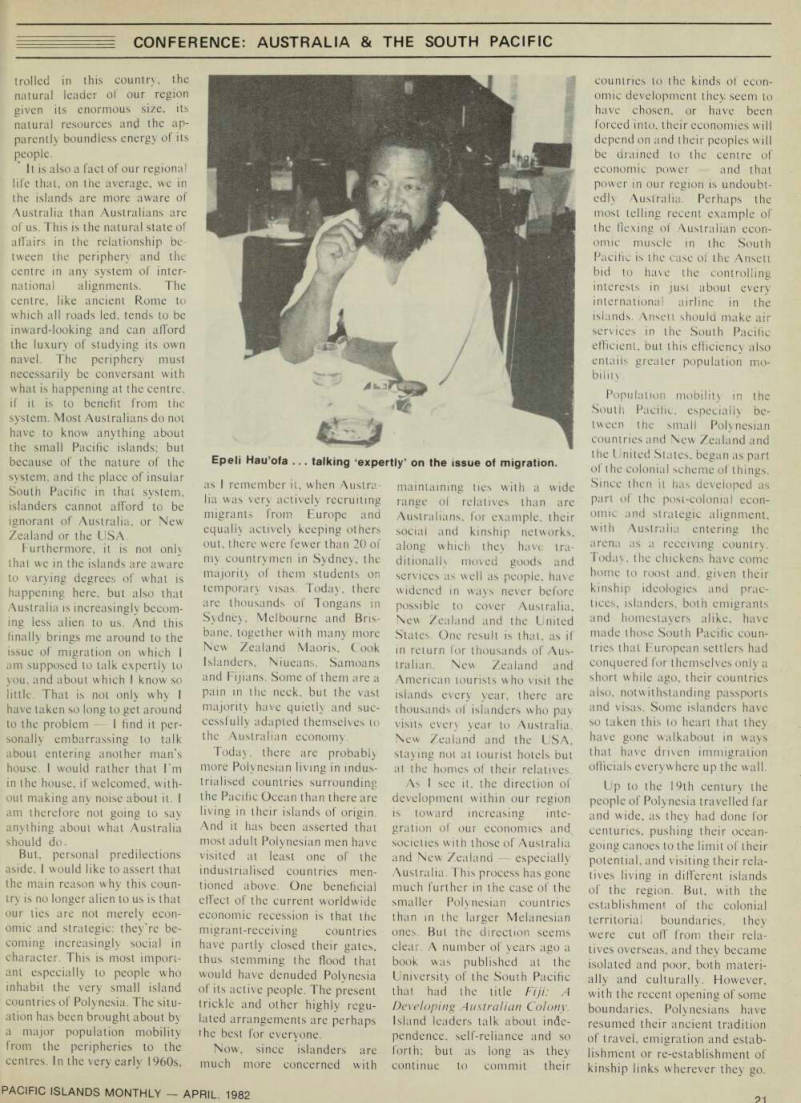
Epeli Hau’ofa ... talking ‘expertly' on the issue of migration.
They are now visiting countries like Australia, looking up rela tives, giving them gifts of fam ily news and traditionally valued goods, and returning home with wonderful stories, cash, goods of all kinds, new ideas, heightened aspirations and a determination to revisit them again and again.
These are very warm and very human things that are happening in the South Pacific region beneath the hard and tough reality of horse-trading conducted at the rarefied levels of international trade, aid and diplomacy. At those levels islan ders are the weak parties depen dent on their far, far stronger neighbours for their so-called development. But at the much lower level of mobility of thou sands of ordinary folk, islanders move, not as dependent people looking for handouts, or as groups of clients making spec tacles of themselves at confer ences like this, but as free and independent kinsmen visiting their relatives wherever they are in their ocean, to have a good time, to earn some honest money by hard work for short periods, and then to return home to build a house or to set up a business that will surely collapse.
When we talk about the issue of migration at official and academic levels, we tend to do so in terms of social, political and economic implications to countries and institutions. But those who migrate, or who visit their relatives abroad, do not think in terms of larger impli cations which are too abstract and remote to be of immediate concern to them. These people make their decisions on the basis of their evaluation of their personal needs and the needs of those closest to them.
As I see it, the issue of migration in the islands revolves on two related problems. The first is the problem of the economic and social viability of local groups and nations that are being drained of their active manpower, pitched against the needs of individuals for social and economic opportunities for themselves and their families.
The other problem is the will ingness of receiving countries to
continue accepting migrants and short-term visitors. There has been a tendency for coun tries like Australia and New Zealand to assist in the econ omic development of the South Pacific islands with the aim to enable the islands to provide adequately for the needs of their people and so prevent or diminish the desire for emi gration. But the reality of small ness and lack of resources to develop the islands along the lines their inhabitants have taken, coupled with high popu lation growth rates and even higher levels of aspirations, have put an effective limit on how far these small states can develop in order to meet the growing demands of their people.
But, if it is the case, as I have dared to suggest, that there is already a growing integration of the economies and societies in our region, which includes Aus tralia and New Zealand, then it is inevitable that goods and people will continue to flow within the system. During my regular fits of insanity, I see the day when all boundaries in our region are done away with in order to allow for an unfettered movement of trade, industries and people. For many years now, some well-intentioned indi viduals and groups have been trying to persuade Australian governments to accept more migrants from the islands. I think that in keeping with our growing integration, all doors in our region should be opened. If Australia is asked to accept migrants and goods from the islands, then it is only reason able and fair that the islands also open their doors for Austra lians and for Australian goods and industries. Not many Aus tralians or Australian industries would like to come to the islands, but there are people here at the centre who are sufficiently crazy to wish to opt out of the ratrace and go tropical. And there are many islanders who are sufficiently insane to wish to come to the centre and join the fray. Thus, those who wish to live in the world of fast pace and acceler ated growth will have their desires fulfilled at the centre of
the system. And those who wish to lead a more relaxed life, to live in a world where things are small-scale and easy to compre hend, will have their desires fulfilled by moving to the peri pheries of the system.
But to return from fantasy to reality, I think that it is not what we say and do as conferees and analysts, but the actual doings of thousands of mobile people that will have the greatest impact on the issue of population mobility in our re gion. And I also think that in the near future, Australian citi zens of South Pacific islands origin will press for greater Australian involvement in our region than has so far been the case. They, with their citizen ship and upbringing here, and with their social, cultural and historical ties with the islands, will, it may be hoped, become more effective spokesmen for their country’s relationship with the island South Pacific than any of us here today.
Niue looks at
idea of TV...
Problem how to keep Niue Island’s population of 3578 at home. Possible solution in troduce television to the island.
Niue’s Auckland Consul Toke Talagi has the task of assessing the technical feasi bility of introducing television to Niue, and of examining the legal implications of the use of overseas programmes. ‘lf we get television the programmes will most likely come from New Zealand,’ he said. Public submissioins have been called for on the scheme before the Niue Government makes a decision.
About three times as many Niueans live in New Zealand as at home, and the island govern ment is keen to stop the exodus and bring people back.
Meanwhile, one of the first things Mr Talagi did was look for a videotape of an Australian documentary on the introduc tion of television to Yap. That painted a controversial view <of the impact of television on an island community. William Gas son in Wellington.
... and also
to Yap
What Mr Talagi saw when he watched the ‘Australian docu mentary’ is described in the following terms in a New Zea land Herald report of November 27, 1981: ‘Blatant electronic colonialism,’ complete with sinister CIA undertones, is investigated in ‘Yap . . . How Did You Know We’d Like TV?’ on TV-1 at 9.30 tonight.
When Australian filmmaker Dennis O’Rourke went to the small Pacific island of Yap, he was looking for a ‘metaphor’ for the relation between the United States and the Third World.
He found the inhabitants in tin shacks, staring with glazed eyes at television.
The television system was installed in Yap in 1979 by a Los Angeles-based company.
It came complete with adver tisements for ‘your local Southern California Ford dealer,’ ‘Big Macs’, vacations in Barbados, and carpet shampoo.
Many of the local population are opposed to television, re garding it as a further threat to their culture and as an attempt by outsiders to create change.
They feel that television along with many other things provided by the United States is designed to create depen dency.
They have a theory, not supported by evidence, that the company which installed the television system to Yap has connections with the CIA.
They say it is a conspiracy to promote United States culture and values in an otherwise insignificant, but strategically important, island . . .
It has been so inundated with free handouts that the people are abandoning their culture and turning to American values and institutions.
Village life, fishing in the lagoon and gardening in the taro patches is being replaced with canned food, beer and shanty towns.
Many people feel that little has been done for the islanders except what was in the strategic self-interest of the United States . . .