Apia: State
pp. 23-28 · Read in the full issue

Tropicalities
of play for
’83 Games
While the Western Samoa Government’s financial position is not as good as it might be, largely due to last year’s big Public Service strike, there is every indication that the 1983 South Pacific Games will be hosted by the country as plan ned. For one thing, national honour will be at stake.
The government maintained a discreet stand during the many months of local and international wrangling over whether the country had the capacity to host the games. All it was saying was that the games would indeed be held in this country as planned.
The main problem from gov ernment’s point of view was finance and organisation, and until these matters had been resolved, it was not willing to say much more. While the public waited, there was a flurry of meetings between represen tatives of the Western Samoa Sports Federation, the Apia Park Board (which administers Apia’s only sports park), a visiting delegation from the People’s Republic of China, and government.
Finally, in early May, 1981, the Western Samoa cabinet approved preliminary proposals for the 1983 games. These represented a compromise be tween the organisations con cerned, and their endorsement by government provided much needed relief after months of bitter feuding.
Cabinet approval mainly con cerned the organisational prob lems: there was to be a board of directors to be chaired by the president of the Sports Feder ation, and an organising com mittee comprising a general manager and other staff and volunteers.
In September 1979, the
Sports Federation had ap proved 12 sports for the 1983 games. These were: athletics, basketball, soccer, swimming, lawn tennis, boxing, weightlift ing, golf, lawn bowls, rugby, netball and volleyball. Then, at a meeting in Solomon Islands last year, Western Samoa’s representative managed to con vince the majority of the South Pacific Games Council that swimming should be excluded because of the fear that West ern Samoa might not be able to provide adequate pools in time or at all.
There was a strong lobby to have the different sports events held at a variety of venues. But in the end the deciding factor
was the nature of the Chinese aid for the development of sports facilities in Western Samoa. This favoured the hold ing of at least the major sports in one place. So now, athletics, soccer, boxing, rugby, and bowls will be held at Apia park; tennis at Chanel College; golf at the Fagalii golf course; weightlifting at Feiloaimauso Hall, or the Chinese gym nasium at Apia Park (if com pleted in time); basketball at Church College Hall, Pesega, or the gymnasium; volleyball at Church College Hall or the gymnasium; and netball at Church College Hall.
Games organisers expect some difficulties in program ming events at Apia Park and are considering three methods of coping with them; provision of floodlights, provision of an eight-lane instead of a six-lane athletics track, and extending the games period from 10 days to 12 days. The park will have
four fields for rugby and soccer.
Boxing will be held outdoors because it is felt that the Chinese gymnasium will be too small to accommodate the spec tators.
Male athletes will be housed at the Games Village at the Malifa/Leifiifi school com pound, and women at the Papauta School. VIPs will stay at the Tusitala Hotel, technical delegates at the Alafua School of Agriculture, and press rep resentatives at the Tiafau Ho tel.
The matter of catering has not yet been settled, but the organisers are negotiating with the New Zealand Government for the New Zealand Army
Catering Unit to do the job.
Transport is another major problem. The organisers are considering the possibility of seeking aid from a foreign country to provide Western Samoa with a school bus sys tem. The buses could then be used to transport athletes.
The sports facilities at Apia Park will be built with the loan of about $6 million from the People’s Republic of China,
while Japanese Government aid is being sought for sports equip ment.
Jean Perron of Canada, one of the key organisers of the 1976 Montreal Olympics, re cently spent two weeks in West ern Samoa looking at prep arations for the 1983 games and offering advice to the govern ment. It’s possible that the organisers will invite him again
for a longer stay.
Felise Va'a
in Apia.
Cautionary tale
from Suva
A few drinks, kisses and cuddles if not a little more were what Private Sairusi Qalivutu was after when he took his girlfriend and some beer late one night in January out to Suva’s Rifle Range. But what the poor chap got instead were injuries to his legs, arms, chest and face, and shrapnel cuts all over his body. His girlfriend was luckier, but still required hospital treatment for a wound in the left thigh.
What made the difference between the private’s light hearted plans and the grim result was a lighted cigarette butt which was idly tossed away only to detonate an unexploded projectile which lay unseen on the rifle range.
Private Qalivutu had a mate with him, also a soldier, who was also accompanied by his girlfriend. But they escaped with nothing worse than shock.
At last report, an army court of inquiry was investigating the explosion and why the two regular soldiers had broken camp.
From the hospital, the news was that Private Qalivutu’s condition was ‘pretty bad’.
Thoughts on a
murder trial
Following an eight-day jury trial in Nukualofa last December, two Tongan policemen were acquitted of murdering, and five of abetting the murder of, an arrested suspect on the night of September 2 (PIM Feb p 5).
The man, according to the post-mortem evidence, died of massive multiple injuries and extensive internal haemorrhag ing, consistent with his having been punched, kicked and
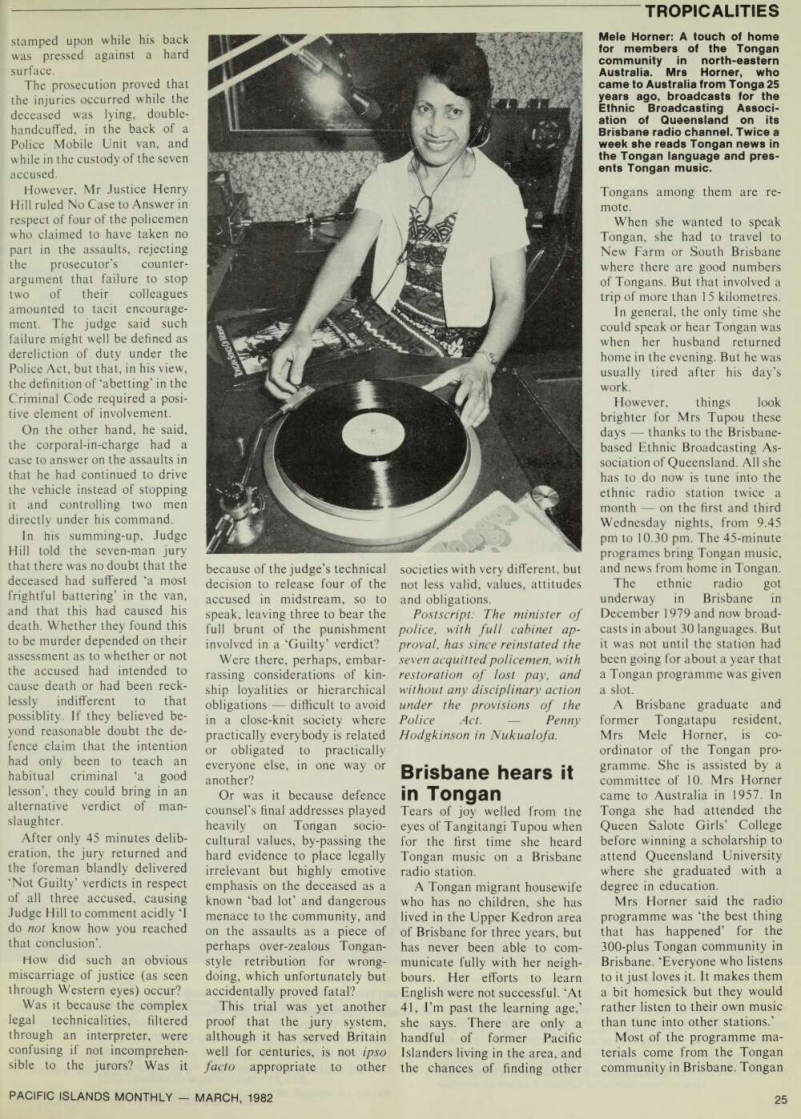
Islands political leaders con tinue to give strong support to the South Pacific Games, seeing the games movement as one of the main forces in maintaining the new regional understanding which has arisen among Island countries. Within the limits of their finances, governments continue to give high priority to subsidising the movement.
Mini-games, which are within the financial reach of the smaller countries, are now held in addition to the main fixtures.
The picture above shows the closing ceremony at last year’s mini-games in Honiara. -Philip Vahia picture.
stamped upon while his back was pressed against a hard surface.
The prosecution proved that the injuries occurred while the deceased was lying, double handcuffed, in the back of a Police Mobile Unit van, and while in the custody of the seven accused.
However, Mr Justice Henry Hill ruled No Case to Answer in respect of four of the policemen who claimed to have taken no part in the assaults, rejecting the prosecutor’s counter argument that failure to stop two of their colleagues amounted to tacit encourage ment. The judge said such failure might well be defined as dereliction of duty under the Police Act, but that, in his view, the definition of ‘abetting’ in the Criminal Code required a posi tive element of involvement.
On the other hand, he said, the corporal-in-charge had a case to answer on the assaults in that he had continued to drive the vehicle instead of stopping it and controlling two men directly under his command.
In his summing-up, Judge Hill told the seven-man jury that there was no doubt that the deceased had suffered ‘a most frightful battering’ in the van, and that this had caused his death. Whether they found this to be murder depended on their assessment as to whether or not the accused had intended to cause death or had been reck lessly indifferent to that possiblity. If they believed be yond reasonable doubt the de fence claim that the intention had only been to teach an habitual criminal ‘a good lesson’, they could bring in an alternative verdict of man slaughter.
After only 45 minutes delib eration, the jury returned and the foreman blandly delivered ‘Not Guilty’ verdicts in respect of all three accused, causing Judge Hill to comment acidly T do not know how you reached that conclusion’.
How did such an obvious miscarriage of justice (as seen through Western eyes) occur?
Was it because the complex legal technicalities, filtered through an interpreter, were confusing if not incomprehen sible to the jurors? Was it
because of the judge’s technical decision to release four of the accused in midstream, so to speak, leaving three to bear the full brunt of the punishment involved in a ‘Guilty’ verdict?
Were there, perhaps, embar rassing considerations of kin ship loyalities or hierarchical obligations difficult to avoid in a close-knit society where practically everybody is related or obligated to practically everyone else, in one way or another?
Or was it because defence counsel’s final addresses played heavily on Tongan socio cultural values, by-passing the hard evidence to place legally irrelevant but highly emotive emphasis on the deceased as a known ‘bad lot’ and dangerous menace to the community, and on the assaults as a piece of perhaps over-zealous Tongan style retribution for wrong doing, which unfortunately but accidentally proved fatal?
This trial was yet another proof that the jury system, although it has served Britain well for centuries, is not ipso facto appropriate to other
societies with very different, but not less valid, values, attitudes and obligations.
Postscript: The minister of police, with full cabinet ap proval, has since reinstated the seven acquitted policemen, with restoration of lost pay, and without any disciplinary action under the provisions of the
Police Act.
Penny
Hodgkinson in Nukualofa.
Brisbane hears it
in Tongan
Tears of joy welled from the eyes of Tangitangi Tupou when for the first time she heard Tongan music on a Brisbane radio station.
A Tongan migrant housewife who has no children, she has lived in the Upper Kedron area of Brisbane for three years, but has never been able to com municate fully with her neigh bours. Her efforts to learn English were not successful. ‘At 41, I’m past the learning age,’ she says. There are only a handful of former Pacific Islanders living in the area, and the chances of finding other
Tongans among them are re mote.
When she wanted to speak Tongan, she had to travel to New Farm or South Brisbane where there are good numbers of Tongans. But that involved a trip of more than 15 kilometres.
In general, the only time she could speak or hear Tongan was when her husband returned home in the evening. But he was usually tired after his day’s work.
However, things look brighter for Mrs Tupou these days thanks to the Brisbane based Ethnic Broadcasting As sociation of Queensland. All she has to do now is tune into the ethnic radio station twice a month on the first and third Wednesday nights, from 9.45 pm to 10.30 pm. The 45-minute programes bring Tongan music, and news from home in Tongan.
The ethnic radio got underway in Brisbane in December 1979 and now broad casts in about 30 languages. But it was not until the station had been going for about a year that a Tongan programme was given a slot.
A Brisbane graduate and former Tongatapu resident, Mrs Mele Horner, is co ordinator of the Tongan pro gramme. She is assisted by a committee of 10. Mrs Horner came to Australia in 1957. In Tonga she had attended the Queen Salote Girls’ College before winning a scholarship to attend Queensland University where she graduated with a degree in education.
Mrs Horner said the radio programme was ‘the best thing that has happened’ for the 300-plus Tongan community in Brisbane. ‘Everyone who listens to it just loves it. It makes them a bit homesick but they would rather listen to their own music than tune into other stations.’
Most of the programme ma terials come from the Tongan community in Brisbane. Tongan
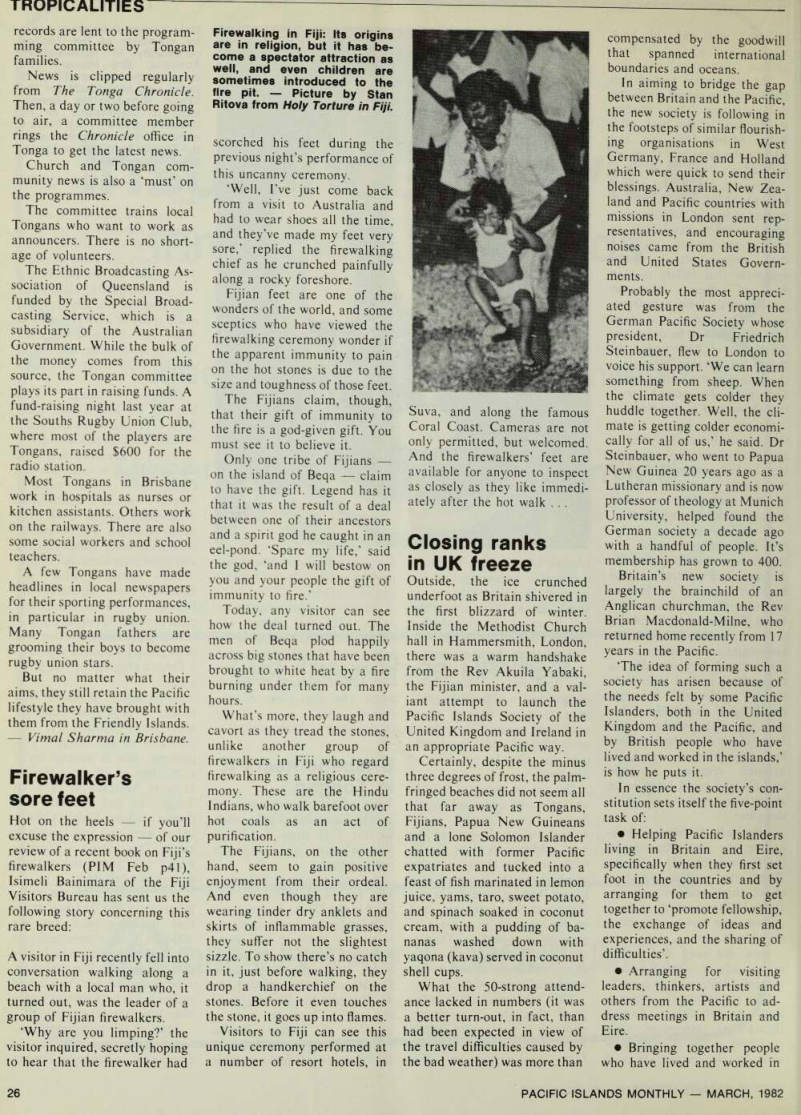
Mele Horner: A touch of home for members of the Tongan community in north-eastern Australia. Mrs Horner, who came to Australia from Tonga 25 years ago, broadcasts for the Ethnic Broadcasting Associ ation of Queensland on its Brisbane radio channel. Twice a week she reads Tongan news in the Tongan language and pres ents Tongan music.
records are lent to the program ming committee by Tongan families.
News is clipped regularly from The Tonga Chronicle.
Then, a day or two before going to air, a committee member rings the Chronicle office in Tonga to get the latest news.
Church and Tongan com munity news is also a ‘must’ on the programmes.
The committee trains local Tongans who want to work as announcers. There is no short age of volunteers.
The Ethnic Broadcasting As sociation of Queensland is funded by the Special Broad casting Service, which is a subsidiary of the Australian Government. While the bulk of the money comes from this source, the Tongan committee plays its part in raising funds. A fund-raising night last year at the Souths Rugby Union Club, where most of the players are Tongans, raised $6OO for the radio station.
Most Tongans in Brisbane work in hospitals as nurses or kitchen assistants. Others work on the railways. There are also some social workers and school teachers.
A few Tongans have made headlines in local newspapers for their sporting performances, in particular in rugby union.
Many Tongan fathers are grooming their boys to become rugby union stars.
But no matter what their aims, they still retain the Pacific lifestyle they have brought with them from the Friendly Islands.
Vimal Sharma in Brisbane.
Firewalker’s
sore feet
Hot on the heels if you’ll excuse the expression of our review of a recent book on Fiji’s firewalkers (PIM Feb p4l), Isimeli Bainimara of the Fiji Visitors Bureau has sent us the following story concerning this rare breed: A visitor in Fiji recently fell into conversation walking along a beach with a local man who, it turned out, was the leader of a group of Fijian firewalkers. ‘Why are you limping?’ the visitor inquired, secretly hoping to hear that the firewalker had
scorched his feet during the previous night’s performance of this uncanny ceremony. ‘Well, I’ve just come back from a visit to Australia and had to wear shoes all the time, and they’ve made my feet very sore,’ replied the firewalking chief as he crunched painfully along a rocky foreshore.
Fijian feet are one of the wonders of the world, and some sceptics who have viewed the firewalking ceremony wonder if the apparent immunity to pain on the hot stones is due to the size and toughness of those feet.
The Fijians claim, though, that their gift of immunity to the fire is a god-given gift. You must see it to believe it.
Only one tribe of Fijians on the island of Beqa claim to have the gift. Legend has it that it was the result of a deal between one of their ancestors and a spirit god he caught in an eel-pond. ‘Spare my life,’ said the god, ‘and I will bestow on you and your people the gift of immunity to fire.’
Today, any visitor can see how the deal turned out. The men of Beqa plod happily across big stones that have been brought to white heat by a fire burning under them for many hours.
What’s more, they laugh and cavort as they tread the stones, unlike another group of firewalkers in Fiji who regard firewalking as a religious cere mony. These are the Hindu Indians, who walk barefoot over hot coals as an act of purification.
The Fijians, on the other hand, seem to gain positive enjoyment from their ordeal.
And even though they are wearing tinder dry anklets and skirts of inflammable grasses, they suffer not the slightest sizzle. To show there’s no catch in it, just before walking, they drop a handkerchief on the stones. Before it even touches the stone, it goes up into flames.
Visitors to Fiji can see this unique ceremony performed at a number of resort hotels, in
Suva, and along the famous Coral Coast. Cameras are not only permitted, but welcomed.
And the firewalkers’ feet are available for anyone to inspect as closely as they like immedi ately after the hot walk . . .
Closing ranks
in UK freeze
Outside, the ice crunched underfoot as Britain shivered in the first blizzard of winter.
Inside the Methodist Church hall in Hammersmith, London, there was a warm handshake from the Rev Akuila Yabaki, the Fijian minister, and a val iant attempt to launch the Pacific Islands Society of the United Kingdom and Ireland in an appropriate Pacific way.
Certainly, despite the minus three degrees of frost, the palm fringed beaches did not seem all that far away as Tongans, Fijians, Papua New Guineans and a lone Solomon Islander chatted with former Pacific expatriates and tucked into a feast of fish marinated in lemon juice, yams, taro, sweet potato, and spinach soaked in coconut cream, with a pudding of ba nanas washed down with yaqona (kava) served in coconut shell cups.
What the 50-strong attend ance lacked in numbers (it was a better turn-out, in fact, than had been expected in view of the travel difficulties caused by the bad weather) was more than
compensated by the goodwill that spanned international boundaries and oceans.
In aiming to bridge the gap between Britain and the Pacific, the new society is following in the footsteps of similar flourish ing organisations in West Germany, France and Holland which were quick to send their blessings. Australia, New Zea land and Pacific countries with missions in London sent rep resentatives, and encouraging noises came from the British and United States Govern ments.
Probably the most appreci ated gesture was from the German Pacific Society whose president, Dr Friedrich Steinbauer, flew to London to voice his support. ‘We can learn something from sheep. When the climate gets colder they huddle together. Well, the cli mate is getting colder economi cally for all of us,’ he said. Dr Steinbauer, who went to Papua New Guinea 20 years ago as a Lutheran missionary and is now professor of theology at Munich University, helped found the German society a decade ago with a handful of people. It’s membership has grown to 400.
Britain’s new society is largely the brainchild of an Anglican churchman, the Rev Brian Macdonald-Milne, who returned home recently from 17 years in the Pacific. ‘The idea of forming such a society has arisen because of the needs felt by some Pacific Islanders, both in the United Kingdom and the Pacific, and by British people who have lived and worked in the islands,’ is how he puts it.
In essence the society’s con stitution sets itself the five-point task of: • Helping Pacific Islanders living in Britain and Eire, specifically when they first set foot in the countries and by arranging for them to get together to ‘promote fellowship, the exchange of ideas and experiences, and the sharing of difficulties’. • Arranging for visiting leaders, thinkers, artists and others from the Pacific to ad dress meetings in Britain and Eire. • Bringing together people who have lived and worked in
Firewalking in Fiji: Its origins are in religion, but it has be come a spectator attraction as well, and even children are sometimes introduced to the
fire pit. - Picture by Stan
Ritova from Holy Torture in Fiji.
the Pacific and who retain an interest in the area. • Encouraging an interest in the Pacific and providing up-to date information of the islands. • Co-operating with similar bodies in other countries, and with governments, churches and other organisations in the Pacific.
To emphasise its multi nationalism, the society is invit ing representatives of both Polynesia and Melanesia to become its first patrons.
Equally, the ethnic diversity is reflected in its governing council. The first elected presi dent is John Smith, 53-year-old former governor of the Gilbert and Ellice Islands and also a former financial secretary to Solomon Islands. He will have as his vice-president the Rev Aquila Yabaki, on loan in London from the Fiji Methodist Church. And one member of the council is Princess Pilolevu, daughter of the King of Tonga, who is married to a diplomat of the Tongan High Commission in London.
Only, Fiji, Tonga and PNG have diplomatic missions in London, and Nauru has an office. Visitors from the smaller island countries have nowhere to turn in difficulties.
There are about 120 Pacific students in Britain, with Fiji having the biggest contingent of about 30. Pacific High Com missions have occasionally ‘res cued’ nationals of other countries faced with the de moralising problems of accom modation and money.
Outside the official channels and commercial firms, the Pacific committee of the British Council of Churches in the missionary field, and the quasi official Voluntary Service Over seas are among the most active operators. The VSO has about 140 volunteers, ranging from doctors to agriculturalists, working in the Pacific.
Other bodies such as the 113-year-old Royal Common wealth Society are equally anxious to further links. The RCS is pioneering a scheme with Kiribati for corporate membership, enabling the country’s nationals to use its club facilities automatically when they visit London.
The Pacific Islands Society
doesn’t mean to cut across the work of these bodies, but in stead to co-ordinate and comp lement their activities.
It is appealing to govern ments, churches, firms and other organisations in the Pacific to keep it informed of intending visitors to Britain so that they can be welcomed in the right style, and build a closer and deeper relationship among people living at opposite
ends of the earth.
Tom
Hughes in London.
Cultural Centre
opens in Apia
Western Samoa’s long-awaited Robert Louis Stevenson Mu seum and Samoan Cultural Centre, Vailima, owned and operated by the Congregational Church of Jesus, were officially opened in December.
Visitors first enter the Stevenson museum where they view pictures and other mementoes of the famous author, including a number of mementoes of German times.
Then they go into a fale where Samoan women will be seen preparing fine mats and siapo.
They then enter a second fale where craftsmen will be at work building canoes, carving statues, and so on.
The next fale is the res taurant where tourists will be served Samoan food, prepared nearby. Delicacies such as poi will be available.
At about midday each day, tourists will be treated to Samoan entertainment, pro vided by local groups. ‘We expect to earn millions for the country from this pro ject,’ said the chairman of the scheme, Aumua loane.
The church has already con ducted a Vigorous publicity campaign overseas and locally to attract tourists to the centre. ‘We are working very closely with the hotels and airlines,’
Aumua said.
The project is expected to profit locals with at least 30 jobs. There will be need for clerks, caterers, grounds people, handicraftsmen, entertainers, tour guides, and so on.
The buildings were built by traditional craftsmen from Falelatai.