a 1000-year-old
pp. 20-21 · Read in the full issue
Cold shoulder for a 1000-year-old canoe
Unheralded by the mass media, and largely ignored even by the scientific periodicals, archaeological discoveries made over recent years in Huahine, French Polynesia, by Professor Yosihiko Sinoto of the Bernice P. Bishop Museum are actually the most important not to say sensational ever made in Polynesia.
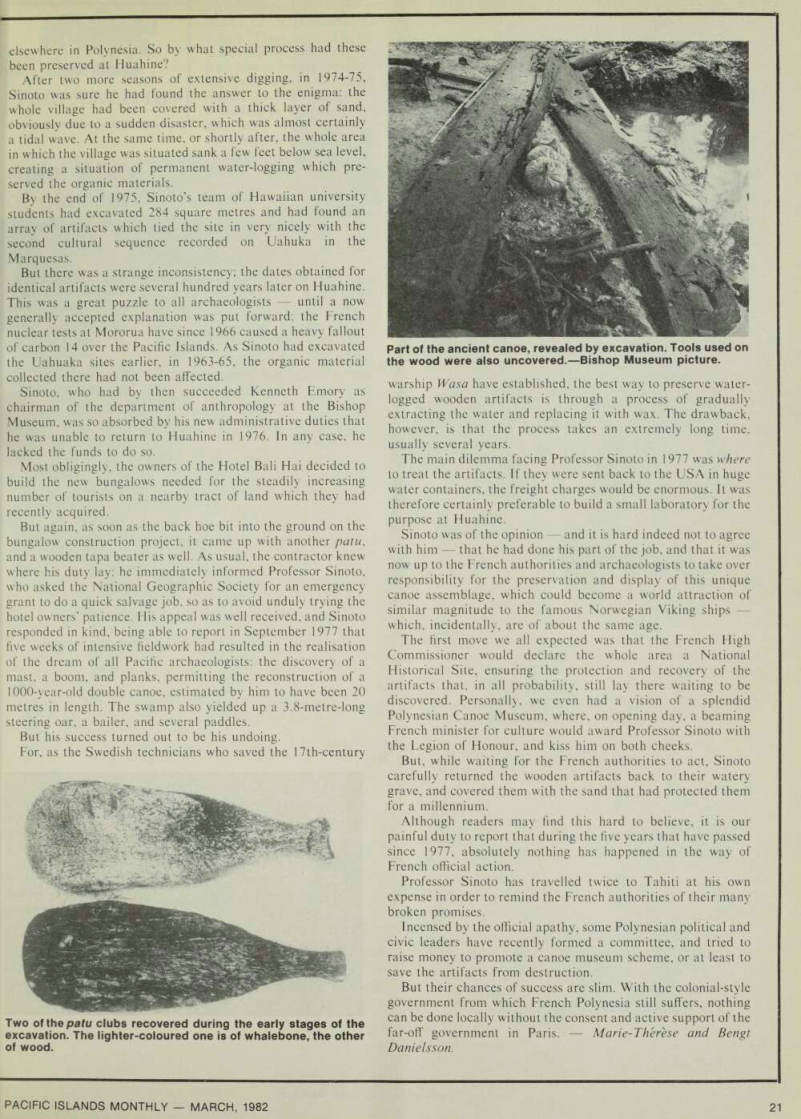
They comprise several well preserved portions of a sewn double canoe more than 1000 years old, surrounded by all the tools used by the pre-historic shipwrights who lived and worked in a fishing village near the present town of Fare. Their miraculous preservation is due to the combined effects of a tidal wave, and the sudden sinking of the land below sea level.
Among the more than 3000 artifacts recovered between 1973 and 1981 by Professor Sinoto’s treasure-diggers are no fewer than 10 flat hand clubs of the patu model previously thought of as having been invented by the New Zealand Maoris.
The joy of discovery is, however, tempered Uy the fact that, despite Professor Sinoto’s heroic endeavours in dealing with French officialdom, no measures have yet been taken to ensure the conservation of these unique treasures, and the protection of the historical site.
The road that eventually led Yoshi as the professor is generally known to his many friends to these momentous discoveries has been long and arduous. He may even, as all good archaeologists should, have had a fair slice of luck. It was also a great help to him that he was guided during the first phase of his fieldwork between 1960 and ’62 by the grand old man of Pacific archaeology, Professor Kenneth P. Emory. Professor Emory undertook his first archaeological survey in French Polynesia in 1925, and was still spry enough 35 years later to return with his favourite pupil.
These first two years proved desperately dull and unproduc tive. But thanks to Emory’s excellent knowledge of the Tahitian language, which Yoshi himself was soon also mastering, the slightly odd couple gradually managed to persuade the islanders to bring them artifacts, and to supply valuable information about the sites where they had been found.
The carefully conducted public relations campaign paid off handsomely in 1962, when they were taken to a burial site on the island of Maupiti. The 13 skeletons they uncovered dated from the ninth century AD, and the burial goods, mostly whalestooth pendants and adzes, perfectly matched the artifacts excavated in New Zealand in the famous moa hunter settlement at Wairau, on the South Island.
Professor Emory spent the next few years in his Honolulu office preparing a series of fascinating reports which have already become classics of their kind. Yoshi, for his part, went on to the Marquesas, where, on the island of Uahuka, he discovered a coastal village dating from 300 AD, making it the oldest known human settlement in Eastern Polynesia, and therefore very likely the dispersal centre for the whole area.
Remarkably enough, all the excavations so far had been financed by the Bishop Museum and various American scientific foundations. The only local contribution, belatedly made by the Tahitian Tourist Board, was linked to a request for Sinoto’s help with the restoration of some marae ruins on Huahine, with a
view to attracting more guests to the Bali Hai Hotel which was under construction there.
As a rule, building contractors are the archaeologist’s worst enemy. Generally speaking, they try to conceal their workmen’s discoveries for fear that the archaeologists will manage to have the whole enterprise stopped, either temporarily or perhaps for good.
So let us do honour here to the Bali Hai contractor. Richard Soupene, who had not only gone to the trouble of collecting all items unearthed, but was also perfectly willing to show them to Sinoto when, in May 1972, he turned up in Fare.
As one of the first artifacts handed over to Sinoto was a patu club of whalebone, he immediately realised the scientific importance and extreme age of the site. A whalebone sample he took back with him to Honolulu confirmed that the settlement was at least 1100 years old.
The hotel owners proved as understanding and helpful as the contractor: they agreed to postpone all work until Yoshi could return and excavate the whole area in a more careful and systematic manner than the drivers of the bulldozers and back hoes had so far done.
However, the local support offered for the commercially motivated marae restoration project did not extend to such a purely scientific undertaking. It was only through the generosity of the French-Polynesian Deane family brothers James and Ben, who had made good in America that Yoshi could at long last start probing the site in August 1973.
Among the artifacts found in the bottom layer, and on the very last day, was a wooden patu. A few other wooden tools, as well as pandanus nuts and coconut shells, were collected.
Carbon 14 samples indicated that they dated from 900-1100 AD.
No other wooden artifacts of similar age had been dug up
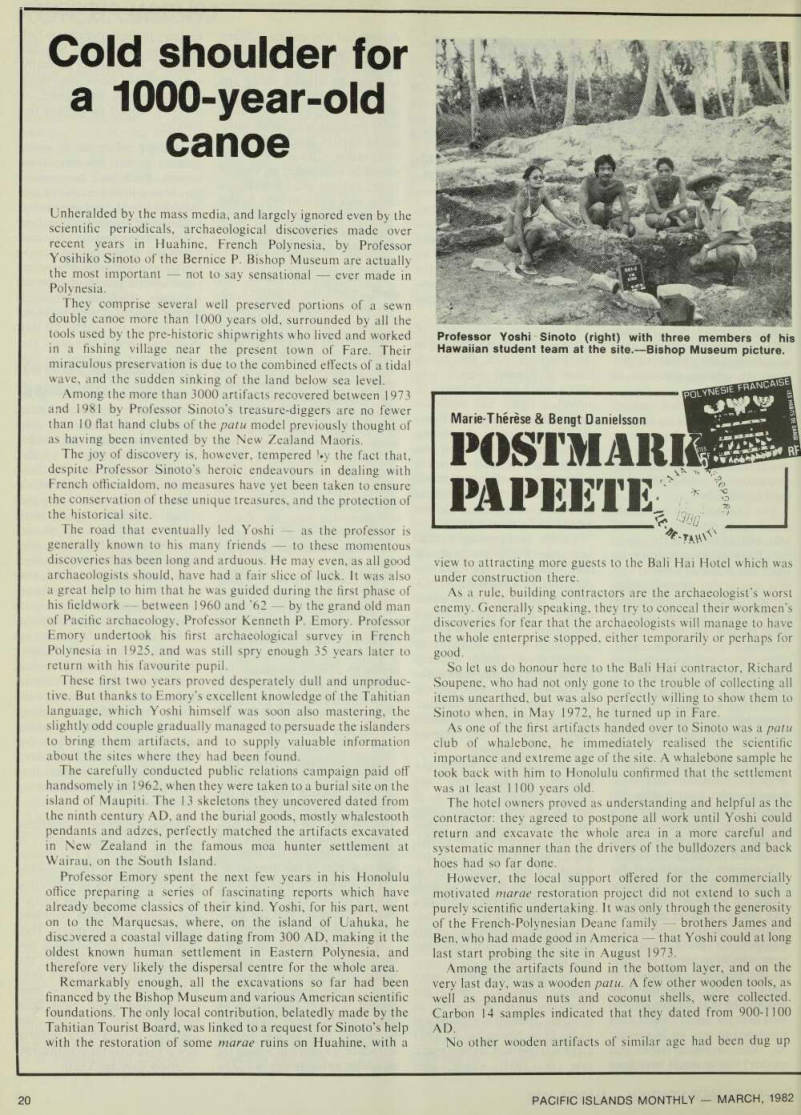
Professor Yoshi Sinoto (right) with three members of his Hawaiian student team at the site. —Bishop Museum picture.
elsewhere in Polynesia. So by what special process had these been preserved at Huahine?
After two more seasons of extensive digging, in 1974-75, Sinoto was sure he had found the answer to the enigma: the whole village had been covered with a thick layer of sand, obviously due to a sudden disaster, which was almost certainly a tidal wave. At the same time, or shortly after, the whole area in which the village was situated sank a few feet below sea level, creating a situation of permanent water-logging which pre served the organic materials.
By the end of 1975, Sinoto’s team of Hawaiian university students had excavated 284 square metres and had found an array of artifacts which tied the site in very nicely with the second cultural sequence recorded on Uahuka in the Marquesas.
But there was a strange inconsistency; the dates obtained for identical artifacts were several hundred years later on Huahine.
This was a great puzzle to all archaeologists until a now generally accepted explanation was put forward; the French nuclear tests at Mororua have since 1966 caused a heavy fallout of carbon 14 over the Pacific Islands. As Sinoto had excavated the Uahuaka sites earlier, in 1963-65, the organic material collected there had not been affected.
Sinoto, who had by then succeeded Kenneth Emory as chairman of the department of anthropology at the Bishop Museum, was so absorbed by his new administrative duties that he was unable to return to Huahine in 1976. In any case, he lacked the funds to do so.
Most obligingly, the owners of the Hotel Bali Hai decided to build the new bungalows needed for the steadily increasing number of tourists on a nearby tract of land which they had recently acquired.
But again, as soon as the back hoe bit into the ground on the bungalow construction project, it came up with another patu , and a wooden tapa beater as well. As usual, the contractor knew where his duty lay: he immediately informed Professor Sinoto, who asked the National Geographic Society for an emergency grant to do a quick salvage job, so as to avoid unduly trying the hotel owners’ patience. His appeal was well received, and Sinoto responded in kind, being able to report in September 1977 that five weeks of intensive fieldwork had resulted in the realisation of the dream of all Pacific archaeologists: the discovery of a mast, a boom, and planks, permitting the reconstruction of a 1000-year-old double canoe, estimated by him to have been 20 metres in length. The swamp also yielded up a 3.8-metre-long steering oar, a bailer, and several paddles.
But his success turned out to be his undoing.
For, as the Swedish technicians who saved the 17th-century
warship Wasa have established, the best way to preserve water logged wooden artifacts is through a process of gradually extracting the water and replacing it with wax. The drawback, however, is that the process takes an extremely long time, usually several years.
The main dilemma facing Professor Sinoto in 1977 was where to treat the artifacts. If they were sent back to the USA in huge water containers, the freight charges would be enormous. It was therefore certainly preferable to build a small laboratory for the purpose at Huahine.
Sinoto was of the opinion — and it is hard indeed not to agree with him — that he had done his part of the job, and that it was now up to the French authorities and archaeologists to take over responsibility for the preservation and display of this unique canoe assemblage, which could become a world attraction of similar magnitude to the famous Norwegian Viking ships — which, incidentally, are of about the same age.
The first move we all expected was that the French High Commissioner would declare the whole area a National Historical Site, ensuring the protection and recovery of the artifacts that, in all probability, still lay there waiting to be discovered. Personally, we even had a vision of a splendid Polynesian Canoe Museum, where, on opening day, a beaming French minister for culture would award Professor Sinoto with the Legion of Honour, and kiss him on both cheeks.
But, while waiting for the French authorities to act, Sinoto carefully returned the wooden artifacts back to their watery grave, and covered them with the sand that had protected them for a millennium.
Although readers may find this hard to believe, it is our painful duty to report that during the five years that have passed since 1977, absolutely nothing has happened in the way of French official action.
Professor Sinoto has travelled twice to Tahiti at his own expense in order to remind the French authorities of their many broken promises.
Incensed by the official apathy, some Polynesian political and civic leaders have recently formed a committee, and tried to raise money to promote a canoe museum scheme, or at least to save the artifacts from destruction.
But their chances of success are slim. With the colonial-style government from which French Polynesia still suffers, nothing can be done locally without the consent and active support of the
far-off government in Paris.
Marie-Therese and Bengt
Danielsson.
Two of the patu clubs recovered during the early stages of the excavation. The lighter-coloured one is of whalebone, the other of wood.
Part of the ancient canoe, revealed by excavation. Tools used on the wood were also uncovered.—Bishop Museum picture.