PNG begins run-up to June poll
pp. 13-15 · Read in the full issue

Jostling at the starting line as PNG begins run-up to June poll
Writing from Port Moresby, STUART INDER reviews the scene as Papua New Guinea’s politicians gear up for the country’s general elections in June. He predicts that Sir Julius Chan will fail to retain the prime ministership, but is much less sure of who will succeed him in the top job when the post election dust has settled.
Glaimi Warena, the big man from Imbonggu in the Papua New Guinea Southern High lands, was in full voice in the daily adjournment debate in the national parliament in Port Moresby in February. It was only the first day of the final sittings of parliament before the general election is held in June and already the house was dangerously close to being with out a quorum. But Warena battled on although few were there to listen to him. ‘Our country is too small, and there are too many bosses’, he shouted in Pidgin. ‘We are a land of copy-cats. When some body sets up a trade store, thousands of other people start trade stores all over the area.
When they run out of money and start planting coffee, every one starts planting coffee. When someone wants to play cards, everyone wants to play cards.
When somebody wants to go courting women, everybody wants to do the same. When somebody throws a beer party, everybody else follows. Mr Somare started the Pangu Party and now everyone in this country is starting their own parties. How many parties are we going to have, and how many men want to become leaders?’
Those few left in the chamber would have probably preferred to hear Warena enlarge on his observation that when Imbonggu men go courting women, everybody in Imbonggu goes courting women. But he proceeded instead to launch into an attack on the evils of PNG political parties which he said were ‘doing nothing to help the people, because certain par ties do not have policies to help the people’. He added that there were instances in which members had been fighting and struggling for leadership and this had been unfair to the community. He particularly at tacked what he saw as a trend
among public servants to resign their jobs so that they could stand for parliament or estab lish political parties.
I suspect there are a great many other Glaimi Warenas out in the electorates, wonder ing aloud where the party system is taking PNG, and probably already convinced that the thing has got out of hand.
There are at present eight political parties, including one in embryo, lined up to fight the election. One or two of them may not even last longer than the closing date for nominations on March 17, and it is possible that new ones may have been launched by then.
Here in Port Moresby party politics is already emerging as an election issue in itself. Are parties of any real value in this country other than as a vehicle for some few leaders to wield personal political power? Do parties in this country achieve real change? The questions are being asked, and there is a feeling of frustration that par
ties have failed as a unifying force.
No single party directs PNG, and none ever has. The present Chan government is an uneasy alliance between four parties and some independents. The parties in the alliance are the Peoples Progress Party, the National Party, the Papua Besena and the Melanesian Alliance (which itself absorbed another group, the Mataungan Association). In equally uneasy opposition for their leaders never know who will be joining the government forces at any time there are the United Party and the Pangu Party.
And adding to these now in the line-up of new factions are the Papuan Action Parly and Ted Diro’s Independent Group.
The Independent Group is not formally a party although former PNG Defence Force Commander Brigadier-General Ted Diro, who leads it, does not hide a belief that it will form itself into a party once its members are in parliament.
The Papuan Action Group is
the invention of Dr Reuben Taureka and Gavera Rea, for mer long-standing Pangu people who have held ministerial office and who apparently want to ride what they hope will be a wave of electoral support for candidates representing provinces on the Papuan side of PNG. Papuans are strong in the national public service, many of them in key positions, and many of them feel that Papuans have lacked the opportunity for the political leadership which has come the way of the New Guineans.
PNG’s two prime ministers since independence, Michael Somare and Sir Julius Chan, have both come from the New Guinea side.
The Independent Group of
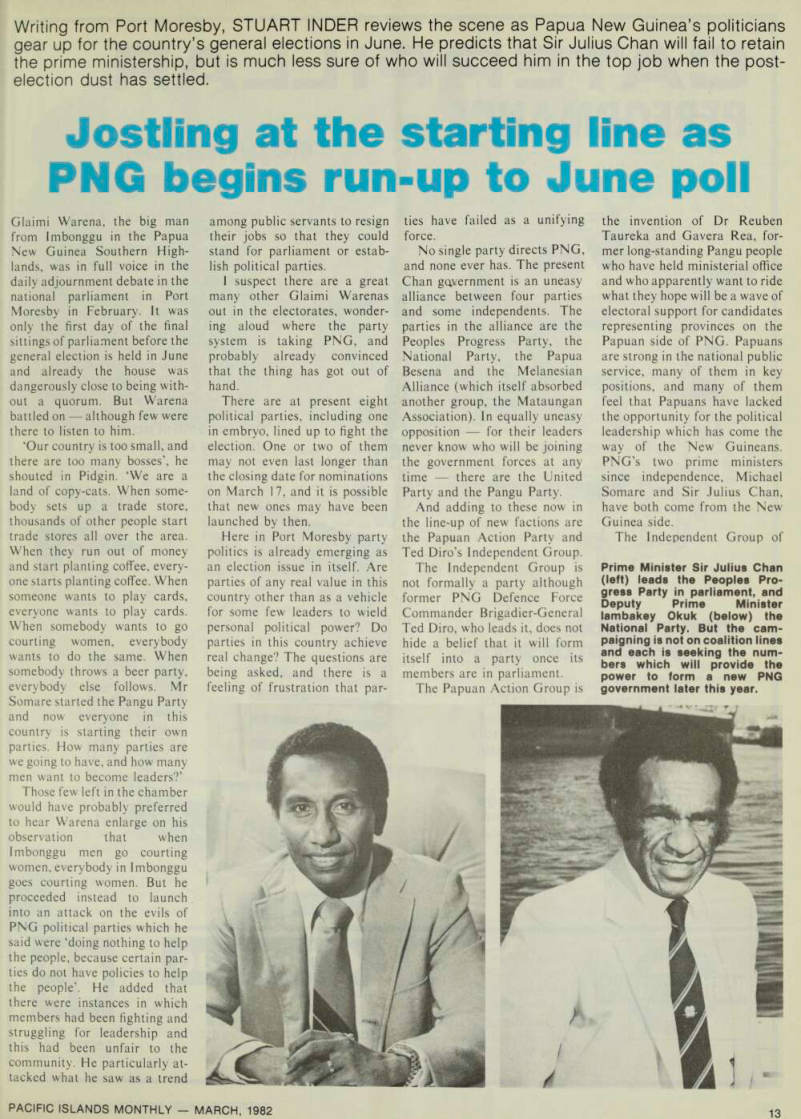
Prime Minister Sir Julius Chan (left) leads the Peoples Pro gress Party in parliament, and Deputy Prime Minister lambakey Okuk (below) the National Party. But the cam paigning is not on coalition lines and each is seeking the num bers which will provide the power to form a new PNG government later this year.
39-year-old Ted Diro also reflects this wave of feeling.
Diro expects to have 41 candidates, all standing as independents but having agreed on a campaign of mutual support.
What the candidates have in common is education and experience in public administration or business. Most will be standing in the Papuan region although there will be some from the North Solomons in the Islands region. Says Diro: T am merely building my base from the Papuan region as Somare built his from the Sepik and Madang areas and Chan from the Islands region.’
Diro believes that the party system in PNG has caused a degree of resentment because the people tend to vote on personal rather than party lines.
For this reason the members of his group are fielding themselves as independents, but chosen by the group because they are ‘worthwhile and
honourable people with a ca pacity to understand complex issues’. Ted Diro does not ex pect to be able to form a government, but he hopes that the support of his group will be needed by any party wanting to do so.
Diro’s group needs to be taken seriously in the elections; the Papuan Action Party need not if indeed it survives.
Michael Somare’s Pangu Party, on the other hand, ap pears to have staged a remark able recovery, with Somare himself being acclaimed by large crowds on his early cam paign tours. He’s brimming with confidence and regularly turning on his famous smile after a lack-lustre two-year stretch in opposition which he says now he was using as a period of consolidation and ‘grassroots building in the prov inces’.
What will be important to discover is whether his un doubted personal popularity can be translated into a sufficient number of seats in the
house to bring him to power.
Out there they can’t all vote for Michael Somare, although if this were a presidential-type election he would be the country’s first president tomorrow.
Political help could be close at hand for him in the form of lambakey Okuk’s National Party. The National Party, at this distance, looks like the one which will best keep pace with Pangu’s popularity, and a National-Pangu coalition could put Somare back as prime minister. This is not inconceiv
able despite earlier clashes be tween the two leaders, and despite Okuk’s avowed am bition for the job.
The United Party is leaderless and in complete dis array, and nobody expects it will be able to get its act together in time for the elec tions. As Papua Besena and the Melanesian Alliance are fairly insignificant in the scheme of things, what of Sir Julius Chan's Peoples Progress Party?
The PPP is the best disciplined party in PNG and it is expected to emerge intact.
But it can’t govern on its own account and Chan doesn’t ap pear to have the personal sup port from any quarter to get him back into prime ministerial office. Somare is adamant that he would not work again with Chan politically (they were once in coalition), although the two men remain friends.
If Sir Julius has been looking especially depressed lately it’s probably because, as an intelli gent and conscientious man (who has tired valiantly to get his ragtag, self-serving collec tion of political party alliances to behave like a responsible government) he knows that in the end there are no thanks in politics.
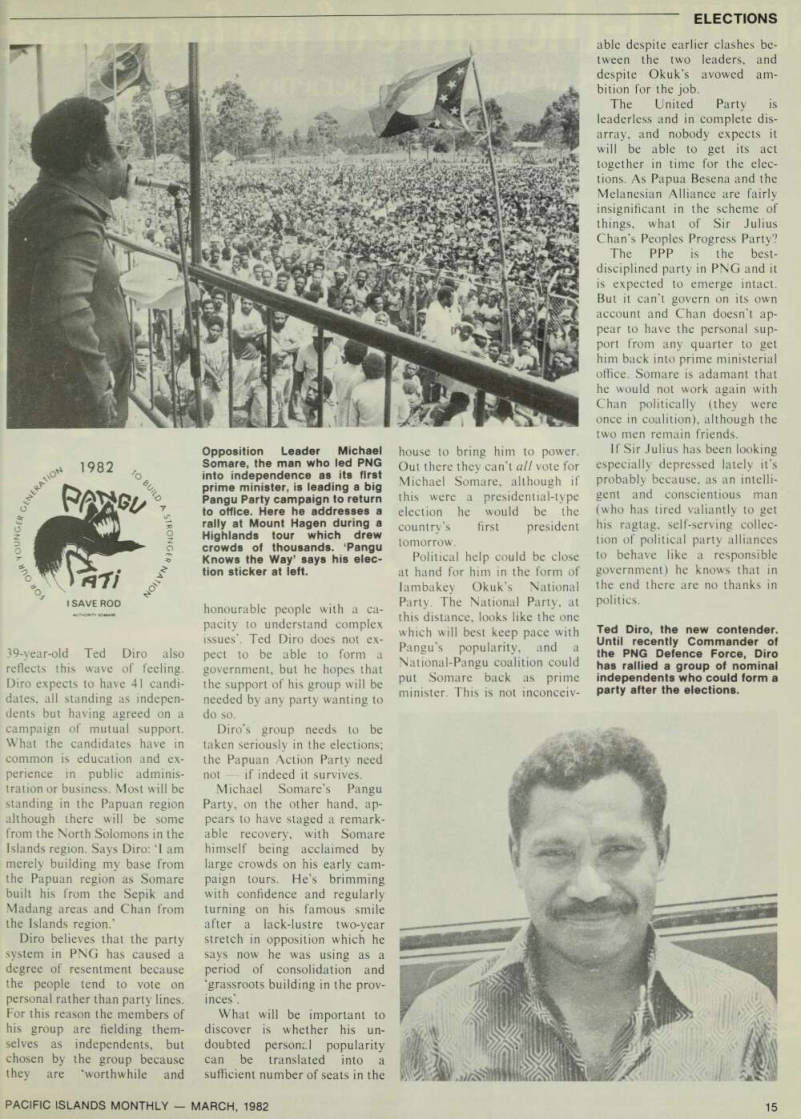
Opposition Leader Michael Somare, the man who led PNG into independence as its first prime minister, is leading a big Pangu Party campaign to return to office. Here he addresses a rally at Mount Hagen during a Highlands tour which drew crowds of thousands. Pangu Knows the Way’ says his elec tion sticker at left.
Ted Diro, the new contender.
Until recently Commander of the PNG Defence Force, Diro has rallied a group of nominal independents who could form a party after the elections.