Letters
pp. 9-11 · Read in the full issue
Pro and con on Fiji in the Sinai
N. W. Lalokalo s letter (P1M Jan pi 0) contains the claim that my letter (PIM Oct ’81 p7) ‘suffers from several errors and misconceptions which should not go uncorrected’. I suggest that this statement applies to his letter rather than mine.
First, my letter was written at a time when only Fiji, Colombia and Uruguay had definitely agreed to participate in the US sponsored Sinai peace-keeping force. I know that other countries have since agreed to participate, but the point is that they have done so only after extremely cautious nego tiations. The Fiji Government, in contrast, agreed to the pro posal immediately, and signed a long-term military agreement.
At least the European countries concerned have tan gible reasons to be interested in political stability in the Middle East. Most bear a measure of historical responsibility for cre ating the political problems there in the first place. Some are military allies of the US, and all have economic interests in the area.
Fiji, a liny nation on a world scale, has no such interests, either political or economic.
Second, the only understand able reasons put forward by the Fiji Government for its involve ment are purely mercenary: 1) lo provide employment for inemployed youth, and 2) to jam about $US5 million. Both •easons lack credibility. Most people who have been engaged n the Middle East have been Public servants or regular ioldiers. As for the few recruits form the unemployed, offering obless young men six months werseas, risking life and limb or a few dollars, cannot be iefended as a reasonable 'em ployment policy’. As for the $5 million, Fijian scrub-cutters on
contract in New Zealand have earned more than that for Fiji in the last four years.
Third, the Sinai force issue would not have been in the headlines in Fiji, criticised by the Pacific Council of Churches and by university students, and debated in the Fiji Parliament, if it were not ‘controversial’. Mr Lalakolo is therefore barking up the wrong tree in asking that 1 give readers an example of an ‘uncontroversial’ peace-keeping force. This was never part of my argument.
Fourth, Mr Lalokalo has not advanced any argument to change my view that the deaths of Fijian soldiers that have so far occurred in the Middle East were unnecessary. His claim that the people of Fiji are ‘quite content with the expressed ap preciation and admiration of Lebanese, Palestinians and Israelis’ is odd. It is indeed hard to believe that there could be unanimity between sworn en-, emies about the presence of Fijian soldiers. If he is saying that the sole reason for sending Fijian troops to the Middle East is so that Fiji can earn some international admiration, he must place small value on human life.
Mr Lalokalo goes on to extol Fijian military sacrifices over seas in the past. In my view, the only justified Fijian military involvements overseas were in the Solomons and Bougainville in World War 11, and in Zimbabwe. In the first instance they fought to defend Fiji and other Pacific Island countries from Japanese aggression, and in the second they went to assist in the holding of democratic elections.
As for the rest, it is mis guided patriotism and a harm ful delusion to believe that dying overseas in any conflict that may come along is a romantic and distinguished way of terminating the lives of representatives of Fijian man hood.
Has Mr Lalokalo been read ing too many American comics a type of reading material which actively fosters such no tions, and which is widely consumed in Fiji?
Fifth, it is news to me that Fiji refused Vanuatu’s request because the ‘dispute was civil and not military’.
So far as I can remember, the
rebels in Santo were armed, as I saw for myself on television, and declared that they were going to fight. Mr Lalokalo adds insult to injury when he refers to the commendable intervention of Papua New Guinea troops in Santo as ‘a comic opera’. How does he think the situation should have been handled?
No amount of dismissive comments from Mr Lalokalo and his type can disguise the fact that the Fiji Government prefers to answer the call from distant foreign countries, rather than from a neighbour. A splen did opportunity to put into practice ‘the Pacific Way’ that Fiji’s leaders are fond of preach ing to the Pacific was here passed up.
Mr Lalokalo says ‘a com monly held principle in Fiji is that a person who does not pay tax to the Fiji Government has no right to criticise its policies’.
Asa Fijian. I know that no such principle exists in the laws of Fiji. The only relevant prin ciple that I know is that regard ing ‘freedom of conscience and expression’ which is guaranteed under Chapter 11, Section 3, of the Constitution, the supreme law of Fiji, ‘to every person’, regardless of ‘race, place of origin, political opinion, colour, creed or sex’. Would Mr Lalokalo care to explain more fully his ‘commonly held prin ciple’?
There is a common Fijian expression for this kind of disputation veiba vakanako - meaning ‘lawyer-like argu ments from the bush’.
I. M. Nakauvadra
Wellington New Zealand This letter cut for length.
Editor.
PFL man replies
to a critic The letter from Kevin B.
Judkins, Second Officer of MT Pacific Voyager (PIM Dec ’Bl p 9), calls for a reply.
I’m afraid Mr Judkins is unaware of the present position of the Pacific Forum Line (PFL). There is no denying that for the first three years of our existence PFL had a chequered career.
But for the past 12 months, with the infusion of new blood at directorial and managerial levels, there has been a corn
plete change of direction. Sev eral points need to be made: • Mr Judkins’ claim that the Marama made a handsome profit is totally incorrect. • A service from Sydney with Fua Kavenga to mid- Pacific Island nations runs regu larly, giving an average voyage time of 27 days. • To the same area from New Zealand with our vessel Forum Samoa the average voy age time is 21 days. • From New Zealand to the Central Pacific, Papua New Guinea area, our vessel Forum New Zealand has an average voyage time of 32 days.
Mr Judkins’ comments relat ing to the reliability of our service are totally unjustified, particularly when our record over the past 12 months is taken into consideration.
The PFL’s financial position for the 12 months ended December, 1981, will show that a significant reduction in the 1980 loss will be achieved.
The Line’s financial and man agement team has new been consolidated in Auckland, New Zealand, and we can confid ently express the view that PFL in 1982 will continue the im provement achieved in 1981.
Critics of our Line would be well advised to look at us in our present condition, andmot judge us by the situation as it was in our formative years.
W. J. Maclennan
Assistant General Manager (Operations) Pacific Forum Line (NZ) Ltd Auckland New Zealand
Hawk-eyed but
friendly . . .
As a very regular visitor to the Pacific region approximately every six weeks I feel that I am fairly well au fait with what is going on on a ‘need-to-know basis. However, PIM is at least the 40 percent contributory factor to my keeping abreast of local events and trends. It is a constant source of usefulness to myself and my colleagues, and is also enjoyable to read, par ticularly for those, like me, who are at present confined to snow bound Britain.
Having got the pleasantries over let us do to you what is frequently done to our publica tions. In your January edition.
on page 25, you have an article on Papeete’s Hotel Stuart head lined ‘Hotel links lazy-lagoon past, jet-age present’. There is a photograph on page 27 illustrat ing this article which is claimed to have been taken ‘about 1930’. Assuming you don’t mean 1930 hours local time, that car parked on the foreshore looks very advanced technology for 1930 AD in fact, is it not one of the 1970 models Alfa Sud or Giulia?
In seriousness don’t bother replying please I’m only trying to prove that PIM is properly read and appreciated here. Please keep up the stan dard par excellence. 1 must also use the cost of a stamp to agree with Frank Lewis from Rabaul (PIM Jan p 8). Yes, a bit too much yachtie stuff — it’s not that they cannot get adequate PR coverage (as if they need it!) elsewhere.
Peter Walters
British Aerospace Hatfield Herts England Thanks. We’re checking the age of that photograph with author John B. Hart. Editor.
Disappointment on
book review Upon reading back in March last year the book review ‘Encyclopaedia in three (unmalching) volumes’ (PIM Mar ’Bl p 47), I immediately ordered the three books con cerned; Man’s Conquest of the Pacific: The Prehistory of Southeast Asia and Oceania: The Prehistory of Polynesia; and Exploring the Visual Art of Oceania, Australia,
Melanesia, Micronesia, and Polynesia.
Only The Prehistory of Polynesia was available. The other two were pronounced ‘out of print’. My bookseller is trying to locale these other books, but to date without success.
I realise that such books would have a limited appeal, and that no great numbers would be printed. 1 am sure that many of your reviews send people for pen and paper to write off to their booksellers, so could you please be sure to give early reviews of books of this type, which are available only in limited quantities. No doubt there are many, like me, who depend on your reviews to know what’s ‘on’ in the Pacific. I feel that travel and adventure books, generally being in large editions, could wait a little longer for review with no loss to anyone.
Perhaps representatives of publishing houses and book sellers reading this could re member that the Pacific is a vast area, and communication is still quite slow in remote areas.
So we need lime, and often we really need the books reviewed because we are in remote places, and no library is avail able to us.
John Mckenna
Our Lady of the Rosary Community Gizo Solomon Islands
USA: ‘Coloniser’
charge disputed
An article discussing Micronesia in the June, 1981, issue of PIM (p 57) intrigued me. One Juan R. Fernandez, apparently a Puerto Rican, evaluates US policies towards this Pacific group. Never hav ing had the opportunity to visit any part of Micronesia, 1 do not offer any expert advice on that area. 1 am, however, concerned at the following statement made by the writer; ‘lt is indeed ironic that as decolonisation is coming to an end, the United States is being increasingly perceived as the last great coloniser.’ Just where this gentleman obtains his information puzzles me.
I would suggest that he get out a map of the world and
study it a bit. If he is of the opinion that the citizens of Poland, Hungary, Bulgaria, Romania, Czechoslovakia, Latvia, Lithuania, Estonia and the Ukraine are not currently being subjected to ‘colonisation’
I suggest that he ask them if he ever gets the chance.
Further, what about Afghani stan, Angola, Mozambique, and his own Caribbean neighbour of Cuba and Grenada?
Colonisation might be sub ject to different interpretations in the minds of different people, but please do not forget that the direction of most of the ‘boat people’ of the world is towards the United States. 1 am sure that the constant influx of all these persecuted people is add ing to the cultural richness of our own country, but let us not forget that they are coming to freedom, and not fleeing from it.
As to Puerto Rico’s own status, undoubtedly there is room for improvement in the political situation. However, within the past week I have seen a UPI report from San Juan that last year’s election indi cated that 47 percent of the people there decided that they preferred Statehood, and 47 percent preferred to continue with the present status as a Commonwealth. Only six per cent indicated a preference for independence.
Urban D. Kapler
Phoenix Ariz
Usa
Angry words from
a ‘kiap-baiter’
It is beyond my comprehension how anyone at all could try to glorify the so-called ‘legendary kiaps’ and their postwar activi ties in Papua New Guinea, as is done in a recent ‘ad’ in PIM. If we examine the facts, the ‘legendary kiaps’ can only go into the history books as a near total disgrace to the white race in general and to Australia in particular.
With a few very rare excep tions, the ‘legendary kiaps’ were known from Kavieng to Daru as the most arrogant, incompetent and ignorant ‘olmasta’ who ever set foot in PNG, many of them being or becoming chronic al
coholics, while others dis tinguished themselves as sex maniacs or sometimes they were both. Testimony to these facts can today be seen in any part of PNG where hundreds of half-Australians roam the streets, belonging neither to him nor to her. Cases in which such ‘legendary kiaps’ fathered four or five and more illegit imate children, and looked after none, are not uncommon in the annals of PNG’s colonial his tory.
By independence in 1975, there was very little the ‘legend ary kiaps’ in PNG could be given credit for, which was not there before their, arrival or which had been established exclusively for their own benefit and the benefit of their white masters, particularly in PNG’s vast rural areas.
Meteoric rises were not un common in PNG’s kiap dynasty in which it only seemed to matter who knew whom. For mer bank employee dropouts could be seen as ‘military intel ligence advisers’; former farmhands advanced to the post of district commissioner. In one case a former Snowy Mountains labourer was to be seen acting as minister for mines and en ergy in the newly established Somare government after serving his time as a ‘legendary kiap’ in the Luiu-Aitape areas.
As already mentioned, there were the rare exceptidps, and some kiaps may have left their positive marks in PNG like John Pasquarelli and the re markable lodge he built on the upper Sepik. But here again, Pasquarelli did not build the lodge as a ‘kiap’.
All major towns and villages were already established long before the ‘legendary kiaps ever set foot in PNG and the addition of numerous clubs< hotels, kiap and white masU accommodation and busines enterprises, can hardly be con sidered as advantages and im provements for PNG’s native and particularly the rura population, most of which i even today still at the sam stage as 50 years ago. Thi acquisition of steel axes an shotguns has hardly made muc difference.
So much for Australia' ‘legendary kiaps’ and the;
doubtful reign in PNG. The Australian taxpayer still today has to pay hundreds of millions of dollars to keep PNG on its feet. Most obviously, if the ‘legendary kiaps’ and their col onial administrative bosses had done what they were supposed to do, the Australian taxpayers’ yearly burden of more than $2OO million to PNG would not be necessary today, seven years after PNG gained its indepen dence.
This letter may be considered what was once known in PNG as ‘kiap-baiting’, but it may also add to so-called contemporary history by showing the other side of the coin one view of what kiaps were all about in the eyes of the PNG ‘native’.
Kessua Tamai
Proserpine Qld Australia
Pacific-Caribbean
ties stronger
A little publicised but significant feature of the 1981 Commonwealth Heads of Gov ernment Meeting (CHOGM) in Melbourne (PIM Nov ’Bl pl 1) was the forging of closer links between island countries of the Pacific and the Caribbean.
With nine Pacific Island members and 10 Caribbean, they comprise almost half the membership of the 40-odd strong Commonwealth. They come even closer to being half if ‘Special members’ of the Commonwealth, Tuvalu and Nauru, are counted.
The Melbourne meeting saw the Pacific and Caribbean groupings getting together in caucus to discuss their prob lems, particularly before the ‘Problems of Small Island States’ session on the second last day of CHOGM.
The daily newspaper The Australian heralded the session with the headline ‘Unhappy Islanders to Push Issues’, and in a short report noted that ‘small island nations plan a united front to swing the conference back to issues that worry them’.
They were, the paper said, ‘upset at being virtually ignored during the proceedings, being upstaged by larger nations and emphasis on the North-South dialogue’.
Topics discussed at the
special session included the failure of the International Monetary Fund to provide effective finance for small states, transport, communi cations, and the need for greater access to overseas markets.
The session passed without attracting much attention. The agenda was in fact shared with another item, ‘Financial and Economic Issues’. Fiji’s Prime Minister Ratu Sir Kamisese Mara probably summed up Island states’ reactions when he was quoted in the press next day saying: ‘CHOGM is full of good philosophies and intentions, but very little real action’.
What seems certain is that, come next CHOGM, Island representatives from the Pacific and the Caribbean will be getting together again in an effort to make a greater impact on proceedings than they man aged in Melbourne.
Max Quanchi
Frankston Vic Australia
US policy: Review
missed the point
It seems to me that Stuart Inder’s review of John Dorrance’s Oceania and the United States (PIM Oct ’Bl p 29) fails to come to grips with the issues. Dorrance is part of the US foreign policy establish ment and one can expect from his writing a best-case scenario for US policies.
Dorrance’s words describing US interests and goals in Oceania seem reserved, hu mane, and reasonable to be sure. Yet, these are almost the same words used in public to describe US policy in Southeast Asia while sustaining a military invasion of the area. At present, the Soviet Union puts such words to use in rationalising its attack in Afghanistan. It is not enough to consider words, one must consult history and care fully question each precept.
Historically, the only difference between the US and other powers in the Pacific has been its ability to overcome or outlast all France excepted.
The peoples of the Pacific (especially Indians, Eskimos, Aleuts, Polynesians, Micro nesians, Okinawans, and Fili pinos) have had to pay a steep
price as the US fought its way to the lop of the heap. Thus, when Dorrance states (p 33) that, in part, US strategic/ security interests derive from its presence in the Pacific, one should remember how that came to be, and the cost of it already to the peoples of the Pacific.
In the next paragraph Dorrance lists US objectives, the last one of which reads, ‘preservation of a friendly and stable political environment supportive of the [listed] inter ests’. Just how insidious this can be is evidenced in the US support, both militarily and at the United Nations, for Indonesia’s brutal invasion of East Timor.
Dorrance writes about ‘inter nationally recognized rights of navigation .. . and innocent passage through territorial waters’, and US access to seabed resources. The impli cations here for small, es pecially island nations, are om inous. They are the words of a policy that allows Dorrance to write with confidence (p5B) that such states, ‘have little hope of being other than international economic wards'.One might probe further and ask: recog nised by whom, under what conditions, and for whose benefit?
Had US policy been as reasonable as Dorrance would have the world believe, the negotiations at the Law of the Sea Conference would have been less acrimonious. The new US administration at one stage broke off the talks enraged over the few concessions won by Third World nations. Further, recent US action against Libya
over differing views of these rights of navigation reveals a US willingness to take by force what can’t be won with words.
Stuart Inder forgot the re porter’s scepticism which re fuses to allow others, such as the US and the Soviet Union, to define issues and concepts.
David Paul
Belmont Mass
Usa
Tm Jesus’ claim
brings protest
I would like to record through your columns my objection to a story in the January 24, 1982, issue of the Sunday Sun, pub lished in Suva, which makes a great fuss of a man, P.P. de Saint Clair, who claims to be Jesus Christ.
Such a story is offensive to believing Christians such as myself.
It cheapens the faith of Christians. If we expect our Lord Jesus Christ to come to earth to take away all his good people who have been worship ping him all along (and leave the odd ones for Satan and his deputy P.P. de Saint Clair) we expect him to come from Heaven, and not some tiny village in southern France like that inhabited by the wicked claimant Saint Clair.
Semi Goneyali
Tailevu Fiji
Support for SPC
SPEC merger
I am in total agreement with Papua New Guinea’s call for a single organisation of South Pacific countries which ‘would mean the effective amalga mation of the South Pacific Bureau of Economic Co operation and the South Pacific Commission’ (PIM Dec ’Bl pl 4).
I am also glad to note that incoming SPC Secretary- General Francis Bugotu is in favour of the merger.
What surprised me was that SPEC Director-General Dr Gabriel Gris has defended the continued existence of the two bodies.
R. Muniappan
University of Guam Guam
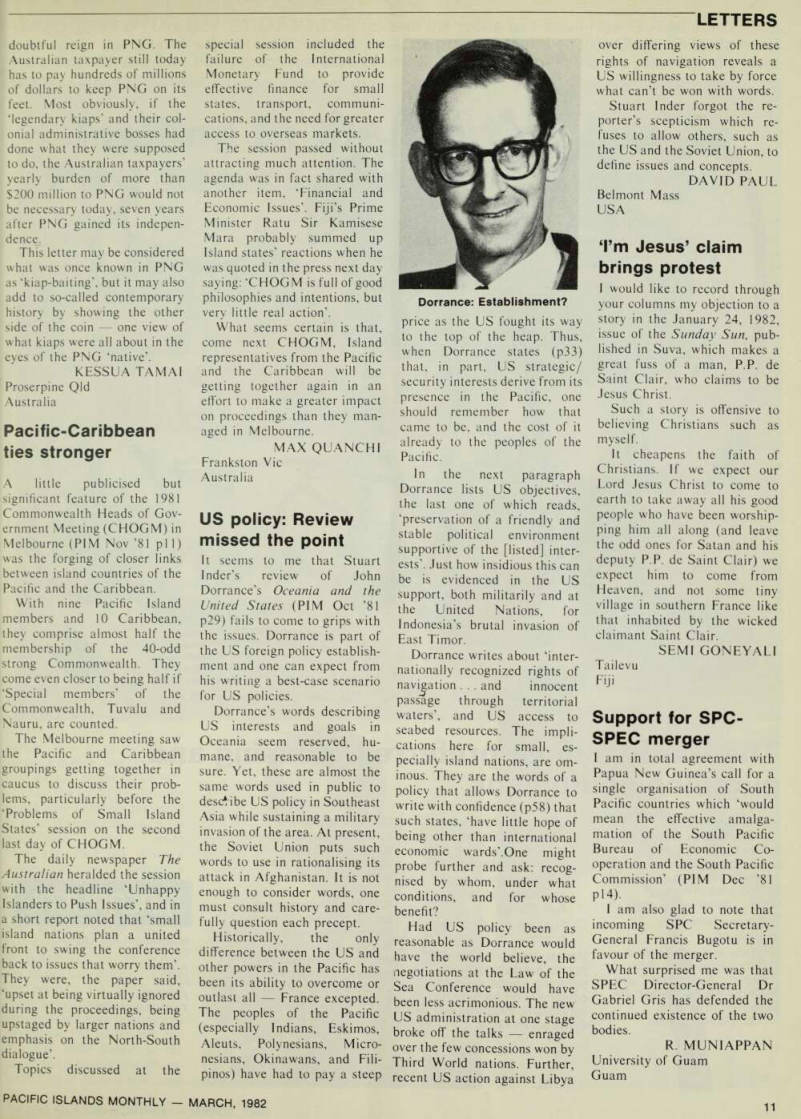
Dorrance: Establishment?