Tonga’s no
pp. 23-27 · Read in the full issue

Tropicalities
‘soft’ drugs
transit post
A tangled tale, with an inter national background and many of the ingredients of a Crime Club thriller, unfolded in Tonga's Supreme Court late last year.
It ended with two West Germans, Werner Heckelmann, 31, and Karl Manfred Schwenk, 38, being convicted on charges of conspiracy, im portation of a prohibited drug, and possession of 25 kilograms of high-grade hashish with an estimated value of between $5OO 000 and $750 000 on the New Zealand market for which it had been intended.
Heckelmann, revealed as the prime mover in this ‘Operation Tonga Transit’, was fined ST6OOO and sentenced to 20 years gaol, while his offsider Schwenk received a 12-year sentence.
The drug saga began early in November, 1981 when New Zealand police advised Tongan colleagues that a known Austrian drug trafficker was believed to be staying at the International Dateline Hotel in Nukualofa. When a local check revealed that a man answering the description given, but call ing himself Jan Nielsen (not the name of the trafficker), was indeed staying at the hotel, two New Zealanders -- a policeman and a Customs officer -- flew to Tonga to stand by while local police made a search-warrant raid on ‘Nielsen’s’ room.
Because the suspect had reportedly been seen talking to and visiting the room of another hotel guest (Schwenk), police decided on a simultaneous search of both rooms on the offchance of finding a more than casual link. The Austrian, found in possession of a false Danish passport and three small
pellets of hashish, was handed over to the New Zealanders and, with his wife and child, taken back to that country to stand trial on other counts.
From the Tongan angle, it was the ‘on spec’ subsidiary raid which yielded the major results.
In Schwenk’s room, police found an aluminium trunk con taining the plaster model of a religious statue. It was in two sections a three - sided base with bas-relief religious motifs, and a sculptured head of Nobel Peace Prize winner. Mother Teresa. The model was an expensive and impressive work of art and might well not have aroused suspicion but for the fortunate fact that the New Zealand officer had two Polar oid photographs of it, and that these had been found in the possession of another trafficking suspect (Heckelmann) who had been interrogated in Auckland.
In view of this strange coinci dence, the Tongan officer in charge of the raid sent for a drill and bored investigatory holes in the plaster head and base.
When the drill emerged showing traces of what looked and smelled like hashish, the plaster moulds were broken
open and found to contain 57 cellophane-wrapped packages containing 25 kilograms confirmed by New Zealand Department of Scientific and Industrial Research to be hash ish of unusually high THC content.
Further interrogated in Auckland, Heckelmann admit ted ownership of the cache, supported Schwenk’s claim that he had known nothing of the model’s contents, and volun tarily travelled to Tonga to stand trial.
The two accused were held in custody for several weeks while police painstakingly unravelled a train of evidence which showed that the men had trav elled from Frankfurt to Nepal together. There, while Schwenk devoted his time to girls and gambling, Heckelmann had purchased the hashish, com missioned the hollow statue which was to be its hiding place, and packed it carefully in the aluminium trunk. This he con signed, in Schwenk’s name and as luggage in advance, first to Manila and later to Tonga, via Singapore and Auckland. Docu ments preserved by Schwenk showed that Heckelmann, armed with Schwenk’s written authorisations, had taken pos session of the trunk in Manila and again in Tonga, before passing it to his co-conspirator and flying on to Auckland to set up his marketing contacts. Al though convinced that the in itial Austrian suspect was heavily involved in the drug running exercise police were unable to find any concrete evidence of this or to elicit any admissions from the two ac cused which suggested the Austrian was involved.
In passing sentence Mr Jus tice Hill said the evidence showed Heckelmann to be a cunning criminal who cared nothing for the lives which might be endangered by his actions, an who deserved a sentence of real severity.
Schwenk, he added, had pleaded ‘t e traditional smuggler’s defence’ (‘I didn’t know what was in the package’).
Whether his claim was true or false was, however, irrelevant, as it was not a valid plea under Tongan law. He stressed that possession, knowingly or un knowingly, was the relevant offence and that the prosecution does not have to prove knowl edge that the material carried was, or contained, a prohibited drug.
Tongan authorities hope that this facet of the local law, plus the severity of the sentence imposed in the kingdom’s first major drug trial, may prove discouraging to any other traffickers who might cast an eye in Tonga’s direction as a possible ‘soft’ staging post.
From Penny Hodgkinson in Nukualofa,
Better late than
never in Fiji...
Fiji’s Parliament received an 11-years belated Independence gift from Britain’s House of Commons late last year.
It is a parliamentary clerk’s table made of English brown oak, and was officially presented to a joint meeting of the Upper and Lower Houses.
The presentation was made by a House of Commons del egation led by John Stradling Thomas, Conservative MP for Monmouth, and including
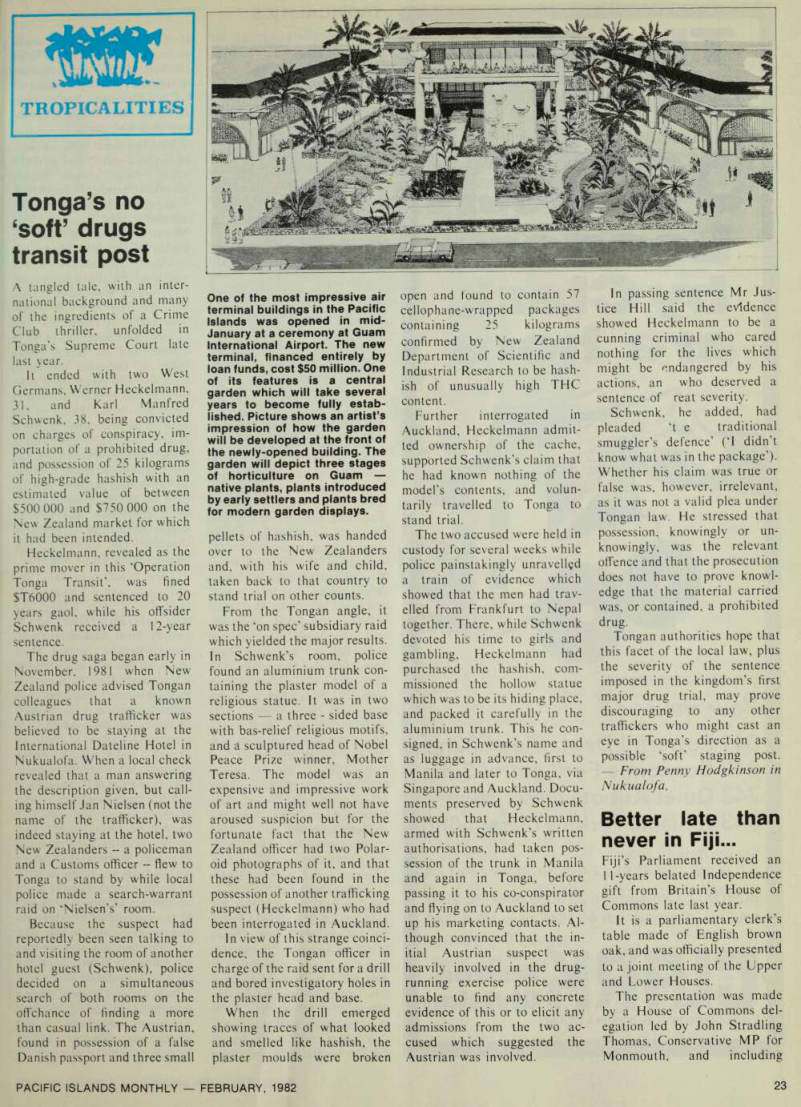
One of the most impressive air terminal buildings in the Pacific Islands was opened in mid- January at a ceremony at Guam International Airport. The new terminal, financed entirely by loan funds, cost $50 million. One of its features is a central garden which will take several years to become fully estab lished. Picture shows an artist’s impression of how the garden will be developed at the front of the newly-opened building. The garden will depict three stages of horticulture on Guam native plants, plants introduced by early settlers and plants bred for modern garden displays.
Austin Mitchell, Labour MP for Grimsby, and Michael Ryle, the Clerk of the Overseas Office at the House of Commons.
Speaking after presenting the keys of the desk to the Clerk of Parliament Mrs Lavinia Ah Koy. Mr Thomas said it was a great honour and privilege for him to present the gift from the ‘Mother of Parliaments’.
Bill Clark, Leader of the Fiji House, said it was a tradition of Commonwealth parliaments to send gifts. The Speaker’s chair in the House was a gift from India, for example. The Oppo sition Whip, Mrs Irene Jai Narayan, endorsed Mr Clark’s remarks and said that the table was an excellent gift of fine craftsmanship. But finer still were the sentiments behind the gift, she said.
Greenpeace vs.
Hippopotame
The revelation that huge quantities of nuclear waste that had been stockpiled on Morurua Atoll, French Polynesia, are spilling over into the ocean coincided with and perhaps even prompted the sailing of the protest vessel Greenpeace 111 (also described in many press reports as Vega).
Little by little the mass media in Europe, America, Australia, New Zealand and the Pacific Islands began spreading the bad news. The fact that France’s best known ecologist, Brice Lalonde who attracted no fewer than 1 200 000 votes in France’s May 1981 presidential election - had joined his friend and fellow peace activist Bruce McTaggart for the new protest cruise to Moruroa was particu larly embarrassing for the French Government.
To stem the mounting tide of criticism at home and abroad.
Minister for Defence Charles Hernu. at the end of November, produced an old trick that has always worked well in the past: he announced in the French National Assembly that he was going to invite a number of Polynesian government council lors and parly leaders to visit Moruroa on December 3 ‘so that they can see for themselves that there are no radiation dangers for the personnel living
there’. Their lour conductor was to be no less a personage than the boss of the French nuclear submarine fleet. Admiral Claude Fieri, who lost no lime in flying out to Tahiti to ac complish his mission.
The last time such an invi tation was issued was in 1979 after it had become known (thanks to articles in opposition newspapers) that several serious accidents had occurred on Moruroa, resulting in the deaths of two technicians, the spilling of plutonium on the atoll's surface, and a large-scale under-water leakage of radio active matter into the ocean.
The eight assemblymen and government councillors (who, of course, had no expert know ledge of radiation problems) were literally taken for a ride: all they did, or were allowed to do, was to make a tour of the atoll by helicopter. On their return to Tahiti they quite frankly declared that they had seen nothing and learnt nothing.
In the official bulletin, distrib uted to all mass media, their main conclusion was worded slighty differently it stated that they had noticed no pol lution whatsoever on Moruroa...
Their reaction to the 1981 invitation was different from that of two years before: like wise old barracudas who’ve already been hooked, they all refused to take the bait. Even worse for the poor minister and his admirals, they recalled that the Territorial Assembly had voted unanimously on August 18, 1979, for the French Gov ernment to allow a group of French and foreign radio biologists to visit all the relevant islands of French Polynesia and publish their findings. Since Minister Hernu had stated in Papeete on July 31, 1981, that the new Socialist government of President Mitterrand to which he belonged was going to make a complete break with the hush up policies of previous Right wing governments, this re minder was a timely one. The assemblymen are still waiting for Minister Hernu to make good on his promise.
Nor has Charles Hernu thought of extending his invi tation to the only ones left who are definitely not only willing but eager to go to Moruroa
Brice Lalonde, David McTaggart, and the other ecol ogists on the Greenpeace 111.
For example, the French war ship Hippopotame recently caught up with them 50 nauti cal miles from Moruroa and ordered them not to go closer to the place than 42 miles. ‘Why 42 miles when territorial waters extend only 12 miles?’ the French navy men were asked.
The navy officers explained rather lamely that this was the radius of the danger zone forbidden to all ships by a special decree back in the 19605. The Greenpeace crew immediately pointed out that this decree had been issued at a time when the tests were car ried out in the atmosphere, and that it did not apply any longer unless the under-water tests now taking place at Moruroa are also dangerous for ships passing at that distance.
Impressed by this display of logic, the military high com mand let the Greenpeace 111 proceed until on December 3, 1981, she came within 15 miles
of Moruroa.
Marie-Thérèse
and Bengt Danielsson.
• For later developments, see ‘Postmark Papeete’, pi 4.
Culture theme in
PATA meeting
The Pacific Area Travel Associ ation recently completed its second Tourism and Heritage Conservation Seminar in Manila. Lord Duncan-Sandys, president of Europa Nostra, was the keynote speaker as he had been at the first seminar in Bangkok in 1979.
The theme of the seminar, ‘looking back to tomorrow’, was treated by many experts in the field of historic preservation.
Terry Kemaslon, director of development for PATA whose department sponsored the sem inar, said that the co-operation being developed as a result of the joint efforts of experts in tourism and heritage can do nothing but improve the Pacific as a place to live and visit.
Culture and heritage are the single most important attributes a visitor destination has to offer tourists. Conversely, the con trolled enjoyment of these attri butes by visitors can provide economic stimulus to further
their preservation. The most important message from the seminar for the Pacific Islands was that they should endeavour to retain those physical and cultural attributes that are significant to the area, and to maintain the architectural structure of the villages by building more Tale- type resi dences which blend better into the village environment than European-type houses.
At the same time they should encourage the preservation of early Western-style buildings from the colonial periods. The dances and culture, which are their living heritage, should be cherished and retained for the enjoyment of local people and visitors alike Retention of these aspects of the cultural heritage can en hance the lifestyle of local people, while ensuring that visi tors see what is unique to the destination.
Meeting after the seminar, the PATA Development Auth ority Council resolved to em phasise cultural preservation at its next Biannual Seminar, a change from the emphasis
placed on structures and monu ments in the previous two. This emphasis on ‘culture’ should prove of considerable value to Pacific Island countries who are struggling with the impact of tourist development on their cultures. The meeting decided: ‘The PATA Development Authority recognises the fragile state of many island cultures and if tourism can develop without infringing on this cul ture, they would like to assist in seeing that tourism develop ment is properly implemented.’
Ta’ofi Atoa.
Mariner’s Tonga
in new edition
December saw the publication of a new edition of William Mariner’s account of Tonga in the early 19th century, An Account of the Natives of the Tonga Islands. Entitled Tonga
Islands, William Mariner’s Ac count, the new edition has been wholly produced in Tonga, printed at the Government Printing Office and published by Vavau Press Ltd, of Neiafu, Vavau.
The book marks a couple of significant anniversaries: it ap peared on the 175th anniversary of the Port-au-Prince massacre in which, on December 1, 1806, an English privateer of that name was seized by the Tongans at Haapai, and many of her crew killed. The lives of 26 men were spared so that they could work the captured guns.
Among them was an English youth, William Mariner, who was to remain in Tonga for four years, living as the adopted son of the warrior king Finau ‘Ulukalala.
The book’s publication also coincides with the 150th anni versary of the introduction of printing in Tonga.
A feature of the new edition is that it carries a preface by Mariner’s great-great grandson, Denis McCulloch, of Wallingford, England.
Mariner left Tonga in November 1810. On his return to London his experiences fired the imagination of the young Dr John Martin, who had long wanted to write the history of a society that had been uninfluenced by Western civilis ation.
From Mariner’s narration, he produced the account and, into the bargain, compiled the first comprehensive dictionary, and a grammar, of the Tongan language.
His work was first published in two volumes in London in 1817. The two volumes have been combined into one paper back volume by Vavau Press.
It includes the original
appendices.
The new preface contains Mr McCulloch’s account of the family and fortunes of his ancestor. He describes a career that led up to a £1 million Exchequer Bill forgery scandal in which Mariner found himself involved, and suggests that the impact of this event on Mariner ‘may have led him to his mysterious death in 1853’
He pays warm tribute to the work of Dr Martin, writing: Tf it had not been for the enthusi
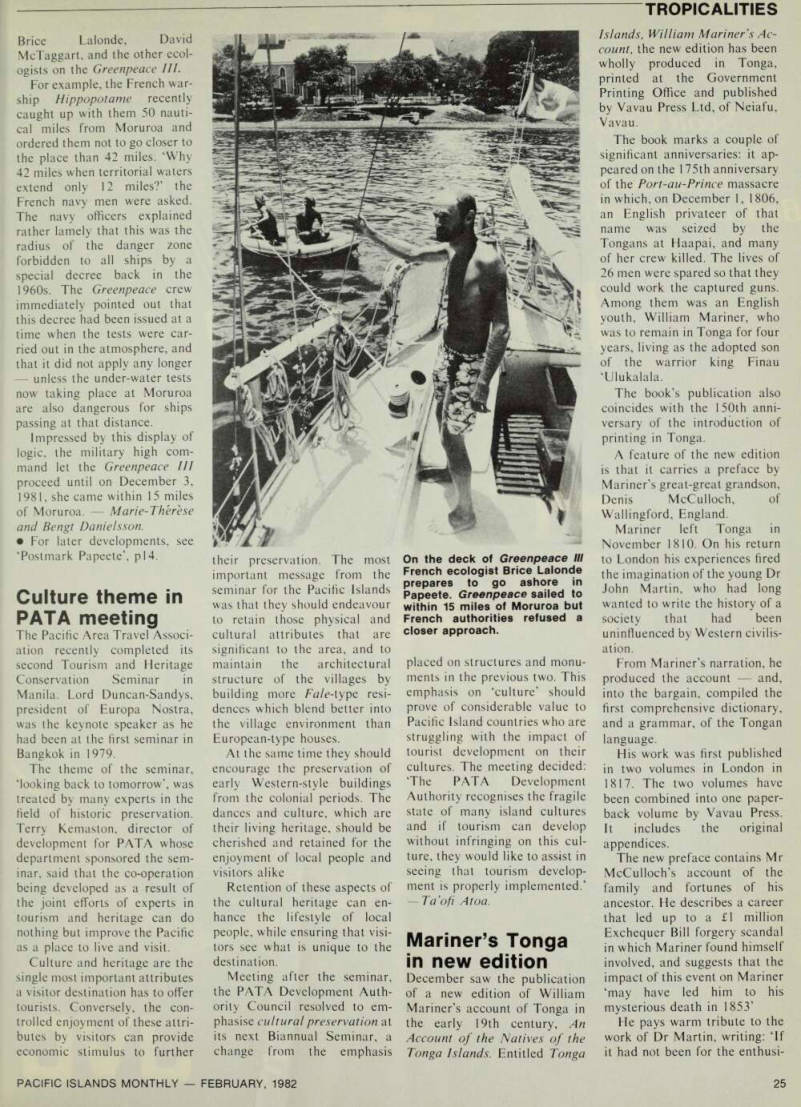
On the deck of Greenpeace III French ecologist Brice Lalonde prepares to go ashore in Papeete. Greenpeace sailed to within 15 miles of Moruroa but French authorities refused a closer approach.
asm, tact and patience of this young doctor, we should today know practically nothing of the story, and the record of an important period in the history of Tonga would be much the poorer... I leave to scholars in the various fields of Polynesian studies to assess the values of the Account in their own ways’.
McCulloch recognises Mafi Habe, Mariner’s adoptive mother, and the great debt Mariner owed her for her efforts in educating a desperate European castaway to become a confident young Tongan chief.
Of the forgery scandal of his later years McCulloch says it came as a shattering blow to Mariner, who had been held in high regard for his probity in business.
The new edition contains an etching depicting Mariner as a young man, and a previously unpublished daguerreotype of him done in about 1850. Tonga Islands, William Mariner’s Ac count, by John Martin, MD, fourth edition, Neiafu 1981, is available from booksellers, or from Vavau Press Ltd, PO Box 83. Neiafu, Vavau, Tonga.
Stuart Inder comments: There may be some dispute as to whether the Vavau Press edition is in fact the fourth edition, as claimed, depending on whether or not one is a purist in these matters The original editions of Mari ner’s Tonga were published in 1817, 1818 and 1827, and all were extremely popular in their dav All of them were two-volume editions, the second volume being three-quarters filled with the dictionary of Tongan words put down by Dr Martin from young Mariner’s memory.
The 1827 edition is marked on the title page as ‘third edition’. But in fact an American publisher in 1820 had pirated the second, 1818, edition, and published it in one volume in the USA, omitting the dictionary and a short introduction to the dictionary, but publishing the narrative in full, complete with the foldout map seen in each of the original editions.
Specialist collectors might debate whether in view of this American edition of 1820, the British 1827 one published as a
Constable Miscellany edition was not in fact the fourth edition, making the new Vavau edition the fifth.
In recent years two other reprints were published in Tonga before the Vavau Press edition, both by H. G.
Cummins. But as these were
straight reprints they cannot fairly be called ‘new editions’.
The Vavau Press edition, reset and put into one volume, complete with the dictionary, and with the new introduction by McCulloch, is an important development in the production history of this famous work.
It is worth noting that a straight French translation of the book has also appeared.
Beche-de-mer to
the pigs?
Will sea slugs appeal to a pig’s palate?
That is the question behind a novel proposal to boost the supply of pig food in Tokelau.
The Director of Agriculture and Fisheries, Semu Uili, realis ing that land sources of animal feeds are limited, is looking to the sea for help and specifically in the direction of the beche-de-mer which litter the lagoon floors of each atoll.
The beche-de-mer are a wasted resource,’ says Mr Uili. ‘Although Samoans eat them, our people just don’t bother.’
His idea is for the slugs to be gathered from the shallows, dried in the sun then ground up with coconut as a basic pig food. ‘We’ve got to look at all the possibilities for feed if we are to increase pig production. Our pigs are used to eating fish occasionally when there is a surplus in the village, and at Fakalaofo the pigs actually go fishing themselves on the reef.’
Mr Uili graduated from the University of the South Pacific School of Tropical Agriculture and Fisheries at Alatua, near Apia, in 1977. The following year he was appointed director of agriculture and fisheries in a revamped Tokelau Public Ser vice. His right-hand man is another Alafua graduate, Foua Toloa, who was appointed ex tension officer in 1981.
Mr Uili’s staff includes three field supervisors (one on each atoll) and about six field assist ants. Both the director and extension officer are based in Apia, where the Tokelau Public Service has its headquarters, and visit Tokelau by sea when ever they can. From Devel opment, published by the Exter nal Aid Division of the New Zealand Ministry of Foreign Affairs.-
‘Extinct’ bird in
Irian Jaya
A typ.c of bird believed to have died out nearly a century ago has been discovered in Irian Jaya, according to a report in The Evening Standard , Lon don.
It was living in an elaborate tower of boughs and fruit built to attract its mate, the news paper said.
There may be a thousand or more of the birds left, said explorer Jared Diamond who discovered the Yellow-Fronted Gardener Bowerbird in an Irian Jaya rainforest.
The British National Geo graphical Society, which has supported Diamond’s research, said the only previous trace of the bird in the Western world came from three skins and plumes sold to British zoologist Lord Rothschild in 1895.
Several expeditions to locate the ‘mystery bird of New Guinea’ ended in failure.
Diamond said the bird looked like ‘a fat chunky robin with an incredibly glorious golden or ange crest’.
Diamond, Professor of Physi ology at the University of Cali fornia Medical School in Los Angeles, came across the bird in largely unexplored mountains.
He said: The discovery was a totally unexpected bonus. It’s like being in the world 30 million years ago.’
Englishman William Mariner (above) as the 18-year-old adopted son of a Tongan noble, and (top) 40 years later as a London stockbroker. His four years in Tonga provided ma terial for an important contem porary book which has now been re-published.