The big question
p. 21 · Read in the full issue
that just won’t go away...
Like all the other new Pacific Island nations, Vanuatu is at tempting to govern itself within the conceptual framework of a European language, as required by the constitution. Throughout the Pacific, the constitutions, legal systems, education, and, in many cases, the media are still dominated by the languages of the former colonial powers.
What distinguishes Vanuatu from the other island groups, adding to their problems of self governance, is the legacy of not one, but two, colonial languages. The difficult ies created by this linguistic schism go back to the earliest days of the condominium gov ernment, and have not abated in the slightest.
The divisiveness of the English-French dichotomy runs deep throughout the country, especially in the two competing education systems, each of which enrols approximately 50 percent of the school popu lation. Although the French didn't gel involved in education in Vanuatu on a significant scale until the 19605, and there fore began as the minority system, they caught up quickly in terms of numbers of students whose parents were attracted to the French schools because they were new and, more import antly, free. (Anglophone schools have always charged fees in Vanuatu.) The linguistic division of the schools can be seen in virtu ally all other aspects of the society: broadcasting, news
papers, movies, churches, com merce, parliament, and the laws.
In addition to the English- French division, Vanuatu is further fragmented by 108 different indigenous languages for its 112 000 people (January 1979 census). This ratio of languages to speakers is higher than for any other nation in the world. Such linguistic diversity reflects a long tradition of separateness of the ni-Vanuatu.
Bridging all of these languages, European as well as indigenous, is Bislama, the Vanuatu dialect of Melanesian pidgin, which is spoken by most ni-Vanuatu of school age and above. Born out of the necessity to communicate across linguis tic boundaries, Bislama is a dynamic language that is de veloping rapidly to meet the growing communication needs of Vanuatu, both within the country and externally with Solomon Islands and Papua New Guinea.
Because of its dynamic role and widespread use, Bislama shows considerable dialect vari ation (especially in vocabulary) from one island to another, and especially between the urban (heavily anglicised) and rural areas. Those who are eager to make greater use of Bislama argue strongly for the standard isation of usage, and especially of spelling. They would also argue, perhaps naively, that the way to standardise is through an authoritative grammar and dic tionary.
Although Bislama has served as the lingua franca of Vanuatu for several generations, it was never accepted as a viable language of communication by the governing powers. Its use, in fact, was discouraged, and in many cases especially in schools it was forbidden. The first meeting of the elected Representative Assembly in 1976 was dismissed abruptly by the Clerk (a Frenchman) be cause the members began to conduct discussions in Bislama.
The strong, and often emotional, opposition to Bislama is based on the grounds that Bislama is nothing more than simplified broken English with no grammatical rules and a severely limited vocabulary, and therefore unsuitable for anything more than simple, rudimentary communication.
Nothing could be further from the truth. Like all other human languages, Bislama has a very fixed and complex set of gram matical and phonological rules (see the grammar of Bislama by Jean-Michel Char pentier). Furthermore, the vo cabulary of Bislama is con stantly being expanded, usually by borrowing English words, to meet the growing needs.
Proof of its adequacy as a medium of sophisticated com munication is the translation of the Bible , and the week-long 1981 conference, where Bislama was the principal me dium for papers and discussions that touched upon subjects covering politics, economics, law, education, and communi cation itself.
Most ni-Vanuatu, as well as
others, see Bislama as the unifying linguistic force. Yet, neither the constitution nor the independence agreements show that recognition. On the con trary, the constitution, in its present form, guarantees con tinued divisiveness by mandat ing that, although Bislama is the National Language (on a par, perhaps, with the National Flower), it is not the language used where it counts: in edu cation and the law. According to the constitution, French and English are the official languages to be used in these two important areas. Further more, French finan cial aid is directly tied to the maintenance of the French edu cation system in Vanuatu.
This is the real problem that Vanuatu and all other Pacific Island nations must face. As long as education and law are conducted in the alien languages, then the systems will remain alien ones. Language shapes thought. The language used in the education and legal systems plays the crucial role in determining views of the world.
It would appear, judging from the current language policies, that most of the new Pacific Island nations want to continue to inculcate European values and world views through their schools and legal systems. This is, in fact, what is happening.
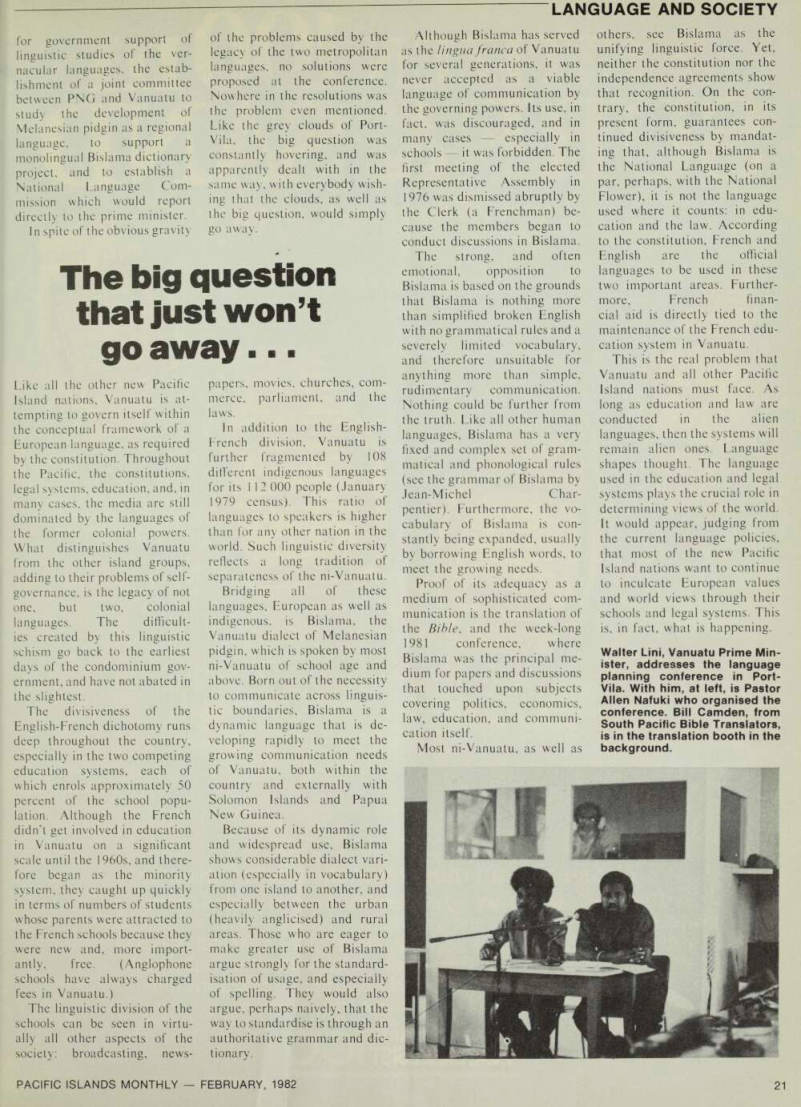
Walter Lini, Vanuatu Prime Min ister, addresses the language planning conference in Port- Vila. With him, at left, is Pastor Allen Nafuki who organised the conference. Bill Camden, from South Pacific Bible Translators, is in the translation booth in the background.