month’ on New Caledonia
pp. 29-31 · Read in the full issue

March is named as ‘action month’ on New Caledonia
Political
Currents
A French Government spokes man, in a statement issued in Paris in January, named March as ‘action month’ for the adop tion of new laws by the French Parliament which will shape the future course of the French Pacific territory of New Caledonia.
Earlier, in mid-December, the government had announced it intended to rule by decree in the territory for the next 12 months.
Article 38 of the French constitution gives it this power.
Rule by decree means that the local Territorial Assembly will be stripped of what powers it ever had to change legislative measures originating in Paris.
Explaining the move in an address to the assembly in Noumea on December 14, Sec retary of State for Overseas Departments and Territories Henri Emmanuelli declared: ‘The government has decided to use this power because, ulti mately, the French Government is responsible for what happens in New Caledonia. It is deter mined to live up to that respons ibility.’
As a sweetener, Mr Emmanuelli told the conservative-dominated as sembly that use of Article 38 was in no way intended to deprive the territory of its institutions. Indeed, he added (tongue in check?). The as sembly would remain free to enact other even more am bitious reforms if it so desired’.
But he made clear who would be calling the shots when he outlined the six areas of reform which are to receive the im mediate attention of the govern ment. These were 1) organisa tional changes to ensure access of all New Caledonians to positions of authority; 2) ‘poss ible’ modification of existing land reform legislation to accel erate and widen the land reform process; 3) reform of mining and energy organisation to en sure that resources are used more in the general interest than in the past this raises
the spectre for the present beneficiaries that, in future, nickel mining royalities may actually be paid to traditional owners of mined lands; 4) tax reforms, in the direction of egalitarianism and modernis ation; 5) building cultural insti tutions to affirm Melanesian structures enabling a more bal anced economic and social de velopment.
As if all that were not enough. President Mitterrand has appointed a close political associate in the Socialist Parly, Christian Nucci, 42, as the new high commissioner to oversee the reforms on the spot in New Caledonia. An indication of Mr Nucci's political standing is
that until his appointment to Noumea, he was vice-president of the National Assembly in Paris (PIM Jan p 6).
Commenting on the appoint ment, which was ratified by the Council of Ministers on December 9, a spokesman for President Mitterand said that Mr Nucci would lake the pos ition as a parliamentarian on special appointment. He would resign his seat only if he remain ed in the position for more than
six months. It is the first time a parliamentarian has been ap pointed high commissioner of a French territory in the Pacific.
Mr Nucci was quoted in Le Monde of December 10 as saying: T wish to listen, to inform myself and, in close consultation with the sec retariat for Overseas Depart ments and Territories, to promote the reform policy which has been developed for New Caledonia. ‘I shall devote myself to the
most rapid possible realisation of the dispositions made by the government in regard to this overseas territory.’
He said that he proposed to bring a fresh approach to new Caledonia, and to distance him self to some extent from day-to day events.
Mr Nucci arrived in New Caledonia on December 13, 1981, on the same plane as Mr Emmanuelli.
In other developments re
lated to the New Caledonian situation; • Speaking in the Fiji Parlia ment in December, Prime Min ister Ratu Sir Kamisese Mara said the South Pacific Forum appointed mission to Paris which he is to lead had been deferred until early this year.
The mission is to discuss with President Mitterrand the prob lem of independence for France’s Pacific territories, and France’s nuclear testing in the Pacific. • In a December speech to the Pacific regional conference of Rotary International in Mel bourne, the Australian Prime Minister Malcolm Fraser said the new French Government had shown signs of taking a fresh approach on the question of decolonisation.
Mr Fraser said it was less than 20 years since every South Pacific State was subject to some form of colonial adminis tration, and it was a matter for great satisfaction that the political life of the independent states of the South Pacific since independence had been one of political stability. ‘But not all Pacific islands are yet self-governing, and the prin ciples of self-determination and independence for all Pacific island countries principles which certainly enjoy Austra lian support still need to be advanced,’ Mr Fraser said.
Mr Fraser said the strategic importance of the South Pacific had been amply demonstrated in earlier limes, and Australia had a direct and immediate interest in continued stability throughout the decolonisation period and beyond it. ‘We in Australia are well aware of the responsibilities which fall upon us in relation to the South Pacific region and are continuing to take initiatives, as we have done in past years, to discharge those responsi bilities.’
In a specific reference to
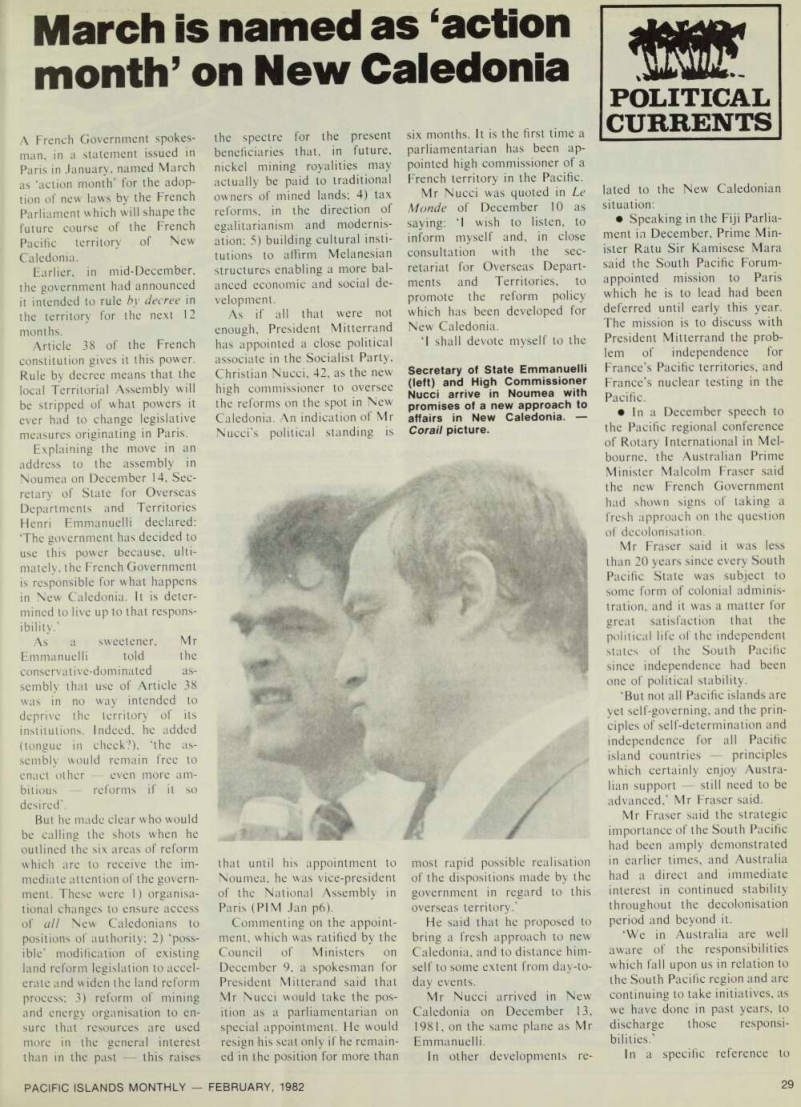
Secretary of State Emmanuelli (left) and High Commissioner Nucci arrive in Noumea with promises of a new approach to affairs in New Caledonia. - Corail picture.
Ratu Mara’s proposed Paris visit (on which he will be accompanied by high officials from Papua New Guinea and Tonga) Mr Fraser said: This delegation could advance moves for independence of French territories in the South Pacific.’ • Leader of the Labor Party Opposition in the Australian Parliament, Bill Hayden, visited New Caledonia in January. In an article on his visit which was widely pub lished in the Australian press, he wrote: ‘lt is the misfortune of the new Democratic Socialist ad ministration of France led by President Mitterrand that he has been landed with a legacy of accumulated neglect of import ant transition arrangements necessary to transform New Caledonia from dependent col ony to independent nationhood.
This is the heritage of a series of paternalistically aloof, conservative French govern ments unable to grasp one elementary lesson, which after Dien Bien Phu and Algeria should have been understood with greater clarity by France than any other country in the world.
That lesson is that colonialism is an objectionable anachronism anywhere, and to obstruct the momentum of the forces of national independence is to court disaster...
The anti-independence argu ment about Melanesians being a minority is spurious. Current population growth rales ensure a Melanesian majority again before the end of the 1980 s. ‘A more productive course for European settlers would be to discard this artificial argu ment, acknowledge the Kanak people’s right to determine the future of their own country, and to develop processes which ac commodate non-Melanesians. ‘Australia has a prime inter est in these developments so close to our shores.
‘Make no mistake. If badly handled, the issue of New Caledonia independence could have grave consequences. ‘New Caledonia will be inde pendent. The real question is when and how the process is consummated, with good will or in bloody conflict’. • The noted supporter of New Caledonian independence.
Professor Jean Guiart of the Musee de I’Homme, Paris, has circulated a leaflet alleging that the November 7 1981 riots in Noumea (PIM Dec p 5) were deliberately provoked by Righlwing settler circles to pro vide a basis for the November 11 March for Peace and Frater nity staged by anti independence forces (PIM Dec p 5).
Professor Guiart writes; The riots in Noumea on November 6-7 were organised and paid for by the local Rightwing, which used a small group of Melanesians who have been
working for them over recent years.
They carefully stoned the stores belonging to small Asian and European merchants. The larger or more luxurious stores owned by the leaders or friends of the Right were not touched.
This group found a small number of ready followers among unsuspecting jobless young people and adolescents, unorganised and politically un trained, who joined in the fray.’
With his own leaflet Pro fessor Guiart encloses another which was found in the wake of the November 11 march. It contains the names of 14 of the most prominent supporters of New Caledonian independence including those of Guiart and his son. The leaflet blames the 14 for inciting ‘racial hatred’ and ‘brutal violence’ and calls for their ‘rejection’ by New Caledonian society, ‘be fore they become the murderers of our children’.
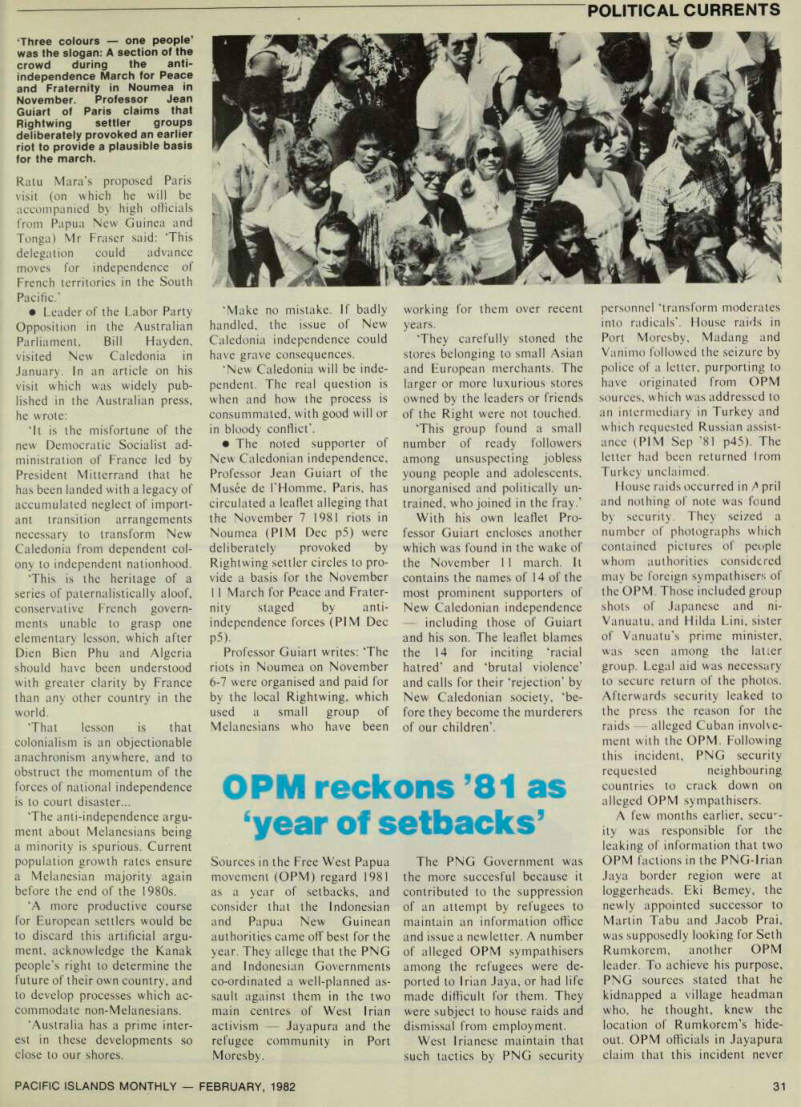
‘Three colours - one people’ was the slogan: A section of the crowd during the anti independence March for Peace and Fraternity in Noumea in November. Professor Jean Guiart of Paris claims that Rightwing settler groups deliberately provoked an earlier riot to provide a plausible basis for the march.