Western Samoa to the polls: Has
pp. 11-13 · Read in the full issue

the time come for a change?
Leading Apia journalist REUSE VA’A previews the general elections to be held in Western Samoa on February 27 If there is to be a change of government, he says, the man most likely to be his country’s next prime minister is Vaai Kolone, leader of the Human Rights Protection Party, now in opposition.
Western Samoa’s general elec tions on Saturday, February 27, are almost certain to result in a 50 to 60 percent turn-over of sitting members at least that has generally been the case with such elections in the past. Past experience also shows that no body is safe from this tendency to violent shake-outs in the membership of the Fono, or Legislative Assembly, at elec tion times: candidates of all political beliefs are liable to suffer nasty shocks.
However, there is a unique feature about the 1982 election that could possibly be significant enough to upset this long-standing tradition. This is the fact that for the first time in the history of this country a strong political party, the Hu man Rights Protection Party (HRPP), is taking the field against the government and, indeed, all comers. The electors may just decide to sweep the HRPP to power, in reaction against the two-term govern ment of Tupuola Efi. Certainly, all sitting HRPP members (they represent about half the 47-strong membership of the assembly), are confident they will be returned. Their opti mism stems in part from their
For the first time in what has been a no party system, a strong party is now challenging the established government.
party’s success against govern ment candidates in 1981 and earlier by-elections.
Tupuola’s supporters, inside and outside parliament, do not constitute a formal political parly. In effect, however, they are a party, since they have political organisation, and the common goal of holding on to power. They also have a central fund for political campaigning, and other party-type expendi
tures. The organisation is cer tainly there a fact which becomes most obvious around campaign time, from November to election day.
The newly formed Labour Party (Tautua mo Samoa in Samoan) represents a third force in the field for the 1982 poll. According to its leader, the sitting MP Mapuilesua Pelenato, this party stands for free enterprise, and for the development of an industrial base to supplement agriculture.
Mapuilesua accuses both the government and the HRPP of hypocrisy. They say one thing in debate and then vote against it later,' he says, referring to the practice of certain members who vole against their individ ual beliefs in order to support a parly position.
Apart from the fact that he is an able parliamentary orator, little is known about Mapuilesua’s capabilities. He obviously aspires to be prime minister, but he labours under the handicap that he is not well known on a nation-wide scale.
These then are the three political parlies or, rather, two parties, and one ‘party’ that will contest the elections. It is unlikely that any more will
appear between lime of writing and election day.
Of course, there will be independents. But most of these are already secretly committed to one or other of the three major groupings. The fact is that it is extremely difficult for candidates to remain unat tached to a party: the need for campaign funds literally forces them into the arms of one or the other of them. So, not in-
frequently, it is financial need rather than ideological convic tion that drives candidates to join a political organisation. At this stage of development, it may be seriously doubted whether many of the chiefs (< matai) understand, or can dis tinguish between, political ideologies such as conservatism, liberalism, socialism, commu nism, and so on.
It may be safely assumed that the Labour Party will offer no serious threat to the two main parties. For one thing, Mapuilesua Pelenato is re ported to have only a shaky hold on his own constituency. His chief rival for the seat will be veteran politician Tagaloa Leota Pita whom he unseated in 1979. Tagaloa must be counted as a strong candidate.
So the real fight will be between the government and the HRPP and the power
brokers will be the indepen dents.
Looking at the government’s record since the last elections in February 1979, no one could accuse it of not trying. It has continued to do everything ex pected of it in maintaining and extending government oper ations, most notably in econ omic development. In foreign relations, Tupuola has followed an innovative course, and with overall success.
The recent budget figures provide some evidence of pro gress, and generally reflect good economic management. Any careful study of the economic record (including foreign aid.
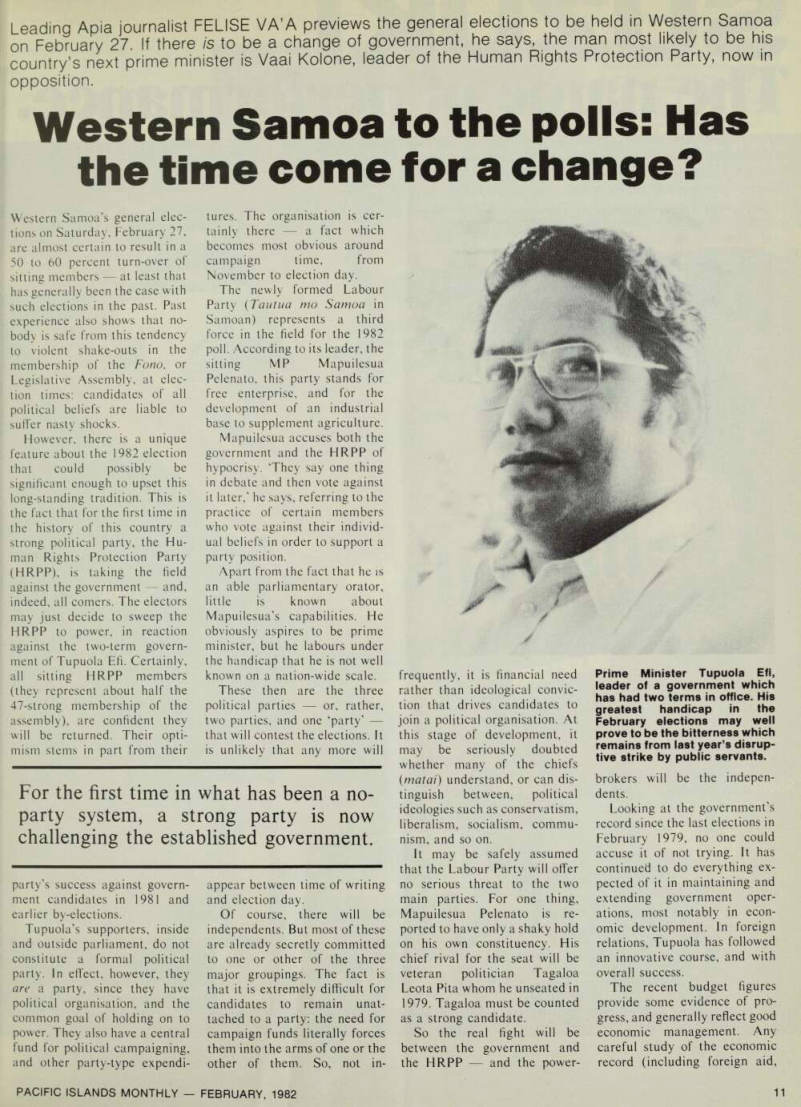
Prime Minister Tupuola Efi, leader of a government which has had two terms in office. His greatest handicap in the February elections may well prove to be the bitterness which remains from last year’s disrup tive strike by public servants.
which jumped from SWS6 200 000 in 1979 to $l2 050 000 in 1981, a 94 percent increase) shows a gener ally good performance.
The main dark spot appears in the export-import figures.
Exports in 1979 reached an all time high of $l5 340 000. This performance was maintained in 1980, with a figure of about $l5 250 000. But exports nosedived in the first nine months of 1981 to about $7.7 million. Final figures for the year are unlikely to exceed $lO million, a massive fall from the $l5 million of the preceding two years.
Government is blamed for this fall. One MP has claimed that the government’s inability to settle the public servants’ strike of April-July 1981 had meant that people were discour aged from producing key export products such as copra and cocoa. There is surely much substance to this claim.
The export figures must be seen against the background of the figures for imports. These were worth approximately $6l million in 1979, $57.5 million in 1980, and $44.9 million for the first nine months of 1981. Indi cations are that the figure for the full year will again exceed $6O million.
The cost of living remains high. While no Sampan is starving, the locals generally are finding the cost of many
items beyond their means. To buy them, they depend on remittances from overseas.
There was a 24 percent increase in the Consumer Price Index in 1979, and a 29 percent increase in 1980. Figures for 1981 show a 21 percent rise over the first nine months, with clear indi cations of further increases in the final quarter.
International reserves fell from a high point of $5 161 000 in December 1979 to $3 088 000 in September 1981. ‘This figure is dangerously low and makes us extremely vulner able to any one of a number of contingencies,’ Finance Minis ter Vaovasa Filipo observed in his budget speech. In this con nection, government introduced a bill, later passed, enabling it to borrow for the purpose of meeting any balance of pay ments problems.
All things considered, Tupuola’s government is un popular.
The biggest single reason is the bitterness left over from the public servants’ strike. The strike arose over a claim for a salary increase, and other griev ances. But the government handled it badly from beginning to end.
The cost of the strike to the country was enormous. While estimates vary greatly, the min ister of finance puts the figure at about $3 million. But in fact it is much more, given the $5 million decline in the value of exports almost certainly a side-effect of the strike and the many millions lost in remit tances from Samoans abroad.
The other major reason for the government’s unpopularity is the series of scandals in government, first in the Health Department the uncovering
of a conspiracy to defraud government and, more re cently, the case involving for mer Minister of Justice Asi Eikeni.
The Chief Justice found that the former minister was not telling the truth in court, and that he had conspired to deceive Customs concerning goods he had brought into the country, and the duty to be paid on them.
While the minister is unlikely to face perjury charges a legal istic point the scandal has seriously undermined his pos ition as a politician and an individual. Asi, for his part, has denied that he did any wrong.
Perhaps a further reason for the unpopularity of the govern ment is the simple fact that it has been in power for so long.
Power breeds indifference and arrogance. It also breeds care lessness.
It was arrogance that pre vented the government from recognising that the public ser vants fully intended to go ahead with their strike. It was arro gance that led them to treat with disdain the public ser vants’ petition for a salary increase. It was arrogance again that led them to refer to the public servants as ‘good-for nothings who in any case are not earning their pay, or are steal ing government property’.
Then, the Public Accounts Committee and the Auditor began spilling the beans and for much of 1981 the public in Western Samoa had a heavy diet of scandals reported in the press, all involving government figures.
After all this, the Samoans reason, perhaps it is time for a change.
Time will tell.
If there is to be a change of government and a change is almost universally predicted by the usual crop of pre-election prophets in Apia Vaai Kolone, leader of the HRPP, is the man most likely to be this country’s next prime minister.
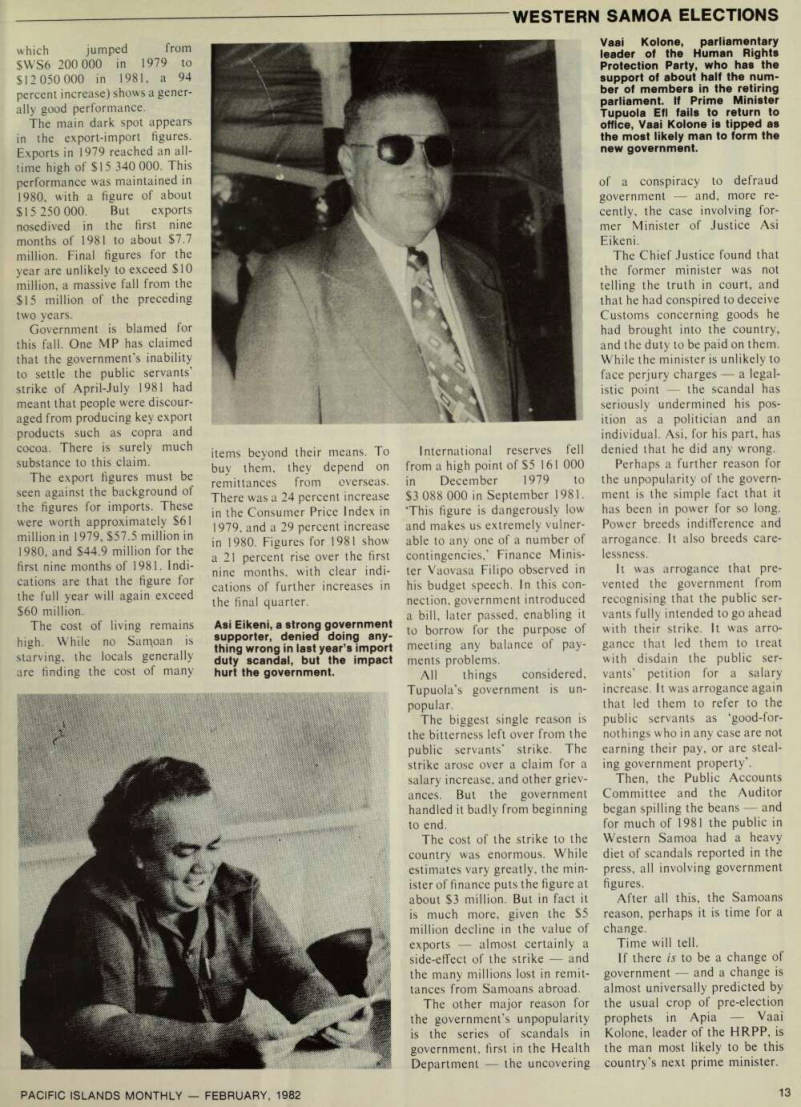
Asi Eikeni, a strong government supporter, denied doing any thing wrong in last year’s import duty scandal, but the impact hurt the government.
Vaai Kolone, parliamentary leader of the Human Rights Protection Party, who has the support of about half the num ber of members in the retiring parliament. If Prime Minister Tupuola Efi fails to return to office, Vaai Kolone is tipped as the most likely man to form the new government.