drama
pp. 14-15 · Read in the full issue
1981 revival of a 1973 drama
History seemed to be repeating itself just before Christmas, 1981, as the nuclear protest drama that had shaken French Polynesia nine years before was re-enacted in almost identical terms. There was the yacht Greenpeace 111 again, patrolling at Moruroa outside the 12-mile limit, escorted by a French naval vessel. Her captain was once again the courageous David McTaggart who, in 1973, had almost lost the sight of his right eye after being beaten up by the French marines who captured his yacht.
In Papeete itself, the elected members of the Territorial Assembly were protesting more vociferously than ever against the serious health hazards resulting from the steadily increasing number of nuclear explosions 88 so far at the badly battered atoll.
When the French defence minister, or the admirals responsible for the Moruroa testing programme, occasionally deigned to reply, they simply continued to swear, with fingers crossed on the bomb, that Moruroa was the cleanest and safest place on earth.
But the main difference between 1973 and 1981 was that the tests are no longer made in the atmosphere but underground or, should we say, under-water. It was precisely this fact that made the new Greenpeace 111 protest voyage (begun from San Diego, California, at the end of October) much more difficult.
Back in 1972 and ’73, the presence of a yacht in Moruroa waters meant that no bombs could be exploded without exposing its crew to lethal irradiation. This explains why the French navy at the time resorted to piratical seizure of the vessel in international waters. This time, the CEP technicians felt they had no reason to stop exploding their depth charges. So the choice of protest tactics left to the Greenpeace people was rather narrow.
The most obvious course was to take on board a few radio biologists equipped with the necessary instruments and put them ashore here and there in the islands to take samples of the flora and fauna, and examine the health of the population. But the big drawback to this scheme was that the French navy was perfectly willing and able to prevent any such landings.
David McTaggart sought to meet his problems by taking on board a person whose sensitivity to nuclear health hazards was of a quite special quality.
The person in question looked exactly like the other long haired, bearded crew members Chris Robinson from Australia, Lloyd Anderson from the USA, and Tony Marriner from the UK. But as it happened he was Brice Lalonde, the politically highly astute leader of the French ecological movement. A veteran of the 1973 sea battle off Moruroa (where he had arrived on the vessel Fri), he has continued ever since to wage a valiant fight against the proliferation of nuclear power plants in France. He has acted to such good effect that he became eventually, at the age of 35, the candidate of the entire French ecological movement in the May 1981 presidential poll.
In the first round of the election he secured 3.9 percent of the total vote I I 26 254 votes. Then, it was largely due to the support of Lalonde’s voters in the second round that Frangois Mitterrand became president. The ecologists still hold the
balance of power in a good number of French constituencies. So, Brice Lalonde was actually more important to the success of the new Greenpeace mission than a whole swarm of radio-biologists.
The goal he set himself from the beginning of the cruise was to elicit a firm commitment from President Mitterrand that all nuclear tests at Moruroa would be suspended until the whole disarmament problem came up for discussion at the special United Nations conference on the subject in May, 1982.
Mitterrand again demonstrated what a consummate poli tician he is by sending a most graciously worded message saying that he was most strongly in favour of general disarmament, and that Brice Lalonde was ‘welcome back to Moruroa at a later date to make a personal examination of the flora and fauna in the region of the testing site’.
Brice Lalonde replied in similarly vague and ambiguous terms, saying that he considered the message ‘an excellent starting point for further discussions’, and that he was ‘much interested in taking an active part in the study of the radio active pollution in French Polynesia’.
Not a word was said on either side about the proposed moratorium even though at the very moment of the exchange of these polite messages, the seismological stations in Wellington, New Zealand, and Hagfors, Sweden, announced that on December 5 and 8 two more bombs had been exploded at Moruroa. However, it could be argued that these were the last tests to take place before the UN disarmament conference . . .
The Greenpeace 111 had now been at sea for 40 days, and her provisions were almost exhausted. No invitation to land on Moruroa had been received. On the contrary, the sturdy French navy ship Hippopotame kept circling the yacht, and cutting across its bows to show how far it was to be allowed to go.
Wisely, David McTaggart and Brice Lalonde set sail for Tahiti, tailed closely by the Hippopotame. Although they didn’t know it, their timing was perfect: the French press, including such respected and widely known newspapers and magazines as Le Monde, Le Figaro, and Le Point had been publishing a whole
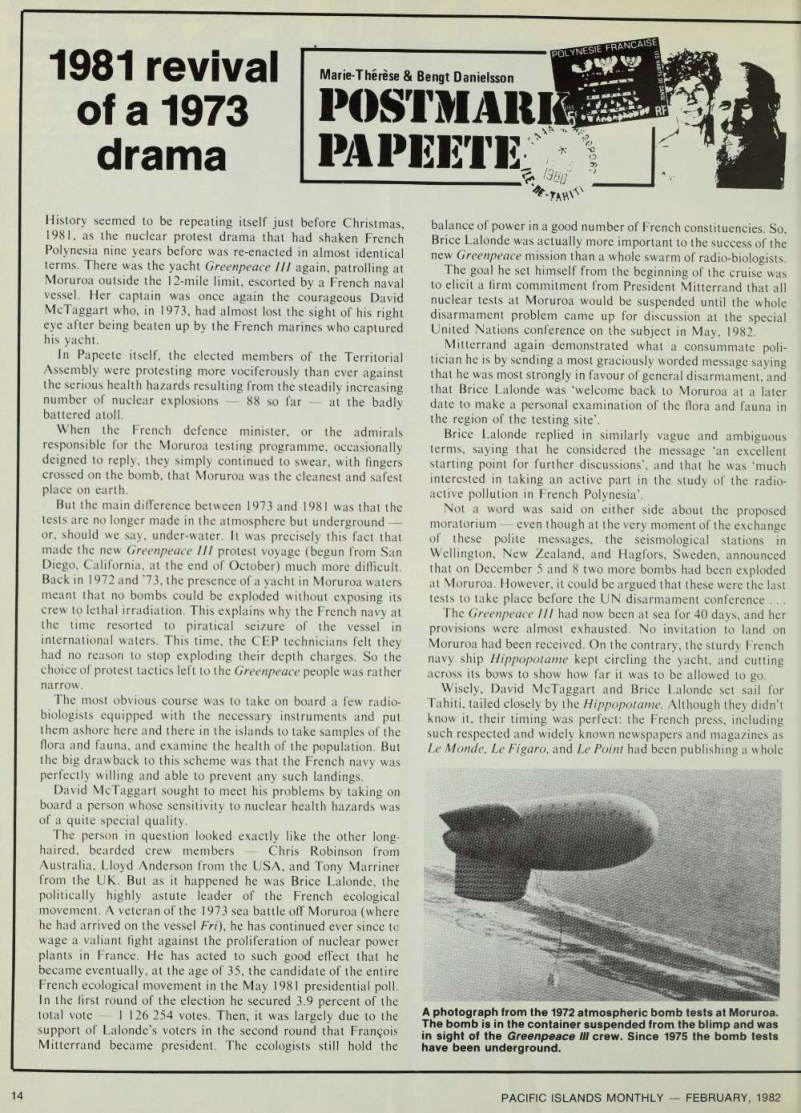
A photograph from the 1972 atmospheric bomb tests at Moruroa.
The bomb is in the container suspended from the blimp and was in sight of the Greenpeace III crew. Since 1975 the bomb tests have been underground.
series of Moruroa horror stories about the plutonium exper iments, the huge pile of nuclear waste swept out to sea, the extensive underwater leakage and fracturing of the atoll, the sinking of the atoll, and the arrival of African monkeys for use in experiments with the neutron bomb.
It also happened that as the Greenpeace 111 was sailing into Papeete harbour on December 16, our own little local parliament, the Territorial Assembly, had just started meeting for its annual budgetary session. Having been lulled for years into believing that the nuclear tests were harmless, the members felt betrayed and outraged by the latest revelations of the many nuclear leaks and accidents at Moruroa.
Most vocal of all in protest was Deputy Gaston Flosse, leader of the local branch of the French Gaullist party. With a long record of blind trust in his French masters, Flosse made a spectacular reversal of his previous pro-nuclear stand; he quickly proposed a motion recommending a sensationally simple method of discovering the truth about the nuclear pollution of France’s Polynesian territory. He proposed the immediate calling-in of an unspecified number of impartial civilian radio biologists of both French and foreign nationalities, of whom some at least should come from Australia and New Zealand.
Their task would be to take samples everywhere in the islands of plants, animals and foods, and to make a detailed health survey of the whole population.
The December 21 debate followed attentively by Brice Lalonde from the public gallery resulted in early and overwhelming victory for the anti-nuclear forces.
Strongest support for Flosse’s motion came, paradoxically, from his arch-enemy, the respected Autonomist leader Jean Teariki although Mr Teariki was unable to prevent himself from wondering aloud whether Flosse’s dramatic reversal of position might not have something of an opportunistic character, given that elections were only five months away.
Flosse and other members of his party replied, with what seemed unfeigned sincerity, that they had changed their minds after the recent revelations about the frightening extension of radioactive pollution of the atoll.
Flosse therefore voted with what feelings one cannot tell for a last-minute amendment emanating from Teariki’s party which requested the French Government to suspend immedi ately all testing at Moruroa until the international team of radio biologists had completed its survey.
A few assemblymen protested that such a suspension, which would probably last a long time, would suddenly throw thousands of men out of work. (Actually, only 750 Polynesians are employed by the CEP, a number representing less than two percent of the total workforce in the territory.) Flosse very pointedly declared that he considered health more important than money, and in the end the amendment was adopted by a two-thirds majority.
Since President Mitterrand is determined to maintain and develop France’s nuclear strike force, it is most unlikely that he will take much notice of this last request. All he has to do is to repeat what all his predecessors have said in such situations in the past: that, under the present colonial system of government, the Polynesians have no say in matters of national defence.
But, luckily, French Polynesia’s Territorial Assembly is fully in charge of local health services. It can thus without delay implement the bold decisions taken during its momentous Christmas session of 1981, even though such action will be frowned upon by the French authorities.
Anticipating that, in the event, the assemblymen will muster the necessary courage to act along these lines, David McTaggart and Brice Lalonde are already on the look-out for experienced radio-biologists willing to spend some time doing interesting fieldwork in our radio-active paradise. Marie-Therese and Bengt Danielsson.