straight
pp. 7-10 · Read in the full issue

Letters
Sir Julius
sets a record
straight
I was surprised to read Second Officer Kevin B. Judkin’s criti cism of my defence of the Pacific Forum Line (PIM Dec ’81 p9), and his assertion that my statement that the Papua New Guinea Government ‘saw the project as one supporting the islands that did not get shipping services to their part of the world’ was a political faux pas.
I question his competence to speak authoritatively on this subject.
It is a matter of personal pride to me that before entering politics 1 managed a modest coastal shipping business for
several years, and achieved some small success. 1 was interested, therefore, in pursuing the matter, and took the time and trouble to locate a copy of the September issue of PIM from which Second Officer Judkins had quoted. I was left with the impression that his remarks were intended as no more than a red herring. Cer tainly, his comments had little relation to what I was quoted as saying in the September PIM (p 74).
The PIM article stated right at the beginning that as finance
minister 1 had been opposed to the establishment of the Pacific Forum Line. I have, in addition, expressed on many occasions very strong reservations about
government-owned corpor
ations, which are rarely success ful because bureaucrats are not businessmen.
In the same issue of PIM I was also quoted as saying: relationships are not built on talks and politics alone. They need to have some visible sign of achievement, of together ness, and this (the Pacific Fo rum Line) is one of them.’
That was the essence of my remarks, and that was the message that seems to have escaped Second Officer Judkins.
(Sir) Julius Chan
Prime Minister of Papua New Guinea Port Moresby Papua New Guinea The handicrafts
of Tonga
I have just received a copy of Tongan Handicrafts , published in 1980 for the Australian Development Assistance Bu
reau by the Australian Govern ment Publishing Service.
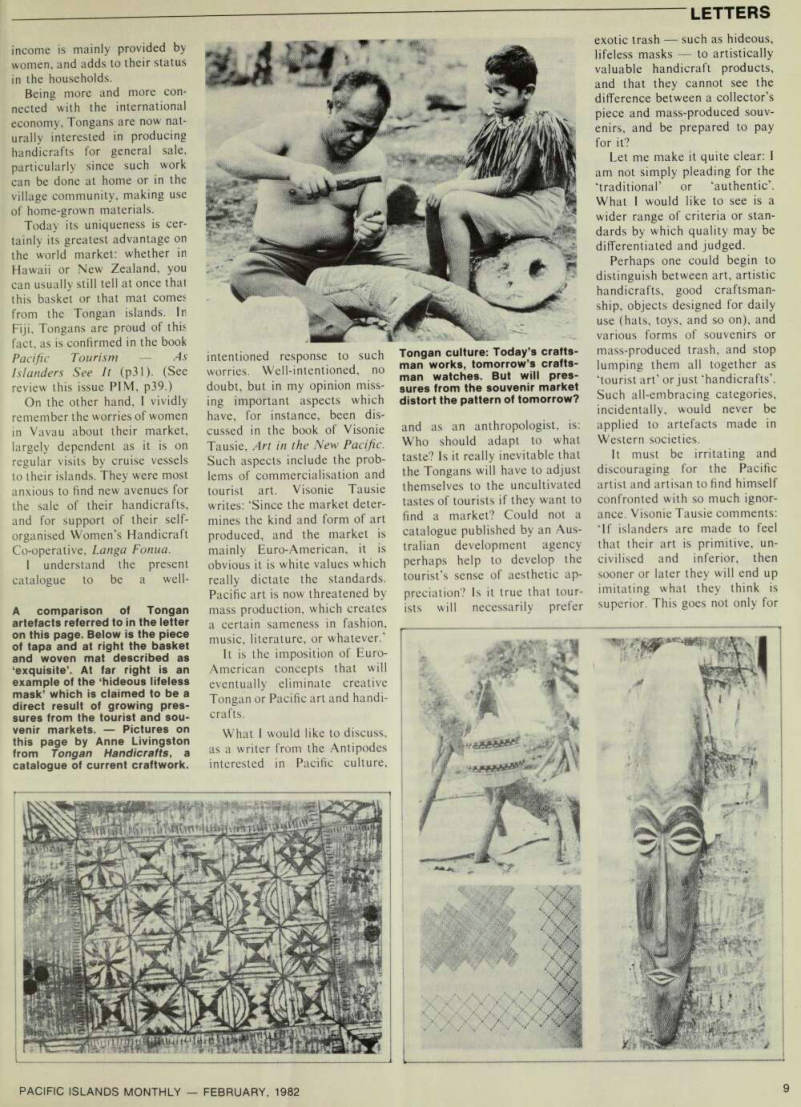
I have long been waiting for such a catalogue. When I finally had it in my hands, I was both excited and disappointed. Ex cited, because 1 recognised some of the most beautifully made handicrafts of the Pacific - mats, tapa, baskets. Disap pointed, because of the growing number of standardised curios or trash pretending to be tra ditional, and placed indiscrimi nately side by side with objects of exquisite craftsmanship. If those who have a copy of the book would just compare the finely woven mat (44), basket (31), or piece of tapa (60), with the lifeless mask (73), which has no relation whatsoever lo Tongan tradition, I think they will see my point.
My criticism, however, is not directed in the first place at the producers. I fully realise that for them handicrafts mean in come, important cash for school fees, and goods like tinned meat and clothing, and I am far from blaming the makers for their efforts to earn money for their families’ needs. Moreover, such
Sir Julius: Ship operator, prime minister - and letter-writer.
income is mainly provided by women, and adds to their status in the households.
Being more and more con nected with the international economy, Tongans are now nat urally interested in producing handicrafts for general sale, particularly since such work can be done at home or in the village community, making use of home-grown materials.
Today its uniqueness is cer tainly its greatest advantage on the world market; whether in Hawaii or New Zealand, you can usually still tell at once that this basket or that mat comes from the Tongan islands. In Fiji, Tongans are proud of this fact, as is confirmed in the book Pacific Tourism As Islanders See It (p3l). (See review this issue PIM, p 39.) On the other hand, I vividly remember the worries of women in Vavau about their market, largely dependent as it is on regular visits by cruise vessels to their islands. They were most anxious to find new avenues for the sale of their handicrafts, and for support of their self organised Women’s Handicraft Co-operative, Langa Fonua.
I understand the present catalogue to be a well-
intentioned response to such worries. Well-intentioned, no doubt, but in my opinion miss ing important aspects which have, for instance, been dis cussed in the book of Visonie Tausie, Art in the New Pacific.
Such aspects include the prob lems of commercialisation and tourist art. Visonie Tausie writes: ‘Since the market deter mines the kind and form of art produced, and the market is mainly Euro-American, it is obvious it is white values which really dictate the standards.
Pacific art is now threatened by mass production, which creates a certain sameness in fashion, music, literature, or whatever.’
It is the imposition of Euro- American concepts that will eventually eliminate creative Tongan or Pacific art and handi crafts.
What I would like to discuss, as a writer from the Antipodes interested in Pacific culture.
and as an anthropologist, is: Who should adapt to what taste? Is it really inevitable that the Tongans will have to adjust themselves to the uncultivated tastes of tourists if they want to find a market? Could not a catalogue published by an Aus tralian development agency perhaps help to develop the tourist’s sense of aesthetic ap preciation? Is it true that tour ists will necessarily prefer
exotic trash such as hideous, lifeless masks to artistically valuable handicraft products, and that they cannot see the difference between a collector’s piece and mass-produced souv enirs, and be prepared to pay for it?
Let me make it quite clear; 1 am not simply pleading for the ‘traditional’ or ‘authentic’.
What 1 would like to see is a wider range of criteria or stan dards by which quality may be differentiated and judged.
Perhaps one could begin to distinguish between art, artistic handicrafts, good craftsman ship, objects designed for daily use (hats, toys, and so on), and various forms of souvenirs or mass-produced trash, and stop lumping them all together as ‘tourist art’ or just ‘handicrafts’.
Such all-embracing categories, incidentally, would never be applied to artefacts made in Western societies.
It must be irritating and discouraging for the Pacific artist and artisan to find himself confronted with so much ignor ance. Visonie Tausie comments: ‘lf islanders are made to feel that their art is primitive, un civilised and inferior, then sooner or later they will end up imitating what they think is superior. This goes not only for
A comparison of Tongan artefacts referred to in the letter on this page. Below is the piece of tapa and at right the basket and woven mat described as ‘exquisite’. At far right is an example of the ‘hideous lifeless mask’ which is claimed to be a direct result of growing pres sures from the tourist and sou venir markets. - Pictures on this page by Anne Livingston from Tongan Handicrafts, a catalogue of current craftwork.
Tongan culture: Today’s crafts man works, tomorrow’s crafts man watches. But will pres sures from the souvenir market distort the pattern of tomorrow?
art, but also for other aspects of Pacific cultures .. . The islanders must clearly evolve a practical solution. Obviously, tourist income is needed. The question is how can this be obtained without losing self respect? ... A set standard of quality is necessary.’
To me this ‘standard of qual ity’ also means a questioning of our ‘Euro-American concepts’.
It is a matter of dialogue.
One may hope that a growing awareness of such questions among Pacific artists will eventually help us to under stand and recognise ‘the devel opment of the creative potential drawing on the past for inspi ration’, but at the same time producing material ‘which is relevant and contemporary’ (Visonie Tausie).
It is in this sense that new standards are needed. The Tongan Handicrafts catalogue, unfortunately, fails to reflect ideas of this nature.
Renate Von Gizycki
Kassel Western Germany
A trans-Tasman
argument
I refer to a letter from N. J.
Bullock of Auckland, New Zea land (PIM Dec ’Bl p 9). The letter begins with a reasonable defence of the New Zealand police force, and ends with an unwarranted attack on an as pect of Australian life that, I am sure, we all regret.
The tone of Mr (or Ms) Bullock’s letter is one of righteous anger from beginning to end. Yet the writer’s ire appears to have been prompted less by any inaccurate state ments made by Bruce Turner (PIM Sep ’Bl plO) than by the fact that an Australian had had the goddamned audacity to criticise something that hap pened in N. J. Bullock’s own country.
This is shown clearly by the irrational remark with which Bullock rounds off the letter; T suggest that you clean up your own backyard before you cross the Tasman and attempt to clean up ours.’
It appears that Australian society must become perfect before any Australian can as sume the right to express a
disapproving opinion on any aspect of life in our trans- Tasman neighbouring country.
I am not going to bother refuting the calumnious charges made by Bullock, ex cept to say that they betray not even a hint of empathy with the Australian Aborigines. Bullock uses this sad issue in an attempt to justify a nationalistic dig at the Aussies.
Over the years I have read many letters like Bullock’s, penned by New Zealanders along the same touchy, nationalistic lines. One wonders at their sharp, defensive tone!
If it is true that New Zealand society has no skeletons in its own closet, why is it necessary for people like Bullock to be constantly defending their country’s record, and attacking ours?
A century and a half after it was signed, in good faith, by Maori chiefs, the treaty of Waitangi has still not been ratified by the New Zealand parliament. Could it be that some cherished Kiwi myths are fraudulent after all?
S. Greaves
Eastwood NSW Australia
Social history
of planters
Under the aegis of the Acad emy of Social Sciences, Austra lia and the South-western Pacific, I am writing a social history of Australian planters, plantation managers, and their families between 1900-1980.
The main thrust of the work will be the social experience of plantation life living con ditions, adaptation to life in the islands, aspirations, European ‘sense of community’, the role of women, success and failure in financial and social terms, and so on.
The source material is di verse, but memoirs, diaries, record books, photographs, and reminiscences from planters would form the basis of the account.
While the connections be tween Australia and the islands are most important, the general European experience of plan tation life would be illuminat ing. This is particularly true of planters: ‘Going South’ on
leave, education of children, health, obtaining supplies, and marketing production in Aus tralia irrespective of any family ties with Australia.
People who feel they could contribute their experiences to the project should contact me in the: Department of Pacific His tory, Research School of Pacific Studies, Australian National University, Canberra, ACT, 2600.
(Dr) I. Bruce Watson
Canberra ACT Australia
N-tests: French
White Paper
It was interesting to know that Pacific radio-activity was the lowest since 1960 (PIM Dec ’Bl p 5). As the French nuclear tests have been deep underground for years this is what one would expect: there is no way that the Moruroa weapon tests could add to the fallout already in the atmosphere, which is a good thing.
The highly emotional drives are perennial, they come and go, and I have no doubt that they will for many years. And you can’t blame people for being concerned over weapons.
In the interests of good infor mation I would like to mention the White Paper, in English, which has been produced by the French Government, covering in detail virtually every scientific angle on the environ ment surrounding Moruroa.
Weapons are one thing. No body wants a nuclear war whose effects would be almost incon ceivable. But one can see the French Socialist government’s point of view in deciding to continue the tests.
By June, 1979, according to the Illustrated London News, the USSR had deployed all along its boundary with Europe 150 of the SS-20 rockets. Today the number is about 250. Each rocket has three warheads.
Each warhead is separately directed to a different city with an accuracy of about half a mile. Each warhead has an explosive force about 30 times that of the bomb dropped on Hiroshima. Yet this awful scen ario is never mentioned. 1 was in Paris during the 1981 anti-weapon demonstrations
that were so well-orchestrated all over Europe. The number of demonstrators was small com pared with those in Germany and Britain, and the demon stration was peaceful. It was notable, however, that no men tion was made of the SS-20 rockets deployed by the Russians. The Americans were the only ones who were con demned by these well-organised rallies. One wonders why?
J. C. Grover
Chatswood NSW Australia
Pacific women:
A reply
In a long letter (PIM Nov ’Bl p 9), the South Pacific Com mission’s Director of Pro grammes W. T. Brown rightly praises the excellent work done by the 60-odd delegates who attended ‘his’ seminar on the role of Pacific women, held, at great expense, at Papeete in July, 1981. In doing so, he is merely echoing what we had said two months previously (PIM Sep ’Bl p2O).
On the other hand, we feel obliged to express our complete disagreement with Mr Brown’s attempt to persuade PIM readers that this SPC confer ence represented a great pion eering effort. That honour surely goes to the Pacific women who as early as 1975 organised a conference in Fiji along the same lines as last year’s Papeete gathering. The Fiji conference was attended by no fewer than 90 delegates from 19 countries.
If Mr Brown cared to dig out from the library of his Noumea headquarters the 142-page ac count of the proceedings of the Fiji conference (edited by Vanessa Griffen under the title Women Speak Out ) he could well be embarrassed to find that the 46 resolutions adopted by the conference were practically all put forward again at the Papeete seminar.
What is needed now and all delegates were agreed on this point is therefore not more talks, but some action.
Marie-Therese
And Bengt Danielsson
Papehue Tahiti French Polynesia