Yachts
pp. 71-75 · Read in the full issue

Joan D. Pease Re
ports from Pago Pago ,
American Samoa:
• THIRD SEA. A 21.3 m schooner owned by writer Harold Stephens stopped at Pago Pago in September after a seven-day crossing from Penrhyn atoll (Tongareva). Since 1972 when it was launched in Singapore, the vessel has sailed 128 000 km in Asia and the South Pacific Islands. Stephens, better known as Steve, gathers material for magazine articles and books while travelling through the islands.
His book, Asian Portraits, is a collection of true stories about exciting people he has met while cruising in Southeast Asia. A simi lar collection about South Pacific
personalities is underway.
The current trip, which will end in China, began from Hawaii in June. The schooner first stopped in Bora bora and then crossed to Tahiti where Steve and his crew partici 3ated in the July 14 Bastille Day 'estivities. They continued on to Vloorea, Huahine and Raiatea be ore going to Penrhyn, the vessel’s ourth visit to the atoll.
Third Sea will call at Vanuatu, s apua New Guinea, Manila and Jong Kong prior to its final desti lation. Canton, China.
Steve’s favourite port after 10 ears on the schooner is
Zamboanga, the Philippines. ‘This is the dividing point between the Pacific and Asia. There’s the clash of both cultures and the excitement of sailing in Asia.’ He’s made the trip between Borneo and Zamboanga a number of times. • EQUINOX. A 10 m steel sloop, Equinox is returning to New Zea land, the completion of a circum navigation which included long stops in South Africa and Germany.
Owners Jorg and Julie Zimmerman took jobs in South Africa where they stayed for eight months. ‘That is the best country for hospitality.
The people were marvellous to us,’
Julie said. ‘The day we left there was an equinox tide and we sailed through a pod of sperm whales,’ she added.
They called at Brazil, the Azores, France and England before going to Germany where Jorg has a sister.
They worked for two years and left Europe in July, 1980. The return to the South Pacific included stops at St Thomas, Puerto Rico and Haiti.
After transiting the Panama Canal, the Zimmermans called at anchor age in the Marquesas, Tuamotus and Society Islands before calling at Pago Pago.
Jorg first sailed Equinox from Germany to New Zealand in 1969 and spent several years cruising in the Pacific Islands: Fiji, Papua New Guinea, Vanuatu, New Caledonia and the Solomons. • YANKEE GlRL.Television cam eras from the American Broadcast ing Company filmed this 3 m sloop arriving in Pago Pago on a crossing from Hawaii. Not much larger than a dinghy, the vessel was built by
Gerry Spiess who began his single
handed cruise from Long Beach, California, in June. After a five-day stop at Catalina Island he com
pleted a 34-day passage to Hawaii.
The 40-day crossing to Pago in cluded a brief visit to Fanning Island.
In spite of its size, the vessel has room for 75 litres of water, over 200 litres of fuel, an outboard engine, several cases of canned food and costly radio equipment for Spiess to keep in contact with friends and
Abc-Tv.
The tiny vessel stopped in Suva, Fiji, in late September, and will call at Noumea before its arrival in Australia.
PAUL RYSAVYreports
from Rarotonga , Cook
Islands:
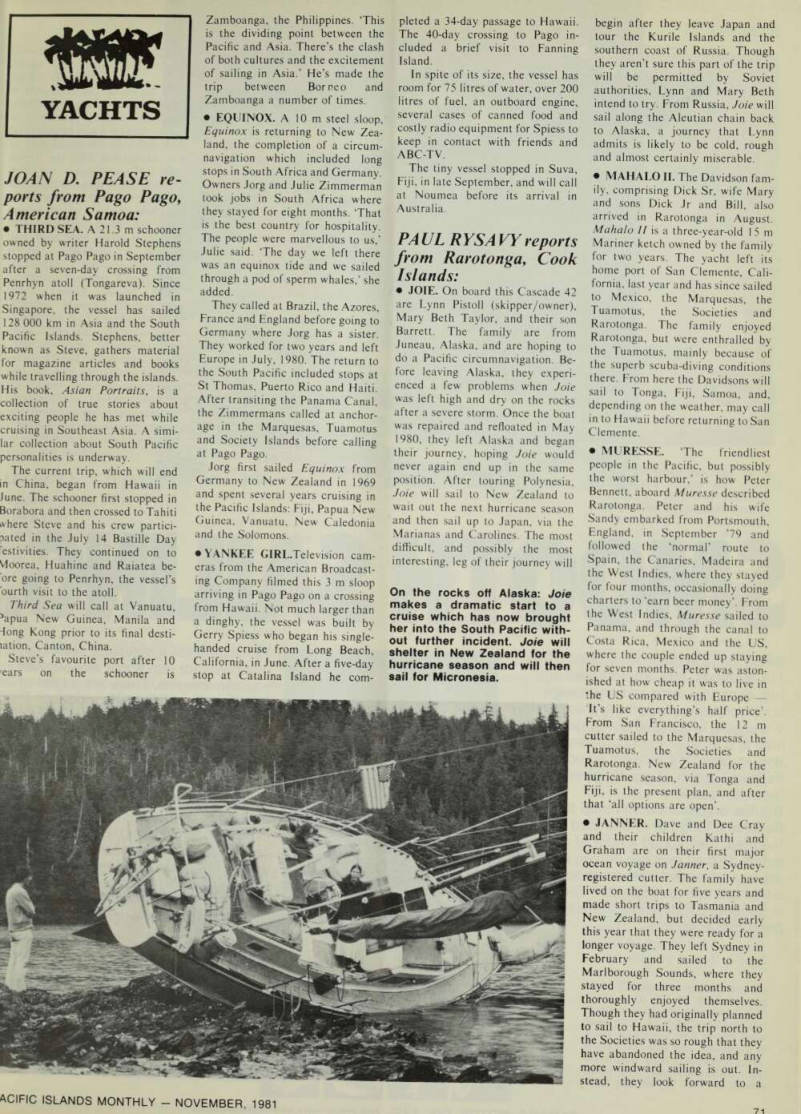
• JOIE. On board this Cascade 42 are Lynn Pistoll (skipper/owner), Mary Beth Taylor, and their son Barrett. The family are from Juneau, Alaska, and are hoping to do a Pacific circumnavigation. Be fore leaving Alaska, they experi enced a few problems when Joie was left high and dry on the rocks after a severe storm. Once the boat was repaired and refloated in May 1980, they left Alaska and began their journey, hoping Joie would never again end up in the same position. After touring Polynesia, Joie will sail to New Zealand to wait out the next hurricane season and then sail up to Japan, via the Marianas and Carolines. The most difficult, and possibly the most interesting, leg of their journey will
begin after they leave Japan and tour the Kurile Islands and the southern coast of Russia. Though they aren’t sure this part of the trip will be permitted by Soviet authorities, Lynn and Mary Beth intend to try. From Russia, Joie will sail along the Aleutian chain back to Alaska, a journey that Lynn admits is likely to be cold, rough and almost certainly miserable. • MAHALO 11. The Davidson fam ily, comprising Dick Sr, wife Mary and sons Dick Jr and Bill, also arrived in Rarotonga in August.
Mahalo II is a three-year-old 15 m Mariner ketch owned by the family for two years. The yacht left its home port of San Clemente, Cali fornia, last year and has since sailed to Mexico, the Marquesas, the Tuamotus, the Societies and
Rarotonga. The family enjoyed
Rarotonga, but were enthralled by the Tuamotus, mainly because of the superb scuba-diving conditions there. From here the Davidsons will sail to Tonga, Fiji, Samoa, and, depending on the weather, may call in to Hawaii before returning to San Clemente. • MURESSE. The friendliest people in the Pacific, but possibly the worst harbour,’ is how Peter Bennett, aboard Muresse described Rarotonga. Peter and his wife Sandy embarked from Portsmouth, England, in September ’79 and followed the ‘normal’ route to Spain, the Canaries, Madeira and the West Indies, where they stayed for four months, occasionally doing charters to ‘earn beer money’. From the West Indies, Muresse sailed to Panama, and through the canal to Costa Rica, Mexico and the US, where the couple ended up staying for seven months. Peter was aston ished at how cheap it was to live in the US compared with Europe It’s like everything’s half price’.
From San Francisco, the 12 m cutter sailed to the Marquesas, the Tuamotus, the Societies and Rarotonga. New Zealand for the hurricane season, via Tonga and Fiji, is the present plan, and after that ‘all options are open’. • JANNER. Dave and Dee Cray and their children Kathi and Graham are on their first major ocean voyage on Janner, a Sydney registered cutter. The family have lived on the boat for five years and made short trips to Tasmania and New Zealand, but decided early this year that they were ready for a longer voyage. They left Sydney in February and sailed to the
Marlborough Sounds, where they
stayed for three months and
thoroughly enjoyed themselves.
Though they had originally planned to sail to Hawaii, the trip north to the Societies was so rough that they have abandoned the idea, and any more windward sailing is out. In stead, they look forward to a
On the rocks off Alaska: Joie makes a dramatic start to a cruise which has now brought her into the South Pacific with out further incident. Joie will shelter in New Zealand for the hurricane season and will then sail for Micronesia.
pleasant trip from Rarotonga to Tonga, Fiji, New Caledonia and back to Sydney. • AOKAUTERE. On the last leg of a world cruise is Aokautere. a 15.5 m Auckland-registered ketch. The ferro-cement vessel is jointly owned by New Zealanders Fred Day, Paul Brown and John Brookbanks, who built her themselves. The three Kiwis and three crew left Auckland in December 1976 for what has proved to be an enjoyable and interesting trip. In the five years they have been away, they have visited Brisbane, Darwin, Indonesian ports, Mauritius, Seychelles, Tanzania, Kenya, Aden,
Israel, Greece, Sicily, Spain,
Gibraltar, Morocco, England (for 15 months), the Canaries, the West Indies, Panama, Ecuador, the
Galapagos, the Marquesas, the
Societies, and Rarotonga. From
caiT
Tonga and Fiji. Though they have experienced no real unpleasantness or hostility on their journey, everyone on the boat is looking forward to sailing into Auckland.
Marcia Da Vock
reports from Port-Vila
1/ 9 ly SHEARWATER. This Rhodesdesign 14 m sloop left Seattle, Washington, in August, 1980.
Jwners Moore (‘Mugs’) and
Marcia Davock cruised the Hawaiian Islands, then spent five nonths in Tahiti and the Society slands. We previously cruised this irea m 1973 aboard another boat, md lound things much unchanged h |S J ime - p "ces are high, but the )eople and scenery are some of the »est in the Pacific. We both speak rench, which we feel is an asset to ruisers visiting these islands. hearwater sat out a March trop- ■ ' a de P ression on Tahiti-iti, where
winds reached 55-60 knots. The storm was upgraded to near hurricane force as winds roared past the south coast of Tahiti. More peaceful visits were made to Maupiti, Mopelia (‘a real favourite, but a tricky pass’), and deserted Suwarrow Atoll in the Cook Islands, where 10 other boats par ticipated in a delightful and well organised ‘roast pig and lobster feast’. After a quick re-provision stop at American Samoa, we cruised Vavau, Tonga, and Fiji. We particularly liked the Exploring Isles in the northern Lau Group and Makongai in the Lomaiviti Group.
Fishing and lobstering were excel lent in the outer islands, and supplies were reasonably priced in the cities. Shearwater’s future plans include Vanuatu, Solomon Islands, and Papua New Guinea.
Peter Mcquarrie
reports from Funafuti
Tuvalu:
• JUNOPHER. This 10 m Van de Stadt sloop built from fibreglass covered plywood arrived at Funafuti in August from Hull Island in the Phonenix Group.
Crewed by Gerard Gundy and his son Dominic, Junopher, which is registered in Bristol, United King dom, is on a circumnavigation.
Route so far has been UK, Panama, California, Hawaii, Pal myra, Hull, Funafuti.
After leaving here the cruising plan calls for visits to Vanuatu and Solomon Islands, Papua New Guinea, Indonesia, Sri Lanka, and Suez, and then the final run home. • JENNILOU. This 9 m Newport 30 arrived in Port Funafuti in
September with owner/skipper
Jerry Neuburger and crew John
Kelly.
Jennilou comes from San Francisco. She took 15 days from there to Hawaii, then 22 days from
Hawaii to Funafuti. She is headed for Vanuatu where Jerry is to head a fishing-boat building project, help ing to develop the local fishing industry.
Jerry and Jennilou are expected to be in Vanuatu for two years.
Tihouireasin Re
ports from Kamaka in
the Mangareva Islands,
French Polynesia:
Since last year the Mangareva Islands have been open again to visitors, and since the entry restric tions were lifted about 15 yachts have visited us. French authorities closed the islands to visitors during and for some time after the atmo spheric atomic tests on Moruroa Atoll. The islands are very beautiful
with deep, well-protected anchor
ages. Because of our nearness to Pitcairn a distance of less than 300 nautical miles we could be of interest as a rest stop for boats making for Pitcairn. I came from Tahiti ‘to these islands and at present am settling in my family.
We would welcome the occasional visitor.
The Pacific
Peacemaker Pro
JECT reports:
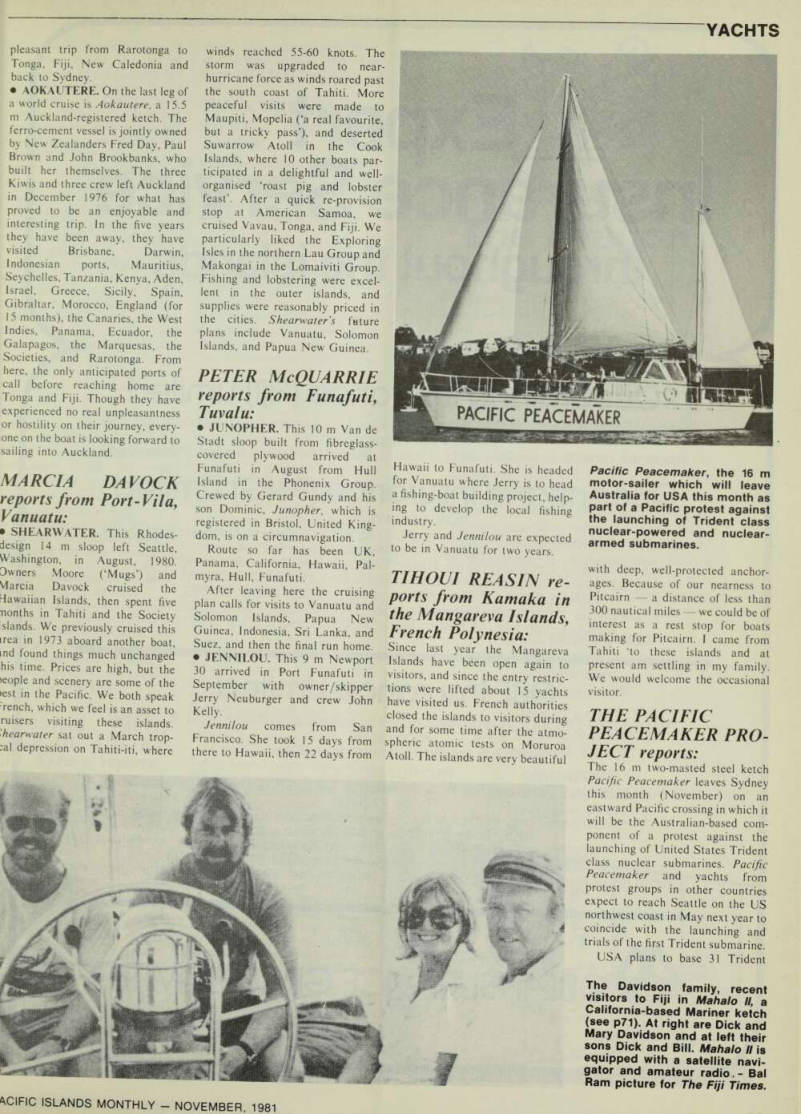
The 16 m two-masted steel ketch Pacific Peacemaker leaves Sydney this month (November) on an eastward Pacific crossing in which it will be the Australian-based com ponent of a protest against the launching of United States Trident class nuclear submarines. Pacific Peacemaker and yachts from protest groups in other countries expect to reach Seattle on the US northwest coast in May next year to coincide with the launching and trials of the first Trident submarine.
USA plans to base 31 Trident
Pacific Peacemaker, the 16 m motor-sailer which will leave Australia for USA this month as part of a Pacific protest against the launching of Trident class nuclear-powered and nuclear armed submarines.
The Davidson family, recent visitors to Fiji in Mahalo II, a California-based Mariner ketch (see p71). At right are Dick and Mary Davidson and at left their sons Dick and Bill. Mahalo II is equipped with a satellite navi gator and amateur radio. - Bal Ram picture for The Fiji Times.
submarines in Seattle and possibly the western Pacific. They will be nuclear-powered and equipped with first-strike nuclear weapons. Protest movements in Pacific Island countries, Australia and New Zea land oppose the commissioning of the submarines on nuclear and arms-race grounds.
The Australian-based Pacific Peacemaker project is being financed by donations from anti nuclear and peace groups and their supporters. The ketch was bought for $B5 000 and the ownership is held in shares which will be re deemed when the ketch is sold on its return.
The crew members will be Bill and Lorraine Ethel and their four children, navigator lan Gaillard, film-makers Dave Roberts and Martha Ansara, and the New Zea land peace activist the Rev George Armstrong. The Australian protest also represents Micronesia to the north, and a Micronesian represen tative has been invited to join the
zrew. Stopover points during the
voyage will be New Zealand and French Polynesia, where liaison >vith other Pacific anti-nuclear groups will be strengthened.
Bill and Lorraine Ethel both served in Britain’s Royal Navy before settling in Perth, Western \ustralia. They became involved in mti-nuclear and peace movements vhen plans were announced to levelop the naval base at Cockburn >ound in Western Australia.
More than 1000 people attended ceremony on Sydney Harbour in August at which the ketch was amed and the protest operation 'as explained. Pacific Peacemaker xpects to return to Australia y December next year
Rujsing Yacht
:lub of a
-1 A, Sydney, reports:
ustralia’s longest and toughest
can race, a distance of 13 475 km, 11 be inaugurated from Sydney ruising Yacht Club of Australia January 24, 1982. It is the Xerox
'dney-Rio race.
The world’s best maxis will be mpeting. Already (mid ptember 1981) about 20 yachts s listed to take part.
The Brazilian and Australian thorities, and a number of com :rcial organisations, are enthusi ically supporting the event by ging trade expositions and sem rs in Rio. While the yachts are in 3, a special Australia Week will staged in the course of which Rio 1 be declared Sydney’s Sister y-
Ml information from: Sydney
) Yacht Centre Pty Ltd, Cruising
Yacht Club, New Beach Road, Darling Point, Sydney, NSW, Aus tralia, 2027. Telex No 72278.
The Cornell
FAMILY reports from
London:
PIM has received the following circular letter from its one-time Pacific yachting correspondent Jimmy Cornell, his wife Gwenda, daughter Doina. and son Ivan.
Dear Friends, The list of letters to write was getting longer every day, and we were making so little progress with it that we hope you will excuse this brief newsletter.
On March 20 1981 we transited the Suez Canal and completed our
88 000-km-long circumnavigation.
The Mediterranean welcomed us with cold weather and a late spring.
After spending a month with Gwenda’s parents in Kos and Patmos and a memorable Easter on Tinos with some old Greek friends, we sailed Aventura up to Romania, arriving in Constanta on May 16 Jimmy was quite pleased with his reception in Romania as he was regarded as the first Romanian to sail around the world. We spent a busy time there with family and old friends and meeting many of Jimmy’s BBC listeners who came to visit Aventura. A plan to leave Aventura in Romania, while we made a quick overland trip to London, had to be abandoned.
Leaving Doina and Ivan with Jimmy’s mother, we sailed Aventura back to Greece and hauled her out on the dry land at Olympic Yachts, Lavrion. We bought a car, loaded up our most important possessions, collected the children and arrived back in Lon don on July 18. exhausted by a 4500-km drive across Europe.
So here we are back in 103 Venner Road, London, SE26 SHU.
Our short-term plans are to clean up our house, devastated by five years of careless tenants, and put it on the market. Doina and Ivan are looking forward to starting Fowey School in Cornwall in September. Jimmy will not be returning to the BBC
fulltime, although continuing to
collaborate with them freelance.
Our long-term plans are to return to the Pacific and make our base in Australia. Jimmy had hoped to sail Aventura back this year, but that proved to be too much of a rush, so that trip has been postponed for 1982.
If you are passing through Lon don we should be delighted to see you and we still have plenty of room for guests. Our new telephone number is 659 2202.
Best wishes, Jimmy, Gwenda, Doina and Ivan.