PNG mine production
pp. 61-69 · Read in the full issue


Trade
Winds
PNG mine production hit by activists
One of the deep-seated political controversies which troubled Papua New Guinea when the Bougainville copper mine was being established ten years ago resurfaced in October and led to demonstrations which inter rupted production at the mine.
The controversy concerns the formula under which royalties from the mine are shared be tween the North Solomons provincial government on Bougainville Island and the central government of PNG.
Land owners and community leaders, discontented with the provincial share of the royalties, set up road blocks which pre vented many workers from reaching the mine. They said they would continue to interfere with the day-by-day work of the mine until their provincial gov ernment was guaranteed a bet ;er share of the royalties. The Drovincial government which las its offices only 30 km from he mine did not sanction the oad blocks and demon trations, but there was evi lence of tacit sympathies.
Leaders involved in the ctivism warned the mine man gement of their intentions, but hey took the mine by surprise /hen they set up their road ilocks earlier than expected, tfter only a day they relaxed heir guard on the road blocks, nd mine labour was used to ;move the obstacles without icident.
Several days later however )ad blocks were again set up, nd demonstrators armed with icks intimidated and turned ack the occupants of vehicles hich tried to get through, heir action caused a series of iterruptions to work at the line. Mr lambakey Okuk, who as acting prime minister when le main trouble surfaced, said ; would not negotiate with oups who took the law into eir own hands and told them make proper and peaceful bmissions if they wanted their ise heard.
The activists said later that eir campaign would be ‘con tuous’ unless there was some sponse to their demands. The inerals and Energy Minister,
Mr Korowi, and the Prime Minister, Sir Julius Chan, were both briefed on the situation and have been studying the demands. They were expected to request a formal statement of attitudes from the provincial government before taking any action on the demands. The mine itself is not involved in the politics of the situation because the total royalties being paid are not in dispute.
The sharing of royalties from the Bougainville mine was one of the major issues which led to the creation of the provincial government system in PNG.
Land owners on Bougainville Island were given personal rentals and compensation pay ments, but they claimed the island should have greater autonomy within PNG and a special royalty revenue of its own because of the operation of the mine in the area. The PNG government, then led by Michael Somare, agreed to de volve some powers in response to pressures from Bougainville.
This led to the creation of the North Solomons provincial gov ernment on Bougainville, and later to the spread of provincial governments throughout PNG.
Mr Somare conceded that the North Solomons province had claim to special revenue from the mine, but said that the overall national interest was paramount. The present govern ment continues to endorse this attitude.
The central government re
tains the sole right to negotiate royalties with mining com panies and to collect the royalties, but it holds separate negotiations to allocate a share of the royalties back to the provinces where they originate.
The controversy on Bougainville is based on claims that the central government should increase the amount flowing back to Bougainville.
PATA sets up
regional office
Thirteen countries from the South Pacific region were rep resented in Australia in October when the Pacific Area Travel Association established a re gional office in Sydney and held a conference of travel industry and government representatives to discuss PATA’s role in the South Pacific.
PATA, which has its head quarters in San Francisco USA, represents governments, tourist and travel authorities, and com mercial tourist and travel inter ests in the Pacific, the Pacific rim and southeast Asia. The office in Sydney (at 20 Bond Street, City) is the South Pacific regional office. PATA was established to provide liaison between countries in travel and tourist matters and to promote travel and tourism.
Countries represented at the regional conference in Sydney were Australia, American Samoa, Cook Islands, Fiji, Kiri bati, New Caledonia, New Zea-
land, Papua New Guinea, Solomon Islands, Tahiti, Tonga, Vanuatu and Western Samoa.
Delegates decided that the South Pacific region of PATA should work closely with the South Pacific Bureau for Econ omic Co-operation, the econ omic planning body which rep resents South Pacific govern ments. Preliminary planning was also started on a new programme to promote the re gion as a tourist destination.
Papua New Guinea, Fiji and New Caledonia already have extensive programmes, and new interest was shown at the con ference by Solomon Islands and Cook Islands.
PATA’s South Pacific direc tor, Mr lan Kennedy, left Syd ney soon after the conference for an extensive tour of the region to co-ordinate tourist and travel programmes in member countries.
Fiji complaint
on butter deal
Fiji has complained about the price it has to pay for New Zealand butter, and in a sharp reaction New Zealand has offered to end the contract if Fiji thinks it can get a better deal anywhere in the world. The New Zealand Dairy Board in September invited Fiji to cancel the existing dairy products agreement and turn to inter national tenders in search of lower-priced dairy products.
The controversy arose from criticism in Fiji when there was an increase in the price of butter supplied from New Zea land. The managing director of Rewa Co-operative Dairy Com pany of Fiji, Mr Alister Martin, met representatives of the New Zealand Dairy Board in August and appealed for a reduction in the price of butter. The board was unable to agree to his request, and claimed that Fiji was getting a better deal than most countries. The board said it could not accept the argu
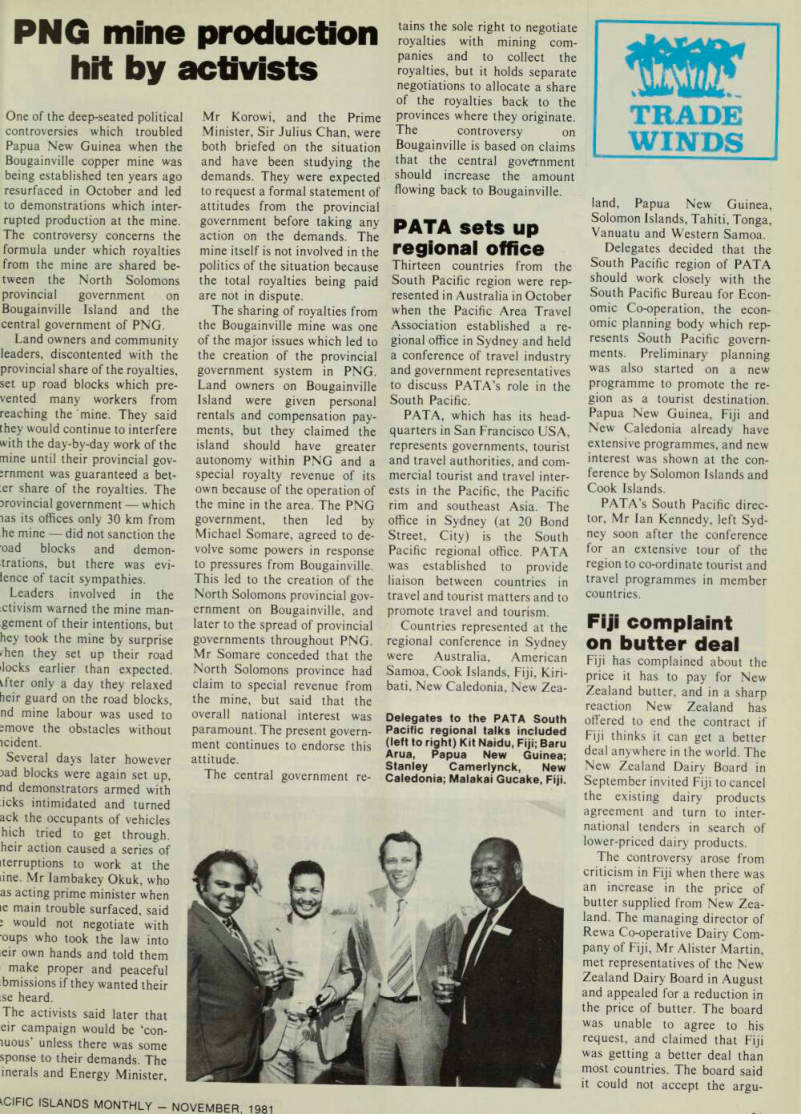
Delegates to the PATA South Pacific regional talks included (left to right) Kit Naidu, Fiji; Baru Arua, Papua New Guinea; Stanley Camerlynck, New Caledonia; Malakai Gucake, Fiji.
ment that Fiji had been hit harder than other world con sumers. Fiji sources continued to claim that New Zealand had discriminated against the Fiji market, and this led to the dairy board’s offer to allow Fiji to cancel the contract.
A spokesman for the board said that open tender pricing would soon reveal whether New Zealand was being competitive in its pricing structure. The board also offered to match any genuine offer from elsewhere in the world provided that quality, quantity and periods of contract were comparable. The dairy board also sent a delegation to Fiji to explain its position and to discuss pricing structures.
Later reports from Fiji indi cate that the Rewa Co operative has made tentative inquiries on the world market but so far has been unable to find a cheaper source of supply.
New Zealand supplies about 37% of the butter retailed in Fiji. The contract is •enegotiated every six months, md the current contract which became effective on July I
embodied a price increase of 35% created by rising pro duction costs in New Zealand.
The retail price for a 250-gram pat of butter increased in Suva shops from 56 to 78 cents.
Despite the increase in price of its own product the dairy board quoted figures showing higher prices still from many suppliers, including a price from France which was 26% above the New Zealand price.
The Taranaki Herald, a newspaper circulating in one of New Zealand’s dairy centres, published an editorial sympath ising with the Fijians for the rising price of consumer goods but stressing that they were getting a better deal from New Zealand than could be obtained elsewhere.
The editorial said that Fiji’s ‘anger and ire were unsurpris ing’ but claimed that the criti cism was neither fair nor reasonable. New Zealand ac cepted a high degree of moral responsibility to help its Island neighbours but New Zealand farmers were not in the business of being philanthropists to the
world. They needed to make some profit on their goods, and even with the latest increase Fiji was getting its butter at less than open market price.
The editorial continued ‘Like most small independent states the Fijians are a proud people, if sometimes over-suspicious in dealing with the rest of the world. The dairy board’s calm response and its offer to rescind the contract if the Fijians feel they can do better elsewhere should go a long way towards convincing not only Fiji but other Island states of New Zealand’s willingness to con tinue dealing fairly, if not quite so generously, as in the past.’
William Gas son in Wellington.
Ok Tedi given
line of credit
Despite continuing dissatis faction from many landowners in the area, Papua New Guinea is pushing ahead with its plans for the development of the Ok Tedi copper mine in the mountainous central west of the
PNG mainland. The overall project is now seen as one of national importance, despite opinions by some financial ob servers that the real economic benefit to PNG will be small.
The PNG government believes that in the long term the project will be valuable be cause of spin-off development which it will create.
The dissatisfaction by some landowners is not seen as a serious threat to the develop ment of the mine. Evidence at a series of land hearings has indicated that many claims to the land, or claims to right of usage, could not be upheld on evidence. The more urgent problems are likely to be politi cal, arising from the claims of people in the area for greater autonomy and for a regional sharing of financial benefits.
Senior ministers in the Chan government also believe that the community and land prob lems are not nearly as great as those which threatened the de velopment of the Bougainville mine a decade ago.
Unrest over the Bougainville
development was the major factor which led to PNG adopt ing a system of provincial gov ernments. The Bougainville people were the first to gain provincial recognition with the formation of the North Solomons Provincial Govern ment.
Meanwhile the Australian government has authorised the Export Finance and Insurance Corporation in Australia to offer a $212 million line of credit to finance the supply of Australian goods and services associated with the establish ment phase of the mine. The Ok Fedi Mining Company Ltd and ;he corporation are now nego iating loan terms and con iitions.
Partners in the project are Dampier Mining (Australia), 10%; Amoco Minerals (USA), 10%; Kupfer Explorations West Germany), 20%; the *NG government, 20%.
PNG may ultimately seek to acrease its equity, but this is ot a major point at issue. PNG as a highly-formalised mining olicy based on world-wide con ultations and on an examin tion of the strengths and 'eaknesses of mining develop ment in other Third World ountries. One of the corner ones of the PNG policy is to laximise financial returns and immunity benefits without ty ‘g up excessive capital in luity.
* refit drop for
lougainville
ougainville Copper’s earnings om its copper and gold mine in apua New Guinea dropped by S% for the first half of this year )mpared with the same period
last year. The result was $l6 million for the first six months of this year, compared with $5O million for the first half of last year. The factors leading to this result were continuing low prices for metal mining pro ducts, the strong state of the PNG currency and steeply ris ing costs.
The company predicts that the situation will continue into next year, but describes the medium term prospects as still good. The share situation has reflected this confidence despite the returns shown in the half yearly report.
Production at the mine in creased by 10% during the period under review and sales went up by 21%. However these improvements were not suf ficient to offset the other fac tors. A further boost to pro duction is expected in the im mediate future as the company brings new processing capacity into use.
However much of the new processing capacity will not contribute to a net increase in production, but will be needed to offset the lower grade of ore which is being encountered as the big open pit mine deepens.
Undercutting
the giants
The fledgling Air Vanuatu has moved aggressively to undercut big rivals Qantas and UTA with its fares on the Sydney-Port- Vila route.
Air Vanuatu’s Inclusive Tour fare (payable 21 days in ad vance for a minimum of 10 passengers) is $A297 (Qantas and UTA $332). The individual IT fare requires a minimum stay of six days and a maximum
of 23. Qantas and UTA are charging $4OO, and Air Vanuatu $360.
Economy class return fares without conditions on length of stay or departure date are $594 with Qantas and UTA, and $526 with Air Vanuatu. First class fares are $BO4 and $726 respectively.
With all three airlines, chil dren between two and 12 years travel at half-price, and chil dren under two sitting on their parents’ knees at 10%.
Britain reports
Pacific aid
Despite pressures in Britain to reduce public spending, aid to the Pacific Islands will continue into the 1980 s at a high level, the London Press Service has reported. Net official develop ment aid to the region was quoted at a level of more than SA4O million a year.
A major part of development aid from Britain is directed to the University of the South Pacific in Fiji. The university maintains departments in Kiri bati, Cook Islands, Tonga, Western Samoa and Solomon Islands in addition to Fiji.
British aid funds are spent in six Island countries, and major projects have involved telecom munications, education, health services and agricultural devel opments.
In addition, the Common wealth Development Corpor ation which operates autonomously but can draw
Night turn-round at Port-Vila for Air Vanuatu, undercutting Sydney-Vanuatu fares. The DC9 aircraft is chartered from the Australian airline Ansett. - Les Nouvelles Caledoniennes pic ture.
finance from the British govern ment, invests in development projects in the region.
PNG criticises
trade balance
The Papua New Guinea Foreign Affairs and Trade Min ister, Mr Noel Levi, was highly critical in September of the favourable trade balance main tained by Australia and New Zealand in relation to the Island countries of the South Pacific.
He told a conference on trade, investment and development, held in Port Moresby, that the factors leading to the situation could be understood but the fact remained that the imbal ance was far too heavily in favour of the two developed nations of Australia and New Zealand. He said that protec tionist policies adopted by the two countries were preventing the Island countries from de veloping a broader trade base.
Mr Levi, who was opening ;he talks, said that for various •easons strong links had been •etained between the Island countries and the powers which lad once ruled them. Many of he reasons were good ones, and he fact that strong links had )een maintained was a good eflection on the stability of the ’acific region and on the nature if the Pacific community in ;eneral.
However the situation had icrpetuated a type of trade link /hich was not necesarily in the est interests of the Island ountries and which restricted tie trade relationships of the
ewly-independent Pacific.
Mr Levi said that the 1980 •ade figures between the acific Islands on the one hand nd Australia and New Zealand ti the other were six to one in ivour of New Zealand and mr to one in favour of Austra a. It was important for the acific community to negotiate, at for increased aid from the aveloped countries, but for a •eater sale of exports to them.
He conceded that the pro icts coming out of the Pacific land countries tropical 'riculture products, mined etals, timber, sugar and fish - were not extensive, but he
amed the developed countries
r not creating a situation
which would allow the develop ment of a greater range of Islands exports. Mr Levi said that present policies and situ ations in Australia and New Zealand stood in the way of any significant diversification of Islands exports.
Referring to the South Pacific Regional Trade and Economic Co-operation Agree ment (SPARTECA), Mr Levi said that exemptions and sus pensions were defeating the object of the agreement. (SPARTECA was negotiated by Australia and New Zealand with the South Pacific Forum Island countries to permit duty free access of manufactured goods from the Island countries.) Mr Levi also accused the developed countries of being too heavily involved in shipping lines at the expense of the Island countries which were trying to develop their own lines.
Mr Levi said that the Island countries should adopt aggress ive policies to dismantle the food trade monopolies which Australia and New Zealand had developed in the Pacific. He said that even in the Island countries which were exporting goods, the ownership of the exporting companies was often in the hands of investors and businessmen from the devel oped countries. ‘lt’s the monop olistic network of the rich,’ he said.
He suggested that the Island countries could establish mar keting corporations for copra, coconut oil, timber and fish within the region.
Profits go up
for big three
The South Pacific Islands’ biggest trading companies, W. R. Carpenter Holdings Ltd and Burns, Philp and Company Ltd, have reported increased profits for the last financial year but there’s been a downturn in income from Islands operations.
Carpenter’s profit rose by 17% to a record $A 15.42 million. A sharp improvement by the Aus tralian divisions more than com pensated for a big decline in income in Papua New Guinea and Fiji, where lower com modity prices cut profits by 55%.
Burns Philp’s profit was a record $20.3 million, a 15.1% increase, but in the Islands there was a 69% fall in net profit. The rebellion on Santo, Vanuatu, was among the events that affected the company’s operations. Despite the record profit some analysts have been critical of the Burns Philp result on the grounds that full value did not appear to have been extracted from a huge increase in sales turnover. The profit increase of 15.1% was returned from a sales increase of 41%.
Although commodity prices fell in Papua New Guinea,
Steamships Trading Company
Ltd increased its profit from K 3.33 million to K 4.36 million.
Much of this came from rev enue in New Guinea Industries Ltd.
PATA meeting
for Bangkok
The 1982 Pacific Area Travel Association Conference will be held in Bangkok, capital of Thailand.
The conference will take
place amid festivities marking the 200th anniversary of the founding of Bangkok in 1782 by the first king of the present ruling dynasty, the Chakri.
Venue for the meeting will be Bangkok’s luxurious Dusit Thani Hotel.
Soft loan for
Tonga reserve
The King of Tonga’s state visit to Kuwait in August appears to have borne fruit in the shape of a SUSI million 10-year loan from the OPEC Fund for Devel opment. The interest-free loan, with a grace period of three years before repayments begin, has been provided to assist the kingdom with its current
balance-of-payments problems.
The Tongan High Com missioner in London, Mr ’lnoke Fotu Faletau, signed the loan agreement on behalf of Tonga at the OPEC headquarters in Vienna.
The expression of goodwill represented by the loan has increased speculation on the possible outcome of the main
purpose of the royal visit to Kuwait discussions on the feasibility of establishing a Kuwaiti-funded regional bulk oil storage depot in Tonga.
Penny Hodgkinson in Nukualofa.
Vanuatu signs
CDC agreement
Vanuatu and the Common wealth Development Corpor ation have signed an agreement providing a basis for CDC involvement in the economic development, of Vanuatu. The CDC is a UK-based organis ation established under parlia mentary charter to sponsor and maintain major economic pro jects on good financial terms in developing countries.
The agreement was signed in Port-Vila by the minister re sponsible for agriculture, fisheries and forests, Sethy Regenvanu, and by the CDC’s South Pacific regional control ler from Fiji, David Lincoln- Gordon. Mr Regenvanu said he believed the agreement would provide a major contribution to
development in Vanuatu and he thanked Mr Lincoln-Gordon for personal efforts in preparing and arranging the agreement.
Since the agreement was signed an assessment team from the CDC has visited Vanuatu to examine projects which could form the basis for CDC involve ment. Cocoa and forestry pro jects were given priority during
the assessment.
Ian
McIntyre in Port-Vila.
Australia aid
programmes
Australian direct aid to de veloping countries and to inter national organisations providing aid will be $653 million in 1981-82. The Pacific region is the biggest recipient. The aid figure was announced in the Australian budget tabled in parliament in August. In terms of Australian dollars it is an increase of 15.3% over the previous year’s figures, and in real terms related to world money values it is seen as an increase of about 6%.
The biggest single outlet for
the funds will be Papua New Guinea which will receive budget support and associated payments totalling $254 million. PNG will not bring down its budget until later in the year, but the Australian support is expected to provide about 30% of the PNG revenue total. Under an arrangement between the two countries the real value of Australian financial aid to PNG is being scaled down at the rate of 5% a year.
Other bilateral aid payments by Australia to developing countries will amount to $267 million. Multilateral aid will amount to $132 million chan nelled through development finance institutions. United Nations agencies and regional organisations.
The Australian Treasurer, Mr Howard, told parliament that this year’s aid to PNG was the first under a new five-year programme negotiated by the two governments last year, and which would continue until 1985-86. The total five-year commitment was expected to
involve at least $l2OO million, but each annual payment would be determined by a formula involving an annual reduction of 5% in real terms. Mr Howard said that the arrangement would allow PNG to gradually lower its dependence on Austra lian aid. At the same time, however, PNG would be able to pursue its economic and social development policies in the knowledge that substantial Aus tralian assistance would be available throughout the five year period.
The $254 million which Aus tralia has allocated to PNG this year consists mainly of the direct untied budget grant of $241.3 million, which in dollar terms is an increase of $9.3 million over the previous year.
The remaining amount includes provision to retire non-nationals of PNG who worked for the original Australian adminis tration of PNG or for the Australian Staffing Assistance Group. It also includes in creased contributions to the PNG-Australia Technical Co operation Programme.