What the Forum did and
pp. 13-15 · Read in the full issue
The Region
Two writers look at how Pacific ties are shaping
What the Forum did and what it didn’t do
L" Rowing two articles, STUART INDER reports on the important 12th meeting of the South Pacific Forum which he a tended in Port-Vila, Vanuatu, in August, and DON STEWART looks at the future of the South Pacific Comm™ a " d , th ® s ° u,h P aci,ic Conference as they enter ‘the turbulent 1980s’. Stuart Inder is a former publisher and editor of PIM, and Don Stewart until earlier this year was director of administration of the South Pacific^Commission.
New Zealand Prime Minister Robert Muldoon put the boot into the South Pacific Forum at its Port-Vila meeting. It was, he said at the beginning of the first day of the two-day formal session, largely a waste of time too formalised, lacking the spirit of the early days and he wasn’t likely to attend another meeting unless things improved.
As far as he was concerned, they didn’t; mostly he found the meetings a bore, and fretted that he had more pressing things to do at home.
Australian Prime Minister Malcolm Fraser couldn’t make it at the last minute, because he did have more pressing things to do at home. He sent Deputy PM Doug Anthony, who had been in the middle of his vacation and stayed only a couple of days, but who left behind him Australian Foreign Minister Tony Street.
But Mr Muldoon’s forthright expression of views was oppor tune. It was just 10 years since the forum first met in Wellington, in August 1971, so was it now on the right path?
The need for reappraisal was underlined by two proposals on the agenda one asking whether the forum’s technical and administrative arm, the South Pacific Bureau for Econ omic Co-operation (SPEC), and the South Pacific Commission [SPC), should be amalgamated, md another proposing that >ome kind of new regional organisation be developed to mable the Pacific Islands to ipeak as one voice in world councils, such as the United Nations.
At no time did the forum nembers sit down and single nindedly discuss the forum’s uture. But by the time the 'arious motions were debated, md Mr Muldoon’s views hewed over, it was clear that he Island leaders have no
serious misgivings about it.
Those with longest experience agreed that the Port-Vila meet ing was slower and more formal ised than many past meetings, but no more so than could be expected in view of its enlarged membership —l3 now, plus an observer (the Federated States of Micronesia), compared with the founding membership of seven in 1971.
The decision to hold the well attended SPEC meeting just before the forum met also added to the ‘big conference’ atmosphere in Port-Vila and detracted somewhat from the informality that was present, for example, at last year’s smaller meeting at Kiribati.
Port-Vila found itself hosting a large-scale international con vention, and the surprise prob ably was that the convention managed to retain as much of the Islands atmosphere as it did.
Everybody helped to make it work those who made the careful selection of eating places for the various private luncheons and dinners, the com petent SPEC secretariat staff
with their long working hours, the easy professionalism of the Intercontinental Hotel people, the - smooth transport and se curity arrangements, and the true consensus style of control by conference chairman Father Walter Lini. ‘He’s not tough.
He’s a Christian who believes in dialogue,’ as somebody ex plained it.
The fact that Vanuatu’s prime minister didn’t hurry debate along was probably one of the things that irked Mr Muldoon, but the day is gone when there can be unity around the forum table as to the perfect way of running things. Needs are different.
Mr Muldoon’s point that he could spend his time better back home wasn’t unreason able, and the problem to be faced is how best to accommo date busy leaders, no matter where they are from, if the Forum is to continue to be what its members want it to be a meeting of Pacific Island heads of government discussing com mon problems.
The formal agenda should
obviously be culled hard. There were more than 30 items on this one, and by the end of the first day the forum had dealt with only seven matters. Some of the remaining items had to be dealt with at express train speed the next day.
Only key items should reach the forum’s agenda others can be dealt with at the SPEC meeting by the senior public servants. If there are still special points of clarification needed after that, the leaders will find a way of clearing up the ones that interest them during their various opportuni ties for informal talks.
To sum up, the South Pacific Forum has to work, for there is simply no alternative to it, irrespective of what changes might occur to existing organis ations, and despite the possible advent of new ones.
Sir Julius Chan made it clear that Papua New Guinea’s pro posal for some kind of new political alliance was not a proposal for replacing the fo rum. What he wanted was some kind of power grouping which would be recognised in inter national forums as specifically Pacific Islands. At present the Islands are generally lumped together with African and Third World blocs, and do not speak with a recognisable voice.
On this matter Sir Julius has been influenced by the views of his Secretary for Foreign Affairs and Trade Paulias Matane, who until recently was PNG‘s Ambassador to the UN and from long experience is very conscious of the disadvan tages abroad caused by the lack of a clear Pacific voice.
Before the conference began there was a view in the corridors that what PNG aimed for was a
brotherhood of Islanders only, without Australia and New Zealand, which would replace the forum. This misinformation was no doubt fuelled by the fact that PNG produced no formal paper on its proposals, and thus there was plenty of scope for imagination. Reaction was that such a concept wasn’t on.
When Sir Julius explained his proposal in the conference room there was no debate on it, but Sir Julius agreed to formu late a more specific proposal for next year’s Forum meeting in Tuvalu.
Australia’s Doug Anthony probably best summed it up later at a news conference: ‘There’s merit in it. You could have some sort of grouping, if this is the wish of those nations, without interfering with the present structure. But you do need some sort of structure that will incorporate Australia and New Zealand. We are there, and participating. If they want to have a separate identiy for political purposes, that could be set up as an adjunct to the forum.’
The whole idea will go no further unless Sir Julius pushes it.
A SPEC/SPC merger will, if it happens, strengthen the fo rum. Such a possibility has been seriously studied since 1978, but it has been in the air longer than that. It came close to a blood-letting at the South Pacific Conference in Papeete in 1979, when the then director of SPEC, Mahe Tupouniua, made a fairly emotional plea for an end to the ‘siege mentality’ of the SPC on the issue, which he said was undermining the health of regional co-operation in the Islands. He stressed then that SPEC had no sinister plans for a take-over it was simply the forum’s executive and did what it was told to do ‘without embellishment’.
The Port-Vila forum agreed to convene a special SPEC committee session to undertake a detailed study on the feasi bility of a SPEC/SPC merger, with all its implications.
Thus a decision on the future of the SPC is finally approach ing. The forum has been in no hurry to grasp the nettle in the past because members aren’t united in how to approach it.
What overlapping is there?
Would costs indeed be less if the two organisations were rationalised? Would the US, France and Britain continue their funding at the present scale if a rationalisation ex cluded them from the new body?
And what, anyway, would be the political implications if the South Pacific Commission were to disappear how would France and the US in particular have a voice in the South Seas, since their territories are ineli gible for forum membership?
There are still no simple answers, and the forum is going to have to feel its way. It can expect some feedback at the next South Pacific Conference which officially opens in Port- Vila on October 24. The SPC probably won't like it but the fact remains that the SPC can’t survive unless the Forum countries want it to survive, and the final decision will be made by the Forum.
One regional organisation whose aims were not discussed officially in Port-Vila but which got passing attention in the corridors was the Pacific Islands Conference, set up last year at a meeting in Honolulu attended by most Islands leaders, including all the Micronesians. This conference (PIM May 1980 p 22) discussed developmental goals and was designed as an on-going body which would enable the Islands,
both north and south, to develop closer ties with international organisations able to help them.
The conference was sponsored by the US East West Center, and participants agreed there should be a second general meeting this year, somewhere in the Islands.
This meeting is not now likely before next year, and it seems that the organisation is not to have any permanent shape to the extent it will conflict with the current multiplicity of re gional and would-be regional organisations for which one can only offer heartfelt thanks.
Regionalism also raised its head with a proposal, again from PNG, that a regional peace-keeping force be estab lished that could be used in a similar role to that played by PNG forces last year when they supported the Vanuatu Govern ment against the Santo rebels.
This proposal fared little bet ter than Sir Julius’s plan for a regional political voice, al though it was certainly debated.
Sir Julius told the forum that he wanted to test feelings on the matter. The feeling was that nobody wanted to embrace such a complex, highly political plan, especially in view of possible developments in New Caledonia.
Who would compose such a force, who would pay for it, how would it be commanded, who would decide whom it was to be used against, and when? As
Ratu Sir Kamisese Mara ob served, peace-keeping forces are invariably sent to places where there is no peace.
The discussion resulted in a typical South Seas resolution designed to put the idea aside and at the same time save PNG’s face. The forum, ‘noted the importance of the mainten ance of peace and stability (security) in the region and called on member governments to give their attention to this important issue’. Over to Sir Julius again.
The New Caledonia situation occupied the greatest amount of the forum’s time (with transport matters second), and received a spectacular amount of press attention. The French Govern ment itself guaranteed this by using its diplomats in a vain effort to make the debate a non event.
The French Ambassador to Fiji unwisely suggested to Ratu Mara the day before the prime minister left Suva for the forum that France would regard Fiji’s support for any forum inter ference in New Caledonian affairs as an ‘unfriendly act’.
The warning was tacitly backed by the understanding that as Fiji sells ss2m worth of sugar annually to the EEC, it was vulnerable to political pressure.
Ratu Mara was, as he pub licly stated in Vila, ‘very, very angry’ at this approach, and ‘gave the ambassador a lemon’.
Which for anybody who has
seen Fiji’s Prime Minister on the warpath, was no doubt putting it mildly. That France was prepared to beard such a notably independent leader as Ratu Mara in such terms is eloquent commentary on the high state of anxiety France is in over the defence of its indefensible Pacific policies.
It certainly got no relief from the forum members. They re solved that; The governments comprising the South Pacific Forum, reaffirming their belief in the principles of self determination and indepen dence applying to non-self governing Pacific Island countries including the French territories, decide to send a delegation led by a forum head of government to Paris to meet with President Mitterrand of the French Republic, to discuss with him the question of the evolution of the French Govern ment’s policies with respect to the progress towards decolon isation of the people of the French Pacific territories.’
The resolution left the com position and timing of the delegation to its leader, who is to report to the next Forum. The leader, not unexpectedly, turned out to be Ratu Mara.
He didn’t seek the job, and he did in fact weigh up his position against possible difficulties it might cause Fiji at
the hands of France. Typically, he decided that whatever the consequences it had to be done because the alternative solution in New Caledonia would be a lot more violent.
It’s unlikely that the del egation will go before next year, by which time a new Mitterrand policy on decolonisation may have defused events. But a lot of forum leaders don’t hold out much hope.
What they see is a danger that the New Caledonian co lons will take the initiative from the hands of the French Gov ernment even if it should decide to grant New Caledonia auton omy under eventual Melanesian leadership. This would lead to a bloodbath. It is because of the various terrible alternatives that the forum felt it had to involve itself in New Caledonia’s future while there was still time to use its influence.
The initiative for the New Caledonia resolution came from Vanuatu, which in turn had been strongly lobbied by the Kanak Front Independantiste.
Father Lini made it clear that Vanuatu was trying to do what it could ‘at every level’ to help New Caledonia achieve auton omy, because it had the closest relations with both New Caledonia’s autonomist move ment and France, and could
take a stand with less offence.
He told an end-of-conference news gathering: ‘1 think it was the most peaceful way for the forum to take a united stand on New Caledonia rather than let the situation develop where they will continue to kill Melanesians members of the Front Independantiste be cause already we have four who have been killed, and the indi cation we have is that before the end of the year more will be killed in New Caledonia by the white settlers.
That is why we believe that if the forum can take a united stand it will help deter the New Caledonia situation from de veloping into almost a racial issue, when we believe that it is, and should continue to be, a political issue.’
The original Vanuatu plan had sought, as an additional pressure against France, to get New Caledonia relisted as a
colony at the UN to ensure its affairs would come before the decolonisation committee.
Father Lini was not happy that the forum did not accept this plank in his platform, but he realised that the forum was trying to work in a way that was likely to be diplomatically ac ceptable to France and the forum countries themselves.
Similarly, he accepted the fo rum’s change of wording in the resolution so as to make it apply to all of France’s Pacific territories, rather than New Caledonia alone.
He said Vanuatu had chosen to concentrate its efforts on the New Caledonian situation be cause once a peaceful solution could be worked out there, it would be beneficial to the other French Pacific territories.
There is no doubt, however, that it is New Caledonia which disturbs Father Lini and the forum.
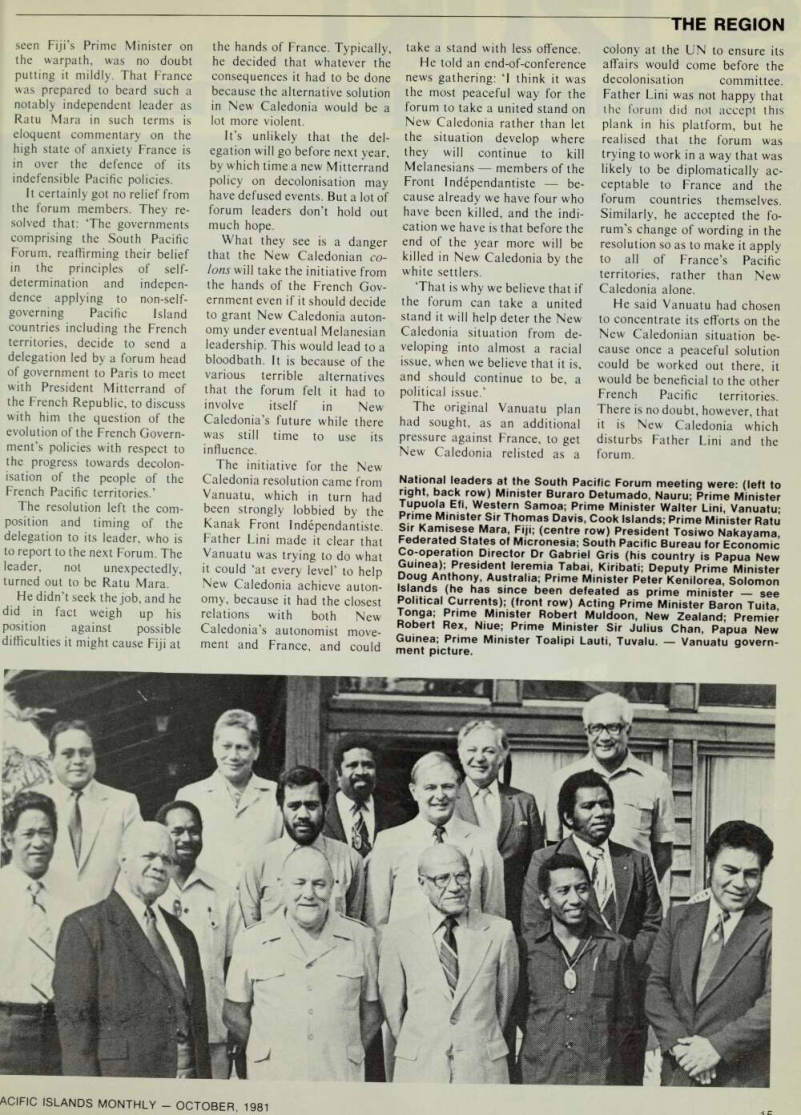
National leaders at the South Pacific Forum meeting were: (left to right, back row) Minister Buraro Detumado, Nauru; Prime Minister Tupuola Efi, Western Samoa; Prime Minister Walter Lini, Vanuatu- Prime Minister Sir Thomas Davis, Cook Islands; Prime Minister Ratu Sir Kamisese Mara, Fiji; (centre row) President Tosiwo Nakayama Federated States of Micronesia; South Pacific Bureau for Economic Co-operation Director Dr Gabriel Gris (his country is Papua New Guinea): President leremia Tabai, Kiribati; Deputy Prime Minister Doug Anthony, Australia; Prime Minister Peter Kenilorea, Solomon Islands (he has since been defeated as prime minister see Political Currents); (front row) Acting Prime Minister Baron Tuita, Tonga; Prime Minister Robert Muldoon, New Zealand; Premier Robert Rex, Niue; Prime Minister Sir Julius Chan, Papua New Guinea; Prime Minister Toalipi Lauti, Tuvalu. Vanuatu govern ment picture.