Fiji and
pp. 7-11 · Read in the full issue

the Sinai force
Letters
I am prompted to write to you after reading the item ‘Fiji to Join Sinai Force?’ (PIM Jul p 5).
Your description of this United States ‘peace-keeping force’ proposal as ‘contro versial’ is apt. Indeed, so far Fiji is the only country in the world (apart from the USA and Israel) that has agreed to par ticipate in it.
It is common knowledge that most countries are, if not sus picious of the plan, directly opposed to it. Others have their own political reasons for staying clear of being involved. Even Australia and New Zealand, two neighbouring countries who are in close military alliance with the US, have found good excuses not to participate. All, except the government of Fiji, which is still under the delusion hat the whole world appreci ites and admires the sacrifice of ~iji military manhood in Readers will recall that last 'ear, when our cultural rela tes and neighbours in the /anuatu Government re vested the Fiji Government to ontribute troops to help restore 'eace in that troubled country, hey were fobbed off with the
lame excuse that Fiji would only support a United Nations sponsored peace-keeping force.
Now, when the distant USA and Israel requested Fiji troops for ‘peace-keeping’, without UN support, my government promptly agreed!
I recall that a few years ago Ratu Sir Kamisese Mara intro duced the now well-known slogan ‘the Pacific Way’ (of doing things) which is supposed to denote peace, co-operation, courtesy and helpfulness. When a Pacific neighbour, in its hour of need, called on Fiji to put into practice the philosophy of the Pacific Way, we were found wanting.
Does Fiji‘s Pacific Way phil osophy now apply only to non- Pacific countries with the ability to pay for our generosity? When Sir Julius Chan visited New Zealand in June he was rightly critical of Fiji's unprincipled refusal to assist the Vanuatu Govern ment, in contrast to our willing ness to assist the US and Israel in their troubles.
What a shame it is to note that Ratu Mara justified his decision with the argument that our foreign military involve ment is helping to solve the problem ol youth unemploy ment in Fiji. With a total of 14 deaths and casualties to Fiji youth in the Middle East so far, it is questionable whether that is a price worth paying to solve domestic problems.
Furthermore, we are not even earning the foreign exchange that the UN was expected to pay to Fiji (because of the lack
of enthusiasm of some members of the Security Council). And now the US has volunteered to pay the balance in return for getting involved in their inter nationally unpopular peace keeping plans.
By any standards, this is the most disastrous and idiotic foreign policy decision to have been made by a Pacific leader.
I. M. Nakanvadra
Wellington New Zealand
Tonga’s royals
and marriage
I refer to the letter from P.
Manutu'ufanga ’Unga (PIM Jun p 7) concerning the mar riage of Prince Ala’i of Tonga.
Not only did Mr ’Unga misun derstand my earlier letter, but his letter contradicted itself.
Firstly, whether for right or wrong, the king still feels it necessary for the royal family to marry into the noble families.
Therefore, His Majesty could not allow his son to break this tradition, because many other members of the royal family might then wish to do so.
Secondly, while Mr 'Unga places the blame for the mar riage solely on Mr Anderson, this is unfair. Prince Ala’i and Miss Anderson began their friendship in Tonga under the eyes of the king. Something should have been done at that lime. Then, as the two arrived in Honolulu, Mr Anderson should also have forbidden the mar riage.
Thirdly, I never mentioned any law forbidding royal commoner marriages. I did mention that Tonga’s royals must seek the king’s consent for every marriage, with noble or commoner alike. (See the Con stitution of Tonga, Article 36.) Princess Siu’ilikutapu’s 1970 marriage to a Tongan com moner while studying in New Zealand set the precedent for the king’s action in his son’s case. The king annulled the princess’s marriage. Later she married into the noble family of Kalaniuvalu-Fotofili.
Fourthly, Mr ’Unga hints at Miss Anderson’s lack of ‘birth status and background’. Here he contradicts himself. For in deed Miss Anderson possesses both ‘birth status and back ground’. She is the child of a high chief and a stepdaughter
of the Hon Ma’afu. These are her qualifications for ‘birth status’. Next, she is at ease in the company of Tonga’s mon arch and of the royal family.
Her parents are (or were) great friends of the king and queen of Tonga. These factors I believe give her qualifications as to ‘background’.
The main point of my letter is
this: I do not think anyone wishes to humiliate the king. (I personally admire the king greatly.) Nor should the royal family discard all its traditions.
However, this situation has proven nothing and has divided a close family. The king should welcome this lovely girl into his
family.
Randy Duff
Indianapolis Ind
Usa
Chile: Crocombe
replies
Chile’s Ambassador to Austra lia Dr Jorge Valdovinos feels that I am ‘under considerable misapprehension’ about the situation in Chile, and in par ticular Easter Island (PIM Jun p 9). Easter Island, the ambassa dor states, ‘falls within the regular civil administration of the nation. It has a provincial governor and a mayor who heads the local council. It holds no particular military status, and the Chilean navy ceased to administer it in 1966’. The ambassador’s statement is misleading at best.
I have been on Easter Island with the admiral of the Chilean navy who was appointed minis ter of the department with special responsibility for Easter Island, and with the army general who is head of the University of Chile which has an extension division on Easter Island, and with the serving
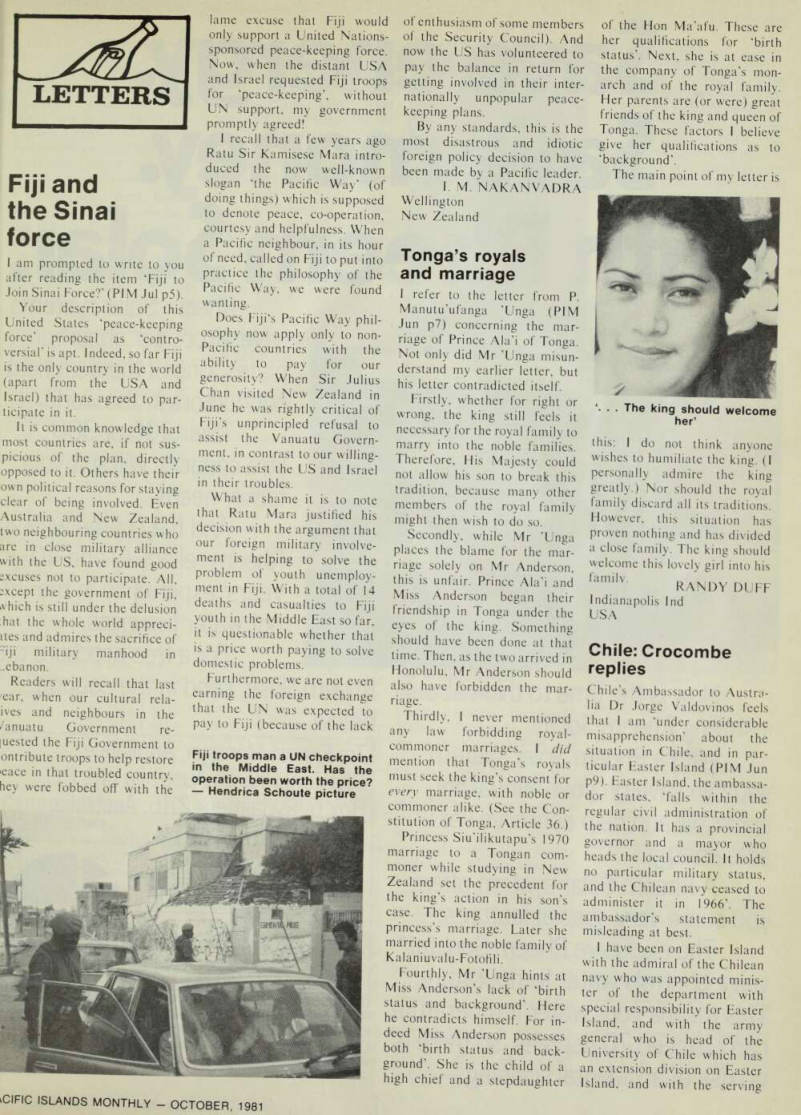
Fiji troops man a UN checkpoint in the Middle East. Has the operation been worth the price? -Hendrica Schoute picture
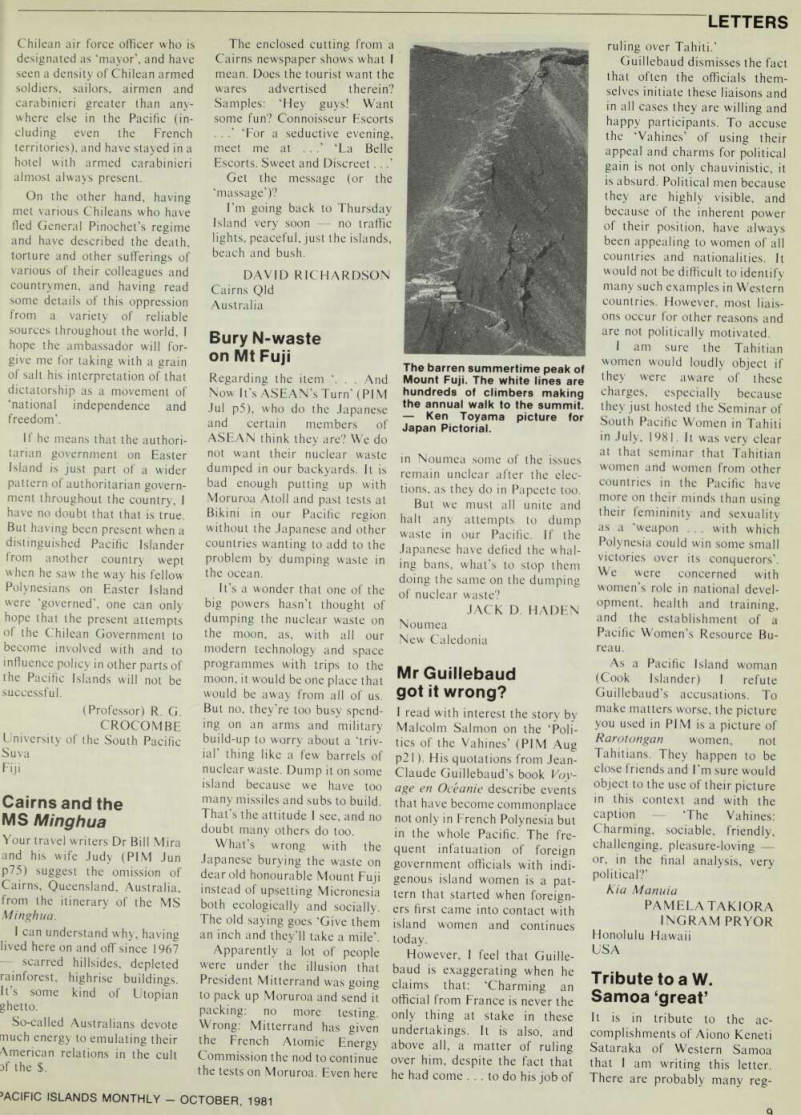
...The king should welcome her’
Chilean air force officer who is designated as ‘mayor’, and have seen a density of Chilean armed soldiers, sailors, airmen and carabinieri greater than any where else in the Pacific (in cluding even the French territories), and have stayed in a hotel with armed carabinieri almost always present.
On the other hand, having met various Chileans who have fled General Pinochet’s regime and have described the death, torture and other sufferings of various of their colleagues and countrymen, and having read some details of this oppression from a variety of reliable sources throughout the world, I hope the ambassador will for give me for taking with a grain of salt his interpretation of that dictatorship as a movement of ‘national independence and freedom’.
If he means that the authori tarian government on Easter Island is just part of a wider pattern of authoritarian govern ment throughout the country, I have no doubt that that is true.
But having been present when a distinguished Pacific Islander from another country wept when he saw the way his fellow Polynesians on Easter Island were ‘governed’, one can only hope that the present attempts of the Chilean Government to become involved with and to influence policy in other parts of the Pacific Islands will not be successful. (Professor) R. G.
Crocombe
University of the South Pacific Suva Fiji Cairns and the
MS Minghua
Your travel writers Dr Bill Mira and his wife Judy (PIM Jun p 75) suggest the omission of Cairns, Queensland, Australia, from the itinerary of the MS Minghua.
I can understand why, having lived here on and off since 1967 - scarred hillsides, depleted rainforest, highrise buildings.
It s some kind of Utopian ghetto.
So-called Australians devote much energy to emulating their American relations in the cult 3f the $.
The enclosed cutting from a Cairns newspaper shows what I mean. Does the tourist want the wares advertised therein?
Samples: ‘Hey guys! Want some fun? Connoisseur Escorts . . ‘For a seductive evening, meet me at . . ‘La Belle Escorts. Sweet and Discreet..
Get the message (or the ‘massage’)?
Em going back to Thursday Island very soon no traffic lights, peaceful, just the islands, beach and bush.
David Richardson
Cairns Qld Australia
Bury N-waste
on Mt Fuji Regarding the item . . And Now It's ASEAN’s Turn' (PIM Jul p 5), who do the Japanese and certain members of ASEAN think they are? We do not want their nuclear waste dumped in our backyards. It is bad enough putting up with Moruroa Atoll and past tests at Bikini in our Pacific region without the Japanese and other countries wanting to add to the problem by dumping waste in the ocean.
It’s a wonder that one of the big powers hasn’t thought of dumping the nuclear waste on the moon, as, with all our modern technology and space programmes with trips to the moon, it would be one place that would be away from all of us.
But no, they’re too busy spend ing on an arms and military build-up to worry about a Triv ial’ thing like a few barrels of nuclear waste. Dump it on some island because we have too many missiles and subs to build.
That’s the attitude I see, and no doubt many others do too.
What’s wrong with the Japanese burying the waste on dear old honourable Mount Fuji instead of upsetting Micronesia both ecologically and socially.
The old saying goes ‘Give them an inch and they’ll take a mile’.
Apparently a lot of people were under the illusion that President Mitterrand was going to pack up Moruroa and send it packing: no more testing.
Wrong: Mitterrand has given the French Atomic Energy Commission the nod to continue the tests on Moruroa. Even here
in Noumea some of the issues remain unclear after the elec tions, as they do in Papeete 100.
But we must all unite and halt any attempts to dump waste in our Pacific. If the Japanese have defied the whal ing bans, what’s to stop them doing the same on the dumping of nuclear waste?
Jack D. Haden
Noumea New Caledonia
Mr Guillebaud
got it wrong?
I read with interest the story by Malcolm Salmon on the ‘Poli tics of the Vahines’ (PIM Aug p2l). His quotations from Jean- Claude Guillebaud’s book Voy age en Oceanic describe events that have become commonplace not only in French Polynesia but in the whole Pacific. The fre quent infatuation of foreign government officials with indi genous island women is a pat tern that started when foreign ers first came into contact with island women and continues today.
However, I feel that Guille baud is exaggerating when he claims that; ‘Charming an official from France is never the only thing at stake in these undertakings. It is also, and above all, a matter of ruling over him, despite the fact that he had come ... to do his job of
ruling over Tahiti.’
Guillebaud dismisses the fact that often the officials them selves initiate these liaisons and in all cases they are willing and happy participants. To accuse the ‘Vahines’ of using their appeal and charms for political gain is not only chauvinistic, it is absurd. Political men because they are highly visible, and because of the inherent power of their position, have always been appealing to women of all countries and nationalities. It would not be difficult to identify many such examples in Western countries. However, most liais ons occur for other reasons and are not politically motivated.
I am sure the Tahitian women would loudly object if they were aware of these charges, especially because they just hosted the Seminar of South Pacific Women in Tahiti in July, 1981. It was very clear at that seminar that Tahitian women and women from other countries in the Pacific have more on their minds than using their femininity and sexuality as a ‘weapon . . . with which Polynesia could win some small victories over its conquerors’.
We were concerned with women’s role in national devel opment, health and training, and the establishment of a Pacific Women’s Resource Bu reau.
As a Pacific Island woman (Cook Islander) I refute Guillebaud’s accusations. To make matters worse, the picture you used in PIM is a picture of Rarotongan women, not Tahitians. They happen to be close friends and I’m sure would object to the use of their picture in this context and with the caption ‘The Vahines:
Charming, sociable, friendly,
challenging, pleasure-loving
or, in the final analysis, very political?’
Kia Manuia
Pamela Takiora
Ingram Pryor
Honolulu Hawaii
Usa
Tribute to a W.
Samoa ‘great’
It is in tribute to the ac complishments of Aiono Keneti Sataraka of Western Samoa that I am writing this letter.
There are probably many reg
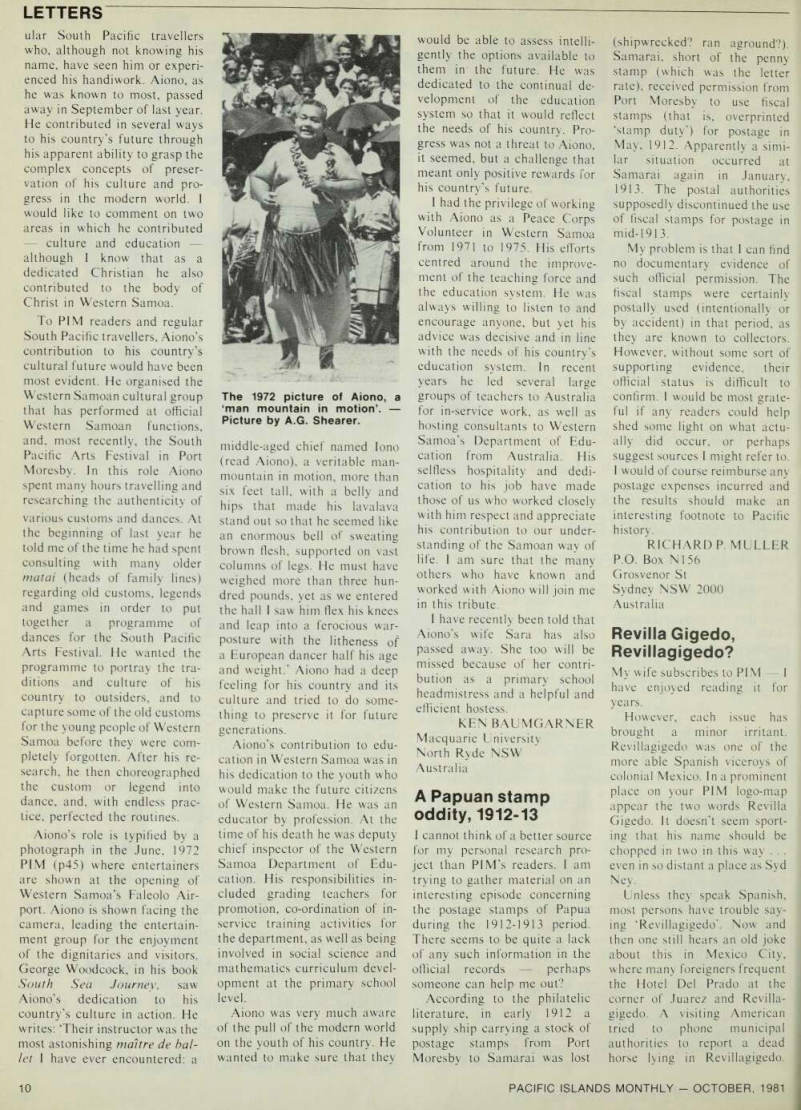
The barren summertime peak of Mount Fuji. The white lines are hundreds of climbers making the annual walk to the summit. -Ken Toyama picture for Japan Pictorial.
ular South Pacific travellers who, although not knowing his name, have seen him or experi enced his handiwork. Aiono, as he was known to most, passed away in September of last year.
He contributed in several ways to his country’s future through his apparent ability to grasp the complex concepts of preser vation of his culture and pro gress in the modern world. I would like to comment on two areas in which he contributed - culture and education although I know that as a dedicated Christian he also contributed to the body of Christ in Western Samoa.
To PIM readers and regular South Pacific travellers, Aiono’s contribution to his country’s cultural future would have been most evident. He organised the Western Samoan cultural group that has performed at official Western Samoan functions, and, most recently, the South Pacific Arts Festival in Port Moresby. In this role Aiono spent many hours travelling and researching the authenticity of various customs and dances. At the beginning of last year he told me of the lime he had spent consulting with many older matai (heads of family lines) regarding old customs, legends and games in order to put together a programme of dances for the South Pacific Arts Festival. He wanted the programme to portray the tra ditions and culture of his country to outsiders, and to capture some of the old customs for the young people of Western Samoa before they were com pletely forgotten. After his re search, he then choreographed the custom or legend into dance, and, with endless prac tice, perfected the routines.
Aiono’s role is typified by a photograph in the June, 1972 PIM (p 45) where entertainers are shown at the opening of Western Samoa’s Faleolo Air port. Aiono is shown facing the camera, leading the entertain ment group for the enjoyment of the dignitaries and visitors.
George Woodcock, in his book South Sea Journey, saw Aiono’s dedication to his country’s culture in action. He writes: ‘Their instructor was the most astonishing maltre de bal let I have ever encountered: a
middle-aged chief named lono (read Aiono), a veritable man mountain in motion, more than six feel tall, with a belly and hips that made his lavalava stand out so that he seemed like an enormous bell of sweating brown flesh, supported on vast columns of legs. He must have weighed more than three hun dred pounds, yet as we entered the hall I saw him flex his knees and leap into a ferocious war posture with the litheness of a European dancer half his age and weight.’ Aiono had a deep feeling for his country and its culture and tried to do some thing to preserve it for future generations.
Aiono’s contribution to edu cation in Western Samoa was in his dedication to the youth who would make the future citizens of Western Samoa. He was an educator by profession. At the time of his death he was deputy chief inspector of the Western Samoa Department of Edu cation. His responsibilities in cluded grading teachers for promotion, co-ordination of in service training activities for the department, as well as being involved in social science and mathematics curriculum devel opment at the primary school level.
Aiono was very much aware of the pull of the modern world on the youth of his country. He wanted to make sure that they
would be able to assess intelli gently the options available to them in the future. He was dedicated to the continual de velopment of the education system so that it would reflect the needs of his country. Pro gress was not a threat to Aiono, it seemed, but a challenge that meant only positive rewards for his country’s future.
I had the privilege of working with Aiono as a Peace Corps Volunteer in Western Samoa from 1971 to 1975. His efforts centred around the improve ment of the teaching force and the education system. He was always willing to listen to and encourage anyone, but yet his advice was decisive and in line with the needs of his country’s education system. In recent years he led several large groups of teachers to Australia for in-service work, as well as hosting consultants to Western Samoa’s Department of Edu cation from Australia. His selfless hospitality and dedi cation to his job have made those of us who worked closely with him respect and appreciate his contribution to our under standing of the Samoan way of life. I am sure that the many others who have known and worked with Aiono will join me in this tribute.
I have recently been told that Aiono’s wife Sara has also passed away. She 100 will be missed because of her contri bution as a primary school headmistress and a helpful and efficient hostess.
Ken Baumgarner
Macquarie University North Ryde NSW Australia
A Papuan stamp
oddity, 1912-13
I cannot think of a better source for my personal research pro ject than PI M’s readers. I am trying to gather material on an interesting episode concerning the postage stamps of Papua during the 1912-1913 period.
There seems to be quite a lack of any such information in the official records perhaps someone can help me out?
According to the philatelic literature, in early 1912 a supply ship carrying a stock of postage stamps from Port Moresby to Samarai was lost
(shipwrecked? ran aground?).
Samarai, short of the penny stamp (which was the letter rale), received permission from Port Moresby to use fiscal stamps (that is, overprinted ‘stamp duty’) for postage in May, 1912. Apparently a simi lar situation occurred at Samarai again in January, 1913. The postal authorities supposedly discontinued the use of fiscal stamps for postage in mid-1913.
My problem is that I can find no documentary evidence of such official permission. The fiscal stamps were certainly postally used (intentionally or by accident) in that period, as they are known to collectors.
However, without some sort of supporting evidence, their official status is difficult to confirm. I would be most grate ful if any readers could help shed some light on what actu ally did occur, or perhaps suggest sources I might refer to.
I would of course reimburse any postage expenses incurred and the results should make an interesting footnote to Pacific history.
Richard P. Muller
P.O. Box N 156 Grosvenor St Sydney NSW 2000 Australia
Revilla Gigedo,
Revillagigedo?
My wife subscribes to PIM I have enjoyed reading it for years.
However, each issue has brought a minor irritant.
Revillagigedo was one of the more able Spanish viceroys of colonial Mexico. In a prominent place on your PIM logo-map appear the two words Revilla Gigedo. It doesn’t seem sport ing that his name should be chopped in two in this way . . . even in so distant a place as Syd Ney.
Unless they speak Spanish, most persons have trouble say ing ‘Revillagigedo’. Now and then one still hears an old joke about this in Mexico City, where many foreigners frequent the Hotel Del Prado at the corner of Juarez and Revilla gigedo. A visiting American tried to phone municipal authorities to report a dead horse lying in Revillagigedo.
The 1972 picture of Aiono, a man mountain in motion’.- Picture by A.G. Shearer.
After a number of goes at identifying the street, the frus trated Yank asked the person on the other end of the line to stand by a moment. Finally, the gasps of mighty panting were heard and a laboured voice gasped: ‘There is a dead horse in the lobby of the Hotel Del Prado In any event, I think PIM ought to label the group of islands SSW off the coast of Mexico’s peninsular state of Baja California Sur . . . with the undivided name that is theirs . . . even if it is easier to say in two pieces.
Galal J. Kernahan
Anaheim Calif
Usa
PIM Associate Editor Mal colm Salmon has been doing some homework and comments: Reader Kernahan is quite right in urging that it is correct modern usage to write the name of these islands as one word Revillagigedo. Indeed, this was done on maps in editions of Pacific Islands Year Book on which PI M’s map is based until an earlier erudite and helpful correspondent wrote to our office saying that the name should be written as Wo words, and the PIYB editors changed the map accordingly.
But, Mr Kernahan is very much barking up the wrong tree when he insists that the reason why the islands’ name should be written as one word is that the man after whom the islands vere named wrote his name in hat way. That worthy Spanish tentleman was Juan Vicente Jiiemes Pacheco de Padilla, -°unt of Revilla Gigedo, who vas viceroy of New Spain in 789-94. His father, Juan rancisco de Giiemes y Jorcasitas, Count of Revilla jigedo, had held the same ffice in 1746-55. The islands /ere named after his son in 793.
As can be well understood, lerefore, the family must have een pretty well known around ie place at the time. It is robably this contemporary ame which explains the Tun ing together of the two words f the title Revilla and rigedo to describe the lands, as well as the Mexico ity street. (Any schoolboy in
an English-speaking country whose first name happens to be Winston will tell you how sick and tired he gets of being called
Winstonchurchill . . .)
Our thanks to Mr Kernahan - even if he is right for the wrong reasons. (Incidentally, we’ll be changing our map yet again and so will the editors of PIYB.) Again on Oz in the Pacific My apologies to Athol L.
Cottrell (PIM AugplO) and all others who may have taken ‘a certain amount of umbrage’ at my ‘vitriolic’ letter (PIM Jun plO).
It would presumably be use less to argue the point over the ‘lot of help’ given by Australia over the years to its Pacific neighbours. The true purpose of this help was recently bluntly described in public by an Aus tralian MP: it is designed ‘to keep the Russians out’, he said.
This could be expressed quite differently in military and stra tegic terms.
I cannot refrain from saying a few words about Gough Whitlam, described by Mr Cottrell as a ‘now unemployed politico’. Mr Whitlam has been visiting Nigeria in a desperate quest for the international limelight. With even greater
desperation he is still seeking to justify his gutless cowardice on the Timor issue.
The historical facts indicate that Mr Whitlam’s ‘advocacy of slightly revolutionary ideas’ cost 300 000 Timorese and five dinkum Aussies their lives. These facts appear to have been overlooked by Mr Cottrell and his ‘thousands of concerned Australians’.
Apart from the Timor issue, I wonder very seriously where these ‘thousands of concerned Australians’ have been while Indonesia has been slaughtering more than 200 000 inhabitants of Irian Jaya, right on Austra lia’s doorstep. The slaughter is going on to this day, despite all those ‘concerned’ Australians.
And where have they been as thousands of West Papuan refu gees, including many women and children, have been forced back across the Papua New Guinea/Irian Jaya border with the active participation of for mer Australian ‘Kiaps’, now using the glorified title of ‘se curity and intelligence advisers’ to the Somare and Chan gov ernments?
It has become a major trend in our societies today to sidestep the truth and attempt to excuse incompetence and cowardice by the use of the word ‘commu nist’. Mr Cottrell does this.
Gough Whitlam did it when he has suggested that the Fretilin movement in East Timor was ‘communist’.
Despite all this, I am very pleased and proud that Mr Cottrell chooses to address me as ‘Mr Paingame’. After two years in Australia I have be come used to being addressed as ‘Mr Coon’, if not as plain ‘Kanaka’.
I wish to assure Mr Cottrell that I have not the slightest intention of joining any of Australia’s hypocritical politi cal organisations. The last one I would think of joining would be Australia’s ‘communist organis ations’ referred to by Mr Cottrell. As a ‘Coon’ and a ‘Kanaka’ 1 presume 1 wouldn’t be welcome in them in any case. 1 am proud of what I am, and proud of my brothers and sisters in Irian Jaya, and those in Timor as well, who have been sold and betrayed in cowardice and greed. 1 am proud too of
those who continue the struggle.
Let us accept the truth. Let’s stop talking lukewarm hypoc risy and baloney about ‘the many thousands of Australians concerned for their Pacific neighbours’. Historical facts prove the contrary, as indicated in Timor and Irian Jaya.
Vitaliz Paingame
Cairns Qld Australia
Yachtsman turned
back from Nauru To the people of Nauru, I am sorry. I am sorry that after 10 days of hard sailing I was denied the privilege of meeting and coming to know you.
Strictly complying with quaran tine and entry procedures, I hadn t prepared for the bureau cratic bullying and petty crankiness encountered. I can only conclude I must have arrived on the official’s day off, or had committed some similar crime.
I was turned away to sea without a chance to restock food, fuel or water, and I was told that if I protested in any way I would face some vague legal charges. This was astound ing, not solely because it is in flagrant breach of international law or because I was assumed to have no legal requirement for entry but because of the lavish hospitality and co-operation which I have found to prevail elsewhere in the Islands.
Other Islanders have been proud of their culture and have been eager to share it with visitors. What has caused such brutal and rude treatment towards visitors to Nauru? Does this lack of hospitality reflect an eroded pride or even a shame in what 1 came to see? Certainly a customs and immigration official can’t reflect the charac ter of an entire nation, but may I caution that he is the van guard the first and the last impression.
Should he not be an ambassa dor of goodwill, or will future callousness to foreign visitors continue to belittle the Repub lic of Nauru?
Alvah G. Simon
Yacht Zenie P. II Cairns Yacht Club Cairns Qld Australia
Revilla Gigedo (or Revil lagigedo) actually consists of three islands and a large rock.
The group is just over 18 de grees north of the equator and is 550 km from the coast of Mexico. The main island, Socorro (sometimes known as Santo Tomas), includes a vol canic peak. The two other islands are San Benedicto and Santa Rosa (sometimes known as Clarion). Partida Rock is off the coast of Socorro. The group belongs to Mexico.