Yachties’ primer
p. 57 · Read in the full issue
tells it all
The Cruising Life. By Ross Norgrove. Published by Inter national Marine Publishing, Camden, Maine, USA, 1980. ix and 309 pp. SUS 19.95. ISBN 187742 144 5.
New Zealander Ross Norgrove’s latest book, The Cruising Life, is a warts-and-all account of half a lifetime’s experience of cruising for pleasure and profit. It will appeal equally to the would-be eruiser, the armchair sailor and :he barnacled salt. There are some things in it that could put he more squeamish reader off cruising, but the bias is lefinitely towards encourage nent: the writer not only knows lis subject, he loves it as well.
Norgrove takes the reader on i straight course through all the übjects usually dealt with in a >ook of this type. The lifference is that he has learned he hard way, and teaches his sssons in the form of a host of ntertaining anecdotes.
Chapter 6 is probably the
'ook s most thought-provoking
- and it deals with a subject 'hich, I suspect, is the closest 3 Ross Norgrove’s heart: nchoring.
The first two paragraphs sum p the Norgrove philosophy on le subject; ‘Of all the things ou do with your cruising boat, icking a suitable place to
anchor (and anchoring cor rectly) is more important for the success (and continuity) of your cruising career than any other. ‘Carry a minimum of three anchors aboard your vessel.
Each one should have its own chain and/or warp and be capable of holding the ship if, for any reason, the other two are lost. Better than three anchors are four or even five.’
Chapter 10 is a good illus tration of Norgrove’s method. It is a fictional account of a voyage from Pago Pago to Fiji by two characters named Martha and Clarence, sailing in their good ship Tu-Tu.
Martha, like many keen cruisers, is prone to sea sick ness, and takes her medication before they sail. Clarence, who’s just eaten a hearty meal, wishes he had done so too as they feel the first of the swell under their keel.
It soon becomes apparent that the author has done the trip in question probably many times: weather details, courses sailed, reefs and landfalls are all completely authentic. Many lessons and wrinkles are charm ingly taught: like serving hot stew in the cockpit in individual steel pots with handles. (This writer still bears fork marks on his left knee as a reminder of the day a slippery fried egg landed on it from a tin plate.)
Clarence makes his cockpit temporarily smaller, and so less likely to hold vast amounts of water in the event of taking a big wave aboard, by adding blocks of foam. So the lessons go on.
The fact that Tu-Tu carries the dog Arthur as supernumer ary shows that Clarence and Martha have not yet encoun tered Australia’s quarantine regulations. However, Arthur’s presence does demonstrate Nprgrove’s belief that the cruis
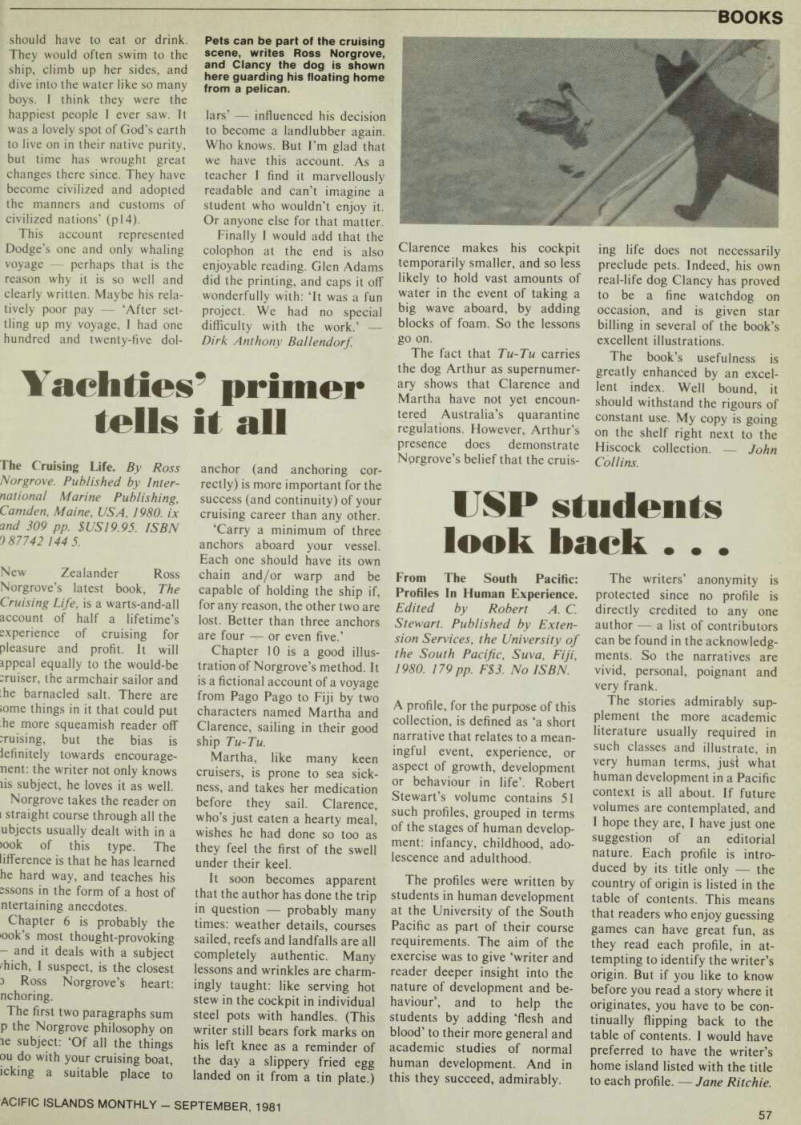
ing life does not necessarily preclude pets. Indeed, his own real-life dog Clancy has proved to be a fine watchdog on occasion, and is given star billing in several of the book’s excellent illustrations.
The book’s usefulness is greatly enhanced by an excel lent index. Well bound, it should withstand the rigours of constant use. My copy is going on the shelf right next to the
Hiscock collection.
John
Collins.
Pets can be part of the cruising scene, writes Ross Norgrove, and Clancy the dog is shown here guarding his floating home from a pelican.