from Nantucket
pp. 56-57 · Read in the full issue
An 1831 whaler from Nantucket
A Whaling Voyage in the Pacific Ocean and Its Incidents. By George A. Dodge. Edited by Kenneth R. Martin. Published by Ye Galleon Press, Fairfield, Washington. 30pp. No price given. ISBN 0 87770 243 8.
Most of us living in the modern day Pacific have never seen a
whale those who ply the seas might see one occasionally. It’s hard to imagine sometimes that whaling was once the industry in these parts, but it flourished in the late 18th and early 19th centuries.
Of the thousands of vessels which combed the Pacific in those days there was one, the
Baltic, Captain Chadwick, which carried George A.
Dodge. She shipped out of Nantucket in 1831 with 30 crewmen, four mates, four harpooners, and young Dodge, who was making his first voy age.
He was eager, excited, im pressionable, and had an excel lent memory, which, combined with the former qualities, re sulted in this account of the voyage originally published in 1882, some 50 years later.
Today we have it freshly edited by the venerable Pacific whal ing historian/editor from New England, Kenneth R. Martin.
Dr Martin has edited several excellent 19th-century Pacific accounts, including last year’s appearance of Naked as a Prisoner: Captain Edward C.
Barnard’s Narrative of A Ship wreck in Palau, 1832-1833 (reviewed PIM Jun p7O). And so it comes as no surprise that this short piece is another small gem in the reviving literature of the period.
The easy and delightful writ ing style is complemented by the meaty information about whaling contained in the vol ume. One of the especially interesting items is about eating habits among the whalers while aboard ship. Dodge explains how they would combine ‘trying-out’ whale blubber the process of cooking it down into oil in huge pots on the ship’s main deck with pre paring food for themselves: ‘We would often catch fish when we were trying-out, put them in the skimmer and cook them in oil, which is as sweet as lard when it is new. It was not an uncommon thing to take a steak from the whale after the blubber was taken off; the meat is of coarse grain, but sweet and good. We would often fry a mess of doughnuts in the same way’ (pis).
Included also are observa tions of various ports-of-call, such as Maui, Tahiti, Callao, Coquimbo in Chile, and others.
At Tahiti Dodge commented on the girls and cultural change: ‘I have often seen these women miles from the shore, playing in the breakers and bathing in the sunshine, like so many fish, fearing no danger, nor worrying about what they
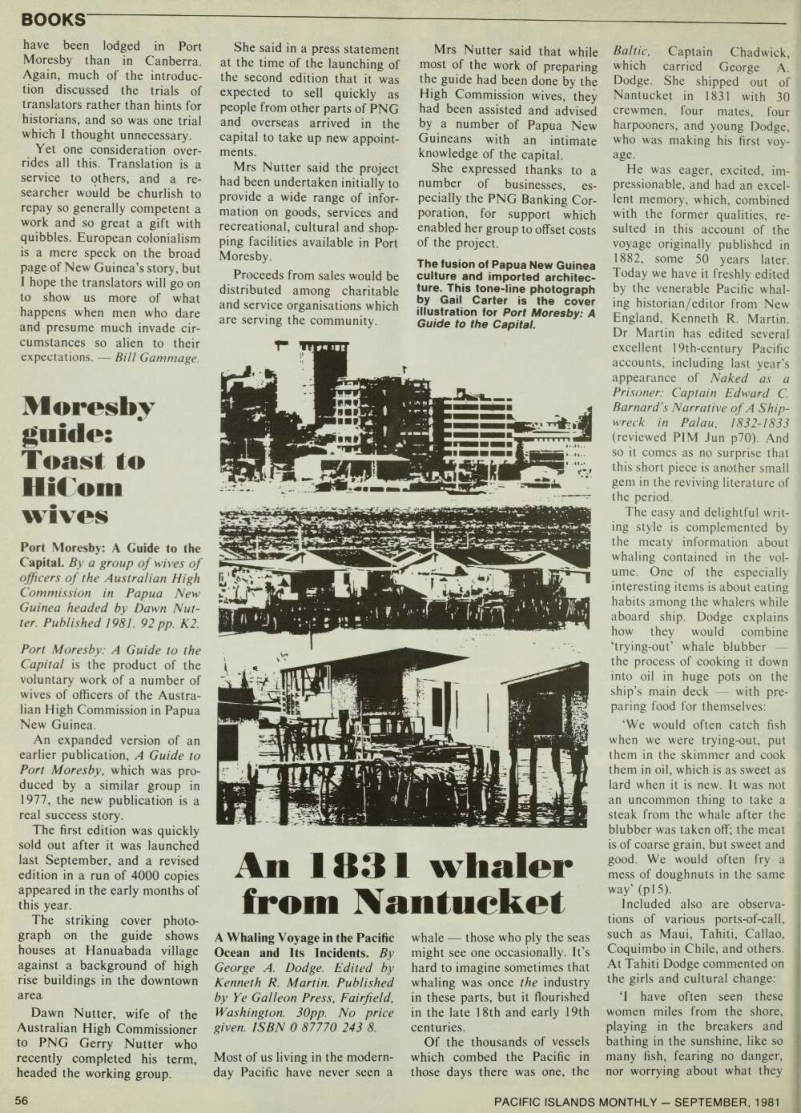
The fusion of Papua New Guinea culture and imported architec ture. This tone-line photograph by Gail Carter is the cover illustration for Port Moresby: A Guide to the Capital.
should have to eat or drink.
They would often swim to the ship, climb up her sides, and , 1 ... dive into the water like so many boys. I think they were the happiest people I ever saw. It was a lovely spot of God’s earth to live on in their native purity, but time has wrought great changes there since. They have become civilized and adopted the manners and customs of civilized nations’ (pi 4).
This account represented Dodge’s one and only whaling voyage perhaps that is the reason why it is so well and clearly written. Maybe his relalively poor pay ‘After settling up my voyage, I had one hundred and twenty-five dol-
lars’ influenced his decision to become a landlubber again, Who knows. But I’m glad that we have this account. As a teacher I find it marvellously readable and can’t imagine a student who wouldn’t enjoy it.
Or anyone else for that matter.
Finally I would add that the colophon at the end is also enjoyable reading. Glen Adams did the printing, and caps it off wonderfully with; ‘lt was a fun project. We had no special difficulty with the work.’
Dirk Anthony Ballendorf