PNG outstation, 1981: ‘The air
pp. 41-48 · Read in the full issue


of a place now forgotten’
Political
Currents
In its sixth year of independence, how is Papua New Guinea faring at the community level? Lawyer KEVIN EGAN, already known for his controversial comments on PNG, presents an unhappy picture.
The former Labor prime minister of Australia, Mr Gough Whitlam, who was a central figure in initiating independence for Papua New Guinea, spent three days in Port Moresby earlier this year at the end of an overseas lecture tour.
Addressing a group of Port Moresby unionists he expressed satisfaction at the state of the nation and at the progress of ‘localisation’ particularly localisation of the judiciary, Localisation in the PNG context is the replacement of whites by PNG nationals.
It is indeed a pity that Mr Whitlam didn’t venture beyond , , . . y , the municipal boundaries of the national capital before making such sweeping assessments about the national state of affairs. This is particularly so when it is realised that only 13% of the people live in Port Moresby and a few other scattered urban areas. The great bulk of the people - and they represent the real PNG are the rural dwellers of the villages, the outstations, the mountains and the plains. A closer inspection of how they are faring today might well have turned Mr Whitlam’s selfsatisfaction to disillusionment.
The gut-feeling of many rural ipnnlp pomp ♦ , , aeople came home to me clearly n the words of a village spokesnan who addressed a land
hearing in the remote Star Mountains near the PNG bor der with Indonesia. The vil lagers had claimed compen sation rights for land which will soon be part of the big Ok Tedi copper and gold mining ven ture. Their claim was found to be spurious, but this in itself is not the point of the story. The point lies in the words which were used by the spokesman when he accepted that the land claim had been unfounded Here’s a translation of what he said; . Not very long a *° we were livin 8 f her fu JUSt as ° ur f ancest ° rs had for thousands of years. It is true that we were sem i-nomadic, that we killed and sometimes even ate each other, that we died in large numbers from sicknesses which we attributed t 0 sorcery but which the govern ment oncers insisted were due to lack of h yB iene and viruses, but the "’ we knew n 0 other existence . jJapp S ° ‘ n °“ r ° W " Way Then came the Australian admin istration in the form of the white patrol officers. They told us to change our old ways and because of their strength and because of the better life that they promised us, we dld sa No more killin g- no more
canniba,ism < n 0 more wandering.
T n h ri ey ‘ patrol P os, ‘ a schoo ' , ‘ f Ce " tre ' PeaCe ’ education for our children, medi cine, We n 0 longer |ived in fear They took our best taro-growing land, the flat land, and built an
In 1979 Papua New Guinea was shaken by a confrontation between the government of the day and the judiciary, arising Jrom allegations of political interference in the course of justice. The justice minister, Mrs Nahau Rooney, was gaoled by the courts and released by the government. In the aftermath five judges resigned.
The public prosecutor, Mr Kevin Egan, who had been instrumental in taking the first legal moves against Mrs Rooney, ended his term of appointment soon afterwards In public statements and in an official report Mr Egan was scathingly critical of what he saw as the crumbling of ethical responsibilities and institutions. i j gan ’ an Aust ™lian. is now attached to the Hong Kong legal department. Earlier this year he re-visited PNG, and he writes here of his impressions.
airstrip on it, but we didn’t even object to this, for we now had contact with the outside world, a world that we previously did not even know existed, and still we were happy, for many good things came to our area in the aircraft that landed.
And then came independence.
Nobody ever asked us if we wanted it, nor were we told what would happen when we got it. We were just told that we now had it.
And then the white patrol officers went away and they were replaced by local ones, but they came and went so frequently that soon we did not know who our ‘kiap’ (patrol officer) was. Now the present one has gone away too. We still have our health centre but it has not had any drugs in it for a long time and although we repeatedly ask the government for replacements no drugs ever come. Then two years ago the government closed the airstrip the airstrip that the old administration built on our best taro growing land and so now there are no goods for our trade stores, we can’t fly out the sick or injured, and we are again isolated. There is no teacher for our school. People are reverting to their old ways and there is no law and order. We are back where we started.
Now you ask us why we made this spurious land claim. We made it to draw attention to our plight. We are desolate. We were promised every thing and upon those promises we built our dreams. You have broken your promises and we are left with nothing. We made this claim be cause it is our last chance. That is all f have to say. Thank you.
Meanwhile, in the far eastern end of the country, in the 'amous and once beautiful robriand Islands, the picture is no brighter. A decade ago this
was a pretty, peaceful little paradise. Crime was virtually unknown, the government ‘station’ was freshly painted, the grass was cut, and the villagers set aside a day each week for community works.
There was an air of efficient productivity about the place.
From the sale of copra or fish through the Department of Pri mary Industries, or carvings to the many tourists who regularly arrived on weekend holiday charters, or from employment with any of the dozen odd private enterprises operating on the main island of Kiriwina, the people had the opportunity to earn moderate cash incomes, which in turn led to better life styles. The present day contrast is staggering.
When I arrived at Kiriwina
airport I was immediately
struck by the chaos. A coffin was being rushed off the plane by a party of wailing mourners.
No one was in apparent control of loading or unloading the aircraft, let alone stowing the cargo. I located my luggage and then moved off in search of transport to the government station some 30 minutes drive away. As I approached the government truck, the usual source of transport, someone was lamenting, The govern ment truck is out of petrol and the clerks on the station in charge of the petrol pump have just gone off duty.’ So much for that.
Having had the presence of mind to speak to the local member of parliament before leaving Port Moresby to estab lish the name and tribal origin of the senior officer in charge, I scanned the faces of the crowd and was able to single him out but only from his character istic tribal features.
There he was, the govern ment’s district officer in charge
bare-chested, bare-footed,
trousers rolled up to the knee,
hair recently slept in, indis tinguishable from the rest of the milling multitude.
We eventually reached the government outstation at Losuia. The roads were narrower than I recalled, and rougher, but then there hasn’t been a grader on the island since before the days of self government. The grass on the station hadn’t been cut in ages and every building was in dire need of paint. All that remained of what was once the doctor’s residence was the broken shell of a galvanised iron water tank, two concrete tank stands, a few stumps, and the front and rear concrete stairs, now reaching aimlessly skywards. My local informant explained, ‘lt was falling down anyway so the people just came and took away anything left that was worth taking.’
On Sunday I decided to walk the three kilometres from the government station to the only hotel on the island still operat ing to see the proprietor, an old chum. On the way I saw human excrement lying uncovered on the road adjacent to nearby villages. When I passed Oiyaveyova, the largest village along the way, I saw three groups of men, about 20 altogether, gambling at cards, a serious and socially disruptive offence in Papua New Guinea.
My informant told me that a man could win up to 70 kina (about SA100) in games such as this. One winner, of course, means many losers, and since there is no longer anyone organ ised to buy copra or fish, since the tourist charters no longer come at the weekends and since all but two businesses on the island have closed down, the opportunities of earning even a moderate cash income have ceased.
Accordingly the loss of even a comparatively small amount of the much prized cash in an illegal card game is a sorry blow indeed, and such games often end in arguments, violence and even knife fights. So contemptu ous are the local people of the forces of law and order on the island, that such card games even take place outside the sub district office, which houses the patrol officers and the police. I am told that apart from the
fortunate few employed as gov ernment servants, the major source of cash incomes for the people on the island is gifts of money from children and rela tives working in urban centres.
Breaking, entering and steal ing has become a means of obtaining beer, cigarettes and tinned food.
The whole island has the air of a place now forgotten, and in many respects that is exactly what it is. The reality is that very little of the supposedly plentiful supply of money in PNG is reaching the rural areas. It is staying in the urban areas or being siphoned off in less-desirable directions. The rural people hear stories of politicians, cabinet ministers and senior civil servants buying businesses, houses and real es tate developments in urban PNG and even in Australia, it has been rumoured. Small wonder the resentment of the village people is intense. Small wonder they look on many of their politicians as temporary ‘nest-featherers’, and this may explain the high failure rate of politicians seeking election for second terms of office.
No matter how well Port Moresby and other urban areas may appear to be thriving, particularly under the impetus of outside capital and develop ment, no picture of PNG can be complete without a look at the rural community the com munity which seems to have been forgotten.
Nauru member
bounces back
Mr Rene Harris, the Nauru politician who resigned from parliament to test whether his electors really supported him, is back in parliament after prov ing his point.
At a by-election held only five days after he resigned from the Aiwo seat he was returned with an absolute majority over three other candidates. Mr Harris, who has been a strong critic of some of Nauru’s money poli cies, said the result of the election was ‘a clear indication of the people’s trust in me’ and said that he was ‘eager and ready to get back to the parlia mentary fray’.
The results of the poll, de clared on July 18, were; Ateo Leslie Will Amram 10, August Detonga Deiye 28, Rene Reynaldo Harris 111, Samuel Edwin Tsitsi 48.
Tonga has four
more MPs
In response to a question tabled in the House last year by Vavau MP Masao Paasi, Tonga’s Deputy Prime Minister Baron Tuita told the legislative as sembly in June that the two most northerly islands in the kingdom Niuatoputapu and Niuafoou would each, on completion of necessary formalities, acquire the right to elect a people’s representative to parliament.
At the same time, he said, the number of nobles’ representa tives would also be increased from seven to nine, to retain the existing balance.
On another aspect of Mr Paasi’s question, Baron Tuita said that His Majesty in Coun cil was considering increasing the number of cabinet minis ters, to reduce the portfolio load on the most heavily burdened.
But he was not at this stage contemplating any change in the present system, whereby all ministers are appointed by the monarch for an indefinite term.
The reality of the official announcement bore little re semblance to the rumour circulating in the capital for weeks to the effect that the government intended to make the parliament more democratically based by in creasing the number of PRs to 12, while keeping the NRs’ total unchanged at seven.
While the isolated Niuas will obviously benefit from having their own elected MPs instead of being lumped in with the Tongatapu electorate, the new move will compound rather than alleviate the representational inequalities as shown in the accompanying table.
Population figures are taken from the 1976 census.
A little arithmetic shows that the outlying districts (Vavau, Haapai and the Niuas), with a combined population of just over 28 000, will have six rep resentatives under the new sys tem, compared with three for Tongatapu/Eua, which em braces more than two-thirds of the Kingdom’s population.
This is a far cry from the earlier rumour and its predic tion that the people’s represen tatives were to be increased by one new member for the two Niuas combined, one for Eua, and three more for Tongatapu, which so ran the wishful thinking was to be divided into east, central and western districts, with two representa tives from each.
Even under the new representational system, Tonga’s ‘Westminster-type democracy’ will still be a long way from the original model, and most expatriate observers see the kingdom’s parliament as little more than a cosmetic trim on a traditional governing sys tem based on inherited and hierarchical authority.
This line of criticism is in-
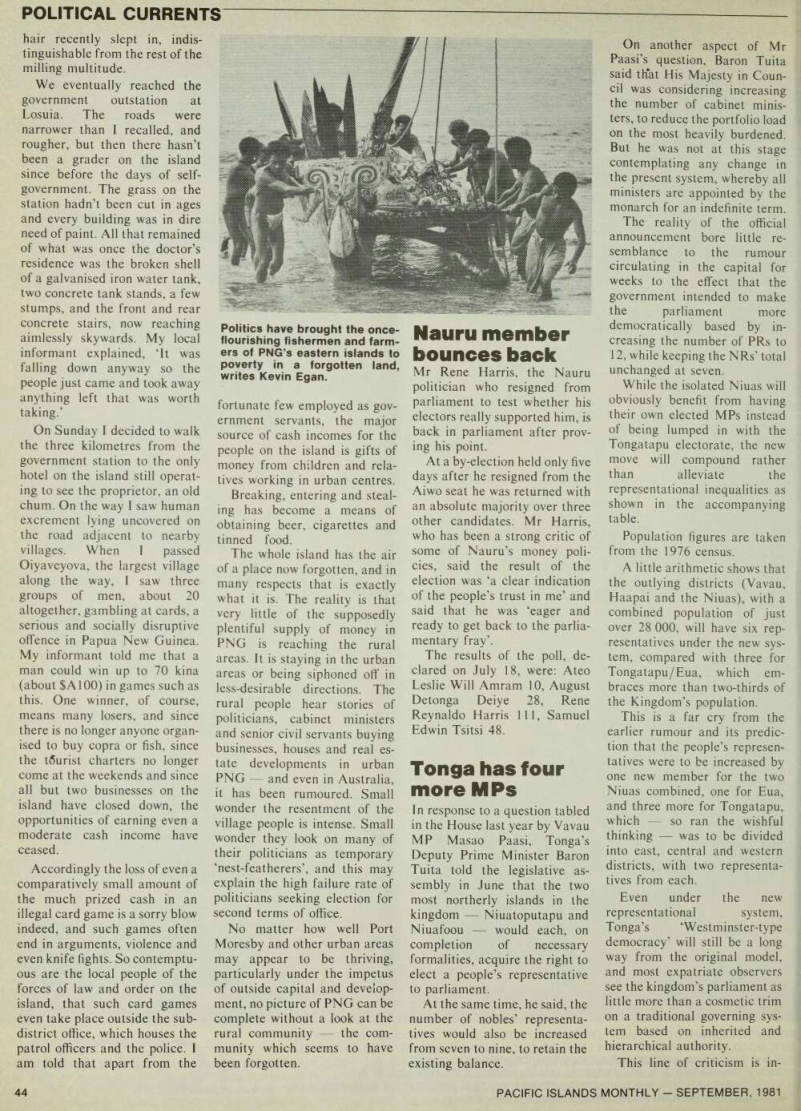
Politics have brought the once flourishing fishermen and farm ers of PNG’s eastern islands to poverty in a forgotten land, writes Kevin Egan.
creasingly voiced among Tongans of the slowly emerging middle class, particularly those educated overseas, who feel themselves hampered by a sys tem that bestows most of the real authority on those born to inherited privilege.
On the other hand, it is essential to recognise th it the overwhelming majority of the grassroots voters indicated in the recent elections that they are perfectly content with the status quo.
While they are satisfied with what they have, who has the right to say the system is wrong, simply because it does not tally with overseas definitions of democracy? Especially when the performance of Western style democracies over the past decade has hardly been such as to inspire slavish imitation as necessarily the idea for develop ing countries like Tonga. It could even be argued that any system freely endorsed by a majority is, by that fact alone, a democracy.
There is little doubt that changes will have to come eventually, in a country so heavily dependent on overseas aid, and so increasingly in volved in regional and inter national affairs.
What may be hoped is that time, opportunity and able lead ership will ensure that these inevitable changes evolve nat urally within the system, and without undue pressures from
Dutside it
Penny Hodgkinson
in Nukualofa.
PNG tough line
on Irianese
Papua New Guinea in July irrested and sent back to Irian laya three Irianese who had
been living in PNG under the protection of permissive resi dence. The men had broken the terms of their residence by active involvement in anti- Indonesian rebel politics, the PNG government said. Friends of the three men have protested on human rights grounds, claiming the men are likely to be gaoled or executed by Indonesia. Two of the deported men, flown out of PNG under police escort, had to leave behind Papua New Guinean wives and children.
Irian Jaya is an Indonesian province sharing a land border with PNG, and contains an anti- Indonesian rebel movement which claims the province should be an independent Melanesian country. PNG has granted residence under inter national protocol to some bor der crossers who can prove that their human rights are at risk in Irian Jaya. However one of the conditions of residence is the renouncing of all involvement in anti-Indonesian politics.
The three men deported in July had demonstrated that they were anti-Indonesian acti vists and had promoted faction fighting on the border, accord ing to the PNG foreign minis ter, Mr Noel Levi.
The men, who had lived in PNG for about five years, are schoolteacher Bob Kubia, con tractor Fred Peiger and health worker Willie Jebleb. Kubia and Peiger are both married to Papua New Guineans and have young children.
Although the deportation of the men to their homeland represents anew hard line by PNG, it does not change the basic policies that PNG has followed since independence.
On a number of previous oc
casions PNG has negotiated residence in a third country for rebels, but the government ap parently no longer intends to spend time on border-crossers who remain politically active.
The situation is one of the most sensitive in PNG’s foreign relations. On the one hand the government realises that the Irianese are ethnically related to its own people and that there is considerable sympathy among Papua New Guineans for their Irianese neighbours.
On the other hand the govern ment is committed to diplo matic friendship with Indonesia and therefore cannot allow PNG to become a refuge or a base for anti-Indonesian acti vists. Indonesia’s unyielding at titude towards its sovereignty in Irian Jaya adds to the sensitivities.
Springbok tour
poser for Chan
The Papua New Guinea prime minister. Sir Julius Chan, was forced on the defensive in July when an official visit he made to New Zealand coincided with the controversial tour by the South African Springbok rugby team. Violence and dissent oc curred in New Zealand over the rugby tour, with the govern ment and the rugby union council being accused of tolerating South African racial policies and of having broken international boycotts of South African participation in sport.
Sir Julius found himself facing suggestions that his presence in New Zealand indicated that he endorsed the football tour.
At a press conference in Wellington Sir Julius stepped carefully but firmly round pol itical landmines strewn in front of him. Yes, he said, he was in New Zealand at a very sensitive time, but that didn’t mean he endorsed South African apart heid. He said that the New Zealand government, not the rugby union council, were his hosts; and in any event his country was on record as oppos ing South African race policies.
Sir Julius said he was an enthusiastic rugby supporter, but added ‘I think the diplo matic relationship between my country and New Zealand is so important that I should not
allow a football game to stop the developments that both of us need’.
Sir Julius refused to be drawn out on his interpretation of the Gleneagles Agreement, under which countries including New Zealand restricted international sporting contacts with South Africa as a protest against South African race policies.
The New Zealand prime minis ter, Mr Muldoon, interpreted the agreement as not preventing the issue of entry visas to the Springboks, but Sir Julius would not discuss interpret ations. i think Mr Muldoon would be the man most suited to interpret what he actually signed’ he said. Sir Julius said that although PNG opposed the tour, it was not PNG policy to interfere in the affairs of another nation. But he added a warning ‘as a friend’ that reper cussions were sure to follow, and there could be some taint ing of relationships within the South Pacific Forum. ‘But we have no intention of allowing our bilateral relations to be jarred by football’ Sir Julius said.
Discussing Pacific regional matters Sir Julius said he sup ported suggestions for the es tablishment of a South Pacific peace-keeping force of the type which his own country mounted during last year’s rebellion on Santo in Vanuatu. He said that history had a habit of repeating itself, and he believed the Pacific countries should be pre pared. In the event of a Vanuatu-type situation in any Pacific country it was probably an ‘impossible dream’ to expect that the United Nations could provide a peace-keeping force of the sensitivities required. The obvious alternative was for the Pacific countries to have an available force of their own ‘but it would have to be thought out carefully because someone would have to pay for it’ he added. He suggested that New Zealand could have a role to play in helping to support legit imate governments which be came involved in Vanuatu-type
situations.
William Gasson
in Wellington.
Reports from Port Moresby indicated that the depth of feeling towards the Springbok presence in New Zealand was
Tongan Legislative Assembly Membership
Type of member Population Number Appointed cabinet ministers 8 Appointed area governors 2 Elected by the 33 nobles 9 Tongatapu district 57 411 Eua district 4 486 Tongatapu-Eua electorate 61 397 3 Vavau district electorate 15 068 2 Haapai district electorate 10 792 2 Niuatoputapu district electorate 1 650 1 Niuafoou district electorate 678 1
widely diversified, even within the government itself. Before he left for the Pacific tour which took him to New Zealand, among other countries, Sir Julius faced some cabinet oppo sition. There was a move among some of his ministers for him to cancel the New Zealand section of the tour, but he received majority support to proceed with his arrangements.
In other South Pacific reac tions to the tour, Fiji and the Cook Islands both refused to allow their airports to be used as transit points for flights by the Springboks.
In Western Samoa the gov ernment issued a statement in which it affirmed its objection and opposition to South Africa’s race policies, but it did not censure New Zealand on the grounds that this would constitute interference in the internal affairs of another country. This precipitated edi torial criticism from The Samoa Times which accused the government of lacking the strength to make a statement of principle (see Islands Press, Pl 8).
New political
group in Fiji
The emergence of a new politi cal group in Fiji, the Western United Front, together with indications of some dissent within the ruling Alliance Party, have added a new measure of fragmentation to Fiji national politics. The situ ation increases the chances that no single party will be strong enough to govern after next year’s general election, and that a coalition will have to be negotiated after the votes are counted.
About 200 high-ranking vil lage chiefs and more than 600 villagers from the Western Div ision attended the inaugural meeting of the party at Nadi.
The man who has been pushing for the establishment of the new group, Ratu Osea Gavidi, was elected president. He is the only independent in the Fiji parlia ment and has crossed swords with the government on a num ber of occasions, most recently in controversies over arrange ments to develop Fiji’s new pine forest industry.
Another member of parlia
ment, Mr Isikeli Nadalo, was elected secretary. Mr Nadalo was formerly aligned with the opposition in parliament, the National Federation Party, but resigned to help form the new group.
The party’s platform places a heavy emphasis on bringing Fijians (rather than Fiji Indians) of the Western Div ision into greater prominence in politics, government, adminis tration, commerce and indus try. The party is also committed to defeating the present Al liance Party government which Ratu Osea described as ‘lop sided rather than representa tive’.
Mr Nadalo denied later that the party was for Fijians only, but the nature of the inaugural meeting and the comments by some of the leaders involved led to suggestions that the party was established on race lines and had a ‘provincial’ outlook centred on the Western Division (see Islands Press, piB).
The main effect of the new party is expected to be in the potential it holds to weaken the position of the Alliance Party.
This in turn could lead to a highly diversified result in next year’s general election, in which political lobbying as much as the ballot box will determine the final shape of government.
N-waste issue
at SPC talks
Since the early ’7os fears about radio-activity have never been far below the surface at any regional meeting in the South Pacific. It was no surprise, then, that this concern was raised on the first day of a recent techni cal meeting held at South Pacific Commission head quarters, Noumea. The meeting was held to prepare draft docu ments for a proposed South Pacific Regional Environment Programme (SPREP) to be sub mitted to a regional conference on the human environment to be held early next year in Solomon Islands or the Cooks.
France no longer stands alone as the nuclear villain of the region. Though it has eased off since its determined push in 1979, the US still cherishes the prospect of using tiny Pacific islands as repositories for high
level radio-active wastes, and it has itself been an active Pacific Ocean nuclear waste dumper since 1942.
Japan has drawn much criti cism over its delayed, but not forgotten, Pacific dumping am bitions. Domestic pressure against land storage of nuclear wastes in Japan is so strong that the Pacific Ocean dumping option had looked relatively easy. But times, and attitudes, have changed. The people of the South Pacific are no longer those ill-informed, inarticulate and unorganised people whom American, British and French governments could ignore when planning and conducting their nuclear weapons tests. South Pacific islanders resent having other people’s rubbish forced on them, particularly when it is radio-active.
To justify its Pacific Ocean nuclear waste dumping am bitions Japan cites the Conven tion on the Prevention of Mar ine Pollution by Dumping of Wastes and Other Matter, ex plaining that its dumping would be subject to conditions im posed under this convention.
The convention title is, how ever, misleading. It was devel oped by industrial states as a basis for controlled dumping, not as an international agree ment to prevent marine pol lution. Critics refer to it as ‘a licence to dump’. The conven tion covers not only nuclear but also other toxic industrial wastes and South Pacific gov ernments are being urged to become party to it. Papua New Guinea and Fiji have done so.
However, a country which is party to this convention effectively admits that there is a place for the ocean dumping of radio-active wastes. This must weaken any stand which that country would otherwise wish to make against such dumping in the Pacific.
A new nuclear waste dump ing threat to the Pacific was revealed at the SPREP techni cal meeting. This arises from the nuclear power ambitions of governments of Southeast Asia.
A project for identification of ocean sites for nuclear waste dumping had been included in a draft East Asian Seas Regional Environment Programme an ASEAN equivalent of the pro
posed South Pacific Regional Environment Programme (PIM Jul p 5). This particularly dis turbed island government rep resentatives, and the represen tative of the United Nations Environment Programme (UNEP) present at the Noumea meeting was hard pressed to explain how it was possible for such a project to have been included as part of a so-called ‘environment programme’, and with UNEP’s apparent sanc tion.
It is believed that the trouble some Pacific Ocean nuclear waste dump site project orig inated from Malaysia. This is ironic in view of an approach made earlier this year by PNG’s minister for foreign affairs and trade to his Malaysian counter part seeking the latter’s support for South Pacific moves to prevent Japanese nuclear waste dumping.
The prospect of a new marine nuclear pollution threat from Southeast Asia further compli cates Australia’s pose against nuclear activities in the region.
Australia supports the Forum, which takes a strong stand against nuclear waste dumping in the Pacific. However, it is also anxious to be on good terms with ASEAN nations and Japan and feels obliged to recognise their nuclear am bitions and, thus, to understand their nuclear waste dumping needs. As an exporter of uranium Australia is likely to encourage nuclear power devel opment and, thus, the pro duction of these controversial wastes. Further, since Australia itself is likely to embark upon a nuclear power programme some day, if it were to support South Pacific island government pro tests too effectively it would be restricting its own prospects for adding nuclear wastes to those toxic industrial wastes which it is now dumping off the east coast of Australia.
The nuclear waste dumping issue is to be featured at the annual conference of the As sociation of Chief Executives of the Pacific Basin, to be held in Guam, early in September.
Proponents of Pacific Ocean nuclear waste dumping would be foolish to expect that Pacific island concern will just fade
away.
(Dr) Graham Baines.