Caledonia’s history
pp. 40-77 · Read in the full issue
The Japanese who belong to New Caledonia’s history
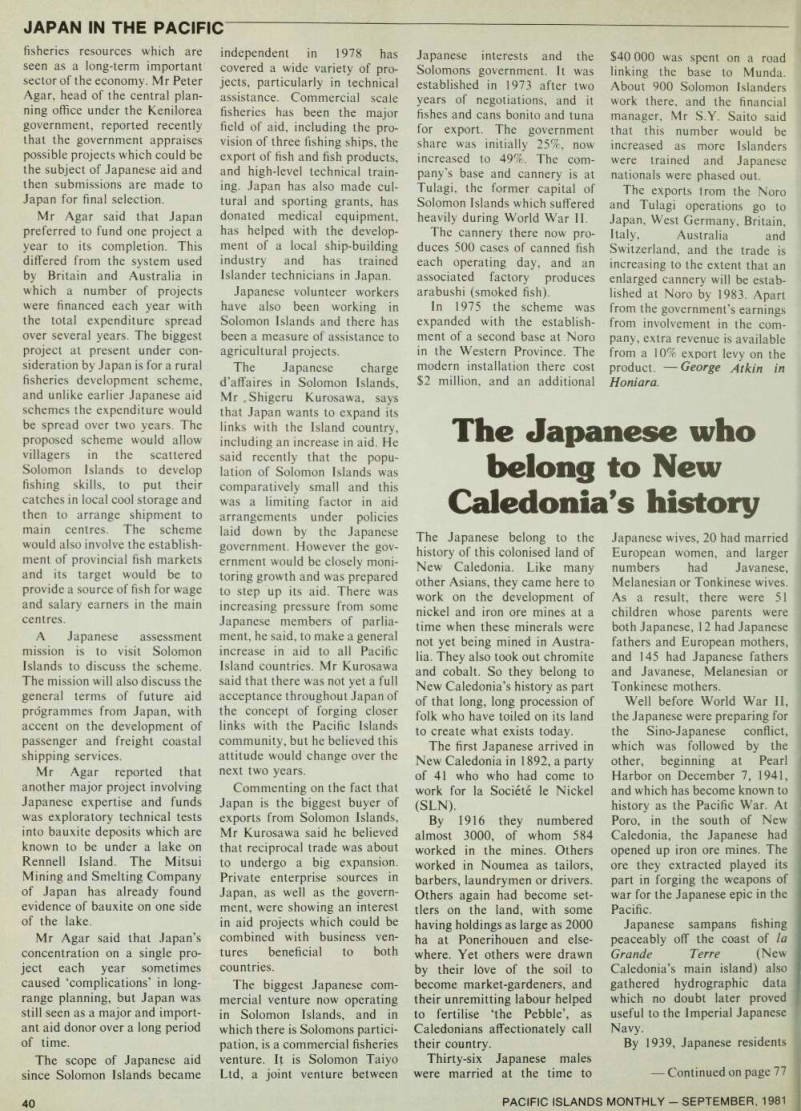
The Japanese belong to the history of this colonised land of New Caledonia. Like many other Asians, they came here to work on the development of nickel and iron ore mines at a time when these minerals were not yet being mined in Austra lia. They also took out chromite and cobalt. So they belong to New Caledonia’s history as part of that long, long procession of folk who have toiled on its land to create what exists today.
The first Japanese arrived in New Caledonia in 1892, a party of 41 who who had come to work for la Societe le Nickel
(Sen).
By 1916 they numbered almost 3000, of whom 584 worked in the mines. Others worked in Noumea as tailors, barbers, laundrymen or drivers.
Others again had become set tlers on the land, with some having holdings as large as 2000 ha at Ponerihouen and else where. Yet others were drawn by their love of the soil to become market-gardeners, and their unremitting labour helped to fertilise ‘the Pebble’, as Caledonians affectionately call their country.
Thirty-six Japanese males were married at the time to
Japanese wives, 20 had married European women, and larger numbers had Javanese, Melanesian or Tonkinese wives.
As a result, there were 51 children whose parents were both Japanese, 12 had Japanese fathers and European mothers, and 145 had Japanese fathers and Javanese, Melanesian or Tonkinese mothers.
Well before World War 11, the Japanese were preparing for the Sino-Japanese conflict, which was followed by the other, beginning at Pearl Harbor on December 7, 1941, and which has become known to history as the Pacific War. At Poro, in the south of New Caledonia, the Japanese had opened up iron ore mines. The ore they extracted played its part in forging the weapons of war for the Japanese epic in the Pacific.
Japanese sampans fishing peaceably off the coast of la Grande Terre (New Caledonia’s main island) also gathered hydrographic data which no doubt later proved useful to the Imperial Japanese Navy.
By 1939, Japanese residents
Continued on page 77
Japan in New Caledonia from page 40 represented 75% of all for eigners living in New Caledonia. On December 8, 1941, the day after Pearl Harbor, 116 Japanese were arrested. An exception was made of the market-gardeners.
But they were rounded up later, under pressure from the Americans. The bank accounts of Japanese were frozen, their property seized, and they were placed in a concentration camp on Nou Island. On December 19, 1941, they were deported to Australia. Some returned after the war to re-establish them selves. But their children had stayed on in New Caledonia and acquired French nationality.
Born on ‘the Pebble’, the :hildren of these families torn apart by the war inherited the qualities of their fathers; zeal in vork, self-discipline, punctu ility. During the war, they had •emained loyal to France. Some net their end on the paths of aattle of the French Pacific Jattalion which, side by side vith Allied forces, led them to dctory and the liberation of *rance.
Names such as Noda, tfatsuda, Nakagawa, and many ithers are synonymous with the inks binding Japan and New Caledonia.
The Japanese have not been ound lacking in efforts to bonds between their far ff kinsmen and the mother ountry: a Franco-Japanese As ociation maintains close links etween its members and the Caledonian families of their athers who were either killed or aangled in the war which tore heir households apart. Religion smains strong, and much quiet ut profound emotion animates he young Japanese, born of a apanese father in New Caledonia, as he sets out on his ilgrimage in search of his ncestral roots even if he is o longer able to speak his ither’s tongue. Two New Caledonian islands have formed relationship of ‘sisterhood’ ith two Japanese islands. They re Lifou in the Loyalty Islands, nd I’lle des Pins. Curiously, leir Japanese ‘sisters’ have ames identical to theirs.
Japan, the newly emerged
industrial and commercial giant which has won for itself a place in the very forefront of world powers by dint of the profound human qualities of its people, has in these latter times, turned to tourism. The Japanese travel a lot.
Naturally, they seek places where pollution is at a mini mum. New Caledonia, particu larly through the influence of television, has become an at tractive destination for them.
Several hundred Japanese tour ists arrive in the territory every week. Oddly, many young couples come here to get mar ried by the Mayor of Noumea it seems it is less onerous to give oneself a present of a trip than to shower wedding gifts, as is the custom, upon one’s nu merous relatives and friends who’ve stayed at home.
The Japanese tourist is much appreciated in New Caledonia for his politeness, his behaviour and also for his financial means.
There are long-standing com mercial ties between Japan and New Caledonia. For more than half a century Japan has been importing New Caledonian minerals to feed its industry.
Before the war it was Poro iron ore and nickel. Today, it is still nickel: in 1980 New Caledonia exported to Japan nickel ore (or part-processed nickel material) to the value of SA67 375 000 this repre sented 27% of New Caledonia’s total exports. As for imports from Japan, the territory in 1980 imported Japanese goods to the value of $A 13 325 000, or 4% of total imports. (By way of comparison, New Caledonia each year imports from Austra lia goods to the value of SA3I million, or 10% of total imports.) The economic crisis, and the costs of sea transport in con ditions of constantly rising fuel prices, have led Japanese im porters to buy part of their nickel requirements from the Philippines and Indonesia. No doubt they are influenced by the fact that the ore from these sources is cheaper than the New Caledonian product. But it is also a matter of trading strat egy: the Philippines and Indonesia are very big buyers of Japanese products. Certainly
New Caledonia is an attractive market, with its relatively high population compared with a number of other Pacific countries. But its 140 000 inhabitants represent only very small beer compared with the countries just mentioned.
Japanese foundries are equipped to process New Caledonian nickel ore which they mix with Philippine and Indonesian ores and, recently, Australian ores as well.
In the last few years exports of New Caledonian nickel ore have fallen by 50%. A task facing the industry in the future is to concentrate the ore in order to reduce the volume of material exported; the nickel ore at present contains only 2'/2% metal, the rest consists of useless soil and water. A real burden’ for the importer.
Tourists on the beaches, Japanese freighters loading nickel ore around the coast, Japanese motor cars on the streets and Japanese photographic and stereophonic equipment in the shop windows these are visible mani-
Testations of the Japanese pres ence here. But more important still are the deep bonds which unite the two peoples, the mem ories of the toil of the Japanese who helped to build this country, and who have left behind a priceless heritage in their offspring, who continue to embody the qualities of the Japanese race.
Caledonians never knew the other face of Japan, the face of the invader. This was thanks to the sacrifices of the Allied sailors and airmen who waged triumphant battle in the Coral Sea on May 7-8, 1942, to stop the Japanese invasion convoy which was heading for New Caledonia with the aim of cutting the sea route between Australia and the United States. This operation changed the face of the Pacific War, probably saved Australia, and for us in New Cale donia preserved the historic image left behind in our terri tory by the thousands of Japanese who settled and founded families here.
Daniel Tardieu in Noumea.