New Caledonia’s tribal people out
p. 14 · Read in the full issue
to ‘recover ancestral lands’
A new movement for Kanak land rights has arisen and is growing in New Caledonia. The movement is distinauished from other similar movements by its tribal basis, its strong attachment to customary forms of action, and its Snce of ties with political parties. A special correspondent in Noumea tells the story.
For more than a year now a new nationalist movement has been developing among the tribal people of New Caledonia.
Based essentially on land own ership concepts and associated beliefs, its practical aim is to regain ownership of lands which have long been alienated, some since as long ago as the 19th century.
The movement cuts across existing political factions indeed, many of its leaders deliberately keep their activi ties apart from political parties in the hope that a single unified front will be formed over what they see as a basic single cause.
The nucleus of the movement lies with about 20 tribes. They are using traditional means of communication to spread its influence, and now believe that all tribal groups are generally sympathetic, and that the exist ing solid core will soon expand.
The ‘traditional means of communication’ involves move ment on foot by couriers who spread through all areas follow ing customary procedures to make contact, express goodwill, exchange gifts and greetings, and then sit around the fire and talk.
There are about 150 tribes in New Caledonia, whose average population is estimated at about 250. This suggests that the hard core nucleus of the movement at present is about 5000 people (20 tribes of 250), and observa tion suggests that the numbers actively involved are steadily growing.
For the immediate future the main thrust of the movement is to send letters to or make contact with French colons occupying alienated land, and to make the point that the land traditionally belongs to the Melanesians who want it back.
In general, they are prepared to see that the colons are treated fairly at present they do not want to seize lands forcibly because of the violence and
trouble which might result.
They would prefer a system by which the French authorities take back the land from the colons and give it back to the Melanesians as the rightful owners under traditional law and custom.
Despite this generally peace able approach, in recent months there have been two forcible occupations, and one incident of confrontation in which a Kanak was shot dead by his colon employer (PIM Aug p 6). This last incident it is true arose from a dispute over pay and not over the land issue, but it expresses the tensions that can rapidly erupt in the New Caledonian context. French riot police were sent to the scene of the killing and are believed to be still (late July) on the property.
If satisfaction cannot be ob tained by peaceful pressures the ultimate plan is to move onto the land using whatever mini mum force is necessary to achieve re-ownership.
In areas where the colons have already been contacted there has been a mixed reac tion. Some of the settlers are prepared to sell out if the government institutes a plan, although obviously the issue of valuation will be controversial.
Others are digging in and have refused to discuss the issues.
The total number of settler families (and therefore the ap proximate number of properties involved) is estimated at about 250.
The movement, which started in a fairly small way in localised areas about 12 months ago, is now reaching something of a peak and is being acknowl edged rather than dismissed by the French authorities. The fact that this has coincided with the coming to office of the Mitterrand government in France will face French colonial activities in the Pacific with one of its major problems. For while the French structure is firm
ly estalished in the over seas territories, President Mitterrand as a socialist leader could not tolerate a situation which the world would see as metropolitan repression of the rights to land of a Third World people.
One major practical issue which will cloud the picture involves verification of which tribes own what land. Two uprisings and their aftermath contribute to this area of poten tial controversy. The first was a mini-war in 1878 in which 150 whites and nearly 1000 Melanesians died, and the other was a rebellion in 1917. After both these events French authorities forcibly re-located many tribes. This means that today many tribes live in areas distant from their traditional lands. The possibility cannot be ignored that Melanesian unity could be strained by disputes between themselves over claims to specific areas of land.
Extensive research is being carried out by ORSTOM, the body responsible for scientific research in France’s overseas territories, in an endeavour to pinpoint the traditional lands of today’s tribes. Many maps have already been issued, based on research into the situation exist ing before 1878, and before 1917.
In one of their letters the tribes refer to a threat by one of New Caledonia’s deputies to the French National Assembly, Jacques Lafleur, to use helicop ters to keep the people in line.
In fairness to Lafleur, it should be noted that there is no record of his having made such a threat. The statement by the people was probably a loose inference arising from the prac tice of the authorities of using helicopters with armed riot police on occasions when con frontations occur.
The tribes’ letters are written in French with great dignity, sometimes having an almost
biblical tone. The first paragraph of one of them reads: ‘This letter laying claim to ancestral lands is drawn up by the tribe of Baco. It is the first announcement of a plan for the “Recovery of Land” which has been prepared by the tribes of Voh, Kone, Pouenbout and Poya. These tribes have set up a committee consisting of two delegates from each tribe. It works independently of political parties and is achieving Kanak unity as a fact at the grassroots.
The end result of this action is to be the occupation of lands, each tribe seeking to recover the lands within their tra ditional borders. When all tribal lands have been recovered, the whole country will once again become Kanak, and indepen dence will be at hand.’
The letter goes on: ‘The tribes of Gomen, Koumac, Poum, Pouebo and Ponerihouen are now asking for information. The “Word” is going around in Hienghene, Ouegoua, Ballade, Belep, Houailou. It says “We must recover the ancestral lands, and nothing will have the power to stop us.” Now 149 tribes, all the tribes from the north, from Poya and Ponerihouen, are uniting to take common action. Tomorrow all of New Caledonia will follow.’
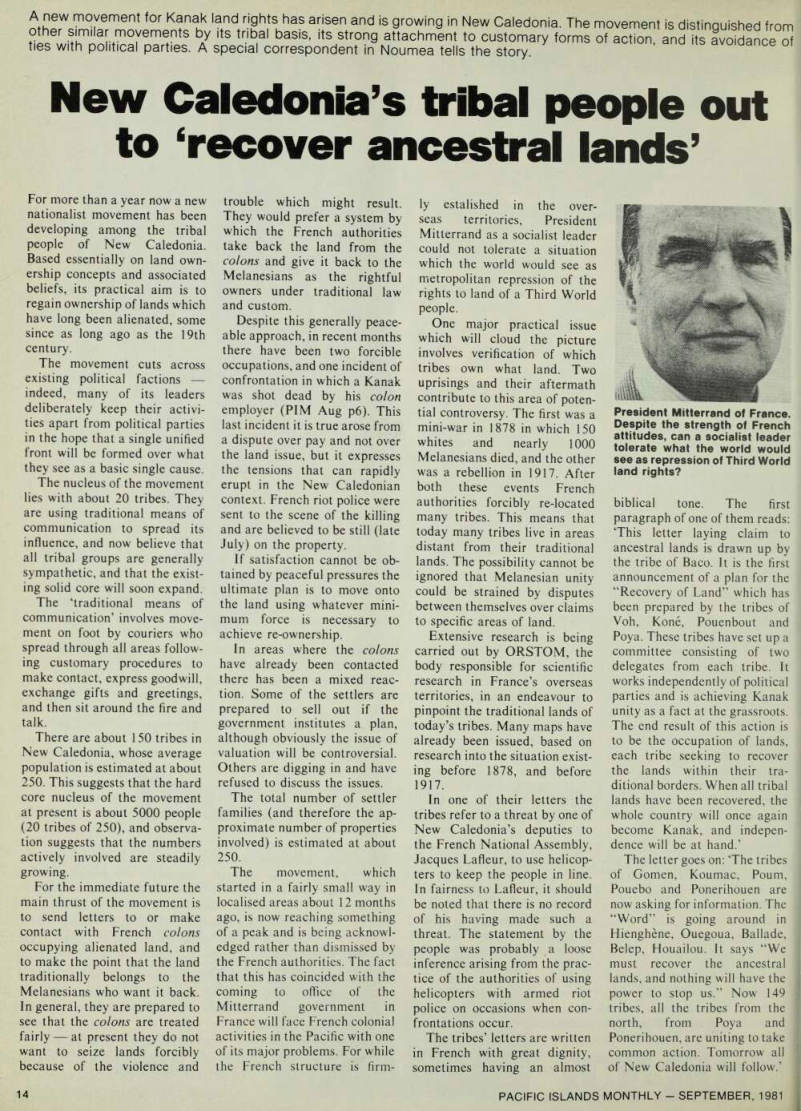
President Mitterrand of France.
Despite the strength of French attitudes, can a socialist leader tolerate what the world would see as repression of Third World
land rights?