Come back, Jimmy,
p. 13 · Read in the full issue
U.S. In The Pacific
Come back, Jimmy, all is forgiven
It was announced in a Washington Post report in May that the Reagan Administration would be developing a compre hensive Caribbean Basin policy as an attempt to indicate to the region and to the world that ‘it is not locked into a one-time military approach to such re gional problems as the civil war in El Salvador’. It is envisaged that this policy would also provide for economic and social development for the Caribbean, as well as the security measures that will be implemented to combat what Secretary Haig and others in the administration perceive to be communist expansionism in the region.
With the adoption of a Caribbean Basin policy, I earn estly hope that the Reagan Administration will take the next logical step and begin to define its policy towards the Pacific Basin. To allow the absence of an agenda for the region to continue any longer only gives credence to those who criticise the United States for its lack of commitment and establishment of priorities in the region.
President Carter attempted to make some sense of US efforts in the Pacific, especially with respect to the US territories, by advocating a comprehensive territorial policy in February 1980 that reflected the interests and understanding of the Congress. It provided a flexible framework that recog nised the unique cultural, politi cal and economic background of each territory. Unfortu nately, the Reagan Adminis tration has placed Carter’s ter ritorial policy, as well as most of his Pacific policies, in abeyance pending their review and evalu ation.
Without question, the policy decisions made by the Carter Administration are subject to scrutiny and to review by a new administration. But the fact ■emains that decisions were nade in an area which previous administrations had treated -vith benign neglect.
Towards the end of his term
of office, there was every indi cation that Carter was begin ning to recognise the import ance of the Pacific-Asian Basin and, most importantly, of the special roles that each of the American jurisdictions play in the Basin the fact that the Pacific Ocean is blessed with an abundance of marine and ocean resources, the fact that two thirds of the world’s people inhabit the Basin, and the fact that the Pacific Ocean has replaced the Atlantic Ocean as the hub of commerce and trad ing activities of the US.
There is certainly no perfect answer to the many and com plex problems confronting any society, but the fact is that the Carter Administration at least addressed itself to the situation and offered certain avenues to pursue.
Judging from the dilatoriness with which the Reagan Admin istration is moving towards enunciating a Pacific Basin pol icy, filling substantive Pacific positions in Washington and the region, and, in general, respond ing to the needs and desires of the US entities in the Pacific such as the Native Hawaiian Study Commission that the State of Hawaii has been anxiously anticipating for months it is reasonably clear that the Pacific is once again on the low rung on the totem pole of national priorities in Washington.
It was also disappointing to note that in an extensive profile on James Watt and his work as the Secretary of the Interior which appeared on page one in the Sunday (May 31) edition of The Los Angeles Times, con spicuously missing was any mention of the Office of Terri torial and International Affairs, the agency charged within In terior to oversee the territories.
What is it going to take to convince President Reagan, Secretaries Haig and Watt, and other key individuals of this administration to begin to focus properly on the Pacific Basin and accord it the recognition and respect it deserves? Will it
take an ‘EI Salvador’ type of situation to erupt in the Pacific before the administration feels compelled to move it up on its scale of priorities? I would certainly hope not for, if the Reagan Administration har bours the myopic view that trouble spots in the Pacific are confined to the Asian rim of the Basin then they obviously have not been observing some of the current trends in the Islands.
To cite a few examples: Vanuatu, formerly known as the New Hebrides, exploded last year into a full-scale rebellion led by French expatriates and locals headed by Jimmy Stevens, who saw their liveli hood threatened by the change in government from French and British rule to independence.
Many were surprised earlier this year when it was reported that Western Samoa, the first Polynesian island country to achieve independence in 1962, was in the throes of a major government employees’ strike which was jeopardising the term of one of the Pacific’s most charismatic leaders, Prime Minister Tupuola Efi. Further more, one would need to be extremely naive to dismiss en tirely the possibility of some sort of strong reaction from the
Trust Territory entities who are growing increasingly impatient with the Reagan Adminis tration’s procrastinating atti tude regarding their status negotiations and other related issues.
The above-mentioned exam ples lead naturally to a major point worth considering: that is, if the United States con tinues to procrastinate in de fining a policy and agenda for the region, it will create a void that could be filled quite readily by a super-power that it has competed with in Europe, Asia, Africa, and, of late, the Caribbean the Soviet Union.
The signs are there. In the South Pacific, the Russians have established diplomatic contacts with Papua New Guinea, Fiji, Western Samoa, and Tonga, and in many in stances have made generous offers of economic assistance.
Recently they have made econ omic overtures in Vanuatu and the Solomons. And, even closer to home, last year a Soviet official met in an ‘exploratory session’ with a representative of one of the American Micronesian insular areas.
What’s to stop them from taking advantage of a military vulnerability? Their history cer tainly suggests a propensity to do so.
Therefore, insofar as the de cision by the Reagan Adminsitration to develop a comprehensive Caribbean Basin policy, coupled with the appointment of the Caribbean bred Pedro San Juan as the
Assistant Secretary-Designate
for Interior’s Office of Terri torial and International Affairs are a major boon to the Caribbean Basin, the Pacific Basin remains without an official Pacific policy and the US jurisdictions namely, the territories of American Samoa and Guam, the Commonwealth of the Northern Marianas, the three entities of the Trust Terri tory of the Pacific and, to some extent, the State of Hawaii continue to suffer. It is to be hoped that these recent Caribbean decisions will serve as the proper catalyst that will spur the Reagan Adminis tration into developing a Pacific policy for this nation.
Muliufi Hannemann.
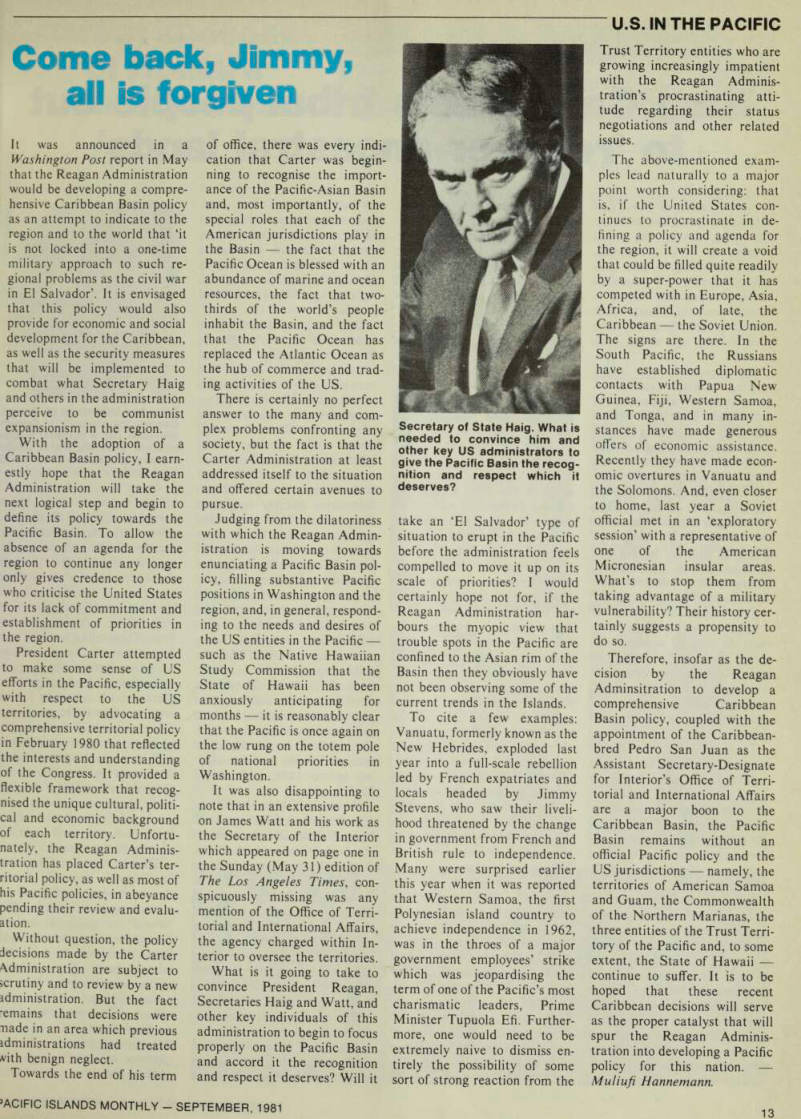
Secretary of State Haig. What is needed to convince him and other key US administrators to give the Pacific Basin the recog nition and respect which it deserves?