Islands looking to new fuel sources
pp. 57-62 · Read in the full issue

new fuel sources
Trade
Winds
In May the Papua New Guinea opposition leader Mr Michael Somare criticised Australia for developing his country on lines which have left it too dependent on increasingly expensive petroleum fuels. His comment focusses attention on the growing interest which Pacific Islands are showing in alternative energy sources.
A PIM survey shows that Papua New Guinea and Fiji are par ticularly active in alternative power research, and are concen trating on small-scale schemes suitable for isolated agricul tural projects and village-level technology.
Both countries, and particu larly PNG, are looking to the production of ethanol, an al :ohol additive for petroleum based fuels. Both have also experimented with bio-gas digesters, and a PNG re searcher Professor Dennis Richardson has suggested fuel ing coastal ships with charcoal derived from coconut husks PIM May p 14). The following •ound-up tells of criticism of \ustralia for allegedly leaving 3 NG excessively dependent on )etroleum-based fuels, and de scribes some of the develop nents in alternative energy banning:
1. Somare says
PNG unprepared
Australia had failed to prepare *NG to face the ‘brutal econ imic realities’ of depending argely on petroleum-based uels, the PNG opposition sader said recently. Mr iomare was speaking in Brisbane in the Australian state f Queensland to a symposium n energy and equity in the 'bird World.
He said some people in PNG ad adopted Australian riorities that had held back evelopment of alternative en rgy resources. ‘Many of us, espite our education, have dopted priorities that were anded down to us by Austra ans, whether in administation r business,’ Mr Somare said.
He also took the opportunity d criticise his country’s govern lent at home for buying ‘a gas uzzling VIP jet aircraft’ in- Lead of spending the money on Iternative energy resources, le alleged that the present
Chan government contained some elements opposed to spending money on alternative energy because they felt such expenditure lowered the national image.
Mr Somare criticised Austra lia for bequeathing his country energy-wasting architecture in the form of buildings which needed continuous air conditioning. He said that when he was prime minister he had drawn up a new building code designed to prevent PNG pro ducing ‘an urban mini- Canberra’. Mr Somare said future directions for Papua New Guinea energy resources lay in conversion of bio-mass plant and animal material into fuel.
He said he believed that the
offcuts, sawdust and shavings from his country’s sawmills contained as much energy as the petroleum fuels which were being imported.
2. Fiji gasohol
is on the way
The Fiji Government, the Fiji Sugar Corporation and several private operators have begun experiments in Fiji to produce ethanol from sugar cane. Uni versity experiments already conducted in Fiji have pro duced gasohol, a petrol substi tute made by mixing ethanol and petroleum substitutes. The use of gasohol would not elimin ate the need for petroleum fuels, but would reduce require ments.
Field trials are in progress to determine the cane variety most suitable for ethanol production.
The government estimates that by 1984 Fiji should be produc ing 120 000 litres of ethanol a day and that the present trend of petrol imports will be re duced by 20%.
Fiji last year sent an assess-
merit team to Brazil where ethanol production is well ad vanced. In addition to studying the technical aspects of the Brazil project, Fiji also studied the relative roles being played by the government and private enterprise in ethanol pro duction. Under the Brazilian system and this appears to be favoured by Fiji private enterprise is heavily involved but is working under govern ment rationalisation and incen tive arrangements.
3. Gas supplies
from husks
Dylup Plantations Limited of Papua New Guinea is well advanced in its plan to use
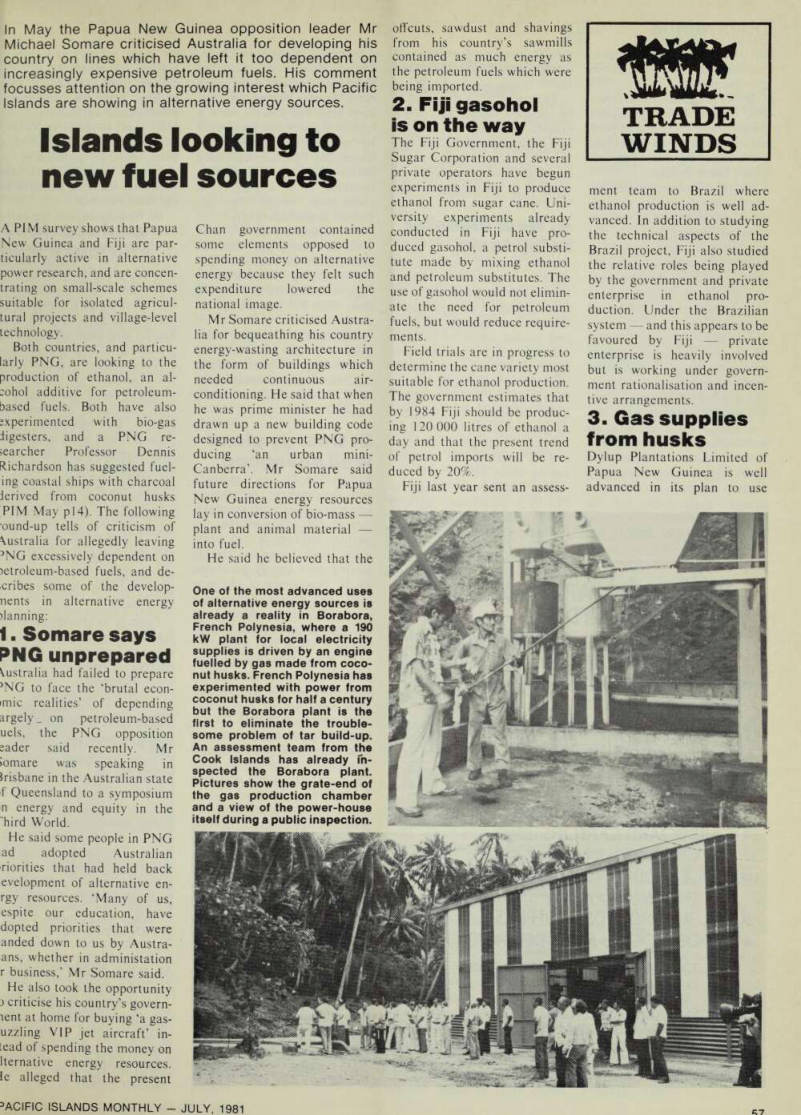
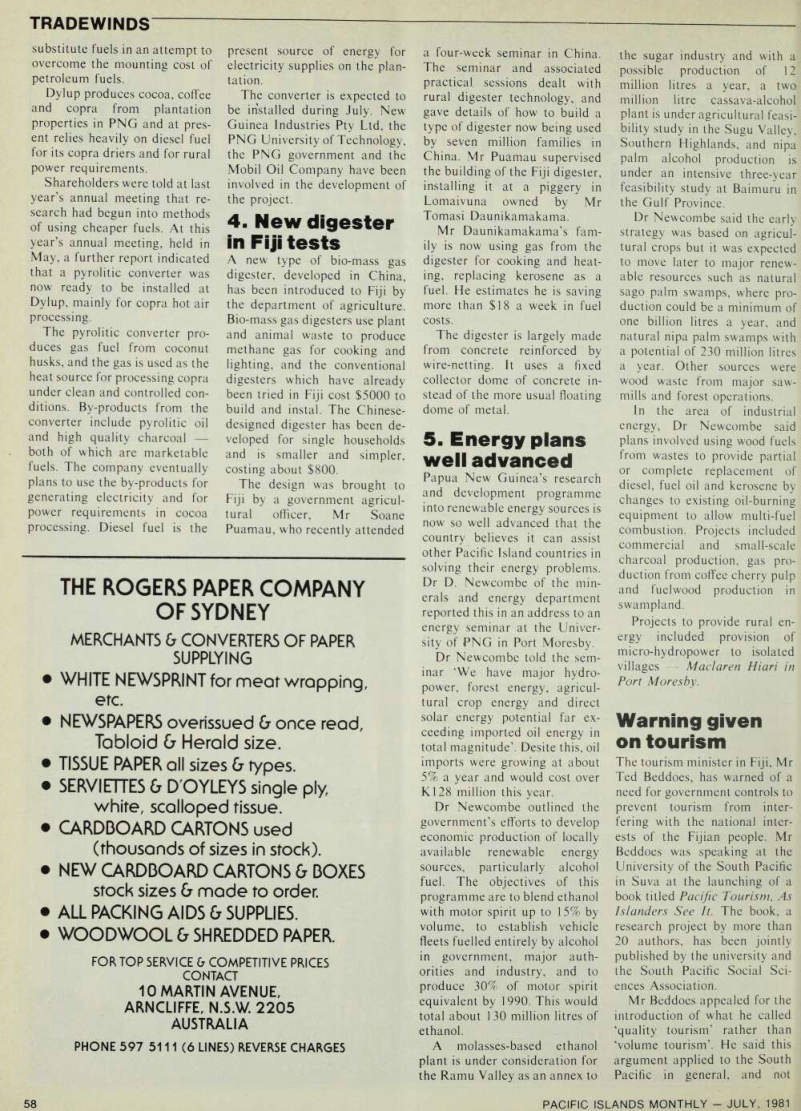
One of the most advanced uses of alternative energy sources is already a reality in Borabora, French Polynesia, where a 190 kW plant for local electricity supplies is driven by an engine fuelled by gas made from coco nut husks. French Polynesia has experimented with power from coconut husks for half a century but the Borabora plant is the first to eliminate the trouble some problem of tar build-up.
An assessment team from the Cook Islands has already in spected the Borabora plant.
Pictures show the grate-end of the gas production chamber and a view of the power-house itself during a public inspection.
substitute fuels in an attempt to overcome the mounting cost of petroleum fuels.
Dylup produces cocoa, coffee and copra from plantation properties in PNG and at pres ent relies heavily on diesel fuel for its copra driers and for rural power requirements.
Shareholders were told at last year’s annual meeting that re search had begun into methods of using cheaper fuels. At this year’s annual meeting, held in May, a further report indicated that a pyrolitic converter was now ready to be installed at Dylup, mainly for copra hot air processing.
The pyrolitic converter pro duces gas fuel from coconut husks, and the gas is used as the heat source for processing copra under clean and controlled con ditions. By-products from the converter include pyrolitic oil and high quality charcoal both of which are marketable fuels. The company eventually plans to use the by-products for generating electricity and for power requirements in cocoa processing. Diesel fuel is the
present source of energy for electricity supplies on the plan tation.
The converter is expected to be installed during July. New Guinea Industries Ply Ltd, the PNG University of Technology, the PNG government and the Mobil Oil Company have been involved in the development of the project.
4. New digester
in Fiji tests
A new type of bio-mass gas digester, developed in China, has been introduced to Fiji by the department of agriculture.
Bio-mass gas digesters use plant and animal waste to produce methane gas for cooking and lighting, and the conventional digesters which have already been tried in Fiji cost $5OOO to build and instal. The Chinese designed digester has been de veloped for single households and is smaller and simpler, costing about $BOO.
The design was brought to Fiji by a government agricul tural officer, Mr Soane Puamau, who recently attended
a four-week seminar in China.
The seminar and associated practical sessions dealt with rural digester technology, and gave details of how to build a type of digester now being used by seven million families in China. Mr Puamau supervised the building of the Fiji digester, installing it at a piggery in Lomaivuna owned by Mr Tomasi Daunikamakama.
Mr Daunikamakama’s fam ily is now using gas from the digester for cooking and heat ing, replacing kerosene as a fuel. He estimates he is saving more than $lB a week in fuel costs.
The digester is largely made from concrete reinforced by wire-netting. It uses a fixed collector dome of concrete in stead of the more usual floating dome of metal.
5. Energy plans
well advanced
Papua New Guinea’s research and development programme into renewable energy sources is now so well advanced that the country believes it can assist other Pacific Island countries in solving their energy problems.
Dr D. Newcombe of the min erals and energy department reported this in an address to an energy seminar at the Univer sity of PNG in Port Moresby.
Dr Newcombe told the sem inar ‘We have major hydro power, forest energy, agricul tural crop energy and direct solar energy potential far ex ceeding imported oil energy in total magnitude’. Desite this, oil imports were growing at about 5% a year and would cost over Kl2B million this year.
Dr Newcombe outlined the government’s efforts to develop economic production of locally available renewable energy sources, particularly alcohol fuel. The objectives of this programme are to blend ethanol with motor spirit up to 15% by volume, to establish vehicle fleets fuelled entirely by alcohol in government, major auth orities and industry, and to produce 30% of motor spirit equivalent by 1990. This would total about 130 million litres of ethanol.
A molasses-based ethanol plant is under consideration for the Ramu Valley as an annex to
the sugar industry and with a possible production of 12 million litres a year, a two million litre cassava-alcohol plant is under agricultural feasi bility study in the Sugu Valley, Southern Highlands, and nipa palm alcohol production is under an intensive three-year feasibility study at Baimuru in the Gulf Province.
Dr Newcombe said the early strategy was based on agricul tural crops but it was expected to move later to major renew able resources such as natural sago palm swamps, where pro duction could be a minimum of one billion litres a year, and natural nipa palm swamps with a potential of 230 million litres a year. Other sources were wood waste from major saw mills and forest operations.
In the area of industrial energy, Dr Newcombe said plans involved using wood fuels from wastes to provide partial or complete replacement of diesel, fuel oil and kerosene by changes to existing oil-burning equipment to allow multi-fuel combustion. Projects included commercial and small-scale charcoal production, gas pro duction from coffee cherry pulp and fuelwood production in swampland.
Projects to provide rural en ergy included provision of micro-hydropower to isolated
villages -
Maclaren Hiari in
Port Moresby.
Warning given
on tourism
The tourism minister in Fiji, Mr Ted Beddoes, has warned of a need for government controls to prevent tourism from inter fering with the national inter ests of the Fijian people. Mr Beddoes was speaking at the University of the South Pacific in Suva at the launching of a book tilled Pacific Tourism, As Islanders See It. The book, a research project by more than 20 authors, has been jointly published by the university and the South Pacific Social Sci ences Association.
Mr Beddoes appealed for the introduction of what he called ‘quality tourism’ rather than ‘volume tourism’. He said this argument applied to the South Pacific in general, and not
merely to Fiji. He said ‘I know this might not be easy to achieve, but perhaps it might be better to look at receiving 20 000 visitors a year staying for 10 days rather than 200 000 staying for three days. The former provides better oppor tunities for exchange of cultural experience and understanding’.
Centre to help
new exporters
Developing countries, including the Pacific Islands, will be given special assistance to market their products in Australia fol lowing the establishment in Sydney of a government sponsored trade facility known as the Australian International Trade Development Centre.
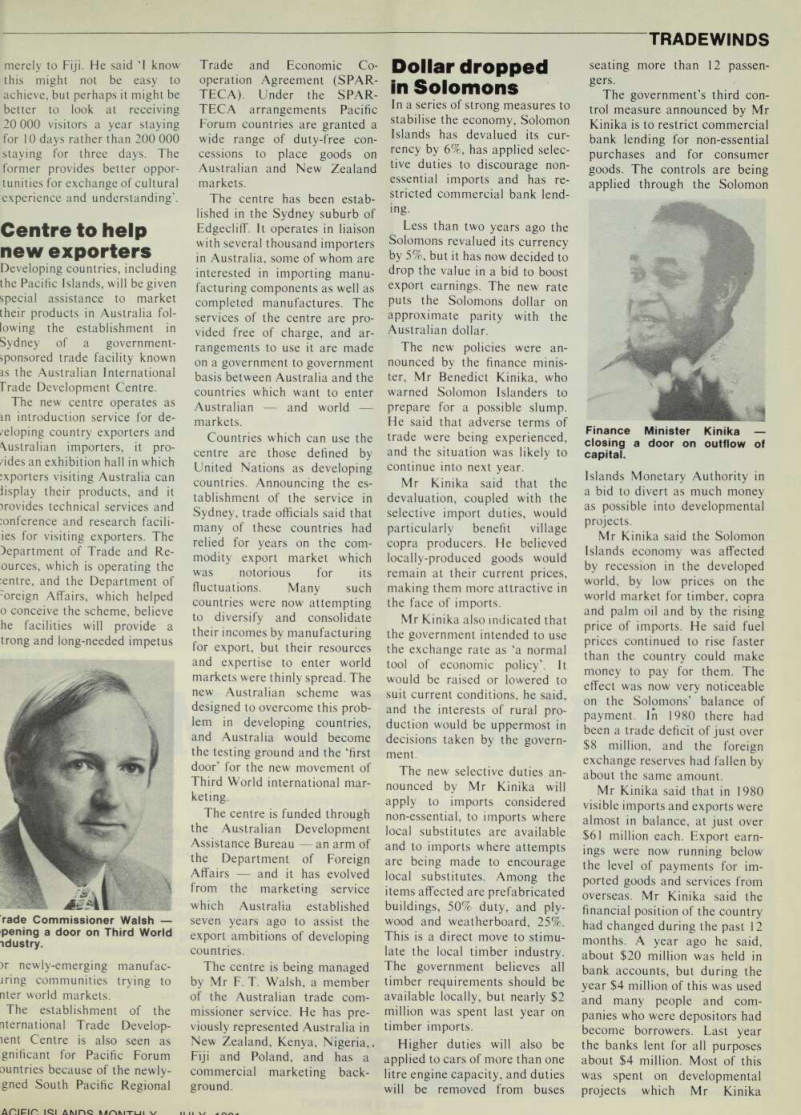
The new centre operates as an introduction service for de /eloping country exporters and \ustralian importers, it pro /ides an exhibition hall in which exporters visiting Australia can lisplay their products, and it arovides technical services and conference and research facili ies for visiting exporters. The department of Trade and Re ources, which is operating the centre, and the Department of 7 oreign Affairs, which helped o conceive the scheme, believe he facilities will provide a trong and long-needed impetus
Dr newly-emerging manufac iring communities trying to nter world markets.
The establishment of the nternational Trade Develop lent Centre is also seen as gnificant for Pacific Forum ountries because of the newly gned South Pacific Regional
Trade and Economic Co operation Agreement (SPAR TECA). Under the SPAR TECA arrangements Pacific Forum countries are granted a wide range of duty-free con cessions to place goods on Australian and New Zealand markets.
The centre has been estab lished in the Sydney suburb of Edgecliff. It operates in liaison with several thousand importers in Australia, some of whom are interested in importing manu facturing components as well as completed manufactures. The services of the centre are pro vided free of charge, and ar rangements to use it are made on a government to government basis between Australia and the countries which want to enter Australian and world markets.
Countries which can use the centre are those defined by United Nations as developing countries. Announcing the es tablishment of the service in Sydney, trade officials said that many of these countries had relied for years on the com modity export market which was notorious for its fluctuations. Many such countries were now attempting to diversify and consolidate their incomes by manufacturing for export, but their resources and expertise to enter world markets were thinly spread. The new Australian scheme was designed to overcome this prob lem in developing countries, and Australia would become the testing ground and the ‘first door’ for the new movement of Third World international mar keting.
The centre is funded through the Australian Development Assistance Bureau an arm of the Department of Foreign Affairs and it has evolved from the marketing service which Australia established seven years ago to assist the export ambitions of developing countries.
The centre is being managed by Mr F. T. Walsh, a member of the Australian trade com missioner service. He has pre viously represented Australia in New Zealand, Kenya, Nigeria,, Fiji and Poland, and has a commercial marketing back ground.
Dollar dropped
in Solomons
In a series of strong measures to stabilise the economy, Solomon Islands has devalued its cur rency by 6%, has applied selec tive duties to discourage non essential imports and has re stricted commercial bank lend ing.
Less than two years ago the Solomons revalued its currency by 5%, but it has now decided to drop the value in a bid to boost export earnings. The new rate puts the Solomons dollar on approximate parity with the Australian dollar.
The new policies were an nounced by the finance minis ter, Mr Benedict Kinika, who warned Solomon Islanders to prepare for a possible slump.
He said that adverse terms of trade were being experienced, and the situation was likely to continue into next year.
Mr Kinika said that the devaluation, coupled with the selective import duties, would particularly benefit village copra producers. He believed locally-produced goods would remain at their current prices, making them more attractive in the face of imports.
Mr Kinika also indicated that the government intended to use the exchange rate as ‘a normal tool of economic policy’. It would be raised or lowered to suit current conditions, he said, and the interests of rural pro duction would be uppermost in decisions taken by the govern ment The new selective duties an nounced by Mr Kinika will apply to imports considered non-essential, to imports where local substitutes are available and to imports where attempts are being made to encourage local substitutes. Among the items affected are prefabricated buildings, 50% duty, and ply wood and weatherboard, 25%.
This is a direct move to stimu late the local timber industry.
The government believes all timber requirements should be available locally, but nearly $2 million was spent last year on timber imports.
Higher duties will also be applied to cars of more than one litre engine capacity, and duties will be removed from buses
seating more than 12 passen gers.
The government’s third con trol measure announced by Mr Kinika is to restrict commercial bank lending for non-essential purchases and for consumer goods. The controls are being applied through the Solomon
Islands Monetary Authority in a bid to divert as much money as possible into developmental projects.
Mr Kinika said the Solomon Islands economy was affected by recession in the developed world, by low prices on the world market for limber, copra and palm oil and by the rising price of imports. He said fuel prices continued to rise faster than the country could make money to pay for them. The effect was now very noticeable on the Solomons’ balance of payment. In 1980 there had been a trade deficit of just over $8 million, and the foreign exchange reserves had fallen by about the same amount.
Mr Kinika said that in 1980 visible imports and exports were almost in balance, at just over $6l million each. Export earn ings were now running below the level of payments for im ported goods and services from overseas. Mr Kinika said the financial position of the country had changed during the past 12 months. A year ago he said, about $2O million was held in bank accounts, but during the year $4 million of this was used and many people and com panies who were depositors had become borrowers. Last year the banks lent for all purposes about $4 million. Most of this was spent on developmental projects which Mr Kinika
rade Commissioner Walsh pening a door on Third World [?]dustry.
Finance Minister Kinika closing a door on outflow of capital.
hoped would generate earnings to repay the loans in years ahead.
The decline in the economy has continued into 1981.
Solomon Islands foreign exchange reserves were now two-thirds of what they were at this time last year. Mr Kinika said the reserves stood at about $2O million which covered only two to three months of pay ments for goods and services. ‘We regard this as too tight for comfort’, he said.
The Solomon Islands govern ment recently invited the Inter national Monetary Fund to study the country’s economic and financial position. Mr Kinika said the government had been able to get finance from overseas for public and private sector investments. He believed the availability of funds would continue but the government had to ensure that the domestic monetary system continued to grow to provide the back-up and in-filling that specific project financing could not provide.
Mr Kinika also announced ;he government’s intention to >eek a syndicated Eurodollar oan of $2O million for capital development over two years.
George Atkin in Honiara.
New fears on
PNG finances
The Papua New Guinea oppo sition leader, Mr Somare, be lieves that deteriorating financial management in his country may force the Inter lational Monetary Fund to step n and supervise economic and inancial management. He said le was not making an empty political statement, but was ndicating a ‘serious possibility’ vhich he had learnt during a ecent visit to the United States capital, Washington.
Mr Somare said it had been nade obvious to him that the MF was becoming seriously mncerned at indications of un :ontrolled government spend ng in PNG. The IMF is nvolved because of its relation hip to PNG’s international >orrowing.
The finance minister, Mr ohn Kaputin, has already ssued a warning that ‘the IMF night come in if we don’t liscipline our expenditure’.
IMF officials made two rou tine inspections of PNG earlier this year. There are indications that they made some criticism of financial management, but there has been no official suggestion of intervention along lines feared by Mr Somare and warned of by Mr Kaputin.
In a statement late in May the deputy prime minister, Mr Okuk, claimed that PNG’s economy was troubled by short term problems but in the overview was in extremely good shape. He described current criticism of the economy as
‘politically alarmist’.
SPARTECA list
is widened
The Australian Government has added clothing, textiles and footwear to the list of goods being allowed free entry from the nations of the South Pacific Forum.
The schedule of goods is part of SPARTECA, the South Pacific Regional Trade and Co operation Agreement signed last year between the Pacific countries and Australia and New Zealand. When the list was announced at the Tarawa Forum meeting in 1980, cloth ing, textiles and footwear were omitted by Australia because they were under review by the Australian Industries Assist ance Commission. But with the reviews now completed, Austra lia has agreed to add certain products to the schedule, giving the Forum countries an advan tage over other developing nations.
A Department of Trade spokesman said the reviews had opened the way for Australia to add extra concessions, as it had intended at the time of the signing. He denied there had been criticism of the decision to withhold textiles and clothing from the schedule at first, although at the time it was reported to have upset several Forum members.
Australia and New Zealand took differing approaches to defining the terms of the agree ment. Australia drew up a list of goods covered for free entry, but New Zealand drew up a list of goods not covered. The New Zealand ‘negative’ list contains apparel and footwear, a de
cision which has already caused some criticism of New Zealand.
About 97% of Australia’s imports from the Pacific are already duty free. They were valued at about $74 million in 1979-80, with phosphate ac counting for $5l million of that.
The Trade Department spokes man said it was too soon to tell whether SPARTECA, which came into effect on January 1, had had any noticeable effect on the volume of Australian im ports from the Pacific.
The benefits of the agreement had always been seen as long term, he said. The scheme aimed to encourage investment in the islands and to promote exporting, and it would make it more difficult for Australia to back out of its special duty free arrangements in the future if it
ever wanted to.
Sue Green in
Melbourne.
SI unionists in
wages unrest
Seven trade unions mustered a demonstration of 3000 workers in May when they marched on the office of the Solomon Islands prime minister, Mr Kenilorea, and claimed he was no longer competent to govern.
The demonstration was sparked by general dissatisfaction over pay rates, coupled with anger at increases in parliamentary salaries. The government has refused a demand by the National Union of Workers for a rise of 180% on the minimum monthly wage. The present minimum is $35 and the workers are demanding a mini mum of $lOO. The rowdy demonstration outside the prime minister’s office was the
first since Mr Kenilorea led his country to independence Leaders of the demonstration delivered a petition to Mr Kenilorea’s office. In it they questioned ‘the honesty of a government which gives itself pay rises but is refusing to better the conditions of workers’.
The petition claimed that the minimum wage had fallen be low what was described as ‘the cost of survival’. It called for the appointment of a com
mission to review all salaries and wages, including those of public servants and pro fessionals in the public service.
It said that a nationwide strike would be organised if the gov ernment did not give some definite indication that it was acting on the demands.
Mr Kenilorea refused to ap pear before the demonstrators outside his office, but later he made a radio broadcast in which he described the demon stration as a political move designed to confuse the people.
He said that neither he nor his cabinet could act on the demands contained in the pet ition without a meeting of parliament. He criticised the unions for taking militant and
disruptive action
In the aftermath to the demonstration Mr Kenilorea’s United Party suffered defeat at a parliamentary by-election for one of the two Honiara seats.
The election was won convinc ingly by Gordon Billy Gatu of the union-backed National Democratic party. He defeated Francis Saemala, a close associ ate of the Prime Minister.
George Atkin in Honiara.
Tax review by
Fiji retailers
A committee of duty-free re tailers has been formed in Fiji to recommend goods from which the government should pro gressively withdraw the current import levy of 10%. The re tailers believe that although the scheme might initially lose some revenue for the govern ment, the overall boost which it would give to duty-free sales to tourists would create a net increase in exchange earnings.
The 10% levy was lifted from cameras in last year’s Fiji budget, and retailers claim this caused a significant increase in camera sales. They believe the same effect on other items would be created if the levy were relaxed. The committee is working in conjunction with the Fiji Visitors Bureau to draw up a list of goods for recommen dation to the government. The submissions are expected to be made in July.
About 60 representatives of the retailing industry attended a conference which discussed
duly free shopping in the con text of Fiji’s economy and their own business dealings. The con ference decided that there was a need for a higher level of training among shop assistants so that new technology goods could be explained to potential buyers. A report to the meeting written by the chairman of the Fiji Visitors Bureau, Mr Mahendra Patel, said that many shopkeepers were not researching the needs of their customers and a high level of training for shop assistants was not being maintained.
Delegates decided to ap proach equipment distributors in a move to arrange training facilities for shopkeepers and shop assistants dealing in new technology equipment.
The Bureau of Statistics sub mitted a report to the confer ence which showed that the share of tourist expenditure which went into duty-free shop ping in Fiji had dropped by more than 10% in the past five years. In 1975 duty-free shop ping accounted for 42% of the money spent by tourists, but by last year this had dropped to 30%. Responding to a survey conducted by the bureau, many tourists had complained that shopkeepers and stall-holders used ‘too much pressure’ in their attempts to make sales.
Profit up, but
bank cautious
The Australia and New Zea land Banking Group (PNG) Ltd has reported an interim profit increase of 58.2% to K 625 000. The bank is an 85%-owned subsidiary of the Australian-based ANZ Bank ing Group.
Despite the result the direc tors have warned that pressures on bank liquidity, official lend ing restraints and competition for deposits could have a dampening effect on the second half’s results.
The bank has declared an interim dividend of 15 toea a share, compared with 10 toea the previous year.
Directors said the buoyant result in the latest half-year period was aided by increased lending volumes and interest margins, and greater volumes of overseas borrowing.