Remembering Capt. Andy, Cook
pp. 53-55 · Read in the full issue

Islands’ Old Man of the Sea
Yesterday
LYDIA DAVIS turns in a memorable pen portrait of a remarkable American man of the sea, Captain Andy Thompson, who for decades sailed the waters of the Cook Islands group. The ‘Dr Tom’ in the narrative is Lydia Davis’ former husband, now Cook Islands’ Premier Sir Thomas Davis.
My first encounter with Captain Andy was when I accompanied my husband on a medical in spection tour of the northern islands of the Cook Group. At that time Andy was skipper of the Tiare Taporo, a schooner trading in copra and owned by A. B. Donald and Co. She must once have been a beautiful ship, but the installation of a diesel engine and the shortening of the mainmast, together with a re duction in sail area, made of her rather a clumsy and uncomfort able old tub. The piercing smell of ripe copra did not assist in making her anything of a cruise ship. Still, back in the ’4os, she was the only vessel to service the isolated islands of the north ern group.
Together with my four-year old son, about 40 or so other passengers of assorted colour and race, and as many boxes and bundles as the tender could hold without actually sinking, we were ferried out to the schooner and ceremoniously welcomed aboard by its master.
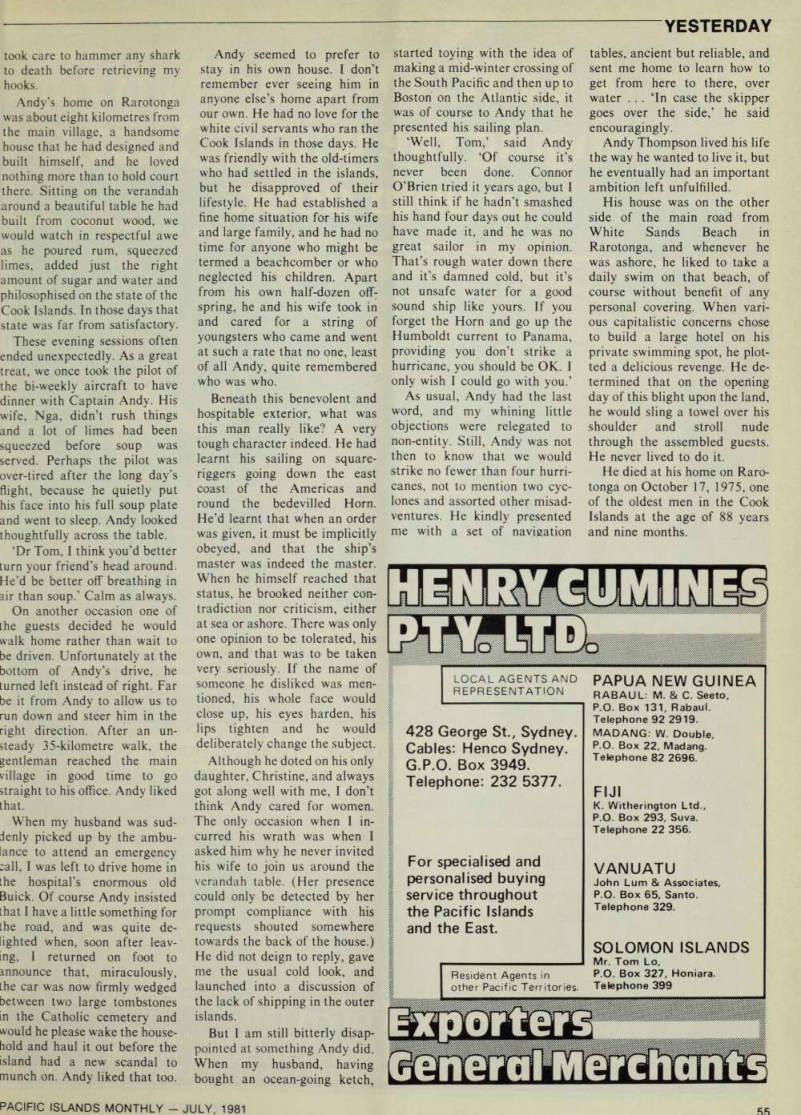
Andy was a barrel-shaped gentleman, bald of head and with the hard blue eyes pre scribed for sailors. He habitu ally dressed in khaki shorts and shirts, wore a khaki solar topee, and nothing else, a fact flaunted for all to see when the backside ance tore out of his shorts. Of :ourse, Andy kept on wearing ihem. He had the accent of a Brooklyn cab driver. Although ae said he had been born in Brooklyn (on January 21, 1887), he had been away from lis home shores so long that I inspected that, like Maurice chevalier, he cultivated that iccent to be cherished as part of lis chosen image. Why, he even ipoke Rarotongan with a Brooklyn accent! ‘Welcome aboard, Mrs Tom,’ aid Andy, apparently bent on baking my hand off with an mormons and callused paw.
Nice to have a lady on the lassenger list. Of course, this
trip we’re a bit crowded, in fact you might say we’ll be like maggots on a cheese. But there’s always an inch or two on the deck. Dr Tom, you’ll have to sleep on the cabin table if you don’t mind getting off at meal times. Mrs Tom, you can have half of one of the bunks in the trade room and your son can have the other half. There’s four passengers on the floor in there, so watch you don’t step on them.’
I found that nothing fazed Andy. That particular trip lasted six weeks. It was six weeks of efficient handling of that clumsy schooner, done with the skill born of years of sailing the same waters, a knowledge of the placement of reefs and the realisation that this ship and its passengers were a responsibility he must and could handle, and do so well. He had never lost a ship or a passenger.
Captain Andy did have one bad habit while at sea. He insisted on wearing ship (chang ing course by turning the ship’s
head from wind) at about 3 am when, it seemed to me, he could just as easily have done it at sunset or dawn. But no, with ear-splitting regularity, each 3 am, he’d shoot up the com panionway, bawl all hands on deck and, above our heads, crash-bang, over would swing the boom, ropes would rattle through the blocks as if the end of the world had come, and the passengers travelling on deck would cower against the gunwales lest they be trampled to death by the crew, or be smothered by a suddenly lowered sail.
Andy rarely went ashore dur ing a voyage. A sudden wind change could drive his vessel on to a reef and he preferred not to delegate this responsibility even to his most senior crewman.
Although he never drank while the ship was under way, he did like to break out a bottle when coming into a landfall.
I remember when we made Manihiki, with a flat calm at sea, he did go ashore. My
husband was holding a clinic so my son and I wandered off to see the island alone. We were invited into various houses and, typically, offered food and a very pleasant coconut-type drink. At about the fourth house I was joined by Andy, who had also been doing a bit of visiting. He was rather drunk, but then, I suddenly realised, so was I the coconut-type drink turned out to be palm toddy, potent stuff. By the time we’d made a few more calls together and were ready to go back to the tender, Andy and I were prop ing each other up at a very acute angle and singing sea shanties. Dr Tom was not amused.
After that, Andy and I be came fast friends. He encour aged me to trawl offshore for tuna for the ship’s table, but firmly refused to allow me to land my catch. Insisting that ladies should know their place, he informed me: ‘Ladies might be able to catch them, that’s just luck, but getting them over the side is a man’s job.’ I remember him watching criti cally as I attempted to extract the hook from the mouth of some strange fish which cer tainly was not a tuna. I was using the simple method of holding its head on deck with my bare foot, to keep both hands free for the job in hand.
He left it to the cabin steward to notice that it was a shark I was manhandling. ‘You’ll know next time,’ he drawled calmly. But I still feel that if there had been real danger, he would have leapt to the rescue: at least for the rest of my deepsea fishing years, I
Captain Andy as many saw him a picture from the 1940s
took care to hammer any shark to death before retrieving my hooks.
Andy’s home on Rarotonga was about eight kilometres from the main village, a handsome house that he had designed and built himself, and he loved nothing more than to hold court there. Sitting on the verandah around a beautiful table he had built from coconut wood, we would watch in respectful awe as he poured rum, squeezed limes, added just the right amount of sugar and water and philosophised on the state of the Cook Islands. In those days that state was far from satisfactory.
These evening sessions often ended unexpectedly. As a great treat, we once took the pilot of the bi-weekly aircraft to have dinner with Captain Andy. His wife, Nga, didn’t rush things and a lot of limes had been squeezed before soup was served. Perhaps the pilot was over-tired after the long day’s flight, because he quietly put his face into his full soup plate and went to sleep. Andy looked thoughtfully across the table. ‘Dr Tom, I think you’d better turn your friend’s head around.
He’d be better off breathing in air than soup.’ Calm as always.
On another occasion one of the guests decided he would walk home rather than wait to be driven. Unfortunately at the bottom of Andy’s drive, he turned left instead of right. Far be it from Andy to allow us to run down and steer him in the right direction. After an un steady 35-kilometre walk, the gentleman reached the main village in good time to go straight to his office. Andy liked that.
When my husband was sud denly picked up by the ambu lance to attend an emergency call, I was left to drive home in the hospital’s enormous old Buick. Of course Andy insisted that I have a little something for the road, and was quite de lighted when, soon after leav ing, I returned on foot to
announce that, miraculously,
the car was now firmly wedged between two large tombstones in the Catholic cemetery and would he please wake the house hold and haul it out before the island had a new scandal to munch on. Andy liked that too.
Andy seemed to prefer to stay in his own house. I don’t remember ever seeing him in anyone else’s home apart from our own. He had no love for the white civil servants who ran the Cook Islands in those days. He was friendly with the old-timers who had settled in the islands, but he disapproved of their lifestyle. He had established a fine home situation for his wife and large family, and he had no time for anyone who might be termed a beachcomber or who neglected his children. Apart from his own half-dozen off spring, he and his wife took in and cared for a string of youngsters who came and went at such a rate that no one, least of all Andy, quite remembered who was who.
Beneath this benevolent and hospitable exterior, what was this man really like? A very tough character indeed. He had learnt his sailing on square riggers going down the east coast of the Americas and round the bedevilled Horn.
He’d learnt that when an order was given, it must be implicitly obeyed, and that the ship’s master was indeed the master.
When he himself reached that status, he brooked neither con tradiction nor criticism, either at sea or ashore. There was only one opinion to be tolerated, his own, and that was to be taken very seriously. If the name of someone he disliked was men tioned, his whole face would close up, his eyes harden, his lips tighten and he would deliberately change the subject.
Although he doted on his only daughter, Christine, and always got along well with me, I don’t think Andy cared for women.
The only occasion when I in curred his wrath was when I asked him why he never invited his wife to join us around the verandah table. (Her presence could only be detected by her prompt compliance with his requests shouted somewhere towards the back of the house.) He did not deign to reply, gave me the usual cold look, and launched into a discussion of the lack of shipping in the outer islands.
But I am still bitterly disap pointed at something Andy did.
When my husband, having bought an ocean-going ketch,
started toying with the idea of making a mid-winter crossing of the South Pacific and then up to Boston on the Atlantic side, it was of course to Andy that he presented his sailing plan. ‘Well, Tom,’ said Andy thoughtfully. ‘Of course it’s never been done. Connor O’Brien tried it years ago, but I still think if he hadn’t smashed his hand four days out he could have made it, and he was no great sailor in my opinion.
That’s rough water down there and it’s damned cold, but it’s not unsafe water for a good sound ship like yours. If you forget the Horn and go up the Humboldt current to Panama, providing you don’t strike a hurricane, you should be OK. I only wish I could go with you.’
As usual, Andy had the last word, and my whining little objections were relegated to non-entity. Still, Andy was not then to know that we would strike no fewer than four hurricanes, not to mention two eyelones and assorted other misadventures. He kindly presented me with a set of navigation
tables, ancient but reliable, and sent me home to learn how to get from here to there, over water ... ‘ln case the skipper goes over the side,’ he said encouragingly.
Andy Thompson lived his life the way he wanted to live it, but he eventually had an important ambition left unfulfilled, His house was on the other side of the main road from White Sands Beach in Rarotonga, and whenever he was ashore, he liked to take a daily swim on that beach, of course without benefit of any personal covering. When vari ous capitalistic concerns chose to build a large hotel on his private swimming spot, he plot ted a delicious revenge. He de termined that on the opening day of this blight upon the land, he would sling a towel over his shoulder and stroll nude through the assembled guests, He never lived to do it.
He died at his home on Raro tonga on October 17, 1975, one of the oldest men in the Cook Islands at the age of 88 years and nine months.