Death on Malaita:
p. 51 · Read in the full issue
Fear and sadness
Lightning Meets the West Wind: The Malaita Massacre.
By Roger M. Keesing and Peter Corris. Published by Oxford Uni versi ty Press. $A 17.50.
Isbn 0 19 554223 I.
This book on the killing of a district officer in Solomon Islands in the early days of British colonial administration •eveals a number of things lome frightening, others sad lening.
Lightning Meets the West Wind: The Malaita Massacre is ibout the killing in 1927 of District Officer William Bell, an Englishman who migrated to Australia, but worked under :ontract with the British col mial administration in Solomon slands.
Mr Bell was killed while ollecting basic rates in the Cwaio area of Malaita, an sland noted in those years for he hostility of its population to olonial rule.
The book is a joint production iy American anthropologist Yofessor Roger M. Keesing nd Australian historian Peter Morris.
Professor Keesing has spent lany years with the Kwaio eople and speaks their
language fluently, and the nar rative reveals many things which not even Solomon Islands know about. A case in point is the description of the way of life of the Kwaio people in those
days.
It can be said that it was very selfish of the Europeans to introduce guns to the Kwaio people, who were already famous for killing each other with spears, and, later on, knives and axes. The book establishes beyond doubt that Kwaio tribesmen were ex tremely jealous and suspicious of each other. The rugged area in which they had to survive moulded them into rough and tough characters, who neverthe less lived in constant fear. The book also describes the qualities of determination and ability to survive hardships instilled in these people not only by the harsh physical environment, but by their imposed experience of having to go to other islands to work to make money to pay their basic rates.
The book equally shows Bell as a tough character, who most certainly was not afraid of the Kwaio. But the sad fact is that he did not take adequately into account that he was dealing
with savages, who were many years behind in the process of Westernisation.
Earlier incidents had fore warned him that trouble was to be expected. His determined staying on in the job despite such warnings gives the narra tive at times something of the suspense of a good Western movie.
Some Solomon Islanders could be upset by parts of the book, especially the account of the authorities’ maltreatment of Kwaio people after their arrest for the killing. It is sad to note that the Kwaio clan head had to kill for European wealth ... for money.
The action of two Australian destroyers in going to Kwaio to destroy villages can best be described as vicious. Stories have it that they not only destroyed villages in Kwaio but also some on Makira and Guadalcanal. It is little wonder that many Solomon Islanders have no great love for Austra lians.
Still today, basic rates are still very controversial. People feel they have been paying them since Bell’s day, only to get very little in return. Rate defaulters, just as in those days, can expect gaol terms of up to three months.
It looks as if the reason for Bell’s death is here to stay ...
basic rates! -
George Atkin in
Honiara.
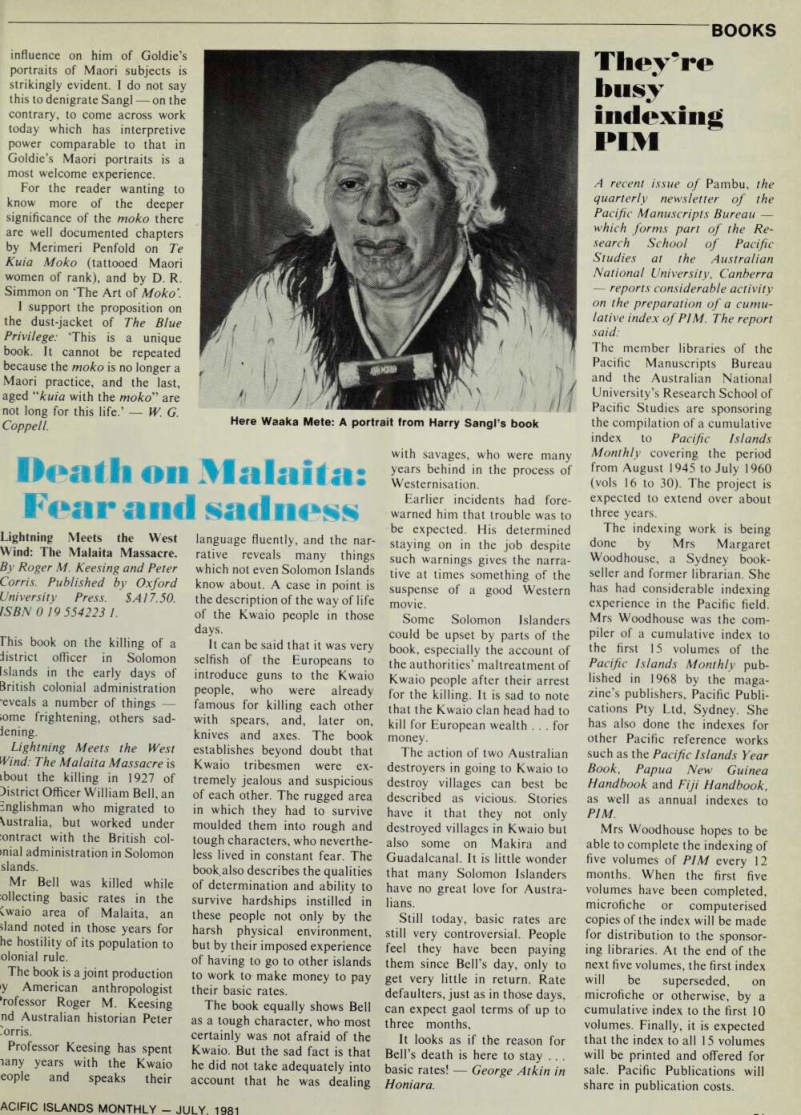
Here Waaka Mete: A portrait from Harry Sangl’s book