Mystique of the vanishing 'moko'
pp. 49-51 · Read in the full issue

vanishing 'moko'
The Blue Privilege The Last Tattooed Maori Women. Text and paintings by Harry Sangl, with chapters by Mer inter i Penfold and D. R. Simmons.
Published by Richards Pub lishing in association with William Collins Publishers, Auckland. 5NZ29.95. ISBN 0 908596 06 5.
As a child I attended an inner city primary school in Auckland which was near the Art Gallery and the Old Colonists’ Mus eum. I spent many an hour looking at relics of the Maori Wars and of colonial days, and wondering about the signif icance of the paintings and sculptures to be seen there.
An impression gained on these museum visits of the dignity and vitality of the Maori race as portrayed by the late 19th-century artists Goldie and Landauer remains with me to this day.
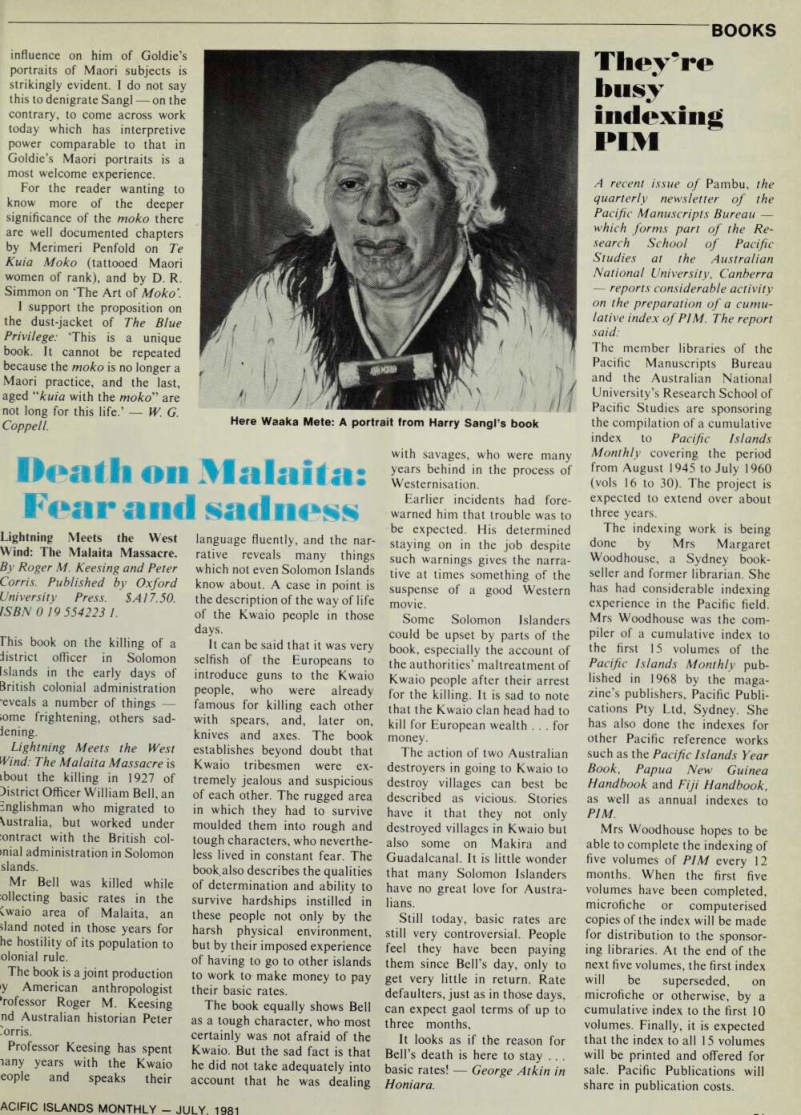
Many of the portraits re corded the facial tattoos, or moko, of Maori dignitaries.
These tattoos were a method used by the Maori people of acknowledging rank in their society. They were personalised marks of status accquired only through suffering and fortitude.
Many of the chiefs who ac
cepted the 1840 Treaty of Waitangi had used represen
tations of their moko to indicate their acquiesence in the treaty, just as Europeans would use signatures.
There are several major studies of tattooing in the Pacific area, but there is still need for further study of its ritual meaning. Harry Sangl therefore has performed a valu able service in preparing The Blue Privilege. He interviewed, compiled biographies of, and recorded in paintings the char acters and the moko of 34 New Zealand Maori women. All the subjects were elderly and, sadly, many of them are now dead. The opportunity will never occur again for such encounters between a biogra pher working with words and paintbrush and a group of Maori women who took the moko with pride, and endured the pain of tattooing by chisel or needle.
I was taken aback when I opened this book at first glance I felt I was looking at a folio of Goldie’s paintings. I know nothing of Sangl’s other artistic output, but the
influence on him of Goldie’s portraits of Maori subjects is strikingly evident. I do not say this to denigrate Sangl on the contrary, to come across work today which has interpretive power comparable to that in Goldie’s Maori portraits is a most welcome experience.
For the reader wanting to know more of the deeper significance of the moko there are well documented chapters by Merimeri Penfold on Te Kuia Moko (tattooed Maori women of rank), and by D. R.
Simmon on ‘The Art of Moko’.
I support the proposition on the dust-jacket of The Blue Privilege: ‘This is a unique book. It cannot be repeated because the moko is no longer a Maori practice, and the last, aged “ kuia with the moko ” are
not long for this life.’
W. G.
Coppell.