Brett Hilder, man
p. 56 · Read in the full issue
Obituary
Brett Hilder, man of the sea, man of many parts
Captain Brett Hilder, MBE, RD, MA, Extra Master, was a per sonality rather than a character.
Outwardly a bluff, commonsense seafarer, he pursued a greater variety of interesting extra curricular interests than half a dozen ordinary men.
He died quietly at his desk in his home at Currumbin, Queens land, on April 9, while waiting to go to the funeral of his friend Mrs Lillian Barclay-Millar (Tiger Lil’) who had died a few days before (see p 97).
Brett Hilder was born in Sydney on March 27, 19l I, son of J. J. Hilder, noted Australian water-colourist. He went to sea as a cadet with Burns Philp Line when he was 16 and served in the famous BP seven-letter ‘M’ ships the ill-fated Malabar, which gave its name to a piece of
Sydney scenery, Morinda, Malaita. M angola, Montoro (Marks I and sometimes II), as well as others all of which were once as much a part of the Southwest Pacific as the reefs and the coconuts.
His first command was an old fashioned tub called Maiwara, trading out of Rabaul with plantation stores and back loading copra. That was 1939, just after he had marooned himself ashore for a year to study for and pass the exam for Extra Master’s certificate, then rare his was only the sixth awarded in Australia. Thirty seven years later it was accepted by Macquarie University, Syd ney, in lieu of matriculation, and led to an MA degree for the Hilder thesis on the voyages of Luis Daez de Torres. This was recently published as a book by the University of Queensland Press (a review of the book appeared in PIM May p 47 accompanied by the magazine’s first announcement of the author’s death).
For his command of Maiwara, Captain Hilder grew a beard, at a time when beards were not fashionable, ‘in order to look older’. But within months World War II broke out, he was recalled to Navy Reserve in Sydney, and seconded to the Royal Australian Air Force, Point Cook, Victoria, as a navi gation instructor. Typically, he at once set about learning to fly and to making the transfer perma nent, calculating that the air force was likely to see more action than the navy.
The only casualty was the beard. Lieutenant Hilder, Royal Australian Naval Reserve (RANR), finally emerged as clean-shaven Wing-Commander Hilder, RAAF, with a Catalina squadron sowing minefields in northern waters.
When BP ships returned to the Southwest Pacific after war service, Brett Hilder, red beard regrown, returned with them, this time as Master of larger vessels running from Sydney
through the New Hebrides, Solomons, Papua New Guinea and occasionally to the then Gilbert and Ellice Islands Col ony.
Not even Bulolo, the ultimate in BP ships and first departure from the company’s early fashion of nomenclature, was in the luxury class. Passenger accommodation on most was limited. The crews were on Australian articles, which guaranteed a lack of pamper ing.
Nonetheless, most of those who made those Hilder voyages treasure the experience, having managed to identify with the ship as an alternative to going slowly crazy as it meandered in stop-go fashion among the islands; putting up with days alongside some decrepit wartime wharf; or anchored out, while wet-season wet thundered down; taking a personal interest in delivering cases of canned meat and bags of rice to some isolated Solomons plantation; or picking a way out through the reef off Inus, Bougainville, in the dark, guided by a hurricane lantern stuck on a stick at the edge of the pass.
They ate BP food (dinner at 5.30 in port), imbibed ferocious cocktails when the ship’s com pany entertained, and met a procession of Islands identities who streamed on board at every port and flukey anchorage to see the skipper and yarn their yarns.
All this largely because, along with superb seamanship, Brett Hilder had a rare gift for friendship. No one who ever travelled the Islands with him forgot him or them. His friends from the Islands are legion.
On board his ships he was host as well as Master, instigator of a
hundred discussions, inspiring in others interest in his interests, ranging widely through marine biology, higher mathematics, Polynesian migrations, exotic grog, painting, navigation, charts, anthropology, lore of the sea, and much, much more.
In the late 1960 s BP ships began to disappear from the Pacific, one by one no longer economic, according to their owners. Finally, the flagship Bulolo went the way of the others, Brett Hilder, by then Commodore of the Line, with her.
During his early service in the RAAF he decided that any son of J. J. Hilder should be able to paint, and after trial and error, self-taught, he painted. Exhi bitions of his water colours, mostly of Islanders, have been held in Sydney, Melbourne, New York and the Islands.
In 1961 his self-illustrated autobiography, Navigator in the South Seas, was published in London. The Heritage of J. J.
Hilder followed in 1966. At the same time he was contributing dozens of articles and drawings to magazines.
Nonetheless, with all his sideline activities, he would probably most like to be remem bered as a Master Mariner and a navigator, a disciple of the great Captain James Cook, whom he admired most among the early explorers of the Pacific.
Of the awards and honours that came his way he probably valued most those bestowed by the Admiralty his name on a tiny, previously uncharted group of islands off Bougainville, or the naming of Hilder Reef, part of the Great Barrier Reef, after he had discovered a new pass in 1963.
To his many Islands friends he was once the youngest and then the last of the great Burns Philp skippers, symbols of a younger and less complicated age when Pacific Islands still retained their South Seas magic, and communications between iso lated plantation or government outpost depended on the six weekly call of a smallish mer chant ship whose name had seven letters and began with an ‘M’.
Brett is survived by his second wife, Janey; his three daughters Beatrice, Christine and Tania,
and his son Julius.
Judy
Tudor.
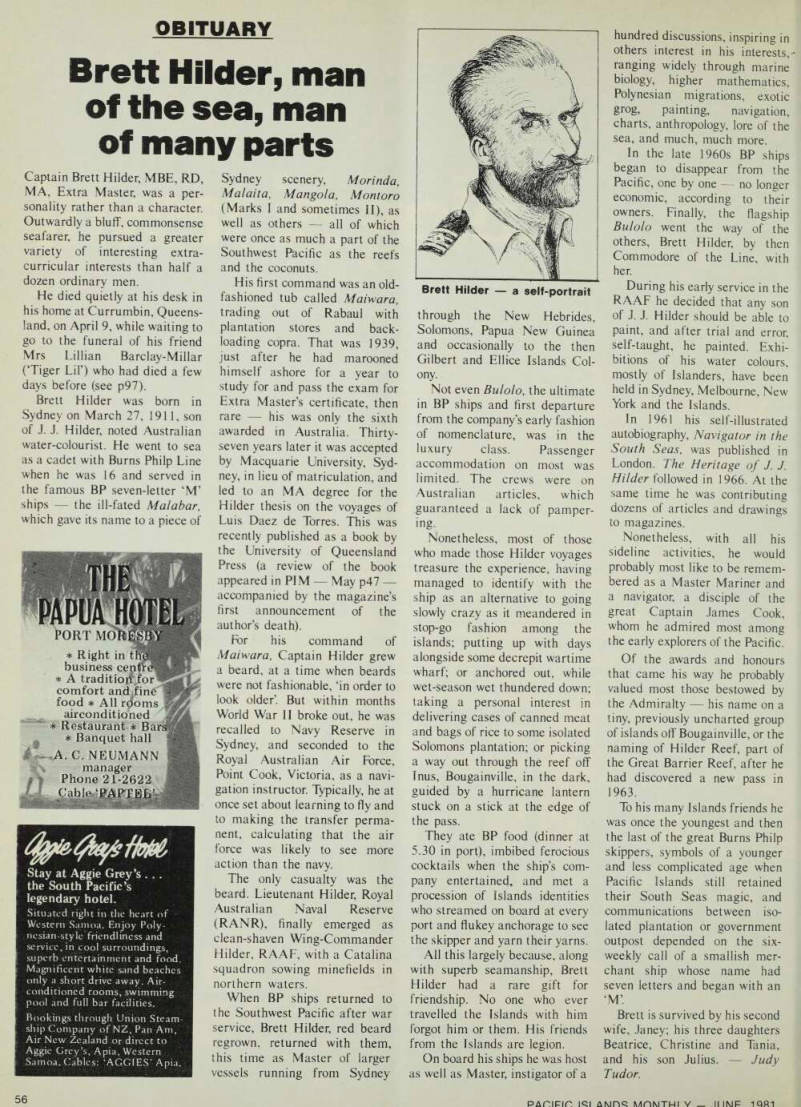
Brett Hilder a self-portrait