Samoa blazes
p. 22 · Read in the full issue
conservation trail
The opening of Western Samoa’s first national park is the highlight of a major conser vation programme conducted by the government of Western Samoa and the New Zealand Department of Lands and Sur vey.
For Rex Mossman, a senior national parks ranger with the department, the opening of O Le Pupu-Pu’e National Park headquarters at Togitogiga is the culmination of two years’ hard work as technical adviser to Western Samoa’s national parks project. O Le Pupu-Pu’e National Park on the main island of Upolu extends from the top of the main ridge between Mt Le Pe Pu'e and Mt Fito to the coastal cliffs of Le Pupu. It is an area that affords dramatic views of the coast and lava formations, as well as conserving a wide variety of Western Samoa’s native wildlife and vegetation.
The park headquarters at Togitogiga, 25 km from Apia, is not only responsible for the administration of its own BOOlhha area and reserve, but also for the other four reserves which make up the new West ern Samoan national park and reserve system.
Plans for the park began in 1978 with the request of the Western Samoan Government for aid in establishing a national area where the country’s scenic, recreational, educational and scientific resources could be controlled and protected for the enjoyment of future gener ations. The Department of Lands and Survey seconded Mr Mossman to the Western Samoan Government as a tech nical adviser on the project.
Travel costs and equipment were met by two international organisations, the International Union for the Conservation of Nature and Natural Resources (lUCN) and the World Wildlife Fund (WWF).
One of the first things Mr Mossman discovered was that
the concept of a national park was new to the Western Samoan public. Education and the promotion of public aware ness about conservation have therefore been prominent fea tures of the project, with national park staff preparing information and display ma terial in both English and Samoan. Films have proved a popular way of getting the conservation message across the local audiences. Advantage has also been taken of opportunities to talk to schools and youth groups.
Mr Mossman believes his most important long-term res ponsibility has been the training of local staff who will eventually assume control of the park’s administration. The staff need to understand what they are doing and why, be able to plan and organise their work, and most importantly, be able to communicate the value of their work to the public,’ he said.
Because there were so few people to draw on who already understood the concept of con servation, training had to begin from scratch.
Basic elements of the job, including administrative and practical skills like first aid, were taught before sending trainees to New Zealand for a short tour aimed at improving their understanding and widen ing their horizons. They were then sent on intermediate man agement courses on national parks and reserves which are intended for overseas students and run jointly by the New Zealand Department of Lands and Survey and Lincoln Col lege, Canterbury.
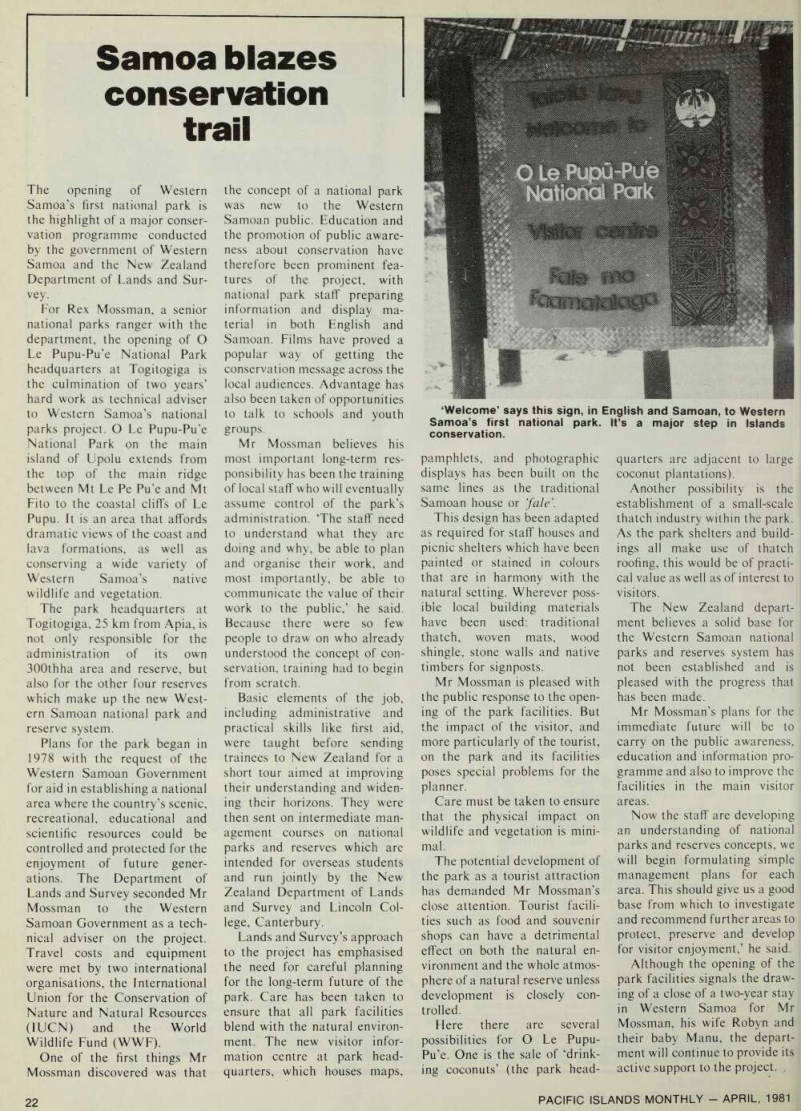
Lands and Survey’s approach to the project has emphasised the need for careful planning for the long-term future of the park. Care has been taken to ensure that all park facilities blend with the natural environ ment. The new visitor infor mation centre at park head quarters, which houses maps,
pamphlets, and photographic displays has been built on the same lines as the traditional Samoan house or fale\ This design has been adapted as required for staff houses and picnic shelters which have been painted or stained in colours that are in harmony with the natural setting. Wherever poss ible local building materials have been used; traditional thatch, woven mats, wood shingle, stone walls and native timbers for signposts.
Mr Mossman is pleased with the public response to the open ing of the park facilities. But the impact of the visitor, and more particularly of the tourist, on the park and its facilities poses special problems for the planner.
Care must be taken to ensure that the physical impact on wildlife and vegetation is mini mal.
The potential development of the park as a tourist attraction has demanded Mr Mossman’s close attention. Tourist facili ties such as food and souvenir shops can have a detrimental effect on both the natural en vironment and the whole atmos phere of a natural reserve unless development is closely con trolled.
Here there are several possibilities for O Le Pupu- Pu’e. One is the sale of ‘drink ing coconuts’ (the park head
quarters are adjacent to large coconut plantations).
Another possibility is the establishment of a small-scale thatch industry within the park.
As the park shelters and build ings all make use of thatch roofing, this would be of practi cal value as well as of interest to visitors.
The New Zealand depart ment believes a solid base for the Western Samoan national parks and reserves system has not been established and is pleased with the progress that has been made.
Mr Mossman’s plans for the immediate future will be to carry on the public awareness, education and information pro gramme and also to improve the facilities in the main visitor areas.
Now the staff are developing an understanding of national parks and reserves concepts, we will begin formulating simple management plans for each area. This should give us a good base from which to investigate and recommend further areas to protect, preserve and develop for visitor enjoyment,’ he said.
Although the opening of the park facilities signals the draw ing of a close of a two-year stay in Western Samoa for Mr Mossman, his wife Robyn and their baby Manu, the depart ment will continue to provide its active support to the project. .
‘Welcome' says this sign, in English and Samoan, to Western Samoa's first national park. It’s a major step in Islands conservation.