budgets and
p. 21 · Read in the full issue
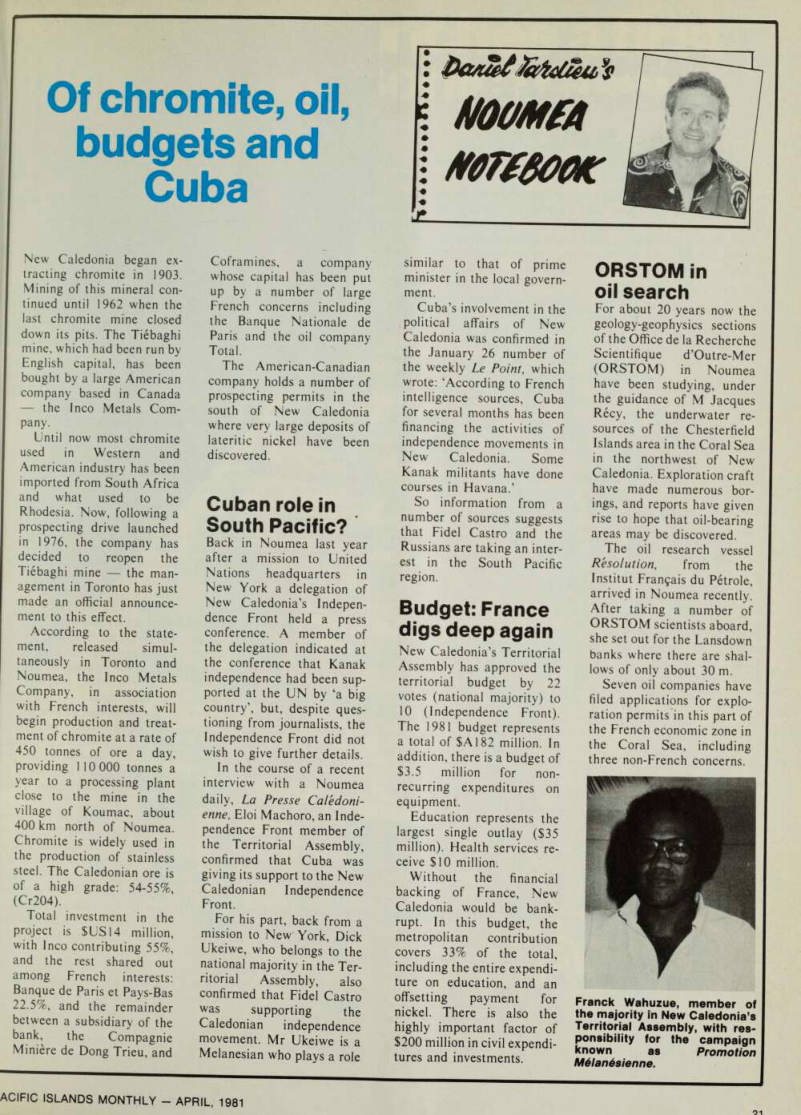
Of chromite, oil, budgets and Cuba
New Caledonia began ex tracting chromite in 1903.
Mining of this mineral con tinued until 1962 when the last chromite mine closed down its pits. The Tiebaghi mine, which had been run by English capital, has been bought by a large American company based in Canada the Inco Metals Com pany.
Until now most chromite used in Western and American industry has been imported from South Africa and what used to be Rhodesia. Now, following a prospecting drive launched in 1976, the company has decided to reopen the Tiebaghi mine the man agement in Toronto has just made an official announce ment to this effect.
According to the state ment, released simul taneously in Toronto and Noumea, the Inco Metals Company, in association with French interests, will begin production and treat ment of chromite at a rate of 450 tonnes of ore a day, providing 110 000 tonnes a year to a processing plant close to the mine in the village of Koumac, about 400 km north of Noumea.
Chromite is widely used in the production of stainless steel. The Caledonian ore is of a high grade: 54-55%, (Cr2o4).
Total investment in the
project is SUSI 4 million,
with Inco contributing 55%, and the rest shared out among French interests: Banque de Paris et Pays-Bas 22.5%, and the remainder between a subsidiary of the bank, the Compagnie Miniere de Dong Trieu, and
Coframines, a company whose capital has been put up by a number of large French concerns including the Banque Nationale de Paris and the oil company Total.
The American-Canadian company holds a number of prospecting permits in the south of New Caledonia where very large deposits of lateritic nickel have been discovered.
Cuban role in
South Pacific?
Back in Noumea last year after a mission to United Nations headquarters in New York a delegation of New Caledonia’s Indepen dence Front held a press conference. A member of the delegation indicated at the conference that Kanak independence had been sup ported at the UN by ‘a big country’, but, despite ques tioning from journalists, the Independence Front did not wish to give further details.
In the course of a recent interview with a Noumea daily, La Presse Caledoni enne, Eloi Machoro, an Inde pendence Front member of the Territorial Assembly, confirmed that Cuba was giving its support to the New Caledonian Independence Front.
For his part, back from a mission to New York, Dick Ukeiwe, who belongs to the national majority in the Ter ritorial Assembly, also confirmed that Fidel Castro was supporting the Caledonian independence movement. Mr Ukeiwe is a Melanesian who plays a role
similar to that of prime minister in the local govern ment.
Cuba’s involvement in the political affairs of New Caledonia was confirmed in the January 26 number of the weekly Le Point, which wrote: ‘According to French intelligence sources, Cuba for several months has been financing the activities of independence movements in New Caledonia. Some Kanak militants have done courses in Havana.’
So information from a number of sources suggests that Fidel Castro and the Russians are taking an inter est in the South Pacific region.
Budget: France
digs deep again
New Caledonia’s Territorial Assembly has approved the territorial budget by 22 votes (national majority) to 10 (Independence Front).
The 1981 budget represents a total of SAIB2 million. In addition, there is a budget of $3.5 million for non recurring expenditures on equipment.
Education represents the largest single outlay ($35 million). Health services re ceive $lO million.
Without the financial backing of France, New Caledonia would be bank rupt. In this budget, the metropolitan contribution covers 33% of the total, including the entire expendi ture on education, and an offsetting payment for nickel. There is also the highly important factor of $2OO million in civil expendi tures and investments.
Orstom In
oil search
For about 20 years now the
geology-geophysics sections
of the Office de la Recherche
Scientifique d’Outre-Mer
(ORSTOM) in Noumea have been studying, under the guidance of M Jacques Recy, the underwater re sources of the Chesterfield Islands area in the Coral Sea in the northwest of New Caledonia. Exploration craft have made numerous bor ings, and reports have given rise to hope that oil-bearing areas may be discovered.
The oil research vessel Resolution, from the Institut Fransais du Petrole, arrived in Noumea recently.
After taking a number of ORSTOM scientists aboard, she set out for the Lansdown banks where there are shal lows of only about 30 m.
Seven oil companies have filed applications for explo ration permits in this part of the French economic zone in the Coral Sea, including three non-French concerns.
Franck Wahuzue, member of the majority in New Caledonia’s Territorial Assembly, with res ponsibility for the campaign known as Promotion Melansienne.