ending the U.S. Trusteeship
pp. 13-18 · Read in the full issue

Micronesia: The long, long haul to ending the U.S. Trusteeship
With 1981 upon us, the long-awaited termination of the United Nations Trustee ship Agreement relating to Micronesia may be in for another delay. Although 1981 was named as the target year for termination by the Carter Adminis tration, some of the more sanguine observers are now beginning to talk about 1984 as a reasonable date for finalising an arrange ment under which the three remaining entities of the Trust Territory of the Pacific Islands, Marshall Islands (Ml), Belau (formerly
Palau), and the Federated States of Micronesia (FSM), would establish a new pol itical status probably ‘in free association’ with the United States.
While the ‘Statement of Agreed Principles of Free Association’ eight major points were worked out at the status negotiations held in Hilo, Hawaii, more than two years ago (April 19, 1978), the fine and final details posed many prob lems for the negotiators on all sides of the table.
The initialling by the FSM and the Ml of the Compact
of Free Association with the US at Kailua-Kona, Hawaii, in October (PIM Dec p 5) represented an interim suc cess. Belau, then on the eve of its November election (see Political Currents), was expected to initial the com pact later on, and has since done so.
But the initialling is far from the end of the matter.
A formal signing will not take place until after further negotiations on several subsidiary agreements, and following approval in a plebiscite planned to be held in Micronesia early in
1981. Even with these hurdles surmounted, the compact must still be pres ented to the US Congress as a joint resolution for enactment into law.
While the three entities Belau, Ml, and FSM are all working towards a similar relationship of free association with the US, the problems they face are quite different. In this article, DONALD M. TOP PING* looks at some of the recent developments in Belau and Ml which may help bring the differences into focus.
1. Marshalls: Eager to get it over
The new constitutional govern ment of the MI (since May 1, 1979) is experiencing many of the familiar problems of a new Pacific Island state: population pressures (3.5% annual in crease), limited land area, urban drift (60% in the urban centers of Majuro and Ebeye, where the population density is the highest in the world), nega tive import-export balance, un employment, and government services that are currently too costly to maintain on self generated revenues. These stan dard problems, found through out the Pacific, are com pounded by US federal welfare programmes that are having a debilitating effect on the tra ditional self-sufficiency of the outer islanders, and continue to lead to unrealistic expectations.
The effects of the devastating
* Professor Donald M. Top ping is Director of the Social Science Research Institute, University of Hawaii at Manoa, in Honolulu, Hawaii.
He has long been an advocate of closer ties between the US State of Hawaii and the Island countries of the Pacific.
1979 tidal wave which inun dated Majuro are still a major problem, with hundreds of fam ilies still living in badly deteriorating tents.
Although a SUS 2 million federal housing programme has been made available for the wave victims, not much prog ress has been made, largely due to the inappropriateness of a federal disaster relief pro gramme with inflexible guide lines applied in a Pacific Island setting. Also, this new housing programme is forcing a funda mental question of who has authority over lands in the MI?
Does the government, through its zoning laws, or the tra ditional landowners have the final say on housing density and who may live where in the capital of the MI?
The US Department of Agriculture (USDA) food is only part of the much broader federal welfare system which is, according to some observers, creating a strong dependency on US support throughout Micronesia, and especially in the MI. The range of such programmes is broad, and the list of recipients extremely
long, since nearly everyone in the Ml qualifies for benefits when the US standard for income level is applied. While the effects of the massive wel fare programmes have not been measured, they have clearly proved to be a disincentive to subsistence farming and fish ing, which form the basis for social organisation in the outer islands.
The recent fall in the price of copra the only cash crop in the Ml from more than 90c to about I4C per kg has made it easier for the outer islanders to rely on US hand outs. The sudden drop in price, a chain reaction to the Soviet invasion of Afghanistan, has resulted in a dramatic re duction in copra production. (Because of the invasion, the US stopped corn oil shipments to Russia, thus reducing the US need for coconut oil.) The relatively new Tobolar copra processing mill in Majuro, once bustling with 24-hour pro duction, is now locked up most of the time due to a lack of copra, or power, or both.
The existing infrastructure of Majuro, installed and operated by American expatriates for nearly 35 years, is of mixed quality. The international air port at Majuro is superb, built to the latest US military specifications in 1973. The 22km long macadam road (the
longest of any atoll in the world) connecting more than half of the islets of the horseshoe-shaped lagoon, is in good condition, and is well travelled by the multitude of vehicles of Majuro. On the other hand, running water is available for only one hour per day (6 to 7pm), and the power goes out as frequently and unprcdiclably as the tropical rainshowers come down.
Internal and external communi cations are practically non existent, except for the military-Trust Territory relay through which all messages are monitored in Kwajalcin and Saipan.
Taken all together, the parts of the infrastructure that work, plus those that don’t, present maintenance problems that even a technologically oriented, well-heeled government would find overwhelming.
While the problems of de veloping and maintaining an adequate infrastructure are very real, they pale when com pared with the more serious problem of population, more than half of which has been dislocated for one reason or another. Starting with the relo cation of the Kwajalein, Bikini, and Enewetak people in the 19505, the Marshallese people have been on the move, mostly towards the urban centres of Ebeye and Majuro, where the
lure of salaried jobs has created population densities exceeding those of Hong Kong or Manhattan.
Even seasoned world travel lers are shocked by Ebeye, where more than 6000 Marshallese are crowded into a land area of less than 0.26 of a square kilometre. The shore line on both sides of the island is covered with the detritus of a consumer society, the most noticeable items being the thou sands of soiled, plastic-lined disposable napkins and rusting beer cans. Flies and rats abound in the garbage thrown into the streets, which provide the only outdoor play area for the chil dren. The harshness of life on Ebeye is tempered by the 600odd jobs available at the nearby Kwajalein Missile Range base a few thousand metres away, and free USDA food for every man, woman, and child on the island and for thousands of others who are not. Because there is such a surplus of the giveaway food, much of it gets shipped to relatives on outer islands.
Although the Ebeye situation has been the subject of heated criticism, investigations, dis
cussions, special programmes, and journalistic exposes, the conditions there persist. Some say they are getting worse.
In addition to the very real physical problems, there are, not surprisingly, some residual political problems in the new government of the MI, some of which may stem from the fact that the Marshallese people, after 30-odd years of training and experience in the US demo cratic model, chose a parlia mentary form of government in December 1978 when they adopted their constitution in a hard-fought referendum. The pro-constitution faction in that referendum were elected to the new parliament by a solid majority in March 1979, taking office on May I of that year.
The losing faction in the referendum (called the Voice of the Marshalls, and led mainly by South Islanders from Ebon and Jaluil) is still attempting to stir up a secession movement, but the voice is pretty weak.
With only four elected seats out of 33 in the Nitijela (Parlia ment), their criticism is limited to a petty and personal level, and to date they have offered no
real opposition or alternatives.
Their most frequent com plaint is that the president and his appointed cabinet wield too much power. In a parliament with only four ‘opposition’ members, such is bound to be the case: there is simply not enough opposition to be heard.
The president is most often accused of misuse of power for commandeering one of the three field trip vessels to visit outer islands not yet serviced by the new Airline of the Marshall Islands (AMI). However, the outer island constituency are honoured by the unprecedented presidential visits which the administration views as essen tial to the development of national unity.
The presidential powers are, in fact, limited by two import ant factors which the critical opposition fails to take into account: (I) the independent public (civil) service system, and (2) the continuation of the traditional land tenure system, by which control of the most important resources, land and lagoons, remains in the domain of the chiefs.
Despite the restrictions of the
Trusteeship status, the govern ment of the MI has been moving ahead, more so than the other new entities of American Micronesia. The efforts of the Marshallese leaders have been largely in two separate but complementary directions: es tablishing a new relationship of free association with the US, and forging new relationships with other countries. The nego tiations with the US for the past 11 years have grown progress ively more frustrating and com plex. The new foreign relations and offers of foreign aid are developing apace, but are being systematically thwarted by the US Government.
For example, in May 1980, the MI government launched the AMI, with assistance from Australia (from which the planes, pilots, and mechanics come). The US Federal Avi ation Agency has refused to permit registration, even though the Draft Compact of Free Association guarantees the MI control of internal transport.
In June 1980, representatives of Japan’s Foreign Ministry visited the Ml with an offer of a
complete $7 million dollar sat ellite communications system, but the offer was withdrawn in August after US officials an nounced that the MI would be hooked up with the rest of Micronesia through a satellite system provided by the US through Comsat.
Undaunted by such setbacks, the MI is still actively cultivat ing foreign relations and aid in such disparate countries as Taiwan, West Germany, and the United Kingdom, which has * recently made an offer of a new power plant. The Ml Govern ment has recently completed fishing agreements with Japan with terms far more favourable than those offered by the US Tuna Fisheries Association.
And, much to the chagrin of US authorities, a bilateral agricul tural aid scheme provided by Taiwan has been operating in
2. Belau: Politics hold centre stage
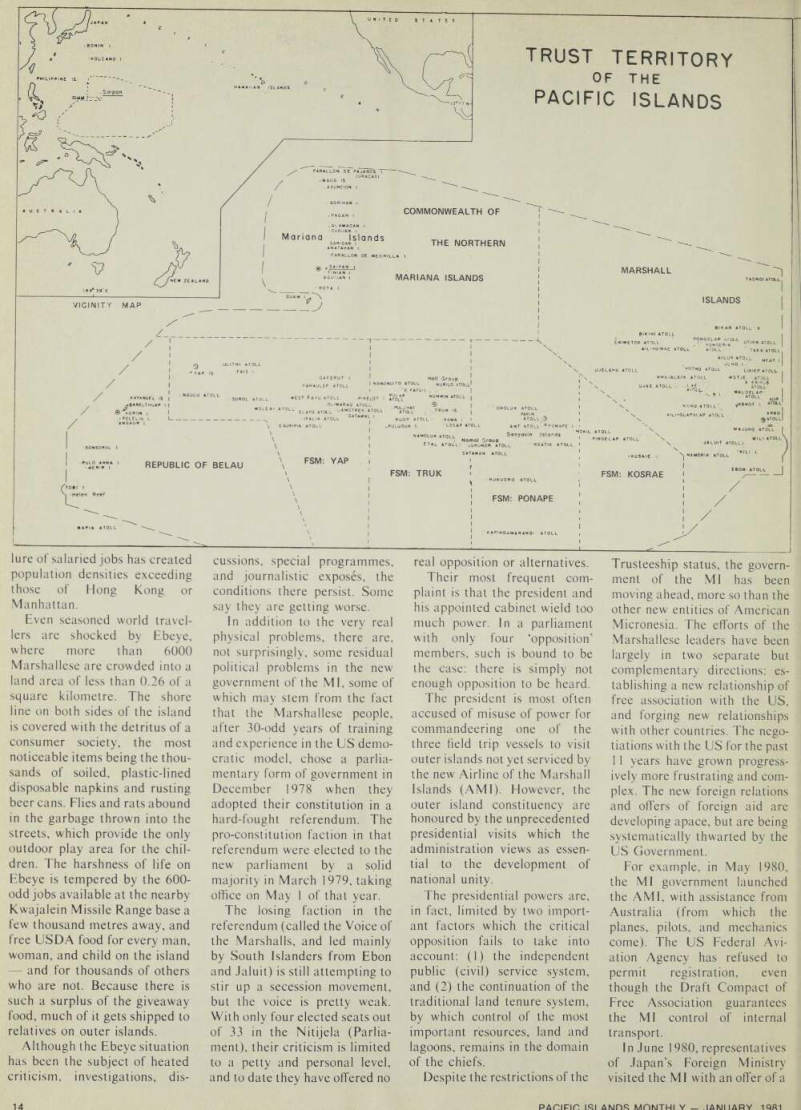
; In the other, westernmost, cor- ; ner of American Micronesia, nearly 4800 km from Majuro, lies the Republic of Belau (as the Palauans now proudly call their islands). With less than half the population of the Ml, (about 15 000), and a larger and more consolidated land area, Belau faces fewer physical problems than the ML However, this advantage is offset considerably by the crippling political struggles, both internal and external, which have put enormous strains on the society during the past 18 months - As a result of the political lines drawn around American Micronesia (and by the Japanese and Germans before that), Belau is the most isolated of all the island groups.
Bclau also suffers from a negative trade balance, expensive government services programmes, a depressed copra market, aging and ailing water and power systems, and heavy reliance on numerous federal welfare programmes. Like most other Pacific islanders, Palauans are hooked on pelroleum, depending on it to run their growing fleet of cars, their
Majuro for more than a year.
In an effort to maintain health care, the MI Govern ment has made an agreement which allows the Seventh-day Adventists to manage all major medical services throughout the islands. Mission schools, Protestant and Catholic, already provide a good pro portion of classroom education in the MI, and, because they are cost-effective, are likely to expand their services.
The problems in settling the proposed status of free associ ation with the US are not quite unique to the Marshalls, and can best be treated along with Belau after a brief overview of the situation there. The major difference is that the Marshallese are much more eager to terminate than are the Palauans, even if it means going fully independent.
overwrought power system, and their gluttonous, high-speed outboard motors. A new road system is being slowly hacked out through the jungles of Babcldaob by the Seabees, and the Airai airport is being re fashioned to meet military specifications by a New Zea land firm. Downer & Fletcher, While these attractive and highly visible work pro grammes go on, Belau’s internal political problems continue to mount, exacerbated, claim the Palauans, by interference from the US Government. As one member of the Belau Legis- Jature put it: Tor over 30 years under US administration we have been tutored in principles of self-government. Then, when we exercised what we learned the US tried to undo our self government.’ When Legislator Roman Bedor issued that state ment, he was expressing the belief of the great majority of Palauans as they view the history of events, The full history is a very involved and complex story, and has produced considerable political unrest in the islands, The highlights are summarised here.
July 12, 1978 Palauans vote 55% to separate from the proposed Federated States of Micronesia.
Jan. 28, 1979 Belau’s popularly elected Consti tutional Convention begins.
March 15 Belau’s then political Status Commission (known to oppose the consti tution taking shape) submitted draft of new constitution to US Chief Negotiator Ambassador Peter Rosenblatt.
April 2 Con-Con finishes final draft.
April 30 US voices strong objections to points in the constitution relating to terri torial waters, access to land for military purposes, and the total ban on any nuclear materials.
June 28 Sixth Palau Legislature, dominated by anti constitution forces, and boy cotted by 10 pro-constitution members, send legislation kill ing the constitution to the high commissioner for approval.
June 29 Sixth Palau Legislature creates Consti tutional Drafting Commission to revise the constitution to make it acceptable to the US.
July 9 Constitutional ref erendum held, adopted by 92% vote.
July 23 New Consti tutional Drafting Commission convened.
July 24 Chief Justice Harold Burnett rules to nullify the Constitution by upholding right of Sixth Palau Legislature to act without a quorum.
July 30 Judge Burnett issues his written decision.
Sept. 4 Elections held as scheduled for Seventh Palau Legislature, now dominated (22 of 28 seats) by People’s Com mittee (pro-constitution) forces.
October 23 Second refer endum on constitution as re vised by the Drafting Com mission. Vote was solidly against revised constitution.
Jan. 1, 1980 Installation of Seventh Palau Legislature, dominated by People’s Com mittee (pro-original consti tution).
July 14 Third Consti tutional referendum in which the original constitution was again adopted by 92% majority.
July 18 Ambassador Rosenblatt sends US response to the third referendum: the constitution is incompatible
with the Draft Compact of Free Association.
Of the three major areas of dispute between Belau and the US —jurisdiction of territorial waters, nuclear materials, land rights the latter is of most concern to the Palauan people.
The US demands are clear: 810 ha of exclusive military use and 12 150 ha (50% of Babel daob) for joint use. Although the new constitution places the control of public lands in the municipalities, the new govern ment of Belau will have to deal with the land issue.
Traditionally, Belau has been divided into two major factions along a geographical line that runs roughly north-south, divid ing the main island of Babel daob (Babelthuap) into east and west; the western faction includes Koror (the district centre) and the South Islands of Angaur and Peleliu. Tradition ally and up to the time of the constitutional crisis, the strongest political leadership came from the elite east side (Reklai) faction. However, with the election of the Seventh Legislature in September 1979, dominated by the People’s Committee, a new leadership emerged from the west faction, and particularly from the South Islands, long considered the backwash of Belau by the majority of Palauans, whose traditional clan ties are to Babcldaob.
Since land is the central issue in future negotiations with the US, a key question facing the Palauans is: who is best qualified to negotiate land rights on the main island of Babcldaob? Most people feel very strongly that it should not be South Islanders. In the first place, they have no traditional ties to the land in question.
Furthermore, the South Island ers, in the eyes of most Palauans, acted very selfishly when they received millions of dollars in US war claims pay ments in the mid-19705, sharing none of it with the government or with the Babcldaob families who provided shelter for them during the battles and occu pation of Angaur and Peleliu.
While the whole community of Belau has been preoccupied with politics, the other all important issue of future politi cal status has hovered like a cloud.
3. Overview: Whose ‘defence needs’?
The long and arduous process of terminating the 1947 Trusteeship Agreement that placed the islands of Micronesia under US control is taking much longer than any one ever anticipated. And as the proposed termination date of 1981 arrived, the negotiators were drifting still further apart.
Since the first negotiations, which were held in Washington in October 1969, governments and negotiators have changed, as have some of the goals and aspirations. But one thing that has remained constant, in the eyes of the Micronesians, is the determination of the US to maintain enough control over the area to keep other foreign powers out, and particularly foreign military powers. This is commonly referred to as the ‘Denial Theory’.
After nearly nine years of on again-off-again negotiations, marred seriously in 1976 by the disclosure of CIA bugging of the Micronesian negotiators’ rooms, a major breakthrough was reached on April 9, 1978,
known as the Hilo Accord. At that round of talks in Hilo, Hawaii, an agreement was reached and signed by the negotiators from the US, Marshall Islands, Belau, and the Federated States of Micro nesia. What they signed was the ‘Statement of Agreed Prin ciples for Free Association’ which consisted of eight major points on which a formal, bind ing document could be devel oped.
Nearly two years later Janua-ry 1980 the ‘Draft Compact of Free Association’
was presented to the nego tiators at Kailua-Kona, Hawaii.
Although parts of it, especially those pertaining to financing, were left somewhat vague, the Marshallese negotiators initial led it, thereby indicating their basic acceptance and earnest desire to work out the fine details. The negotiators from Belau (where the new govern ment had just been installed) and the FSM took the Draft Compact back to their com munities unsigned, with the explanation that it had to be referred back to the people.
While Belau and the FSM were willing to postpone the termination of the Trusteeship status, for somewhat different reasons, the Marshall Islands pushed hard for a final agree ment before the November 1980 US elections. But some major issues are still unresolved, and the process of getting approval from the vari ous principals on the US side is fraught with too many factions and problems.
The key issues on which agreement has proved elusive involve money, land, water, foreign relations, and, overrid ing all of these issues, the perceived defence needs of the US.
The money issue has aroused the ire of the Micronesians from all three of the entities, who feel that the US is being extremely unfair. In the first place, they blame the US for having cultivated an import dependent economy based on US subsidies. Many call it a welfare state. Having success fully implanted that system, the US now threatens to scale down its financial support to levels that Micronesians consider un acceptable. Indeed, with rising prices for imported goods and cutbacks in operating budgets and federal programmes, the financial crunch is already be ing felt in all of Micronesia.
The FSM and Belau also fear that the US may leave them without an adequate infrastruc ture, essential to any meaning ful development. The MI, on the other hand, feel that they can develop their own infra
structure more efficiently after termination, providing there will be continued US and other foreign aid, now discouraged, if not prohibited, by the Trustee ship status. Although the US is proceeding with airport expan sions (Truk, Kosrae, Belau), and building new roads, the Micronesians of Belau and the FSM feel that much more is needed before the US gives up its caretaker role.
The land issue, which is particularly crucial in the MI and Belau, is linked inextri cably with money. The US requirements have been clearly stated: continued exclusive use of the Kwajalein Missile Range in the Ml, and in Belau, 810 ha of exclusive military use, and 12 150 ha (half of Babeldaob) of joint military-civilian use, in cluding harbour and airport facilities.
At Kwajalein, the full mili tary facilities have long been in place and operational; the ques tion now under negotiation is how much money, and the time intervals between renogiations.
In Belau, the question is yet to be seriously negotiated, and most Palauans are wary of com mitting any portion of their lands for the use of any foreign power. Since the newly adopted constitution assigns control of all public lands to the individ ual 16 states (municipalities), each with its own government structure, any national govern ment to government nego tiations over land in Belau are
virtually impossible.
The question of territorial waters is also proving to be a thorny one, particularly in the case of Belau, where the new constitution established sover eignty and jurisdiction over all waters within 200 nautical miles of the baselines con necting all the islands of Belau.
The Palauan claim follows the controversial ‘archipelagic the ory’ of the International Law of the Sea, but which the US does not recognise, favouring instead a three-mile territorial sea. At present, the US position is that the Palauan claim to territorial waters is simply not an accept able one to negotiate. The distinction in this case between the 200-mile economic zone, which the US is willing to accept, and the 200-mile terri torial zone, is a crucial one for the US because it impinges on
US defence needs, i.e., accessi bility to all Micronesian waters for all vessels, including nuclear-powered ones.
The question of defence needs presents another major problem for the negotiators, and is closely bound to the problems mentioned above: money, land, and water. This particular problem is com pounded by the very different viewpoints. The US views the offer of military defence of Microrfesia as a favour for which the Micronesians should be grateful and willing to pay in the form of trade-offs. The Micronesians, on the other hand, have never asked to be defended, and view the pres ence of military troops as a liability, as it proved to be in World War 11. Consequently, the Micronesians feel that the US should pay for the privilege of using Micronesian land and waters to deny access to other foreign powers. They further feel that the fees should be comparable to those paid by the US to such host countries as Spain and the Philippines.
The question boils down to this; Whose defence needs are the plans designed to meet, and what price is the US willing to pay?
Closely related to the de fence needs is the notion of ‘strategic denial’, which has always been in the background, but surfaced with some force at the status negotiations held in Kailua-Kona in the first week of October 1980. What this means is that no foreign military power, except the US, will be permitted in Micronesia, and the US military will be the enforcing agent. Before the Kona talks, the assumption was that strategic denial would be maintained during the 15-year life of the Compact. At Kona, the new US position on denial was announced, a move which severely alienated the Micro nesian negotiators. Not only was the US seen as changing an agreement previously made, but is now demanding denial rights ‘in perpetuity’.
The control of foreign affairs presents yet another thorny problem to the negotiators.
Although the Draft Compact assigns this responsibility to each of the new entities, it adds a critical caveat: ‘except as otherwise provided in this Corn
Peter Rosenblatt, US negotiator
pact'. (Article 11, Section 121(a)). The Compact further states in Section 123 that ‘the Governments . . . shall consult, in the conduct of their foreign affairs, with the Government of the United States’. The bound aries of foreign affairs are further restricted by a later paragraph in the Compact (Section 313) which reads: ‘The Governments of Palau, Marshall Islands, and the Fed erated States of Micronesia will refrain from actions which the Government of the United States determines, after appro priate consultation with those Governments, to be incompat ible with its authority and responsibility for security and defence matters in or relating to Palau, Marshall Islands, and the Federated States of Micro nesia.’
Some of the Micronesian negotiators are now concluding that the above paragraph gives too much authority to the US to determine what actions may be deemed ‘incompatible’, and are beginning to view this proviso as overly restrictive.
Perhaps the biggest obstacle to successful US-Micronesian negotiations is the patchwork of US Government departments, agencies, and, not least, the individuals who have a personal stake in the outcome.
Although Ambassador Peter R. Rosenblatt, the chief US negotiator, also bears the title of the President’s Personal Rep resentative, his job requires that he accomplish the nearly impossible task of satisfying the demands of the Departments of State, Defense, Interior, En ergy, and Commerce; the entire US Congress, some of whose members have very strong con victions against releasing any territories gained through a bloody war; and the UN Secur ity Council, where any agree ment seems almost hopeless.
The Marshallese were es pecially anxious to conclude the Agreement before the November 1980 elections in the US. Although they have had serious difficulties during the past three and a half years with the Carter Administration, they feared that should Reagan win (as he did) they will be forced back to the starting point again, only with a more intransigent opponent.
At the time of writing, hopes
for conclusive negotiations have thus given rise to more overt talk of independence as the only option, with the case being presented to the world body of sovereign nations to judge.
In a last-minute effort to finalise a formal agreement between the US and Micro nesia before President Reagan and the Republican Senate take command, representatives from the Ml and the FSM initialled the Compact of Free Associ ation in Washington. The Palauans followed suit, after their elections on November 4.
Although most of the details of free association set forth in the 52-page document have been agreed upon, certain major disputes remain unresolved, particularly those issues in the Palauan consti tution which were described by Ambassador Rosenblatt as ‘in compatible’ with the compact.
These are the Palauan claim to the 200-mile territorial sea zone, the prohibition against the exercise of ‘eminent do main’ over lands for use by any foreign power, and the ban against nuclear substances.
However, according to a US State Department official, these and other outstanding issues will be resolved at some future date through ‘subsidiary agree ments’ between the US and the three separate entities.
Obviously, all parties in volved were anxious to finalise something. The Carter Admin istration would like to claim successful completion of the negotiations. The Micronesians are fearful of being forced back to point zero in negotiating with the incoming Republicans. The agreement reached may prove to have too many loose ends.
The major hurdles are; 1) the subsidiary agreements; 2) ratification of the compact by separate plebiscites in Micro nesia and by both Houses of the US Congress; 3) approval of the UN Security Council.
With regard to the last point, the US is now stating publicly that UN approval is not necess ary for termination of the trusteeship agreement. UN officials however have ex pressed an opposite view.
While the initialling of the compact is a major step towards terminating the trust territory status for Micronesia, the end is not yet in sight.