Shipping chief
pp. 7-11 · Read in the full issue

Letters
sets record
straight
1 was concerned to read your article TNG line slips far into the red’ (PIM Oct p 72). Over the past 13 years as a reader and contributor to your magazine, I have come to respect the quality of your maritime reporting. It is most unfortunate that you should on this occasion produce an article, which could have poten tially damaging effects on the PNG Shipping Corporation, based on third party information, and not a particularly reliable source at that.
The PNG Shipping Corpor ation did make a loss in 1979, a loss of K 143 000 before payment of Australian turn-over tax, which exacerbated the loss to K 246 163. Expressed as a func tion of an income in excess of K 8.5 million, the loss (before tax) amounts to 1.67% of revenue.
These results take no account of profits from stevedoring invest ments, which are accounted within a different financial year.
While the corporation is less than satisfied with these results, we believe that they should be read in context with the enor-
These developments were not achieved without cost. The coastal trade in PNG operated in 1979 on a government-controlled tariff which had seen no increase for three years. However, with the introduction of reasonable increases to freight rates, and the consolidation of advances made in 1979, 1980 should see the return of the corporation’s coastal business to profitability.
It is regrettable that advisers with little relevant experience or competence should cast subjec tive criticism on ship size and relative effort in the coastal trade. I recollect, with some chagrin, that at least 90% of the (60 hour + working week) effort of the small executive of the corporation in 1979 was dedi cated towards the coastal trade.
I cannot accept that the cor poration has expanded its over seas activities at the expense of the coastal trade. Priority from the outset has been directed towards the coastal trade. Our overseas activities have been basically threefold. • Participation in the PNGL/ NGAL Joint Service element of the highly successful Chief Con tainer Service. This service runs with its own self-contained man agement unit; • Extension of our coastal services through to Darwin.
Given the size and speed of ships we operate, this has been achieved by careful program ming without detriment to the coastal trade. In the course of the year this trade has seen an increase in tonnage of PNG exports carried from 840 tons on the inaugural voyage to 2400 tons on the current voyage; and • Our trans-Pacific service, in troduced earlier this year, has proved extremely successful.
With the fourth sailing currently under way, we have carried the entire PNG coffee crop exported to North America, together with substantial quantities of cocoa, tea, frozen fish and seafood. This
mous progress achieved by the corporation during 1979 and since in terms of providing effective shipping services to PNG, especially on the coastal trade. I would like to take this opportunity of reviewing these developments in order that your readers may get a more balanced view of our activities.
Up to the beginning of 1979, the PNG coastal trade had trad itionally been carried by an armada of superannuated, in competent vessels. Nineteen seventy-eight saw the collapse of the then principal carrier, leaving extensive debts and a near break down of cargo movements on certain routes. Mainport Car goes, in whom the Shipping Corporation had a minority shareholding, took over as the principal inter-mainport carrier, and immediately set about retonnaging and remodelling the company’s operations to match the requirements imposed upon it. This retonnaging was ex ecuted in accordance with a detailed plan, which foresaw not only the immediate requirement but also the future of the PNG coastal trade.
In the course of 1979, the corporation bought out the re maining shareholding in Main ports; injected new management into the company; commissioned one new ship, Moresby Chief, onto the coastal trade; intro duced a limited container oper ation in step with customer demand; and pensioned-off three old vessels. These changes, together with two smaller mod ern ship units commissioned in the latter part of 1978, have given Mainport Cargoes (now renamed PNG Mainport Liner Services) a balanced modern fleet of vessels and capabilities snited to the requirements of the coastal trade. More particularly, it has given our customers the sort of service they require, with adequate capacity for future
developments.
profitable initiative on the part of the corporation has ad ditional benefits to the country in terms of the hidden earnings of carrying PNG cargo in PNG flag ships. Our trans-Pacific service offers stop-off calls to Solomon Islands and Kiribati.
In addition to our coastal and overseas trades, the corporation operates towing and salvage ser vices based in Lae and Port Moresby. These operations pro vide a profitable, vital service.
For the record, the corporation operates a total of six ships, three tugs and a barge.
The corporation has achieved all this on strictly commercial terms in a strongly competitive environment, without recourse to government guarantees, and only modest, by shipping standards, calls on shareholder equity. We have created over 200 jobs for Papua New Guineans, and have established comprehensive train ing programmes for Papua New Guineans in the disciplines of shipping management, navigat ion and marine engineering.
I trust that the foregoing sets the corporation’s record straight within your pages. It is regret table that a line which has demonstrated real initiative and dedication in the development of Papua New Guinea’s shipping requirements should come under such unjustified cloud.
(Captain) P. H. KING
Managing Director Papua New Guinea Shipping Corporation Pty Ltd Port Moresby
Png
Film man asks
for help
I am at present negotiating seven one hour dive/travel films in the Pacific region.
The general theme will be built around the idea of an ex serviceman returning to areas where many spent their youth fighting during World War 11.
We intend diving and filming on ships and aircraft, filming the rusting reminders on land, show ing local culture and the beauty of the areas.
Some of the proposed lo cations are: Papua New Guinea, Solomon Islands, Vanuatu, Guam, and so on.
Assistance and information is required as regards the diving and the location of wrecks (ships or aircraft). The remains of
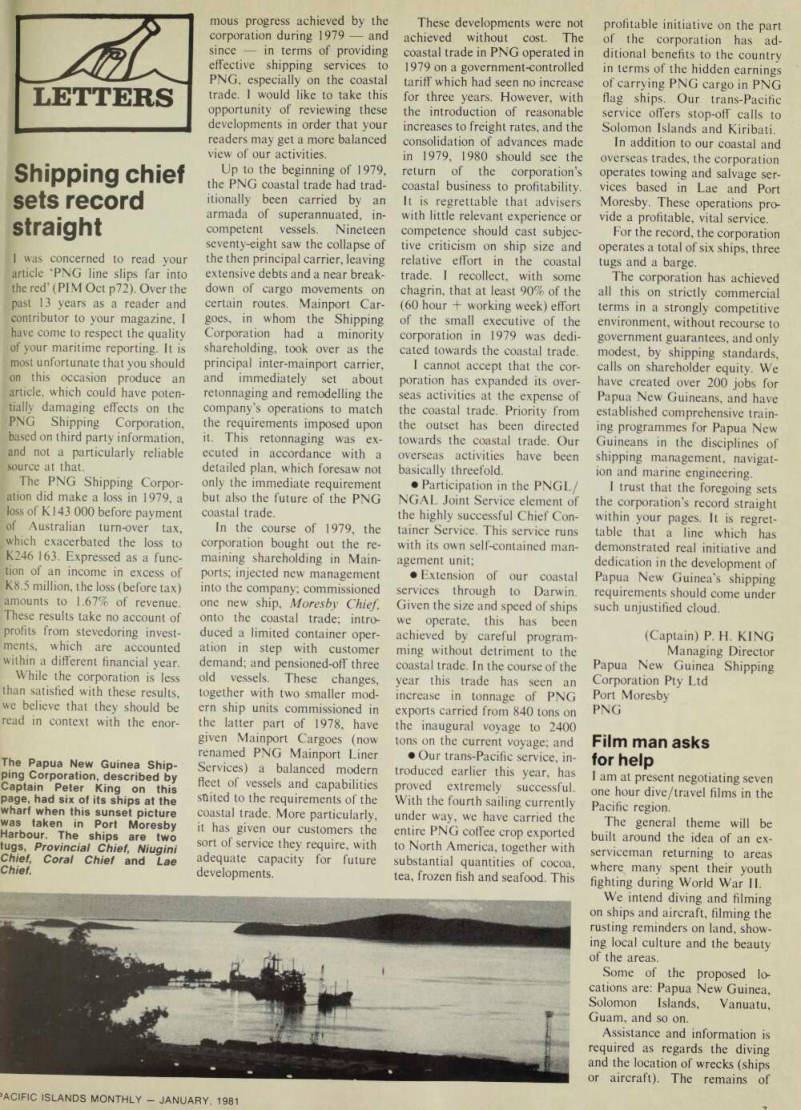
The Papua New Guinea Ship ping Corporation, described by Captain Peter King on this page, had six of its ships at the wharf when this sunset picture was taken in Port Moresby Harbour. The ships are two [?]tugs, Provincial Chief, Niugini Chief, Coral Chief and Lae Chief.
bombers or fighters on land and other reminders of the past, details from people who can remember aircraft coming down or a ship sinking. In fact, any information that will make the film more interesting would be
greatly appreciated.
Hoping that PIM readers can assist.
Walter Deas
Seasports 8 Arkana Place Engadine 2233 Australia
N-testing and
independence
I don’t wish to join the continuing tiff between your correspondents S. Polume and T. de Montluc.
Nevertheless, I would like to take a sniper-shot at the latter’s letter entitled ‘A rose by any other name ...’ (PIM Oct plO).
Specifically, I would endeav our to take de Montluc up on the question of the realtionship be tween ‘nuclear testing’ and ‘inde pendence’. The fifth paragraph of de Montluc’s letter states: ‘.. . most of our people (Tahitian cum Polynesian) do not condone nu clear testing and I am also completely against it; but that is a completely different issue from the independence one’.
On the contrary I would like to contend that there is a definite, direct relationship between nu clear testing and independence.
At the Nuclear-free Pacific Conference 1980, which I was privileged to attend as a rep resentative of the University of the South Pacific Students As sociation, the delegations from the Pacific Islands unanimously agreed that nuclear testing, nu clear waste dumping, and the deployment of nuclear missiles and nuclear-powered vessels in the Pacific Ocean are on the one hand simply the manifestations of our (Pacific Islanders’) help lessness as a political force in the face of the continuing presence of colonial powers such as France and the United States in the Pacific. On the other hand, they are extensions (and the deadliest of all) of what metropolitan colonial governments and peoples have been doing to us ever since they set foot on our shores from blackbirding to shady land deals and now to possible mass genocide through
nuclear radiation poisoning. Fur thermore, the Pacific Island del egations also recognised and resolved that the struggle for a Nuclear-free Pacific is basically a struggle for an independent Pacific Basin. I do not wish to split hairs over the nuances of the word ‘independence’, but I must qualify the ‘Pacific Island delegations’ that I have been referring to.
The Pacific Island delegations at the conference were indigen ous people from Vanautu, Tonga, Fiji, Cook Islands, Palau, Marshall Islands, Truk, Tahiti, Maoris from Aotearoa, Aborigi nes from Australia, Hawaiians from Hawaii, Indians from North America and Canada, and Filipinos from the Philippines.
We were literally drawn together by the realisation that if we were to examine the nuclear fuel and nuclear bomb cycles we would emerge with the disconcerting fact that each major stage of the nuclear cycles (except where the button is) is being centred in or around areas populated by the likes of the above group of people.
Uranium is mined on Aust ralian Aborigines’ and American Indians’ lands. This uranium is transported via the Pacific Ocean to nuclear reactors erected in areas like the Bataan province in the Philippines or on American Indian soil. Nuclear bombs are being tested on Moruroa and were tested in the past in the Micronesian area. Now they are talking of dumping radioactive waste in the Pacific Ocean.
Please note however that there are non-Pacific Islanders residing in these areas too, but a closer inspection will reveal that these are what the metropolitan col onial governments regard as the ‘expendable scum’ of the earth, just like us poor but peace-loving Pacific Islanders.
With these salient points, who in his/her rational mind would dare suggest that there is no relationship between nuclear testing and the independence struggle?
With all respect I will honour de Montluc’s views, but I would also honour the countless voices of the Tahitians in the Te Toto Tupuna, and other similar groups. My request to de Montluc, and to all Pacific Islanders for that matter, is to
please cease looking at ourselves as Tahitian, Tongan, Papua New Guinean, Polynesian, Micro nesian, or Melanesian but to begin to perceive ourselves as Pacific Islanders full stop. In passing I wish to remind de Montluc that if someone sneezes in New Zealand, we catch a cold in Fiji, and if France were to press the button, we’re dead.
Lopeti Senituli
University of the South Pacific Suva Fiji Vanuatu: Was
PNG right?
Operation ‘Wantok Durua’ is over. Members of the Papua New Guinea Kumul Force are settling back into their respect ive battalions. Generally, the whole Vanuatu operation re ceived mixed reactions. While the success of our troops in Vanuatu was highly com mended and acclaimed by many people, countries and forums alike, the initial de cision to send the troops there was not so fortunate.PNG re ceived criticism from within as well as from outside. Amongst those who were highly critical of PNG was Fiji, one of its nearest neighbours and a mem ber nation of the South Pacific Forum.
In the. November 1980 PIM (p 32), a member of Fiji’s House of Representatives, Ratu Osea Gavidi, after having bitterly
attacked PNG, suggested that PNG should have considered the following options to settle the Vanuatu problem: Adopt the tactics that were used on Bougainville; or enter Vanuatu under the umbrella of an inter national peace-keeping oper ation approved by the United Nations.
Fiji’s arguments are certainly valid and legitimate. However, it would be misleading and unfair to compare Bougainville with Vanuatu, simply because the nature, magnitude and in tensity of the rebellion on Vanuatu were dramatically different from the secessionist movement on Bougainville. On the question of an official re quest from the United Nations, the UN charter does not forbid one country from intervening in another’s affairs provided that a request was made by the country seeking aid.
Leaving my counter arguments aside, there are cer tainly a number of basic ques tions that have never been answered to the satisfaction of our critics. One of these basic questions is, ‘Was PNG right in accepting Father Uni’s re quest?' Hopefully the answer or answers to this question would help our critics to appreciate the Vanuatu problem from a defence and security point of view. In the following com ments. 1 am going to suggest that PNG’s decision to accept
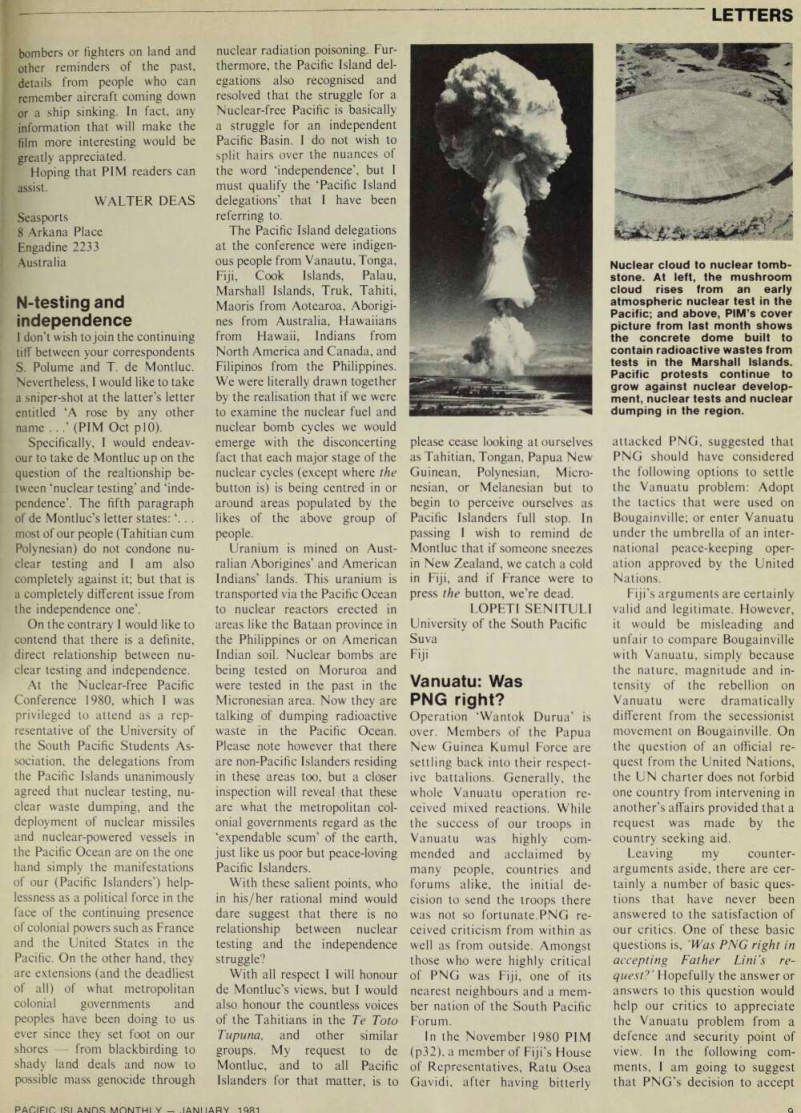
Nuclear cloud to nuclear tomb stone. At left, the mushroom cloud rises from an early atmospheric nuclear test in the Pacific; and above, PIM’s cover picture from last month shows the concrete dome built to contain radioactive wastes from tests in the Marshall Islands.
Pacific protests continue to grow against nuclear develop ment, nuclear tests and nuclear dumping in the region.
Lini’s request was based pri marily on purely political and security considerations. And, given the circumstances that surrounded Vanuatu’s post independence period, the de cision was timely.
To be able to understand how PNG reached that decision, it is helpful to go back and trace the events that led to the request for PNG’s military assistance.
The path to independence for Vanuatu has not been as fortu nate as other neighbouring island nations. Vanuatu in fact has experienced serious politi cal unrest going as far back as the early 70s when talks began about self-rule and indepen dence.
At the heart of this problem was Vanuatu’s unique status as a condominium under the joint administration of France and Britain. Before the elections in 1979, various political groups emerged to contest them. These parties fell into two broad categories of either British or French supporters. The politi cal campaigns generated bitter ness amongst the people which in turn created deep divisions between the French- and British-oriented Vanuatuans.
It was not surprising when the election results favoured the British side by a large majority that violence and se cessionist movements befell the country. As Melanesians, de feat in the elections for the French side caused severe loss of face, and the only way to restore their pride appeared to be to resort to violence.
These violent and rebellious activities were concentrated on the island of Espiritu Santo under the leadership of Jimmy Stevens. At the height of the tension, Luganville, the main town on Santo, was virtually under rebel control. They even commanded strategic points such as the airport, hospital, water resources and fuel installations. There was evi dence of gun-running, and some French settlers were suspected of shipping arms from New Caledonia to Santo. Among the rebels were about 150 hard liners who were armed and were maintaining radio communi cations for the rebels.
France’s position on Vanuatu’s independence was
far from whole-hearted ap proval. On Tanna island, for instance, the French supporters took over Tanna in the initial stages of the revolt. While French officials were not show ing open support for the rebels, their settlers and some mem bers of the police force were seen to be co-operating with them. There was, therefore, an underlying likelihood that there was an element of French involvement in the revolt, if not by its officials, at least by its citizens and settlers.
One other factor that critics need to realise is that France has a formidable military pres ence in the Pacific. According to the London-based Inter national Institute for Strategic Studies (ISS), France main tains four overseas commands, including, interestingly enough, one in New Caledonia and another in French Polynesia.
Some 19 000 French personnel from all services are deployed overseas. As there are two commands in the Pacific alone, the number of French military personnel in the region could easily reach 10 000, a significant force indeed. French troops in New Caledonia can be moved to Port-Vila, the capital of Vanuatu, within an hour.
So, at independence Vanuatu had an internal security prob lem. There were people who were against Father Lini’s
government and has resorted to rebellion activities. Unfortu nately for Fr Lini, these rebels were being supported and insti gated by citizens of a country that has a significent military presence in the Pacific. If French citizens were directly or indirectly involved in the rebel activities the uncertainties and risks to Fr Lini’s losing control were very high. Similarly, the fear of outsiders supporting an underground movement to overthrow Lini’s government was there. If that fear was in fact groundless it did exist philosophically, in the minds of Lini and his government. In such a desperate situation what was Father Lini, the father of the newest nation in the Pacific, going to do?
There were a number of options that were open to him; (a) He could choose to nego tiate with the rebels in the Melanesian way as suggested by Ratu Osea Gavidi. But how does one negotiate in a Melanesian fashion with the barrels of guns pointed at you by hard-liner rebels? (b) He could request the British police and marines to clear out the rebels. But that was asking for a possible shoot out between French settlers who were mixed up with the rebels, and British forces. (c) He could invite New
Zealand or Australia after all, they are close neighbours as well as having huge resources available. But what’s the politi cal logic? He was sending two colonial powers out, the next day he was asking another two in.
In his position, Fr Lini re alised that to negotiate with the rebels would risk innocent lives.
On the other hand, to invite Britain, New Zealand and Australia would attract poss ible sharp and angry reactions from members of the South Pacific Forum and from France. In essence, Fr Lini had a political dilemma. He realised that, while he wanted quick assistance, that assistance must come from a country that: (a) Would invite minimum angry reactions from the region and from France. (b) Would have a significant capability to capture the rebels. (c) Would be sufficiently strongly armed to deter any possible outside aggression.
To Fr Lini, PNG and Fiji appeared ideal choices. Both
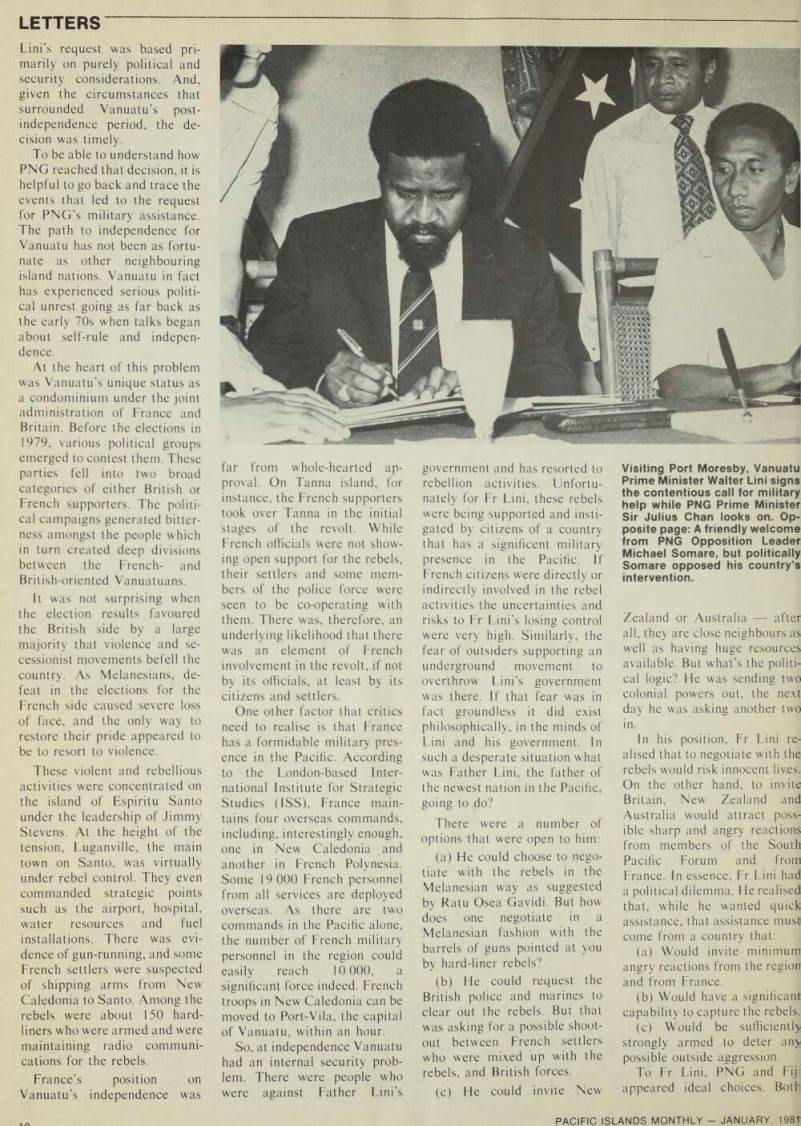
Visiting Port Moresby, Vanuatu Prime Minister Walter Lini signs the contentious call for military help while PNG Prime Minister Sir Julius Chan looks on. Op posite page: A friendly welcome from PNG Opposition Leader Michael Somare, but politically Somare opposed his country’s intervention.
were invited. Of course, PNG could not refuse easily. Being a iStrong advocate of idecolonisation in the Pacific, for her to refuse now in the face of an official request would mean political hypocrisy. PNG accepted, and Fiji turned Lini’s request down.
I PNG’s decision to help Vanuatu may have been seen by critics as unwise. However, given the circumstances that surrounded that country’s pre end post-independence period, it was probably, at that time, the only option open to Fr Lini.
The success of the operation of course tells the full story.
Stephen Poti Mokis
Boroko Papua New Guinea
UTA acts nasty
at Tontouta
Fhe French airline UTA did nothing to enhance its inter national reputation in an inci dent which occurred at Noumea’s Tontouta airport on November 7.
A DC 10 of Thai Inter lational was diverted to Noumea when an aircraft efuellers’ strike at Sydney pre rented it from landing there. )n board the plane was the /ice-Premier of Thailand, Phanat Khoman.
The airline had a set of DCS •assenger steps of its own
available, which it uses for its new Bangkok-Manila-Noumea service. But these were 1.20 m short for use on the DC 10. The 80 passengers, including the vice-premier, were stranded on board for almost 20 minutes before UTA would accede to Thai requests for the loan of a set of DC 10 steps.
The Papeete newspaper Les Nouvelles commented: ‘Every body in New Caledonia and in French Government circles knew that UTA has not taken kindly to Thai International’s intrusion into Noumea with its new Bangkok-Manila-Noumea service. But the fact that UTA had been using rather inelegant means to put a spoke in the Thai company’s wheel could not so easily be made known to the general public, and what did get out could easily be denied or “explained” by the
company . . . But yesterday’s
incident was the end, when a ridiculous decision by UTA showed the whole of Tontouta to what lengths it will go to display its resentment against Thailand ... On board the plane was the vice-premier of Thailand: he saw, he under stood, and he was furious . . .’
If ever there was a courteous, hospitable, cheerful and gracious people, it must be the Thais. I've experienced this personally, having spent almost two months in their beautiful
country. But what a monumen tal slap in the face UTA has given them in return!
Only a few months ago, during a discussion programme on the small screens here in Papeete, UTA, through the mouths of its officials with responsibility for the Pacific region, was assuring all and sundry (even if only very few believed them) that it was not opposed and had never been opposed to the entry of foreign companies into the skies of French Polynesia. It was simply up to them to come in.
If a similar discussion were to be held today, the UTA spokesmen could find them selves confronted by some new - and quite unfriendly attitudes in the light of the recent event at Tontouta.
Really, it’s high lime that there was an end to all this. It’s high time that the French speaking Pacific territories, and they alone, decided what their policy on air transport the key to any development of the tourist industry is to be.
David Scott
Papeete French Polynesia Here it comes
again, Lou
I must join with most of your readers (PIM Dec plO) in ex pressing my distaste at Lou Hitchcock’s prudery in objecting to your cover photographs.
When hotels in the United States Pacific area stop using bare-breasted ladies in their ad vertisements; when Pacific beauties stop being proud of their figures; when the fast diminish ing Calvinist missionaries suc ceed in draping every islander in Mother Hubbards . . . and when the ladies agree to this insanitary, unhealthy and quite unnecess ary curtailment of their free dom and threat to their health then, and only then, should PIM ban unclad ladies from its pages.
Has the prurient Lou Hitch cock, one wonders, actually asked his married friends whether their children’s morals will be damaged by exposure to ladies of the same shape as their own mother, whose mammary glands sustained them in in fancy? One imagines that their response and that of his old
school library would be to reject his attempted censorship of the facts of life and possibly to suggest that he undergo urgent psychiatric treatment to erad icate this unpleasant short coming in his nature.
Kenneth R. Lake
London UK And (would you
believe) yet again!
I thought your November 1979 cover picture (a smiling Island lass) was beautiful. The lass, was utterly charming and natural.
I prefer your Island beauties any day (whether half-clothed, naked or otherwise) to the blatant arrogant poses and dis plays of liberated females on the covers of Playboy, Pent house. or Cosmopolitan maga zines.
Too bad if some PIM readers share Lou Hitchcock’s opinions. Such hypocritical at titudes remind me of the early white missionaries who told our ancestors to cover up. But mark what happened!
We Islanders are still walk ing around fully attired while the descendants of those missionaries are running around in bikinis, shorts, and other scanty pieces.
(Miss) Vuli R. Final
Lami Fiji And now for the November ‘BO show Nobody minds bare-breasted women, but one of the girls in your November 1980 cover pic ture is well under the age of consent, perhaps 13.
Alex Tall
Brisbane Qld Australia Our November 1979 cover aroused a year-long storm touched off by a disapproving letter from one Lou Hitchcock.
Now it seems our November 1980 cover could do the same.
We’re pleased to know that Mr Tall ‘doesn ’t mind bare-breasted women’. But we are intrigued by his comment about the ‘age of consent’. We would be delighted if he could explain himself a little further on this matter. - Editor.