Where the trade winds blow
pp. 51-53 · Read in the full issue

Yesterday
A Memory Of The Old Gilbert
And Ellice Islands
l cable’s length to starboard iy Marakei, green and gold nd glittering in the early rorning sunshine of the Gil ert Island today known as Kiribati. A sailing canoe was
dmming lightly over the
ancing blue water toward us. here were three men aboard er: the Island Magistrate and le Chief of Kaubere in uni- Drms of white shirt, navy blue ilt and silver-buckled belt sat ross-legged on the narrow eck while a khaki-kilted oliceman held the steering addle.
I hastily dressed in working ig of khaki bush-jacket and lorts, thrusting my cap, shoes nd stockings into a bag, for it 'as clear from the distant roar f surf that we should not get
shore dry.
Dick Turpin who, as Lands )fficer, was visiting the island n government business,
reeted the magistrate and
hief of Kaubere as old friends, 'hich indeed they were. I had nly recently arrived in the xilberts and envied him his uent Gilbertese. I was itroduced and shook hands \o na mauri! (At least I knew rat much!) We all balanced ourselves recariously on the frail >oking canoe and sailed for le distant beach. Above the
latched houses and higher
ven than the lofty palm-trees
3se a mighty flag-staff flying
re Union Jack. The beach was rowded with islanders.
Half way across Dick said, They’ve got a reception com littee for us. I can see all the fficials lined up and the local Dree is on parade too. Will you
ispect the police guard-of
onour? I’ll do the rest.”
I was incorrectly dressed, but was too late to do anything bout that, so I waded ashore nd took the salute from the hief of District Police, stand ig in front of a single line of
ame half-dozen fine-looking
By Michael Hook,
former Superintendent
of Police. Illustrations by the author. island policemen, all as capless and bare-footed as I was.
The inspection over, the par ade was dismissed. The line of men made an immaculate right turn all except one, who turned to the left by mistake.
This raised such a gust of de
lighted laughter from the
crowd thronging the beach that all formality was blown away and everyone suddenly became relaxed and human. Even the poor fellow who had muffed the movement was able to grin,
somewhat sheepishly.
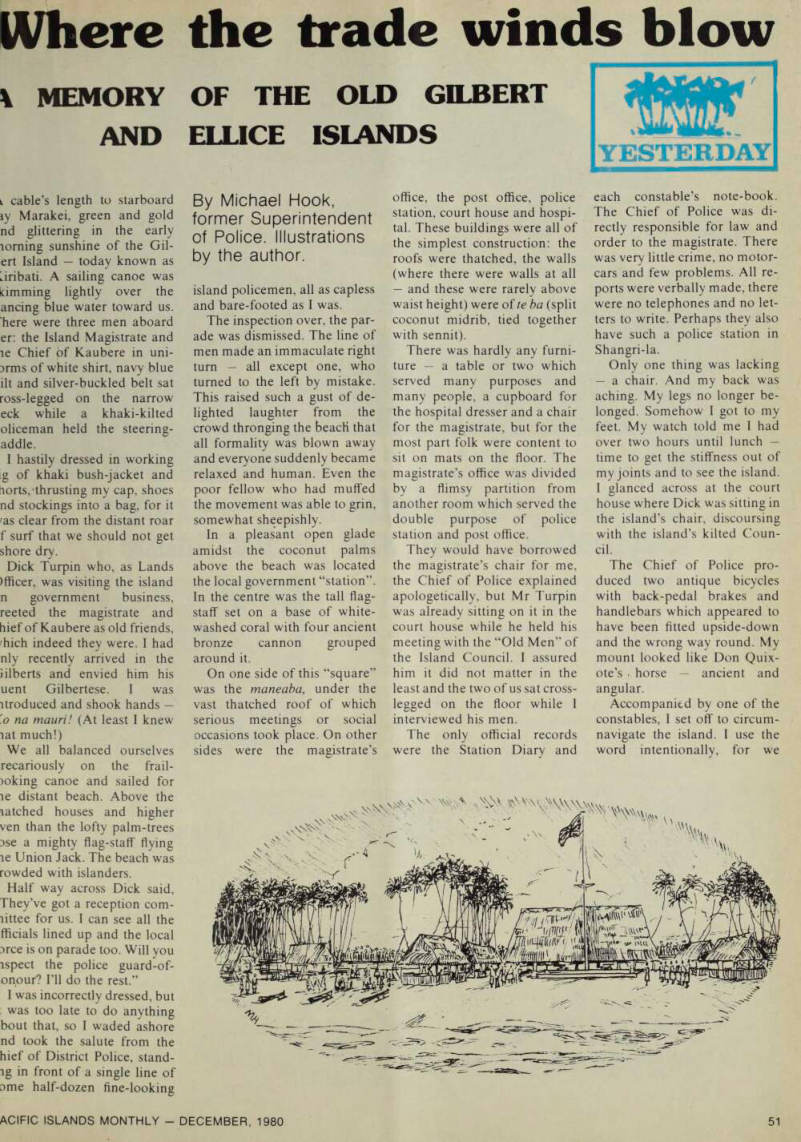
In a pleasant open glade amidst the coconut palms above the beach was located the local government “station’’.
In the centre was the tall flag staff set on a base of white washed coral with four ancient bronze cannon grouped around it.
On one side of this “square” was the maneaba, under the vast thatched roof of which serious meetings or social occasions took place. On other sides were the magistrate’s
office, the post office, police station, court house and hospi tal. These buildings were all of the simplest construction: the roofs were thatched, the walls (where there were walls at all and these were rarely above waist height) were of te ba (split coconut midrib, tied together with sennit).
There was hardly any furni ture a table or two which served many purposes and many people, a cupboard for the hospital dresser and a chair for the magistrate, but for the most part folk were content to sit on mats on the floor. The magistrate’s office was divided
by a flimsy partition from
another room which served the double purpose of police station and post office.
They would have borrowed the magistrate’s chair for me, the Chief of Police explained
apologetically, but Mr Turpin
was already sitting on it in the court house while he held his meeting with the “Old Men’’ of the Island Council. I assured him it did not matter in the least and the two of us sat cross legged on the floor while I interviewed his men.
The only official records were the Station Diary and
each constable’s note-book.
The Chief of Police was di rectly responsible for law and order to the magistrate. There was very little crime, no motor cars and few problems. All re ports were verbally made, there were no telephones and no let ters to write. Perhaps they also have such a police station in
Shangri-la.
Only one thing was lacking a chair. And my back was
aching. My legs no longer be
longed. Somehow I got to my feet. My watch told me I had over two hours until lunch time to get the stiffness out of my joints and to see the island.
I glanced across at the court house where Dick was sitting in the island’s chair, discoursing with the island’s kilted Coun cil.
The Chief of Police pro
duced two antique bicycles
with back-pedal brakes and handlebars which appeared to have been fitted upside-down and the wrong way round. My mount looked like Don Quix ote’s • horse ancient and
angular.
Accompanied by one of the constables, I set off to circum navigate the island. I use the word intentionally, for we
ould scarcely have been closer 3 the sea all the way round and ometimes were actually in it. )n our right was the ocean estlessly scouring the reef; on ur left the turquoise waters of
tie shallow lagoon lay almost
nrippled.
Between these the track ran 3r 10 miles round the atoll on ribbon of land nowhere more lan a hundred yards in width nd no more than a few feet bove the level of high tide. We lade the circuit anti lockwise, for the inhabitants iy that anyone who travels in le other direction round larakei will die within the
ear. Tall palms provided wel
ime shade and the south-east ade wind fanned us. Dead aim-fronds, fallen coconuts
nd potholes kept us alert.
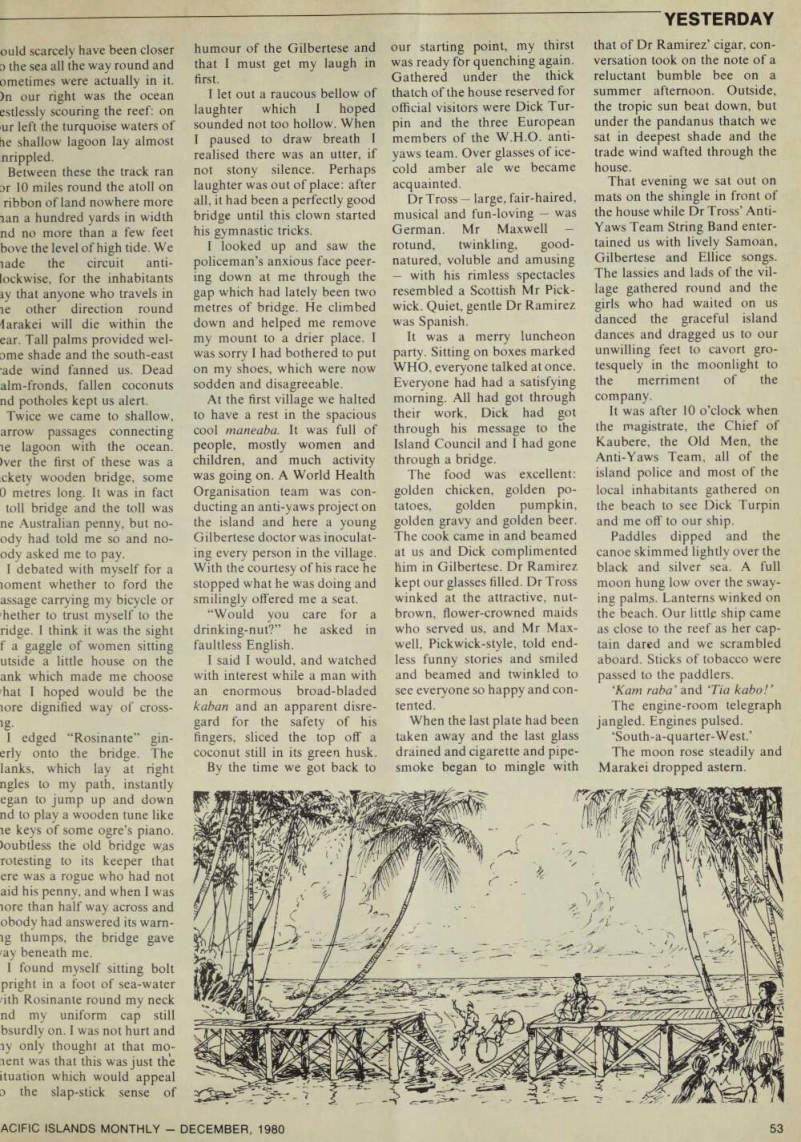
Twice we came to shallow, arrow passages connecting le lagoon with the ocean. )ver the first of these was a
ckety wooden bridge, some
0 metres long. It was in fact toll bridge and the toll was ne Australian penny, but no ody had told me so and no ody asked me to pay.
I debated with myself for a loment whether to ford the assage carrying my bicycle or ffiether to trust myself to the ridge. I think it was the sight
f a gaggle of women sitting
utside a little house on the ank which made me choose r hat I hoped would be the lore dignified way of cross !g-
I edged “Rosinante” gin
erly onto the bridge. The lanks, which lay at right
ngles to my path, instantly
egan to jump up and down nd to play a wooden tune like
le keys of some ogre’s piano.
)oubtless the old bridge was rotesting to its keeper that ere was a rogue who had not aid his penny, and when I was lore than half way across and obody had answered its wam
ig thumps, the bridge gave
ray beneath me.
I found myself sitting bolt pright in a foot of sea-water dth Rosinante round my neck nd my uniform cap still bsurdly on. I was not hurt and
iy only thought at that mo
nent was that this was just the
ituation which would appeal
3 the slap-stick sense of
humour of the Gilbertese and that I must get my laugh in first.
I let out a raucous bellow of
laughter which I hoped
sounded not too hollow. When I paused to draw breath I realised there was an utter, if not stony silence. Perhaps laughter was out of place: after all, it had been a perfectly good bridge until this clown started his gymnastic tricks.
I looked up and saw the policeman’s anxious face peer ing down at me through the gap which had lately been two metres of bridge. He climbed down and helped me remove my mount to a drier place. I was sorry I had bothered to put on my shoes, which were now sodden and disagreeable.
At the first village we halted to have a rest in the spacious cool maneaba. It was full of
people, mostly women and
children, and much activity was going on. A World Health Organisation team was con
ducting an anti-yaws project on
the island and here a young Gilbertese doctor was inoculat ing every person in the village.
With the courtesy of his race he stopped what he was doing and smilingly offered me a seat.
“Would you care for a drinking-nut?” he asked in
faultless English.
I said I would, and watched with interest while a man with an enormous broad-bladed kaban and an apparent disre gard for the safety of his fingers, sliced the top off a coconut still in its green husk.
By the time we got back to
our starting point, my thirst was ready for quenching again.
Gathered under the thick thatch of the house reserved for official visitors were Dick Tur pin and the three European members of the W.H.O. anti yaws team. Over glasses of ice cold amber ale we became
acquainted.
Dr Tross large, fair-haired, musical and fun-loving was German. Mr Maxwell rotund, twinkling, good natured, voluble and amusing with his rimless spectacles resembled a Scottish Mr Pick wick. Quiet, gentle Dr Ramirez
was Spanish.
It was a merry luncheon party. Sitting on boxes marked WHO, everyone talked at once.
Everyone had had a satisfying morning. All had got through their work, Dick had got through his message to the Island Council and I had gone through a bridge.
The food was excellent; golden chicken, golden po
tatoes, golden pumpkin,
golden gravy and golden beer.
The cook came in and beamed at us and Dick complimented him in Gilbertese. Dr Ramirez kept our glasses filled. Dr Tross winked at the attractive, nut brown, flower-crowned maids who served us, and Mr Max well, Pickwick-style, told end less funny stories and smiled and beamed and twinkled to see everyone so happy and con tented.
When the last plate had been taken away and the last glass drained and cigarette and pipe smoke began to mingle with
that of Dr Ramirez’ cigar, con versation took on the note of a reluctant bumble bee on a summer afternoon. Outside, the tropic sun beat down, but under the pandanus thatch we sat in deepest shade and the trade wind wafted through the house.
That evening we sat out on mats on the shingle in front of the house while Dr Tross’ Anti- Yaws Team String Band enter tained us with lively Samoan, Gilbertese and Ellice songs.
The lassies and lads of the vil lage gathered round and the girls who had waited on us danced the graceful island dances and dragged us to our unwilling feet to cavort gro tesquely in the moonlight to the merriment of the company.
It was after 10 o’clock when the magistrate, the Chief of Kaubere, the Old Men, the Anti-Yaws Team, all of the island police and most of the local inhabitants gathered on the beach to see Dick Turpin and me off to our ship.
Paddles dipped and the canoe skimmed lightly over the black and silver sea. A full moon hung low over the sway ing palms. Lanterns winked on the beach. Our little ship came as close to the reef as her cap tain dared and we scrambled aboard. Sticks of tobacco were
passed to the paddlers.
‘Kam raba’ and ‘Tia kabo!’
The engine-room telegraph
jangled. Engines pulsed.
‘South-a-quarter-West.’
The moon rose steadily and Marakei dropped astern.